Why Candle Labels Wrinkle on Glass Jars
A geometry-first troubleshooting guide for small candle brands applying pressure-sensitive labels to glass jars.
 Lena Schmidt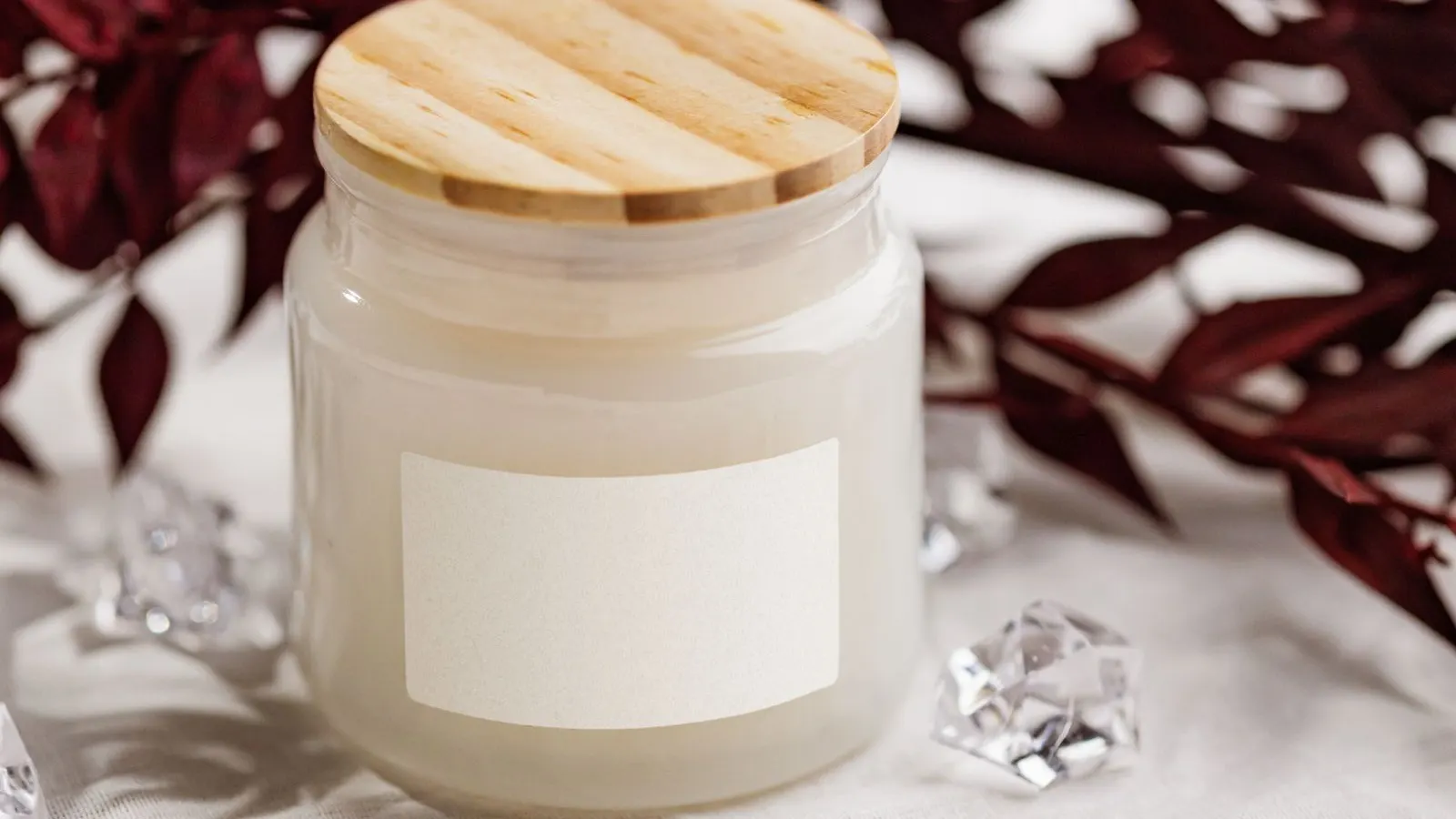
Disclosure: We may earn a commission if you purchase through links on this page, at no additional cost to you.
Quick answer. A wrinkle is not one defect with one cure. On a candle jar, it can be a geometry problem, an application problem, a contact problem at the glass surface, or a change that becomes visible only after the label has sat for a while. The useful first question is not “Which label material is best?” It is “When did the defect begin, and what is the label being asked to conform to?”
This guide is for pressure-sensitive front labels on finished glass candle jars. It does not prescribe a universal paper, film, adhesive, cleaning liquid, or curing time. Those choices depend on the label construction, ink and finish, glass, handling conditions, and the converter’s application guidance. The aim is to run a controlled diagnosis on the real jar before committing to a print run.
Classify the Failure Before Changing the Label
Keep one failed sample. Note when the wrinkle first appeared, take a front and side photograph, and compare it with an untouched jar from the same batch. That simple record separates a crease created at application from later lifting or bubbling that only looks like a wrinkle.
| What you see | Likely decision area | First controlled check |
|---|---|---|
| Edges crease as soon as the label is pressed down | The label footprint may be too large for the local curve, taper, shoulder, ridge, or seam. | Tape a paper dummy of the same outline in the proposed label zone. If it must fold or bridge, change the geometry before changing adhesive. |
| A smooth label traps a bubble while it is applied | The jar may be moving, the first contact may be uncontrolled, or air is being pushed into the label. | Stabilize the jar and repeat the same label with a defined alignment mark and one deliberate application path. |
| The label looks good, then bubbles or wrinkles later | Surface condition, adhesive construction, temperature, humidity, or local vessel irregularity may be involved. | Keep matched samples under the same normal storage conditions and compare a prepared surface with an untreated control. |
| Corners lift or the face looks distorted after handling | The label may be crossing a changing radius, an edge, or a high-contact area. | Move the design inward from the edge or split the label into smaller panels; validate the new placement on the actual vessel. |
Measure the Label Zone, Not Only the Jar
A jar described as “round” can still present a difficult label surface. A straight cylindrical wall offers a single, repeatable curve. A tapered jar changes diameter through the label area. A rounded shoulder, faceted wall, recessed logo, mould seam, or small dent adds another local condition. A flat label is being asked to lie on that three-dimensional surface, so a different adhesive cannot reliably correct a footprint that is too ambitious for the available zone.
Make a full-size paper dummy before ordering labels. Cut it to the planned die-cut outline, position it at the planned height, and hold it in place without stretching it. Inspect both side edges rather than only the centered front view. Then repeat on several production-representative jars, including one from the widest and one from the narrowest observed vessel if there is visible variation. The purpose is not to calculate a universal maximum label width. It is to find whether the artwork asks the material to bridge, buckle, or cross a changing contour.
- Record the height of the label zone and the outside diameter at its upper and lower edges when the jar is tapered.
- Photograph seams, embossed marks, transitions into a shoulder, and any area that will be touched during packing or normal use.
- Check the label with the production lid fitted. A label that looks centered with no lid may visually collide with a wide or low-hanging lid.
- Decide whether the branding needs one front panel, a front and back pair, a narrow vertical strip, or a lid label. These are packaging choices, not merely artwork choices.
Treat Geometry as a Design Constraint
For a reasonably straight cylindrical zone, a front label can usually be tested as a conventional panel. For a taper or a rounded shoulder, reduce the area that must conform: make the panel narrower, shorten it vertically, move it into a straighter band of the vessel, or use separate labels. For a strongly compound curve or textured vessel, move the key information to a flatter area or to the lid. A label that needs cuts in its visible front face to lie flat is usually evidence that the chosen label form and the chosen surface no longer agree.
This distinction matters because material selection comes after the shape question. Film can provide different durability and handling properties than paper, but it is not a promise that a large flat rectangle will lie perfectly over every curved jar. Likewise, choosing a stronger adhesive may change adhesion behaviour without solving a crease created by a taper. Curved substrates and pressure-sensitive adhesive systems have coupled mechanical behaviour; product-specific testing remains more useful than transferring a result from another vessel or adhesive formulation. [2]
Separate an Immediate Crease From a Delayed Bubble
An immediate crease usually deserves a geometry or handling investigation. Start with the jar secured in one orientation. Mark the intended top or bottom position with a removable guide outside the final label area. For a front panel on a curved jar, establish a small, centered first contact and smooth outward with consistent pressure. Do not repeatedly lift and re-place the same pressure-sensitive label unless the label supplier explicitly permits it; a failed attempt can become its own source of distortion.
A delayed bubble or edge lift deserves a different experiment. Use identical labels on matched jars. Vary one condition only: the surface-preparation method, the storage condition, or the label construction. Write down the label material and adhesive description supplied by the converter, the vessel batch, the application date, and the time at which the defect first appeared. Relative humidity can alter tack and failure mechanisms in model pressure-sensitive adhesive systems, but the direction and magnitude for a commercial candle label depend on its construction and use environment. [1] That is why a controlled comparison is more defensible than a generic instruction to use more heat, more pressure, or a thicker stock.
Use a Small Sample Plan Before a Bulk Print
The sample should contain the complete combination that will be sold: the actual jar, its finished surface, the final label outline, the print/lamination choice, and the intended label position. A flat glass test coupon can be useful for comparing print or adhesion, but it cannot approve fit on a tapered candle jar.
| Sample field | What to freeze | What counts as useful evidence |
|---|---|---|
| Vessel | Jar model, batch or date code when available, lid, and finished candle state. | Photographs of each label zone and any visible seam, taper, texture, or irregularity. |
| Label | Face stock, finish, adhesive description, die-cut width and height, and artwork revision. | A converter quote or sample note that ties the construction to the tested pieces. |
| Application | Surface-preparation procedure, operator, alignment datum, and application method. | A short repeatable work instruction that another operator can follow. |
| Hold and inspection | The actual storage/handling conditions and a defined observation window. | Front, side and edge photos at application and after the agreed hold period. |
| Release rule | The brand’s acceptable visual standard and prohibited defects. | A signed sample or clearly dated approval record, not an informal memory of what looked acceptable. |
Do Not Accept Attractive but Weak Explanations
“Use a thicker label” is not a diagnosis. Thickness may affect handling, but it does not remove a taper or make an irregular surface cylindrical. “Use BOPP” is not a diagnosis either: a BOPP face stock can be part of a suitable construction, yet it does not establish that its adhesive, finish, die-cut, and actual jar geometry will work together. “Add more adhesive” is also incomplete, because the supplier must define the adhesive construction and the expected substrate and conditions.
Ask a supplier to state what they are supplying, rather than asking them to guarantee that a label will never wrinkle. The relevant promise is a sample that fits the named vessel and label zone under the agreed conditions. Acrylic pressure-sensitive adhesive research for glass-bottle labels shows why the label is a system rather than a generic sticker: formulation, coating and process conditions, glass contact and test method all matter. [3] [4]
Send This Short Request With the Jar Sample
“Please quote a pressure-sensitive candle-jar label for the attached jar and attached artwork. The label zone is shown in the photographs. Please state the face stock, finish, adhesive construction, die-cut size, minimum order quantity, proof/sample process, and any application or storage limitations. Please supply a small sample set for fit testing on the actual vessel before production. The label must not bridge the shoulder, seam, or textured area marked in the photos.”
If a supplier proposes a different material, ask what problem that change is intended to solve: wetting at the glass surface, resistance to moisture or oil exposure, handling durability, print finish, or conversion practicality. The answer should be tied to the named vessel and label geometry. If it is only a generic material claim, keep it as an unproven option until the sample is tested.
Alibaba Sourcing Candidates to Evaluate
These are candle-label sourcing leads, not a ranking and not proof that either listing will solve a particular wrinkle. Confirm the supplier identity, store history, label material, adhesive construction, die-cut dimensions, MOQ, proof/sample process, and fit on the actual jar before buying.
Embossed Custom Candle Jar Label
A custom candle-jar label listing with shiny embossed printing and waterproof stickers. Request the exact face stock, adhesive, outline and a fit sample for the named jar; treat the print finish as a separate question from adhesive compatibility and geometry.
Best for: A print-finish and geometry sample on your own jar, after the label zone has been measured.
- Custom candle-jar labels
- Embossed / shiny print finish
- Request face stock, adhesive, fit sample
- MOQ
- Check current listing
Foil-Stamped Custom Candle Label
A luxury candle-jar label sticker listing with foil stamping and custom printing. Use it for a print-finish and geometry sample rather than as proof of adhesive compatibility, and confirm the supplied construction against your jar surface and label zone.
Best for: A print-finish and geometry sample on your own jar; not proof of adhesive compatibility.
- Foil-stamped candle labels
- Custom printing
- Ideal for finish and geometry sampling
- MOQ
- Check current listing
References
- Schindler, M., Koller, M., and Müller Buschbaum, P. Pressure Sensitive Adhesives under the Influence of Relative Humidity: Inner Structure and Failure Mechanisms. ACS Applied Materials and Interfaces, 7(23) (2015), 12319-12327.
- Predictive Mechanistic Model of Creep Response of Single-Layered Pressure Sensitive Adhesive Joints. Materials, 14(14) (2021), 3815.
- Synthesis and Properties of Water-Based Acrylic Adhesives with a Variable Ratio of 2-Ethylhexyl Acrylate and n-Butyl Acrylate for Application in Glass Bottle Labels. Polymers, 12(2) (2020), 428.
- Adhesive Performance of Acrylic Pressure Sensitive Adhesives from Different Preparation Processes. Polymers, 13(16) (2021), 2627.
Hook this up to your favourite commenting platform — Giscus, Disqus, or your own.
Continue reading

How to Ship Candles in Hot Weather Without Treating Insulation as a Guarantee
A risk-based shipping and package test guide for small candle sellers.
How to Check Whether a Glass Jar Is Safe for Candle Making
A buyer guide to supplier evidence and finished-candle testing for glass candle containers.

Candle Dust Covers vs Lids for Small Candle Brands
Choose the cover by fit and customer use before comparing unit prices.