Double-Wall Jars: Real Fill Capacity, Liners and Lids
A double-wall jar has an outer shell and an inner cup, and the gap between them is not product space. The number printed on the jar is the outer volume.
 Lena Schmidt
In this guide
Quick answer. A double-wall jar is two nested shells, so it holds less than its outside suggests; SKS Bottle says plainly that this style holds less than a single-wall jar. Treat the listed ounces as a guide, fill a sample with water, and set your fill weight from your own product density. Under the lid, a foam liner seals by compression and does not bond, a pressure-sensitive PS22 liner is not recommended for liquids and oils, and none of them is airtight or tamper-evident on its own. Test the jar, the liner, the cap and the product together for a few weeks before you order a case.
What a double-wall jar actually is
O.Berk describes double-wall jars as two plastic shells, an inner and an outer, which can be the same resin or different ones; common pairings are PP inner with PP outer, or PS outer with a PP inner [4]. Berlin Packaging sells both: a PP/PP version, where the PP inner wall is said to preserve moisture, and a PP/PS version with a polystyrene outer wall for durability [3]. Container and Packaging gives the same split for its 1 oz jars, with a PP inner for flexibility and heat resistance and a PS outer for rigidity [6].
The point of the design is appearance and cost. Berlin calls it a jar within a jar that gives the flush look of a thick-wall jar at a fraction of the cost [3]. O.Berk notes that the jars look larger because of the wall thickness, and that the thick wall often sits flush with continuous-thread caps [4]. Cary says the construction lets smaller quantities of product go into larger-looking containers for retail impact [5]. SKS Bottle states the cost directly: this style holds less than a single-wall jar, though the visual impact is greater [2].
Material also bears on what you can put in. Container and Packaging says its PP/PS jar suits lotions, creams, serums and essential oils at low oil ratios [6]. That is a supplier’s general statement, not a test of your formula, so a high-oil balm or a scrub with a strong fragrance needs its own trial. Polystyrene shells in particular are worth checking against your fragrance load, because the outer shell can craze or crack where the formula reaches it. We have no source for that effect and mention it only as a reason to test at the seams.
How much does it really hold?
Start with the listing. The sources give diameters and weights but rarely the filled volume. Berry Global (Amcor) lists a 1 oz jar at 53 mm diameter weighing 16 g, a 4 oz jar at 70 mm and 2.406 inches high weighing 34 g, a 6 oz jar at 83 mm and 2.495 inches high weighing 39.5 g, and an 8 oz jar at 89 mm [7]. Those are outer dimensions. They tell you the footprint, not the cavity.
One retailer shows how loose the stated figure can be. An Australian soap supplier lists a double-wall jar with a “volume” of 100 ml, an external diameter of 69 mm and an internal diameter of 63 mm, while the description says it holds approximately 90 ml; the page adds that the volume is as stated by the manufacturer, is a guide only because no fill level is marked, and recommends weighing the product separately and then in the vessel [1]. Both numbers sit on the same page. The difference between the shell and the cavity is the lesson: the wall takes 3 mm of diameter on each side.
| Listed size | Our conversion (1 oz = 29.57 mL) | Outer diameter | Source for dimensions |
|---|---|---|---|
| 1 oz | 29.6 mL | 53 mm | Berry Global [7] |
| 4 oz | 118.3 mL | 70 mm | Berry Global [7] |
| 6 oz | 177.4 mL | 83 mm | Berry Global [7] |
| 8 oz | 236.6 mL | 89 mm | Berry Global [7] |
Conversions are the arithmetic here from the listed fluid ounces. They give the stated capacity, which is not the same as the volume you can fill to the lip.
Tolerances add a second layer. A trade article in Beauty Packaging explains that molds and cores vary, so a container that weighs slightly less than specified has thinner walls and holds a little more, and a slightly heavier one holds a little less; it separates the label claim, the quantity printed on the package, from the filling specification, which tells production how much can safely go in [13]. For a two-piece jar the same logic applies twice, once for each shell, and the fit between them can differ lot to lot.
A brand that fills body butter gives a real-world case. Better You says its container can hold up to 268 ml, yet it fills 203 ml, and the jar therefore looks underfilled, and it keeps the fill within 2 ml in line checks [14]. That is a different container, so the figures do not carry over to yours. What carries over is the habit: the brand separates what the jar can hold from what it fills, and it checks the difference.
Weights and measures guidance uses the same vocabulary. The California manual defines the volume, internal volume and capacity of a container as the space occupied by the product plus the headspace, and says direct measurement is generally more accurate than a calculated volume [15]. We are not giving legal advice. Rules on empty space in packages vary by place and by product type, so ask your local weights-and-measures office or a lawyer what applies to your label claim.
Set your fill weight from your own product
-
Weigh five empty jars with their inner discs and lids. Note the spread; it shows the tolerance you are working with.
-
Fill one sample with water to the line where you want the product to sit, put the jar on a scale and read the grams. One gram of water is about one millilitre, so this gives you the usable volume to that line.
-
Make a test batch of your product, fill three jars to the same line, and weigh them. Divide the product weight by the water volume to get your product’s density in grams per millilitre.
-
Set the target fill weight as usable volume times density, then add a margin you can defend. Write the target on the batch record, not just the volume.
An illustration, with invented numbers: if the water test shows 85 mL to the fill line and your whipped butter weighs 0.9 g per mL, the target is about 76 g. A 5 g scoop error is then more than 6 percent of the contents. Check the arithmetic against your own figures and label the net weight you can actually deliver.
Fill temperature matters for butters and balms. Better You says its butter has to be warm when filled so that it flows through the nozzle without splitting [14]. A jar filled warm and left to set can shrink away from the wall, and a liner pressed on a soft surface may sit differently from one pressed on a set one. Weigh again after the product has set.
What goes under the lid?
Most double-wall jars arrive with an unlined cap or with a snap-in disc or a lined cap sold separately. Berlin sells its PP/PS jars with unlined smooth PP caps [3]. Berry Global’s closure pages say the standard liner is available on its 400-thread caps, and some closures are offered lined or linerless [7]. A customer review on a distributor page mentions a cover that snaps in underneath the screw-on lid [16]; that is one buyer’s description, not a specification.
O.Berk’s liner guide lists the common types. PE foam, a generic version of F217, is used on liquid products including cold creams and hand soaps [8]. Pulp and poly pairs a pulp layer with a thin PVC layer and is aimed at food in metal caps [8]. Pulp and foil is for solids and powders rather than liquids [8]. PS22 is a pressure-sensitive polystyrene foam liner for dry products, sealed by ordinary cap torque [8]. A vented liner lets air pass to relieve pressure changes [8]. The page gives no leak limits for any of them and says to test compatibility with your product [8].
| Liner | What the source says | Fit for a cosmetic jar |
|---|---|---|
| PE foam / F217 | Compression seal; used with cold creams and hand soaps [8]; does not bond to cap or jar [11]; not airtight and not tamper-evident [9] | Common choice for creams and butters; test with your fragrance |
| PS22 pressure-sensitive | Adheres to the jar mouth after the cap is set, over about 24 hours [2]; generally not recommended for liquids and oils [10] | Possible for dry or balm-like products; avoid for oily formulas without testing |
| Pulp and foil | For solids and powders, not liquids [8] | Dry scrubs and powders only |
| Vented | Lets air pass to relieve pressure changes [8] | Worth a look if jars bulge in warm transit |
Summary of the cited statements. No source tests these liners in a double-wall jar with a named formula.
Cary adds a practical caution about F-217: it is a three-layer liner, a soft polyethylene foam core between two LDPE films, with no pulp dust, but it does not create an airtight seal and is not a tamper-evident seal [9]. So if your product needs a first-open indicator, a foam liner is not the answer. Our page on [foam liner vs induction seal liner] covers that decision, and [pressure-sensitive vs induction seal liners] covers PS22 in more detail.
The liner is also the part that touches the product. O.Berk says chemical compatibility is critical for the liner facing, and that an improper liner can shorten shelf life or leak in transit [8]. A Packaging Group adds that the jar, liner, cap and formula must be compatible and that testing should include all four together, checking for changes in colour, smell, texture, leakage or seal performance [12].
Where to buy the jars
The listing below is the ordinary stock jar: a plastic cream jar with a screw lid, sold in sizes from 10 to 250 ml.
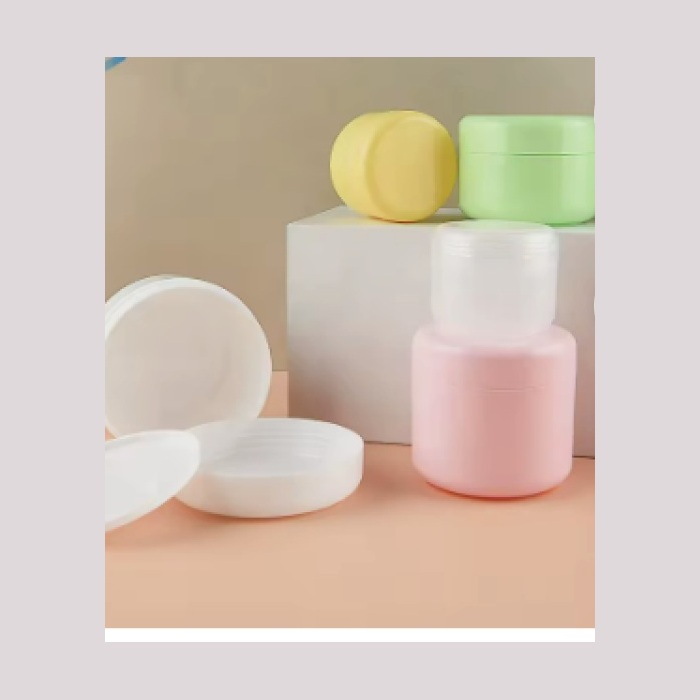
Plastic cream jars, 10 to 250 ml
Round plastic jars with screw lids, listed from 10 ml to 250 ml in several colours.
- Role: Alibaba sourcing candidate
- 10 to 250 ml
- Screw lid
- Stock colours
- MOQ: From 100 pieces
Lids, labels and the label panel
Because the shell is thick and the cap sits flush, the label panel is straight. The Australian listing gives a 69 mm external diameter and 40 mm base-to-shoulder height [1]. Our arithmetic: 69 mm times pi gives a circumference of about 217 mm, so a wrap label on that jar has about 217 mm of travel. Leave a gap at the seam; how much depends on your labeller and your label stock.
Check the thread. Berry Global lists 400 continuous-thread closures including 53, 58, 70 and 89 mm for its jars, and the neck diameter equals the jar diameter in its listings [7]. Match the closure diameter to the jar before you order, as with any finish code. If you plan a shrink band over the lid, read [the cosmetic jar band page] first, because a flush dome lid and a ribbed lid take different bands.
A three-week trial
-
Order ten jars and ten of each candidate liner or lid from the same supplier, in the size you will sell.
-
Weigh empty jars and fill three with water to find the usable volume, then fill ten with product to your target weight.
-
Leave five jars upright at room temperature and five in a warm place for a week. Look for oil rings on the liner, softening, odour change, and gaps between the shells.
-
Turn two jars on their side overnight and look for seepage at the lid.
-
Drop one jar from table height and see whether the outer shell cracks or the inner shell separates. Note it, but do not treat one drop as a pass.
-
Open and close each jar twenty times and check that the liner stays centred and the thread does not cross.
Record the jar resin pair, the liner type, the target fill weight and the results. These go on the spec sheet you give the supplier for reorders.
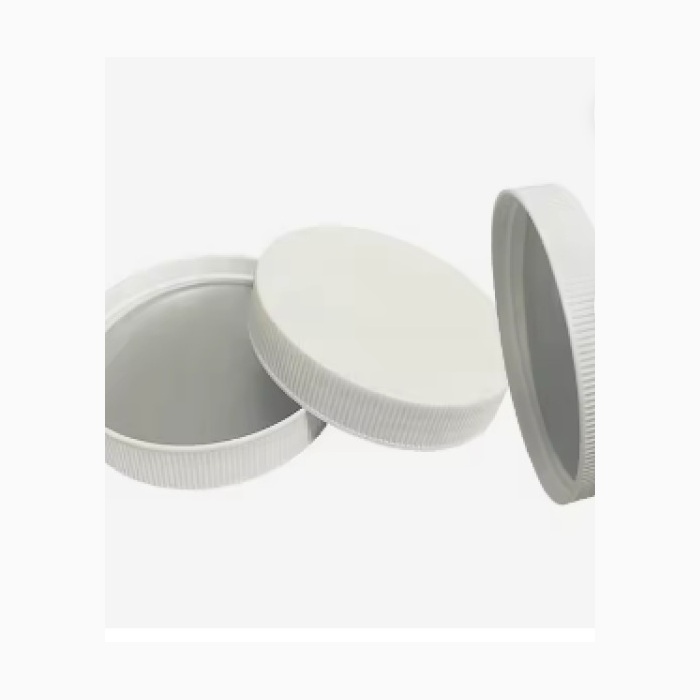
89/400 PP screw caps with foil liners
The lid side of the question: an 89/400 polypropylene screw cap with a foil induction liner already inside, sold by the carton of 750.
- Role: Alibaba sourcing candidate
- 89/400
- Foil liner fitted
- PP cap
- MOQ: From 750 pieces
Questions to ask the supplier
-
Is the jar PP/PP or PP/PS, and which shell is the inner one?
-
What is the brimful capacity and the recommended fill volume, and is a fill line marked?
-
Does the cap come lined, unlined or with a snap-in disc, and what is the liner material?
-
Has this liner been tested with oils or fragrance, and what is it not recommended for?
-
What is the weight tolerance on the shells, and does it change between lots?
-
What is the minimum order, and are samples available?
Common mistakes
-
Filling by the label ounces. Capacity and usable fill differ [1][13][14].
-
Using PS22 on an oily balm. The supplier does not recommend it for liquids and oils [10].
-
Expecting a foam liner to show tampering. It does not [9].
-
Testing the jar alone. Test jar, liner, cap and product together [12].
-
Ignoring tolerance. Shell weight changes the volume [13].
FAQ
Do double-wall jars hold less than they look?
Yes. One supplier says this style holds less than a single-wall jar [2], and another listing shows a stated volume that differs from the volume described [1].
Is a foam liner a seal?
It is a compression seal that does not bond [11], not airtight and not tamper-evident [9].
Can I use essential oils in a PP/PS jar?
One supplier says its jar suits essential oils at low oil ratios [6]; test your own ratio.
What does a jar cost?
A distributor page showed a 4 oz white double-wall jar at $6.64 for 12, about $0.55 each, with lids sold separately [16]. Check the live page; it appeared only in a search snippet.
References
- Aussie Soap Supplies, Jar double wall 90ml. aussiesoapsupplies.com.au (retailer listing).
- SKS Bottle & Packaging, The Packaging Rap 88: Double wall and thick wall jars (Feb 2019). sks-bottle.com (distributor newsletter).
- Berlin Packaging, Double wall jars (PP/PP and PP/PS product pages). berlinpackaging.com (distributor).
- O.Berk, Bottle shape profile: double wall plastic jars. oberk.com (distributor).
- The Cary Company, 8 oz white plastic straight-sided double wall jar 89-400. thecarycompany.com (distributor).
- Container and Packaging, Double wall jars J009 and J008. containerandpackaging.com (distributor).
- Berry Global (Amcor Rigid Packaging), Double wall jar product pages, 0.75 to 8 oz. berryglobal.com and packagingsolutions.amcor.com (manufacturer).
- O.Berk, Liner: the often overlooked element between your cap and bottle. oberk.com (distributor).
- The Cary Company, F217 foam liner 68WL43. thecarycompany.com (distributor).
- The Cary Company, 70 mm pressure-sensitive liner, Sealed for your protection. thecarycompany.com (distributor).
- GlassNow, 70 mm PE foam liner. glassnow.com (distributor).
- A Packaging Group, Why do cosmetic jars have inner liners. apackaginggroup.com (distributor blog).
- Beauty Packaging, How much fill is enough? (Jamie Matusow). beautypackaging.com (trade magazine).
- Better You, New body butter filling process. betteryoultd.freshdesk.com (brand support article).
- California Department of Food and Agriculture, Weights and measures QC manual, container determination. cdfa.ca.gov (government).
- Wholesale Supplies Plus, 4 oz and 2 oz white double wall plastic jar. wholesalesuppliesplus.com (retailer; prices and one customer review).
Continue reading
Stand-Up Pouches: Fill Weight, Gusset and Usable Height
A pouch is listed by three numbers and none of them is the fill volume. Width, height and gusset describe a flat sheet of film, not the space left after the seal.
Spice Shaker Caps: Hole Size, Fit and Product Match
A shaker cap is three parts that are usually sold separately: the base, the rotating or flapping lid, and the liner. Buy them apart and the hole size is the last thing you check.
Metal Balm Tins: Fill Weight, Lid Type and Label Area
The ounce stamped on a balm tin is a trade size, not a fill weight. A 1 oz tin holds about 28 g of wax, and a little less of anything with oil in it.