Lotion Pump Specs: Dose, Dip Tube Length and Neck Finish
Three numbers decide whether a lotion pump works on your bottle: the neck finish it screws onto, what one stroke delivers, and how far the tube reaches.
 Lena Schmidt
In this guide
- What does 24/410 actually tell you?
- How much product does one stroke deliver?
- Why does the listed dose not always match what you get?
- How long should the dip tube be?
- How many presses is a bottle?
- The number that is missing: height with the pump locked
- What do these pumps cost?
- A trial you can do in an afternoon
- Where to buy the pumps
- Questions to ask the supplier
- Common mistakes
- FAQ
- References
Quick answer. A lotion pump order needs four checks: the neck finish (24/410 is the common one), the dose per stroke, the dip tube length, and the height of the pump when locked. Dose is not predictable from the look of the pump: two suppliers list ribbed 24/410 pumps at 1.2 cc and 2 cc, and a third says ribbed pumps give 0.5 cc. To size the tube, measure the bottle from the land to the base, subtract 3/32 inch for the push-up, and take the difference from the tube’s supplied length (Oberk’s method). Order five samples, cut the tubes, prime each pump, weigh ten strokes of your own product, and only then buy a case.
What does 24/410 actually tell you?
The first number is the neck diameter in millimetres, and the second is the thread style. One supplier explains it plainly: a 24/410 neck is 24 mm wide, a 28 mm pump will not seal on it, and a 24/410 pump will not fit a 24/400 bottle even though the diameter matches, because the thread details differ [11]. That source is a manufacturer’s blog and does not give the thread dimensions, so treat it as a warning, not a specification.
Two practical points follow. First, the finish describes only the thread. It says nothing about the height of the collar, the width of the pump head or how far the head travels, so a 24/410 pump from one supplier can look quite different from another’s. Second, match the finish to the bottle before anything else. A great pump on the wrong finish is a pump you cannot use. If you are unsure which finish your bottle has, the page on [matching neck finishes] covers how to read the drawing.
How much product does one stroke deliver?
Output per stroke is the quantity dispensed in one full press. O.Berk puts the typical range for lotion pumps at about 0.5 to 4 mL, determined by repeatedly actuating the pump and weighing what comes out [4]. Here is what some sellers list for 24/410 pumps.
| Pump as listed | Dose | Dip tube | Seller |
|---|---|---|---|
| Smooth lotion pump, black, lock-up | Not stated | 5.125 in | TricorBraun [5] |
| Ribbed lotion pump, white, lock-up | 1.2 cc | 5.125 in and 6.375 in | TricorBraun [5] |
| Ribbed lotion pump, black, lock-down | 2 cc | 5.125 in | TricorBraun [5] |
| White dispensing pump | 0.04 oz (1.1 cc) | 7.5 in default | Cary [7] |
| Clear smooth pump | 2 cc | 6.85 in | Cary [7] |
| Smooth lotion pump | 2 cc | Not included | Berlin Packaging [9] |
| Rivo lotion pump, smooth skirt | 1.8 mL | 5.4 in | Glass Now [8] |
| Kalu treatment pump | 0.2 mL | Not stated | Glass Now [8] |
Doses and tube lengths as listed by each seller; some tube lengths are options on a product with several variants. Not a complete survey.
Look at the ribbed rows. TricorBraun lists one ribbed 24/410 pump at 1.2 cc and another at 2 cc [5]. A newsletter from SKS Bottle says its smooth lotion pumps give 2 cc and its ribbed ones 0.5 cc [6]. So the skirt style does not tell you the dose, and a rule of thumb that works at one supplier fails at the next. The only way to know is to read the dose line, and the only way to trust it is to weigh it.
The size of the dose should come from the product and the user. A thin shampoo that people use by the palmful suits a 2 cc pump. A thick hand cream may want a smaller dose; Songmile, a pump manufacturer, suggests 0.5 cc for thick creams and about 1 cc for everyday lotion or liquid soap, which is its own view and not a standard [11]. At the small end, treatment pumps for serums and gels are a different class: Glass Now lists a 24/410 treatment pump at 0.20 mL [8], and SKS describes its treatment pumps as 20/410 and 190 microlitres [6].
One piece of arithmetic helps when comparing. A 250 mL bottle emptied by 2 cc strokes takes about 125 presses; at 1.2 cc it takes about 208 (the arithmetic here, ignoring what stays in the bottle). If your customer rinses a hand with every wash, that difference is felt. It also changes how fast the bottle empties, which matters if you promise a number of uses on the label.
Why does the listed dose not always match what you get?
The listed dose is a lab figure, and the product matters. O.Berk lists the things that move it: thick formulas resist flowing up the tube and through the channels, a narrow tube bore chokes refill, a poor neck seal lets air in, and a pump that needs many strokes to prime feels broken even when it works as designed [4]. The same page notes that a pump rated at 2 mL is only useful if it delivers close to 2 mL across hundreds of strokes, across a lot and as the bottle empties [4]. That page is marketing content from a distributor that sells pumps, so read it as a checklist of questions, not as proof.
For you, it means the dose on the listing is a starting point. Water-thin and gel-thick products may differ in how many presses it takes to fill the chamber, and a cold warehouse can thicken a lotion enough to change both. Our page on [trigger sprayer output per stroke] sets out a weighing method for a different dispenser; the same idea applies here and is repeated in the trial below.
How long should the dip tube be?
The dip tube must reach the product without bending or blocking. A Packaging Group article says a tube that is too short will not reach the bottom and one that is too long may bend or clog, and it suggests subtracting a few millimetres from the measured height so the tube does not sit on the base [1]. It gives no exact clearance. If you want a figure, O.Berk’s method gives one, shown below.
| Step | What to do (O.Berk method) [2] |
|---|---|
| A | Measure the tube as supplied, from the gasket to the notched end. This is length A. |
| B | Measure the bottle from the land (the top of the neck) to the base, and subtract 3/32 inch for the push-up. This is length B. |
| Cut | A minus B is the length to remove. |
Here is a made-up example. A tube supplied at 6.375 inches, a bottle whose land-to-base height is 5.5 inches: B is 5.5 minus 0.094, about 5.406 inches, so you trim about 0.97 inch (the arithmetic here with invented bottle numbers; use your own).
Where you measure from also matters. TricorBraun says to measure from the top of the gasket and notes that measuring from the bottom of the gasket is a common mistake [3]. We could read only part of that page, so check it for details on the final fit. Use one datum, write it down, and give it to the supplier the same way you measured it.
O.Berk adds that thick lotion tubes can rest in the product with a slight gap at the base so it can flow, while thin sprayer tubes are bent toward the wall for the best draw [2]. If you are unsure, the Packaging Group suggests starting with a tube cut to 4 inches and testing with your product, since you can shorten it or replace it later [1]. Note that this applies to a trial only; a 4 inch tube in a tall bottle would leave a lot of product behind.
How many presses is a bottle?
Brands often pick a pump first and a bottle second, then discover the pairing feels wrong. A quick table of presses per bottle shows why. These are the arithmetic here, assuming the pump delivers exactly its listed dose and ignoring product left behind.
| Bottle | 1.2 cc pump | 1.8 cc pump | 2 cc pump |
|---|---|---|---|
| 8 fl oz (about 237 mL) | about 197 presses | about 132 presses | about 118 presses |
| 16 fl oz (about 473 mL) | about 394 presses | about 263 presses | about 237 presses |
Our arithmetic from the listed doses in the table above; real figures depend on the product and on residue.
A shopper who uses one press for a hand wash and finishes a 16 oz bottle in a few weeks will not notice a 1.2 cc pump. A shopper who needs three presses of a thin product for a full-body use might. Think about how the product is used, then choose the dose, and then test it. If the label makes a claim such as number of washes, run the weighing trial first, because the claim depends on the measured dose and not on the listing.
The number that is missing: height with the pump locked
Many pumps have a lock-up or lock-down feature. The Packaging Group notes that these pumps can sit higher on the bottle and change the tube length you need, and that other parts adding height, such as collars and neck locks, matter too [1]. It also says bottles that look alike (round, square, cylinder) differ inside, so measure each style [1].
Locked height matters for two other reasons. It decides whether a carton or a shipper lid will close over the pump, and it decides whether a shrink band or neck seal can be fitted. Our page on [shrink bands for pump bottles] reports one seller listing a 24/410 saddle pump with about 19 mm between the locked and unlocked head, a figure to verify on the live page. If your bottle has to ship, ask for the locked height in the listing.
What do these pumps cost?
The prices the sources reviewed show are for black or white 24/410 pumps sold individually or by case. TricorBraun lists a black smooth-skirt 24/410 pump with a 5.125 inch tube at $0.52 each, $0.47 at 1,000 and $0.43 at 10,000, as displayed in November 2026 [5]. A black ribbed pump with a 6.375 inch tube is listed at $0.45 each [5]. Jar Store lists a white smooth-sided pump with 6 inch tube and 1.2 cc output at $0.45 each [10]. Cary sells its 24-410 pumps in cases of 1,000 [7].
In round numbers, expect about 43 to 52 cents per pump at those sellers, depending on quantity. The price of the pump is usually a small part of the cost of a finished bottle, but a wrong order of 1,000 is not small. That is why the cheapest useful step is a sample pack, followed by a small test fill.
A trial you can do in an afternoon
-
Choose three pumps that differ in dose (for example, 1.2 cc, 1.8 cc and 2 cc) and ask the seller for five of each, with the tube uncut if possible.
-
Measure the bottle and the tube with the A and B method [2] and trim the tubes with an angled cut. Mark the cut length on each.
-
Fill five bottles with your product at the normal temperature and fit the pumps. Note how many strokes each takes to prime.
-
Weigh the dispensed product from ten full strokes per pump into a cup on a scale, with the density of the product to hand. Divide by ten for the dose per stroke. Do this at room temperature and after a night in a cool room.
-
Keep pressing until the bottle stops delivering and weigh what is left. A large residue points to a tube that is too short or an angle that is blocking the draw.
-
Lay a filled bottle on its side overnight and look for leaks at the neck.
Record the finish, the dose line, the tube length and the temperature. If a later lot behaves differently, those notes are how you find out why.
Where to buy the pumps
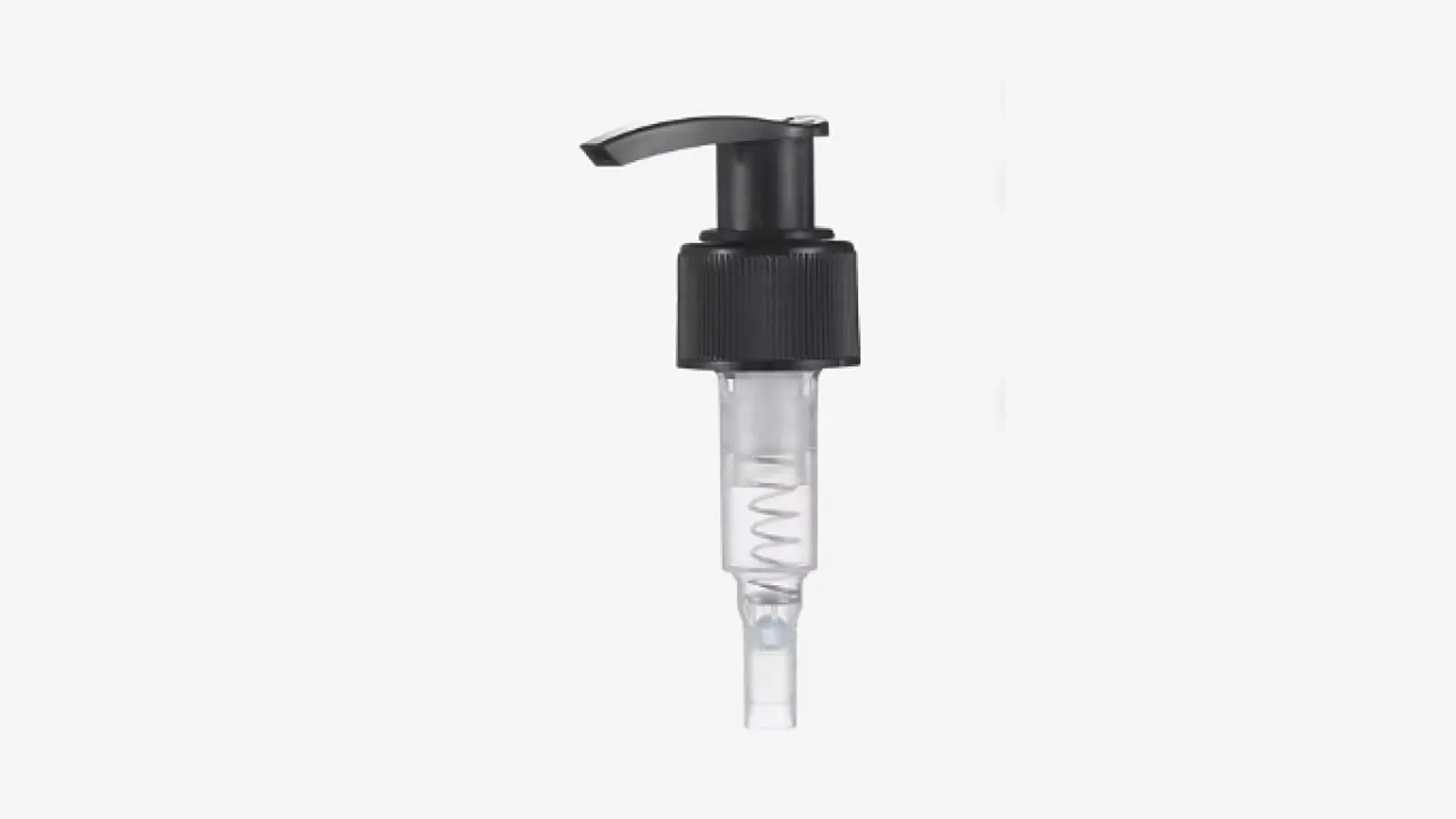
The listing below is the pump this page keeps coming back to: a PP lotion pump in the two neck finishes most bottles use.
Questions to ask the supplier
-
What is the neck finish, and does the collar fit my bottle’s land?
-
What dose per stroke, and how was it measured?
-
What is the tube length as supplied, and can you cut it for me?
-
What is the pump height locked and unlocked?
-
Can I have a sample of each dose before a case?
-
Is the tube material right for my product and bottle?
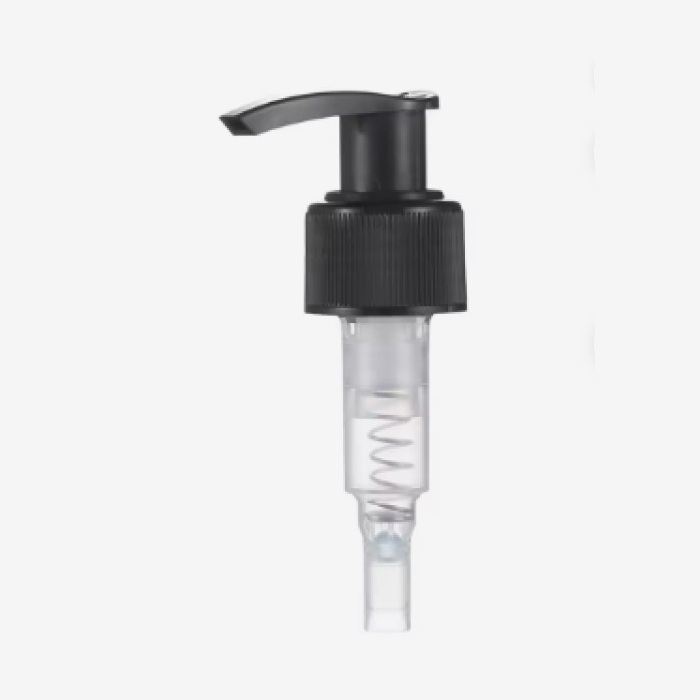
PP lotion pumps, 24/410 and 28/410, 2 cc dose
A standard lotion pump in polypropylene, listed in both 24/410 and 28/410 necks with a 2 cc dose per stroke.
- Role: Alibaba sourcing candidate
- 24/410 and 28/410
- 2 cc dose
- PP body
- MOQ: From 10,000 pieces
Common mistakes
-
Choosing by skirt style. Ribbed does not mean low dose. The same style is listed at different doses [5][6].
-
Measuring from the wrong point on the gasket. TricorBraun flags this as common [3].
-
Cutting the tube once and ordering a case. Trial first, then cut.
-
Ignoring the locked height. It affects cartons and any band or seal.
-
Testing with water. The product’s thickness changes how the pump behaves [4].
FAQ
Will a 24/410 pump fit a 24/400 bottle?
One supplier says no, because the thread style differs [11]. Confirm with the bottle drawing.
Can I trim the tube myself?
Yes. Manufacturers usually supply one long tube so it can be trimmed, and some will cut it for you [2]. Cuts are commonly angled or V-shaped [2].
What dose is best for a thick cream?
There is no single answer. One manufacturer suggests small doses for thick products [11]; test with your formula.
Why does my pump sputter?
Possible causes include unprimed strokes, a thick product, a narrow tube or an air leak at the neck [4]. Check the seal first.
Do I need the lock?
It helps in transit. It changes the height you must plan for [1].
References
- A Packaging Group, How to choose the right dip tube length for lotion pumps. apackaginggroup.com (packaging supplier blog).
- O.Berk, How do you measure dip tube lengths? oberk.com (packaging distributor; Quick Question Monday).
- TricorBraun, How to measure dip tube length. tricorbraun.com (packaging distributor; page read in part).
- O.Berk, Pump output consistency. oberk.com (packaging distributor; marketing content).
- TricorBraun, 24-410 PP lotion pumps (ribbed and smooth skirts, 5.125 and 6.375 inch tubes). tricorbraun.com (product pages; prices as displayed, Nov 2026).
- SKS Bottle, The Packaging Rap (newsletter on pumps). sks-bottle.com (packaging supplier).
- The Cary Company, 24-410 dispensing pumps (1.1 cc and 2 cc). thecarycompany.com (packaging distributor; product pages).
- Glass Now, Rivo lotion pump 1.80 mL and Kalu treatment pump 0.20 mL, 24/410. glassnow.com (packaging retailer; product pages).
- Berlin Packaging, 24-410 natural smooth lotion pump, 2 cc. berlinpackaging.com (packaging distributor; product page).
- Jar Store, white 24-410 smooth-sided lotion pump with 6 inch dip tube. jarstore.com (packaging retailer; price as displayed).
- Songmile, Decoding lotion pump measurements. songmile.com (pump manufacturer blog; opinion on dose and finish).
Continue reading
Stand-Up Pouches: Fill Weight, Gusset and Usable Height
A pouch is listed by three numbers and none of them is the fill volume. Width, height and gusset describe a flat sheet of film, not the space left after the seal.
Spice Shaker Caps: Hole Size, Fit and Product Match
A shaker cap is three parts that are usually sold separately: the base, the rotating or flapping lid, and the liner. Buy them apart and the hole size is the last thing you check.
Metal Balm Tins: Fill Weight, Lid Type and Label Area
The ounce stamped on a balm tin is a trade size, not a fill weight. A 1 oz tin holds about 28 g of wax, and a little less of anything with oil in it.