Why Drip Emitters Clog After Fertilizer Injection
A troubleshooting and prevention guide for fertigation buyers
 Lena Schmidt
Disclosure: We may earn a commission if you purchase through links on this page, at no additional cost to you.
A drip system that runs cleanly until fertilizer is injected is giving you a useful clue: the restriction may be in the stock solution, the injector suction path, the water chemistry, or the lateral itself. Replacing emitters first can hide the cause and make the next fertigation event fail in the same way.
The practical sequence is to separate particles from chemical precipitate, then check the injector and the distribution line in that order. Run clear water, compare pressures and flow with your startup values, inspect strainers and filters, and only then change the fertilizer recipe or hardware. This guide is for technical buyers and growers who need a repeatable diagnosis, not a generic “use a better filter” answer.
The short answer
Most post-fertigation clogging falls into four groups: suspended solids already in the water, poorly dissolved or organic material in the stock tank, precipitate formed when fertilizer meets the source water, and a restriction around the injector or suction line. University of Florida guidance treats water quality and injected fertilizer as separate sources of clogging, while its maintenance table links a reduced injection rate to a clogged injector filter or fertilizer precipitation. [E01][E02]
A filter can intercept particles; it cannot make incompatible fertilizer chemistry compatible. If the solution turns cloudy in a correctly diluted jar test, changing from a screen to a finer screen may simply move the precipitate downstream. [E01]
Start by locating the restriction
| What you observe | Most likely area to check first | Useful confirmation |
|---|---|---|
| Injector draws slowly or stops; emitters are still clean | Suction strainer, concentrate tube, injector throat, or inadequate pressure differential | Run clear water and compare inlet/outlet pressure with the injector data sheet; inspect the suction screen |
| Injection rate falls and a filter pressure difference rises | Filter loading or debris entering from the source | Clean the filter and record the pressure difference before and after cleaning |
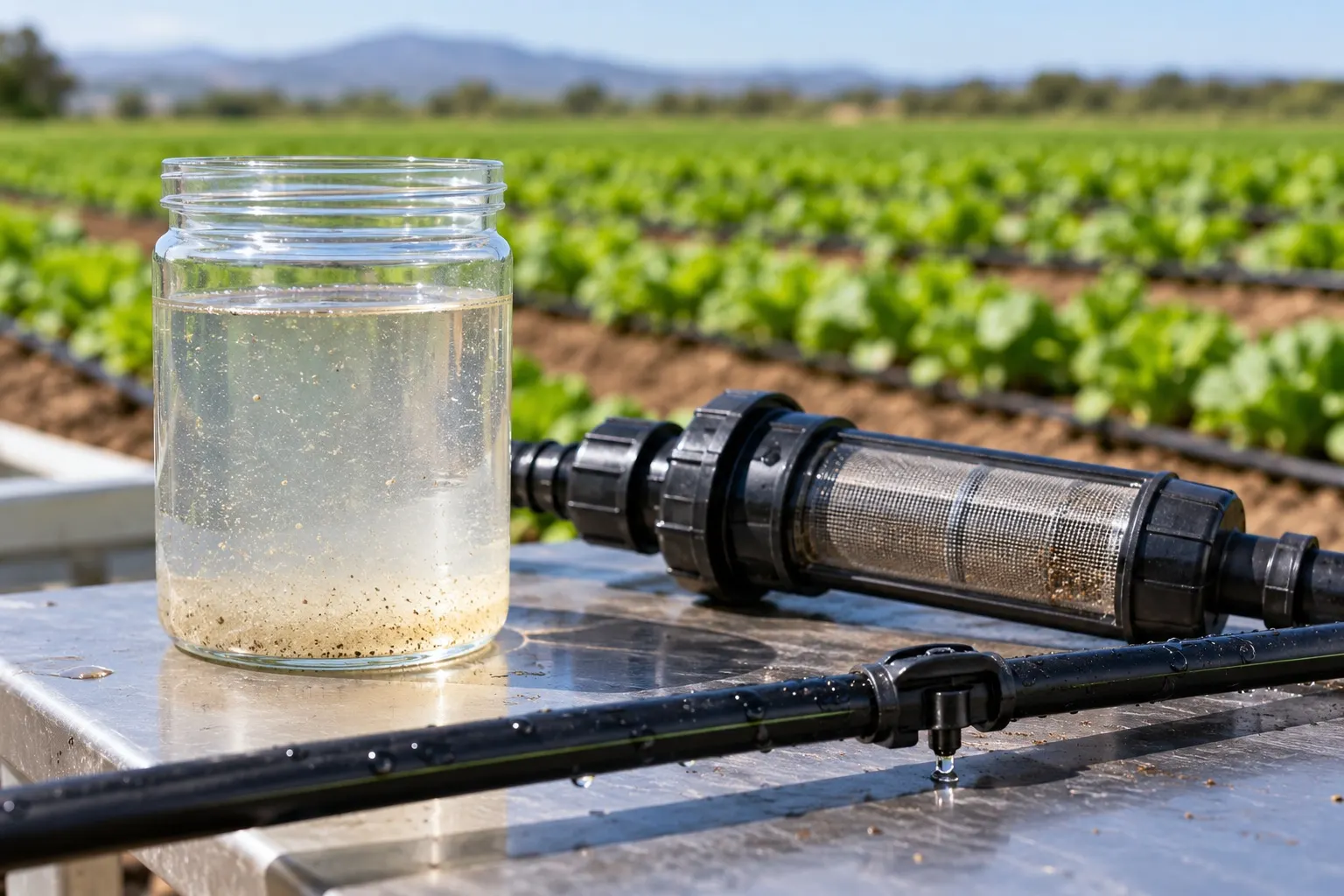
| Solution is milky, flakes form, or deposits appear at emitters | Chemical precipitation in the stock solution or irrigation water | Make a jar test at the approximate field dilution and inspect the line ends |
| Only the far end of a lateral is affected | Insufficient flushing velocity, sediment accumulation, or line obstruction | Open the flush end and observe particles and flow during clear-water flushing |
| Clogging follows one organic or suspension-based product | Undissolved solids, biological material, or a product not intended for low-flow drip | Compare a fully soluble reference fertilizer and inspect the stock tank after mixing |
Treat the symptom pattern as a routing decision, not a diagnosis by itself. A falling injector rate can be caused by a blocked suction screen or by a precipitate in the fertilizer. A clear filter does not rule out precipitation inside an emitter labyrinth. Record pressure, injection rate and end-of-line observations at the same operating point so that the comparison is meaningful. [E02][E03]
Use the water and fertilizer chemistry as evidence
Run a jar test before changing the recipe
Prepare a small amount of irrigation water and fertilizer at approximately the same dilution used in the field. UF/IFAS recommends watching the mixture for about two hours; cloudiness indicates a clogging risk. If two concentrates will be injected separately or together, test the combination that will actually meet in the system. A clear jar test does not prove that the system is clean, but a milky one is a strong reason to stop and resolve compatibility before injection. [E01]
Calcium, phosphate and sulfate need special caution
The reaction is not just a tank problem. UC Cooperative Extension explains that calcium-containing fertilizer can form calcium carbonate in high-pH, bicarbonate-rich water; sulfate can form calcium sulfate where calcium is elevated; and phosphate can react with calcium or magnesium to form deposits that are difficult to dissolve from emitters. [E04] This is why a product can look soluble in clean water yet precipitate in the farm water.
Do not rely on a seller’s statement that two fertilizers are “mixable” without defining the water quality and dilution. For a new combination, ask for the compatibility basis, test the actual water, and keep calcium nitrate separate from phosphate or sulfate concentrates unless a qualified agronomist or fertilizer specialist has confirmed the procedure. The Arkansas troubleshooting guide gives the same practical warning for incompatible fertilizer mixes. [E05]
Organic and suspension products require a different question
“Organic” describes a source or production claim, not a particle-size guarantee. If the product leaves visible solids, films or biological material in the stock tank, ask whether it is intended for drip fertigation and what filtration and agitation the manufacturer specifies. A small garden injector and a commercial low-flow drip line can have very different tolerance for suspended material. If the answer is unclear, test a small isolated zone rather than exposing the whole crop.
A field troubleshooting sequence that avoids guesswork
-
Stop the fertilizer feed and run clean water. Flush long enough for the downstream concentration to fall, then observe the lateral ends and a representative set of emitters. Do not evaluate a clogged line while concentrated solution is still moving through it.
-
Record the operating point. Note source pressure, pressure before and after the injector, pressure difference across the filter, flow and injection rate. University of Georgia guidance emphasizes that Venturi units depend on a pressure difference and that excessive back-pressure can stop suction. [E03]
-
Inspect the concentrate path. Remove and clean the suction strainer, check the tube for kinks or salt deposits, and examine the injector mixing section. University of Maryland recommends frequent inspection of concentrate-line filters and regular cleaning of stock tanks; the schedule should be tightened when the product leaves residue. [E06]
-
Open and flush the line ends. Particles and precipitate that remain in the mainline can be pushed into emitters on the next event. The Arkansas Extension troubleshooting guide lists cleaning filters, hoses and fittings, using fully soluble fertilizer where appropriate, and flushing with clean water after fertigation as routine prevention. [E05]
-
Test the solution separately. Run the jar test using the actual irrigation water and the intended dilution. If it fails, correct the chemistry or product sequence before touching the filter specification.
-
Recheck a small zone. Confirm that the injector draws at the target rate, the pressure profile is stable and the emitters recover. If only the treated zone remains restricted, sample deposits or replace a small number of emitters for inspection instead of assuming the entire system needs a finer filter.
Choose filtration for the contaminant and the operating duty
Filtration is part of the control plan, not a universal cure. UGA recommends an upstream filter in the 140- or 200-mesh range for injector installations, together with pressure regulation and backflow protection. [E03] The correct element still depends on the water source, emitter passage, allowable pressure loss, cleaning method and fertilizer chemistry. Confirm the manufacturer’s filter-equivalent terminology; “mesh” and micron ratings are not interchangeable across all media.
| Filter role | When it fits | Questions to put in the RFQ |
|---|---|---|
| Manual screen filter | A small or medium zone where an operator can inspect and clean the element at each event | Screen material, effective area, clean pressure loss, replacement element, maximum flow and chemical compatibility |
| Disc filter | Water with mixed particle shapes or a duty that benefits from deeper inter-disc capture and a defined backwash routine | Disc grade, filtration rating, backwash flow and pressure, minimum operating pressure, valve/control requirements |
| Automatic backwash unit | Commercial systems where labor, water quality swings or operating continuity justify automatic cleaning | Trigger method, backwash sequence, waste flow, power, fail-safe behavior, spare parts and service support |
Place the filter according to the approved hydraulic layout and the supplier’s instructions; do not infer placement from a marketplace photo. The purpose here is to keep particles from reaching the injector and emitters while preserving enough pressure for the injector to operate. A finer element that loads quickly can create the same low-pressure symptom as an undersized injector.
Prevent the next clog before it reaches the emitters
Keep the stock tank clean and mix until the product is fully dissolved. UGA recommends keeping the intake strainer above the bottom of the tank, inspecting it, and running clean water after fertilizer injection. [E03] That simple sequence prevents settled material from becoming a concentrated slug at the suction line.
Flush with clean water after the injection event rather than stopping immediately when the tank is empty. The required duration depends on line volume and flow; establish it from a measured travel time and verify at the line ends. UF/IFAS notes that flushing should break up and carry out deposits, not merely move them to the last emitters. [E01]
Track benchmark pressure, flow and injection rate. UF/IFAS recommends regular checks of pressure difference across the filter, water at lateral ends and injection-pump settings; a reduced injection rate is a warning that the injector or fertilizer compatibility needs attention. [E02] A simple log often reveals a gradual loading trend before the crop shows uneven growth.
Buyer acceptance checklist for a filtration or injector package
| Check before approval | Evidence to request |
|---|---|
| Hydraulic fit | Flow range, pressure range, clean and dirty pressure loss, injector minimum operating pressure |
| Filtration fit | Element type, stated rating, effective area, replacement parts and cleaning or backwash procedure |
| Chemical fit | Materials of construction, seals, fertilizer and acid compatibility, limits for suspended or organic products |
| Maintenance fit | Access for inspection, drain or waste connection, expected service interval and spare-element availability |
| Traceability | Exact model, variant, drawings, current technical sheet, supplier contact and change-notification process |
Ask the supplier to quote the exact delivered variant, not only the family name. Marketplace listings often combine several diameters, mesh options or control configurations. Treat flow, pressure, warranty, testing claims and supplier history as listing or seller statements until the technical sheet and sample confirm them.
Sourcing candidates for technical follow-up
The following Alibaba listing is a sourcing route for an RFQ. It is not presented as independently tested or as a recommendation for every system. Confirm the exact variant, technical documentation, current price and availability before purchase.
Sourcing Candidate A Manual screen filter
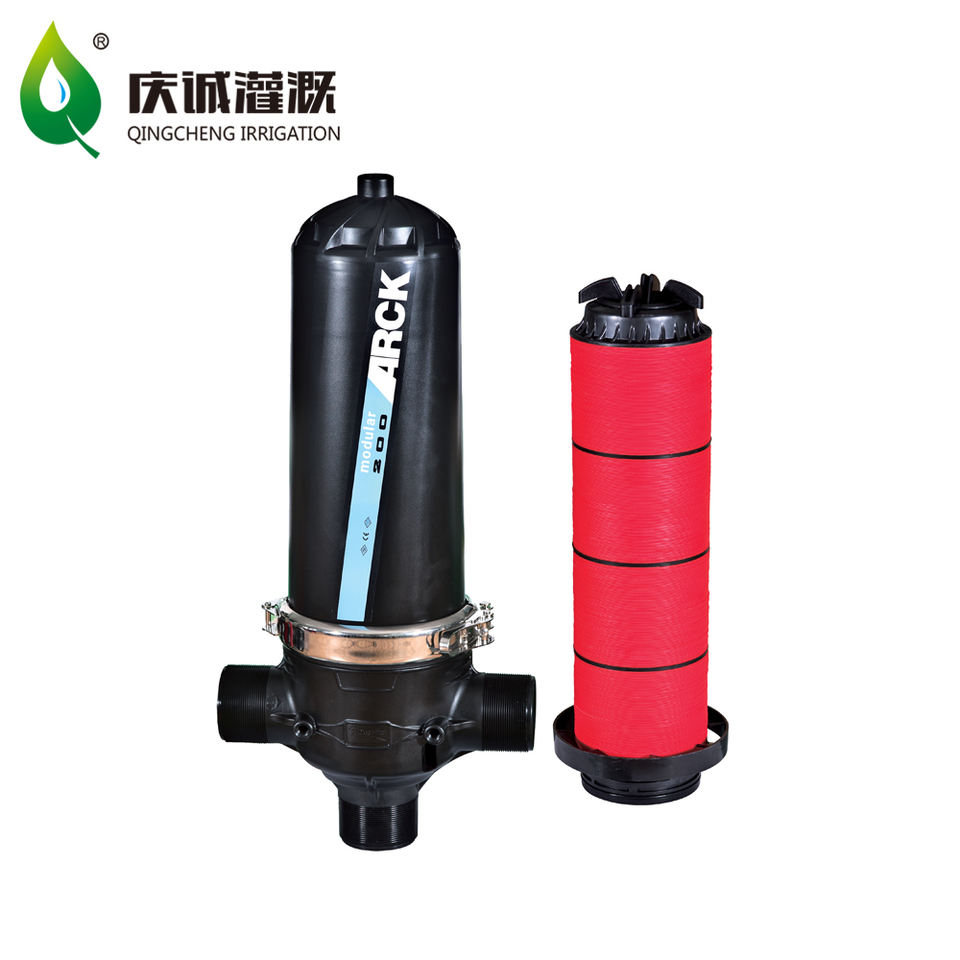
Manual screen filter for fertigation
A manual screen-filter route for buyers investigating particles before they reach injectors and emitters. Verify the exact diameter, mesh option, pressure-loss curve and chemical compatibility before specifying it.
- Role: Alibaba sourcing candidate
- Confirm mesh and effective area
- Request pressure-loss data
- Match filtration to the contaminant load
- MOQ: Check current listing
Marketplace observations: 3-inch plastic inline screen filter; 120 or 150 mesh options shown; 4.7/5 from 11 reviews; supplier profile shows 16 years. These fields are platform-stated and were not independently verified. This candidate is relevant where an operator can inspect and clean a manual filter. Request the clean pressure-loss curve, effective screen area, replacement element and chemical-compatibility statement before specifying it.
This candidate is a manual screen-filter route. Compare it against the measured contaminant load, labor available for cleaning, pressure budget and injector requirements. Do not choose by review count or headline flow alone.
Questions buyers commonly ask
Do I need a finer filter after fertilizer injection
Usually not as a first response. Determine whether the restriction is particulate or chemical. A finer filter can load quickly and increase pressure loss; it will not dissolve a precipitate formed by incompatible water and fertilizer. Start with a clear-water flush, pressure and injection checks, and a jar test.
Should I flush clean water after every fertigation event
A clean-water flush is a standard prevention step, but the time must match the system volume and flow. Verify the end of the line is receiving clean water rather than stopping when the stock tank is empty. Record the travel time so the procedure can be repeated by another operator.
Can I use the same injector for organic fertilizer
Only if the product, injector and filtration plan are compatible. Check the product’s solubility and suspended material, clean the stock tank and suction screen, and validate the actual injection rate on a small zone. Do not treat “organic” as proof that the solution is safe for a low-flow emitter.
References
-
University of Florida IFAS Extension, “How to Reduce Clogging Problems in Fertigation,” HS1202. Source
-
University of Florida IFAS Extension, “Drip Irrigation: The BMP Era—An Integrated Approach to Water and Fertilizer Management for Vegetables Grown with Plasticulture,” HS172. Source
-
University of Georgia CAES Field Report, “Fertilizer Injectors: Selection, Maintenance and Calibration,” Bulletin 1237, 2024. Source
-
UC Cooperative Extension, “Chemical precipitate clogging caused by injected chemicals.” Source
-
University of Arkansas Division of Agriculture Extension, “Drip Irrigation Fundamentals: Troubleshooting a Fertigation System,” FSA6176. Source
-
University of Maryland Extension, “Care and Calibration of Injector Pumps,” FS-1121. Source
-
University of New Hampshire Extension, “Fertilizer Injection Calibration.” Source
Hook this up to your favourite commenting platform — Giscus, Disqus, or your own.
Continue reading
Why Does Fertilizer Concentration Change During Fertigation?
A stock-tank and injection guide for diagnosing dilution, settling and uneven nutrient delivery
What Level Sensor Should a Fertigation Stock Tank Use
A practical guide to low level shutoff continuous monitoring and refill alarms
Why Is My Drip Irrigation Pressure Regulator Not Working
A dynamic pressure troubleshooting guide for fertigation and low volume systems