Dishwasher Baskets vs Clips for Small Lids and Bottle Parts
A basket contains small pieces; a clip holds one in position. Decide which problem you actually have before buying either.
 Lena Schmidt
Disclosure: We may earn a commission if you purchase through links on this page, at no additional cost to you.
A bottle lid comes out of the dishwasher upside down, full of water. A removable valve has vanished beneath the rack. Both problems involve small parts, but they do not necessarily need the same accessory.
Use a closed basket when the main problem is pieces falling through the rack. Consider a compatible dishwasher clip when a larger, lightweight lid needs to stay at a particular angle. A basket can contain a part without preventing it from turning over; a clip can hold a lid without enclosing its separate gasket.
Before buying either, check that each component is dishwasher-safe and identify its permitted rack position. The accessory does not change those instructions. A top-rack-only lid remains top-rack-only inside a basket, even if another basket happens to fit neatly beside the cutlery below.
Containment and positioning are different jobs
A basket provides a boundary. Its walls, base and closed lid should stop the intended pieces escaping. That is useful for detachable spouts, sealing discs and other small components that cannot sit securely between ordinary rack wires.
Positioning is more demanding. A hollow lid needs to remain in an arrangement that allows washing and drainage. If it can tumble freely inside a large compartment, it may finish the cycle facing upward. Finding it inside the basket proves containment worked; it does not prove the loading arrangement worked.
That distinction appears in a Reddit discussion about bottle lids flipping in the dishwasher. One contributor reported that their lids still overturned inside a basket, while another described a basket that did not sit properly among their rack’s tines. These are individual experiences, not product failure rates, but they identify two useful checks before checkout: the parts must fit the organizer, and the organizer must fit the machine.
Do not buy a larger basket automatically when the problem is one flipping lid. More empty space may leave the same positioning problem unresolved. First examine whether a built-in holder, divider or approved rack clip can retain that particular shape.
Check the component rather than the whole bottle
Separate the lid, removable straw and other components only as the bottle maker instructs. A bottle described as dishwasher-safe can still have different care directions for its individual parts. An accessory listing cannot settle those differences.
Owala’s general care guidance, for example, identifies lids as top-rack dishwasher-safe and directs users to remove and clean the spout gasket separately. Its FreeSip Twist instructions are more specific: they recommend hand washing the base and lid while identifying other removable components for dishwasher cleaning. Follow the instructions for the model in your hand rather than combining advice from different designs. [2, 3]
A useful sorting method is to place dishwasher-approved pieces on one side of the counter and hand-wash-only or uncertain pieces on the other. Leave the uncertain pieces out until you have checked their care directions. This avoids treating the basket as a way to make an unsuitable component safe.
Do not remove a permanently attached valve or force apart a sealed lid just because another brand demonstrates a fully removable assembly. If a component is intended to come out, note its orientation before washing. A quick photograph can help with correct reassembly later.
Keep removable parts from different bottle models separated while you work. Similar-looking rings can have different profiles, and appearance alone is not enough to establish interchangeability. A basket helps with washing, but it does not identify which gasket belongs to which lid. Sorting them before loading avoids an unnecessary puzzle when everything comes out.
Measure the available rack space before the basket
Pull out the rack you are allowed to use and identify a stable position for the accessory. Measure that usable space, not the entire dishwasher cavity. Tines, folding shelves and the third rack can make the practical space smaller than it first appears.
Check length and width at the level where the basket’s base will sit. Then check height with the rack in its normal operating position. A tall basket or projecting straw must clear the rack above and any moving spray components.
There is no universal clearance measurement that works for every dishwasher and accessory. Follow the appliance manual and the accessory’s installation directions. If the dishwasher has an adjustable rack, changing its height may solve one obstruction while reducing clearance elsewhere.
The basket should sit as designed without balancing precariously across tines. Close the rack gently and check for interference. Do not bend rack wires or wedge the accessory in place to make a near fit work.
Remember the lid’s loading space as well. An accessory may fit with its doors shut yet be awkward to open beside tall glasses. If it must be removed to load, check whether you can lift it out without tipping the contents into the rack.
Inspect the smallest opening and the smallest part
External dimensions tell you whether the basket fits the machine. They say little about whether a tiny valve can escape through its base, sidewall or lid gap. Compare those openings with your smallest loose component.
A flexible gasket deserves particular attention because it can change shape. Do not assume that an opening which retains a rigid cap will also retain a narrow, soft ring. Inspect the closed basket from several directions before deciding where that ring belongs.
Check the latch and hinges with the basket loaded. A piece caught under the lid can prevent full closure. A latch that appears shut while empty may not be properly engaged when a tall component presses against it.
If the seller does not publish opening dimensions, use clear product photographs and ask for the missing measurement. “Fits bottle parts” is a category description, not a guarantee for every seal or valve. Hand washing one unusually small piece may be simpler than compromising the entire load.
The CDC recommends a closed-top basket or mesh bag for small dishwasher-safe infant feeding components so they do not end up in the filter. That advice supports containment; it does not establish compatibility for every household bag, basket or washing cycle. [3]
Use clips for suitable lids that need a fixed position
A dishwasher clip is worth investigating when a lid is too broad for the basket, too light to remain stable on the rack, or repeatedly flips despite being contained. It needs to grip both the intended rack location and a suitable part of the lid.
Bosch describes its small-item clips, part 00423712, as holders for items such as lids, bottle parts and cups. This establishes a real accessory category, not permission to fit that part to any dishwasher. Check the appliance model and installation details before ordering. [4]
Position the lid according to the appliance and item instructions, with its surfaces accessible to the wash. A clip should not clamp a soft sealing edge out of shape or cover the very recess that needs cleaning. Check that the retained lid does not obstruct the spray arm.
Household clothespins, office clips and improvised ties are not equivalent to a dishwasher accessory with relevant instructions. Their suitability is an unanswered question. If you cannot identify an appropriate holder, hand wash the awkward lid rather than inventing an attachment.
A clip and basket can also work as separate parts of the same setup: the clip retains an approved lid, while the closed basket contains its removable small components. Neither accessory needs to solve every problem by itself.
Load for water access rather than maximum capacity
Distribute parts so their surfaces are exposed. A lid nested inside another lid may remain contained while shielding the surface underneath. Filling every gap can defeat the purpose of choosing an open basket.
Use the supplied holders only for compatible shapes. A straw holder may help retain a straw, but it is not proof that every narrow tube will be cleaned internally. Check the bottle maker’s cleaning directions and inspect the passage after washing.
CamelBak, for example, instructs users of relevant eddy designs to remove the bite valve and straw before cleaning. It also cautions against forcing a brush through the valve slit because that can tear the silicone. Those are model-specific care details; a general basket cannot replace them. [5]
Rack position is equally important. Whirlpool’s general loading guidance places dishwasher-safe plastic containers and lids on the top rack and says small items must be secured against falling through gaps. Yet Whirlpool also sells a small-items basket designed to clip onto the lower rack. The location allowed for the accessory and the location allowed for its contents must both be satisfied. [7, 8]
Keep nearby dishes from covering the basket. A large bowl over its top can obstruct access even though everything fits and the rack closes. Follow the dishwasher’s loading diagram rather than assuming a closed door means a well-loaded machine.
Two basket designs worth comparing
The OXO Tot Dishwasher Basket is a candidate when its dedicated holders match the parts you wash. OXO describes symmetrical opening doors and flip-down holders for straws, with capacity for up to eight bottle nipples. That capacity refers to a particular component type, not eight complete bottles or eight arbitrary water-bottle lids. [8]
View the OXO Tot Dishwasher Basket on Amazon
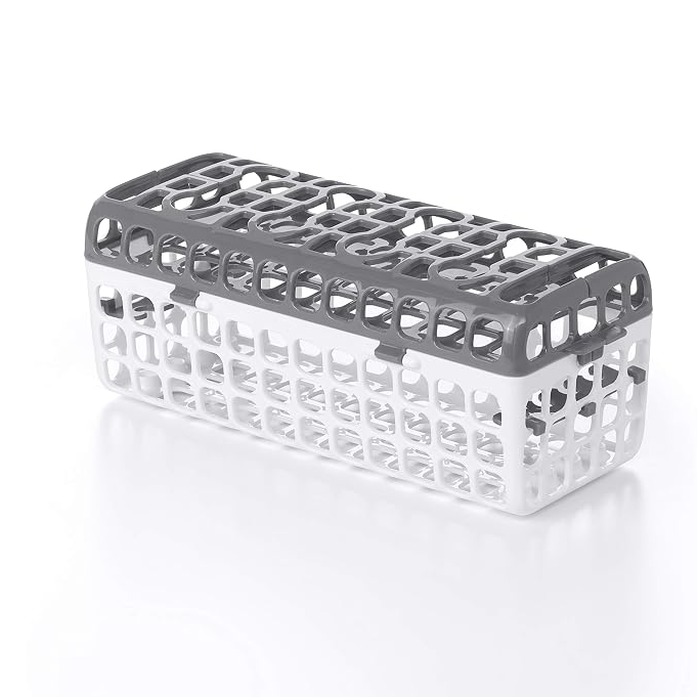
OXO Tot dishwasher basket
A basket whose dedicated holders match the parts you wash. OXO describes symmetrical opening doors and flip-down holders for straws, with capacity for up to eight bottle nipples. That capacity refers to one component type, not to eight complete bottles.
- Role: Amazon consumer option
- Flip-down straw holders
- Opening doors on both sides
- Capacity stated per component type
- MOQ: Check current listing
Its opening arrangement is also easy to misread. OXO’s claim about preventing toppling concerns loading and unloading. It should not be turned into a promise that every loose object inside remains in the same position throughout a wash.
The Munchkin High Capacity Dishwasher Basket uses a different arrangement, with a lower compartment for items such as collars, valves and spouts, alongside a straw rack. Its published directions specify top-rack use. This is a candidate for a mixed collection of suitably sized parts, provided the compartment openings and overall footprint work for your load. [9]
View the Munchkin High Capacity Dishwasher Basket on Amazon
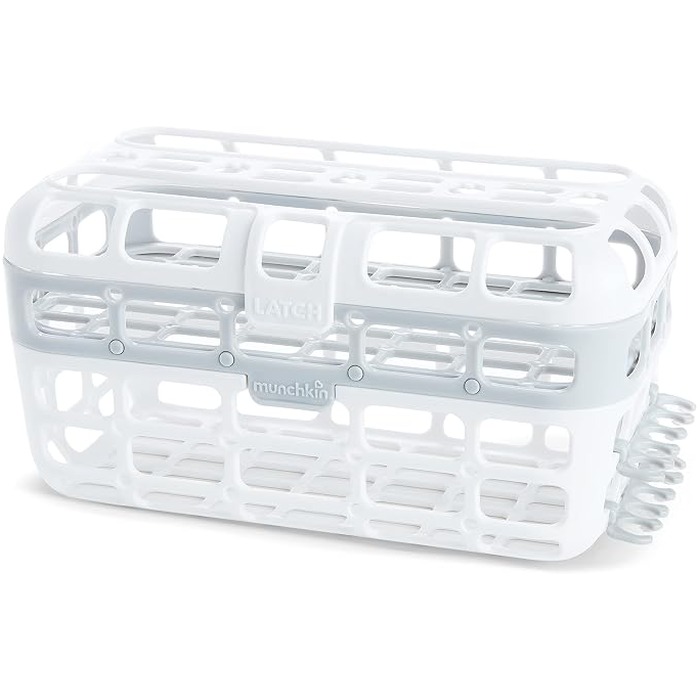
Munchkin high capacity dishwasher basket
A basket with a lower compartment for collars, valves and spouts alongside a straw rack, with published directions specifying top-rack use. A candidate for a mixed collection of suitably sized parts rather than one large lid.
- Role: Amazon consumer option
- Lower compartment for valves and collars
- Separate straw rack
- Top rack only
- MOQ: Check current listing
Neither basket is an automatic answer for a large sports-bottle lid. Lay out the actual parts first and compare their shapes with the intended holders. A family using mostly broad lids may benefit more from compatible clips and a small basket for seals than from the largest bottle-parts organizer.
Choose between these designs by fit and loading arrangement. A high review count can identify an established listing, but a review about baby-bottle nipples does not establish how well it holds your adult water-bottle lid. These are researched candidates, not products tested side by side for this article.
Run a small first load and inspect the result
Before starting, count the removable pieces and check the accessory’s closure. Close the rack carefully and confirm the loaded arrangement follows the dishwasher manual. Choose a cycle permitted for the machine, accessory and contents.
After the cycle, let items cool as directed before handling them. Check whether each piece is still present, whether lids have changed orientation, and whether any surfaces remain visibly dirty. Note where water has collected rather than assuming the whole machine failed to dry.
A clean-looking part with trapped water needs a drainage and drying check. A part with residue needs further cleaning. Those are different outcomes. Do not reassemble wet components simply to clear the counter; follow the product’s drying and storage instructions.
If a lid has flipped, examine the amount of free movement inside its compartment. Try a suitable dedicated holder or an approved clip if available. If parts have nested together, reduce the load. If a piece has escaped, stop using that arrangement and recover it according to the appliance manual before another cycle.
Changing one aspect at a time makes the next result easier to interpret. Replacing the basket, changing the cycle and adding more parts simultaneously leaves you guessing about which change helped.
Make the setup repeatable
Once a loading arrangement works, photograph it. Keep the image with the bottle’s model name and care instructions. This is especially helpful when several people load the dishwasher and similar-looking lids contain different removable pieces.
Inspect the basket itself during routine unloading. A cracked hinge, damaged latch or enlarged opening can undermine containment. Clean residue from the organizer according to its instructions and replace it when it no longer closes or holds parts as designed.
Buy capacity for the number of compatible parts you actually wash between cycles. Two small organizers may suit separated loads; one larger organizer may save handling. Neither is inherently better if it blocks spray access or takes the rack space needed for other items.
The decision is straightforward once the failure is clear. Choose a closed basket for parts that might escape. Choose a compatible clip for a suitable lid that needs to stay positioned. Use both when the lid and its removable pieces have different needs, and hand wash anything the arrangement cannot safely accommodate.
Sources
-
Owala product care FAQ Source
-
Owala FreeSip Twist cleaning instructions Source
-
CDC cleaning and storing infant feeding items Source
-
Bosch small-item clips 00423712 Source
-
CamelBak care and cleaning Source
-
Whirlpool dishwasher loading guidance Source
-
Whirlpool small-items basket 8519716 Source
-
OXO Tot dishwasher basket specifications Source
-
Munchkin regional product information Source
Hook this up to your favourite commenting platform — Giscus, Disqus, or your own.
Continue reading

Swivel Aerator or Faucet Extender for a Short Spout
Which attachment actually fixes a short spout: aiming the stream with a swivel aerator, or moving the outlet with an extender.

Felt vs Rubber Chair Pads for Vinyl Floors
Felt and rubber solve different problems on vinyl. Check the flooring maker's instructions, the movement you actually want, and the contact surface.

1.0 vs 1.5 GPM Bathroom Aerators: Which Flow Should You Choose?
Compare the two ratings on measured flow, rinse time and hot-water waiting rather than on the litre-per-minute number alone.