1.0 vs 1.5 GPM Bathroom Aerators: Which Flow Should You Choose?
Compare the two ratings on measured flow, rinse time and hot-water waiting rather than on the litre-per-minute number alone.
 Lena Schmidt
Disclosure: We may earn a commission if you purchase through links on this page, at no additional cost to you.
Choose a 1.0 GPM bathroom aerator when reducing running-water use is the priority and the installed stream still handles your normal washing and rinsing. Consider 1.5 GPM when the lower-flow option makes those tasks noticeably slower, provided the faucet manufacturer and applicable local requirements permit that rate. Neither number, by itself, tells you how the replacement will perform at your sink.
The useful comparison is between two compatible outlets doing the same job. An impressive spray demonstration cannot tell you whether hot water will arrive promptly in your bathroom, whether the stream will reach your hands comfortably, or whether the replacement actually matches the faucet.
This guide concerns a private bathroom sink. Kitchen pot filling, public-restroom fixtures and specialty faucets have different requirements. Start with the task you need to improve, then choose the flow rating.
What changes between 1.0 and 1.5 GPM?
GPM means US gallons per minute. At their stated rates, a 1.0 GPM outlet delivers one gallon in a minute; a 1.5 GPM outlet delivers one and a half. Those are flow quantities, not pressure measurements. A stronger-feeling stream is not a measurement of the pressure available in the supply pipe.
For equal running time at those actual rates, the arithmetic is straightforward: moving from 1.5 to 1.0 GPM reduces water volume by one-third. Moving in the opposite direction provides 50 percent more water per minute. Both statements describe the same difference from different starting points.
That comparison assumes the faucet actually delivers the stated rates. Treat it as a way to understand the choice, not a promise about your installation. The rate printed on a package needs its test conditions; your faucet, supply and handle position also belong in the comparison.
Suppose water runs for 30 seconds. At exactly 1.0 GPM, that uses 0.5 gallon; at exactly 1.5 GPM, it uses 0.75 gallon. The difference is 0.25 gallon for that event. This is an illustrative calculation, not a household savings estimate. It says nothing about how often the tap runs or how long anyone takes to finish rinsing.
Decide whether the task is timed or volume-based
A lower rate is most useful when the water would otherwise run for roughly the same duration. If you wet your hands briefly, turn the tap off while lathering and rinse efficiently, assess the water used during those running periods. Do not count the entire time spent at the sink as continuous water use.
A fixed-volume task behaves differently. Filling the same container to the same mark still requires the same volume. At exactly 1.0 GPM, filling one gallon takes 60 seconds; at 1.5 GPM, it takes 40 seconds. The lower-flow outlet adds 20 seconds in this example without reducing the amount collected.
Real bathroom use contains both kinds of activity. You may rinse a toothbrush under running water, fill a shaving basin and wash your face at the same sink. Before buying, identify which activity makes the current flow unsatisfactory. “More efficient” is too vague a brief if the actual complaint is a slow basin fill.
For a shared bathroom, ask the other users to try the proposed setting. A replacement that one person likes can still create an everyday nuisance for someone who uses the sink differently. Make the trial about observable results: rinse completion, comfortable reach and the amount of water left on the counter.
Why equal GPM labels can feel different
An aerator’s flow rating does not describe the whole outlet. Neoperl distinguishes simple flow restriction from pressure-compensating regulation. Its explanation notes that a fixed restriction can deliver less water at lower pressure, while its PCA designs regulate flow to remain nearly constant through pressure fluctuations. The operating range still belongs to the specific product. [1]
When comparing candidates, look for the manufacturer’s flow information and applicable pressure range. Do not infer pressure compensation from “water saving,” a colored insert or an attractive stream photograph. If the specification does not say how the device regulates flow, ask before treating it as equivalent to a documented model.
Stream appearance also deserves a separate check. Compare like with like where possible: a bubble stream against a bubble stream, rather than changing both the flow rating and outlet style at once. Otherwise, you cannot tell which change caused your preference.
Evaluate the stream where it meets your hands, not only where it leaves the spout. Try your usual hand position and normal handle opening. Look for an even rinse rather than judging the replacement by the visual size of the water column. Record splashing separately; a flow preference and a splash complaint need not have the same solution.
Measure the faucet before ordering
A simple collection test makes the buying decision more concrete. Use a clean container with readable volume marks and a timer. Choose a container that safely fits under the outlet and can capture the entire stream without overflowing. Keep electrical devices away from the wet area.
With cool water, let the stream settle, then collect it for a measured interval. Record both the volume and elapsed seconds. Calculate gallons per minute as collected gallons multiplied by 60, divided by seconds. With liters, the same calculation gives liters per minute; convert units only after calculating.
For example, collecting 0.25 US gallon in 15 seconds means an observed rate of 1.0 GPM. Collecting 0.375 gallon over the same interval means 1.5 GPM. These are examples for checking the calculation. They are not measurements from an ObjectBrief test.
Repeat the collection with the same handle position and conditions. If results vary, investigate the inconsistency before buying from a single reading. A short collection that misses part of the stream or uses uncertain markings can give a misleading result. DOE’s water-evaluation handbook likewise uses timed collection to measure faucet flow. [2]
Record the normal-use setting as well as a fully open reading. The first helps assess daily experience; the second helps describe the available output. Neither is a standardized certification test, and a collection container cannot tell you the supply pressure.
Check hot-water waiting before choosing the lower rate
A lower-flow replacement can make an existing hot-water wait more noticeable. EPA’s supporting statement for its bathroom-faucet specification explicitly identifies longer basin-filling and hot-water waiting times as potential consequences of reduced maximum flow. [3]
The basic displacement calculation helps explain the trade-off. In a simplified example, assume one gallon of cooled water must leave a hot-water branch before incoming hot water reaches the outlet. At an actual hot-side flow of 1.0 GPM, moving that volume takes one minute. At 1.5 GPM, it takes 40 seconds.
That example is not a prediction of your wait. It leaves out heating response, heat transfer, mixing and the details of the plumbing. Its purpose is narrower: reducing flow does not shorten the time needed to move a fixed volume through a pipe.
Compare hot-water arrival after similar periods without hot-water use. Use the same handle position and a consistent temperature endpoint, taking care with potentially hot water. An immediate second run benefits from the water already warmed by the first run and is not a fair comparison.
If your home uses a tankless heater, consult the exact heater manual before assuming a lower-flow outlet will work satisfactorily. Ask about its activation and operating requirements for this fixture. Do not borrow a minimum-flow figure from another heater or confuse total mixed faucet flow with the flow passing through the heater. [6]
If the heater fails to start or the temperature cycles, report the model, measured flow and observed behavior to its support team. Treat that as a system-compatibility question. Removing internal components or buying an arbitrarily higher-flow insert is not a diagnosis.
What the WaterSense label establishes
EPA currently describes WaterSense-labeled bathroom faucets and accessories as independently certified for efficiency and performance. Its bathroom-faucet guidance identifies a maximum of 1.5 GPM and explains that the label covers private lavatory and bar sink products, rather than every type of faucet. [4]
A 1.0 GPM claim alone does not establish that a product carries the label. Nor does a low number demonstrate thread compatibility, a comfortable stream or satisfactory operation at your sink. Check the exact model’s labeling rather than transferring a certification claim from another item sold by the same brand.
EPA also distinguishes private bathrooms from public lavatories and states that rates of 0.5 GPM or less are not appropriate for private lavatories. A public-restroom recommendation should therefore not become the automatic target for your home bathroom. [4]
Before increasing a replacement’s rating, check the faucet manufacturer’s approved options and current requirements where it will be installed. A national program’s maximum is not blanket permission for every local installation. If the approved replacement is 1.2 GPM, evaluate that option rather than forcing a choice between the two numbers in this comparison.
Compare the cost of the change honestly
Use your own running time if you want a savings estimate. For illustration, a measured reduction of 0.5 GPM maintained for two minutes of daily running would avoid one gallon per day. Multiplying by 365 gives 365 gallons per year. Both the flow difference and the daily duration are assumptions here; replace them with observations from your bathroom.
Apply only the charges on your bill that change with consumption. A fixed monthly service charge does not disappear when the faucet uses less water. Keep any energy estimate separate unless you also know the hot-water share and the relevant heating assumptions.
Compare that estimate with the delivered cost of the replacement, including a required key or shipping. Check whether your water utility offers a suitable aerator before ordering a pack. A free device is still worth fitting only if its exact connection and performance suit the sink. Keep the comparison focused on one working installation rather than the largest savings number printed on a package.
Match the outlet before comparing the price
Keep the removed assembly and identify the faucet model. Ask for a replacement that matches the connection, seal arrangement and installed geometry as well as the chosen flow rating. A listing labeled “universal” still needs to match the actual faucet.
Determine whether you need a complete exposed housing or an insert for an existing assembly. A recessed outlet may require a particular key and replacement cartridge. Do not choose from an outside diameter alone or assume that a familiar-looking insert will seat correctly.
Saving Water Partnership recommends taking the old aerator to the store to check fit and identifies both 1.0 and 1.5 GPM as bathroom options. That is a useful purchasing approach when the original specifications are unavailable. [5]
For online orders, save the exact model number, selected variant and package quantity before checkout. Read fit complaints for the connection you need, rather than treating every negative review as a defect in the flow design. Conversely, repeated complaints about a matching model’s core function deserve attention even when the overall star rating looks reassuring.
Start with one compatible sample when possible. A multipack only becomes economical after you know that its rating, fit and stream work in the intended bathrooms. Keep packaging until the installed check is complete, and confirm the seller’s current return conditions before ordering.
For an exposed, compatible dual-thread outlet, the Niagara N3210B-PC-T 1.0 GPM bubble-stream six-pack offers a lower-flow option. The listing specifies male 15/16-27 and female 55/64-27 connections. Confirm the selected bubble-stream version before ordering.
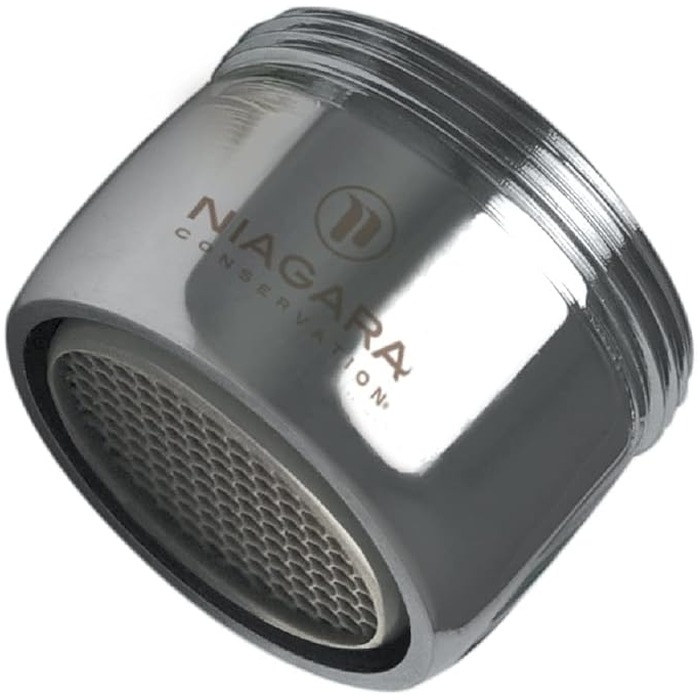
Niagara N3210B-PC-T 1.0 GPM aerator, six-pack
A 1.0 GPM bubble-stream aerator listed with male 15/16-27 and female 55/64-27 connections, sold as a six-pack. It suits an exposed, compatible dual-thread outlet. Confirm the selected bubble-stream version and your own thread size before ordering.
- Role: Amazon consumer option
- 1.0 GPM bubble-stream
- Male 15/16-27 and female 55/64-27
- Six-pack
- MOQ: Check current listing
For a Moen faucet whose parts diagram specifies 137401, the Moen 137401 1.5 GPM service kit is a model-specific alternative supplied with a removal tool. It is not a universal replacement. These two products serve different connections; choose the correct assembly before comparing their flow ratings.
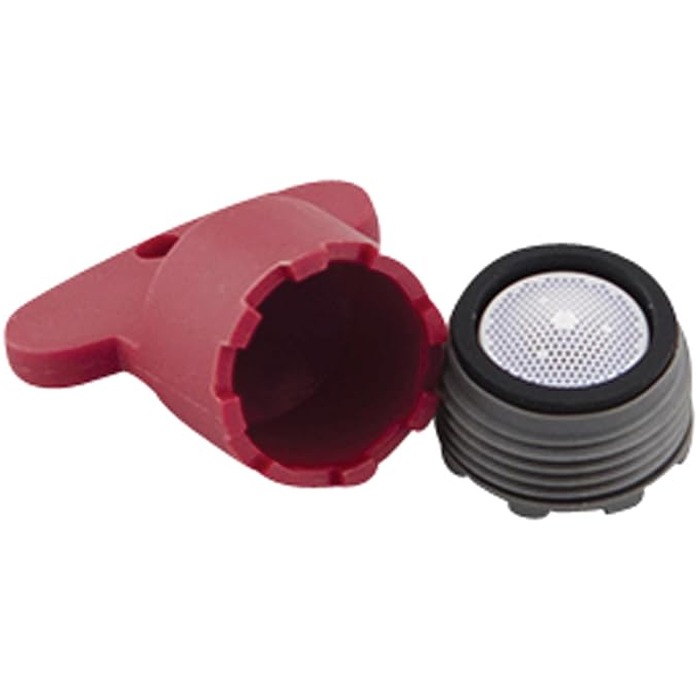
Moen 137401 1.5 GPM aerator service kit
A 1.5 GPM service kit for a Moen faucet whose parts diagram specifies 137401, supplied with a removal tool. It is a model-specific part, not a universal replacement, so check the diagram for your faucet before ordering.
- Role: Amazon consumer option
- 1.5 GPM
- For parts diagram 137401
- Includes a removal tool
- MOQ: Check current listing
A practical way to choose and keep the result repeatable
Choose the 1.0 GPM option for a trial when your measured baseline leaves room to reduce flow and the main activities are brief washing and rinsing. Keep it if users finish those tasks comfortably and the hot-water behavior remains acceptable. Lower running volume has little practical value if the household immediately wants the old outlet back.
Favor an approved 1.5 GPM option when a fair trial shows that the lower rate creates a meaningful inconvenience in normal use. Be specific about the reason: repeated rinse delays, a basin that takes too long to fill, or unacceptable hot-water waiting. Check that the problem follows the flow change rather than a blocked or incorrectly installed replacement.
After installation, inspect the connection for leakage and repeat the cool-water collection test. Then try normal washing and a separate hot-water check. Do not approve the replacement merely because it screws into place. Fit, measured output and everyday usability are separate checks.
Write the accepted model and flow rating beside the faucet’s service information. Include the thread or cartridge designation, required removal key and the installed test result. Photograph the package label. The next purchase can then be a repeat order of a known configuration instead of another round of guessing from photographs.
For several bathrooms, retain one approved sample for each faucet model. Recheck a different model rather than assuming that success at one sink proves compatibility everywhere. The useful outcome is a replacement you can identify, buy again and use without turning an ordinary bathroom task into a compromise.
Sources
-
Neoperl, Water-saving technologies for aerators. Manufacturer explanation of restriction and regulation; product-specific operating limits must be checked separately. Source
-
US Department of Energy, Handbook: Water Evaluation Tools, October 2020. Timed faucet-flow collection methodology. Source
-
US EPA, High-Efficiency Lavatory Faucet Specification Supporting Statement, October 2007. Background discussion of use tasks and waiting-time trade-offs. Source
-
US EPA, Bathroom Faucets. Current program scope and consumer guidance. Source
-
Saving Water Partnership, Install a Faucet Aerator. Bathroom flow options and fit-check guidance. Source
-
Rinnai, Residential FAQ. Minimum-flow operation and hot-water waiting guidance. Source
Hook this up to your favourite commenting platform — Giscus, Disqus, or your own.
Continue reading

Felt vs Rubber Chair Pads for Vinyl Floors
Felt and rubber solve different problems on vinyl. Check the flooring maker's instructions, the movement you actually want, and the contact surface.
Dishwasher Baskets vs Clips for Small Lids and Bottle Parts
A basket contains small pieces; a clip holds one in position. Decide which problem you actually have before buying either.
Swivel Aerator or Faucet Extender for a Short Spout
Which attachment actually fixes a short spout: aiming the stream with a swivel aerator, or moving the outlet with an extender.