Felt vs Rubber Chair Pads for Vinyl Floors
Felt and rubber solve different problems on vinyl. Check the flooring maker's instructions, the movement you actually want, and the contact surface.
 Lena Schmidt
Disclosure: We may earn a commission if you purchase through links on this page, at no additional cost to you.
A dining chair needs to move. A sofa usually needs to stay put. That difference explains why a pad that feels reassuringly grippy under one piece of furniture can be frustrating under another. On vinyl flooring, there is another question before either purchase: is the material touching the floor suitable for that particular surface?
For dining chairs that are pulled out regularly, felt is a practical starting point when the flooring manufacturer recommends it. Rubber grippers serve a different purpose and should not be treated as automatically safe for vinyl. Karndean, for example, specifically warns against rubber furniture feet because rubber can permanently stain its vinyl floor coverings. [1]
There is no honest winner for every floor sold as LVP. The useful choice depends on three things: the flooring instructions, the movement you want, and the condition of the installed contact surface. Start there instead of choosing by softness, thickness or a promise to protect all floors.
First decide whether the chair should slide
Think about the movement that happens every day. A dining chair is pulled away from the table, repositioned while someone sits, and pushed back afterward. If your aim is to make those movements easier, a protector designed to glide is a more relevant category than a product advertised as an anti-slip stopper.
Felt does not make a chair stationary. That is an important limitation if the chair already moves too readily for its user. Changing from bare feet to felt can alter how it behaves, so do not interpret quieter movement as proof that the whole setup is suitable.
Rubber grippers are sold to resist movement. A pad that grips strongly may be useful under stationary furniture, but it can make pulling out a dining chair awkward. The word “protective” does not resolve that tradeoff. Ask whether you are trying to improve movement or prevent it before comparing products.
A rocking chair, office chair with casters or mobility support chair needs a different assessment. This guide concerns ordinary dining chairs with fixed feet. Do not use a general furniture pad recommendation to modify equipment whose stability or rolling behavior is part of its intended function.
Why rubber deserves extra scrutiny on vinyl
Staining is a different problem from scratching. A smooth rubber foot can look harmless, remain firmly in position and still be unsuitable for prolonged contact with a vinyl surface. Karndean’s care advice explicitly includes rubber furniture feet in its warning, not only entrance mats. [1]
Singapore’s Building and Construction Authority also notes in its vinyl flooring maintenance guidance that rubber-backed mats may permanently stain some vinyl floors. The word “some” matters. That guidance supports checking compatibility; it does not establish that every rubber compound damages every vinyl product after a predictable number of days. [2]
Be equally careful with reassuring labels. “Non-marking” may describe a seller’s claim, but it does not tell you whether the exact pad has been accepted for your floor. “Natural,” “clear” and “premium” are not substitutes for a relevant compatibility statement either.
If the floor’s instructions prohibit rubber contact, exclude rubber-bottomed candidates. If they allow specified non-staining materials, ask the pad supplier to identify the floor-contact material and intended flooring compatibility. A generic reply that the product works on hardwood is not an answer about vinyl.
A quick trial cannot establish long-term staining performance. Seeing no mark after an afternoon tells you only what happened during that afternoon. Do not use an inconspicuous test as permission to override a restriction in the flooring care guide.
The flooring brands do not all give the same advice
Shaw’s residential luxury vinyl care page recommends felt protectors and wide load-bearing bases to reduce the chance of scratches and indentations. Its separate resilient-floor technical bulletin calls for heavy-duty felt, non-staining materials and properly maintained contact surfaces. That bulletin also cautions against ordinary retail felt protection that can detach. [3, 4]
Floer takes a different position in its own guidance. It advises avoiding felt pads on vinyl, citing wear, trapped dirt and adhesive-related problems, and recommends suitable furniture sliders instead. This is not a reason to quietly replace one brand’s instructions with another’s. It shows why a universal online answer is inadequate. [5]
Find the name and collection of your floor on the invoice, spare box or installation paperwork. Download the care document for that product and region. A retailer can help identify it if you have only a sample or an older receipt.
If the instructions are unclear, send a specific question: “For this flooring collection, what floor-contact material do you recommend under dining chairs moved daily? Is this exact felt pad or rubber gripper acceptable?” Include the product model, not just a photo of a bag of pads.
Until that question is settled, an affiliate listing should not decide the matter. A pad manufacturer can describe its own product, but it cannot rewrite your flooring manufacturer’s requirements.
Look underneath the protector rather than at its name
A silicone sleeve with a felt bottom is not the same contact arrangement as a silicone foot with no felt. The sleeve may hold onto the chair while the felt meets the floor. Likewise, a furniture cup may have one material inside, another in its body and a third on the underside.
Inspect the actual face that will touch the vinyl. Product photos showing only the top opening or the sidewall leave an important question unanswered. Look for an underside image and a material description that distinguishes the layers.
Do not assume that a layer higher up can never reach the floor. A poorly seated cap, worn base or tilted chair can change the contact. Conversely, the mere presence of a gripping material above a separate base does not prove it is touching the vinyl. Evaluate the installed arrangement.
This is also why a product called a “hybrid pad” needs more explanation. The name tells you little about which material carries the load, which surface slides and what remains exposed as the protector wears. If the supplier cannot describe that construction, choose a better documented alternative.
Felt can be the right material and still leave marks
Before replacing felt with rubber, lift the chair and inspect the existing pads. Look for embedded grit, a missing section, exposed adhesive, an exposed fastener or a base that has shifted sideways. These observations are more useful than assuming that every mark proves the material itself was wrong.
Shaw’s technical guidance emphasizes a clean, smooth contact area and replacing worn, damaged or missing rests. [4] A pad is a maintained part of the chair, not a permanent shield. Its condition after months of use matters more than how soft it felt when you opened the package.
Do not confuse the outline of a larger pad with a properly supported bearing surface. A floppy overhang is not the same as a designed load-spreading base. Nor does buying the thickest felt establish that the chair will rest flat or that its weight is adequately distributed.
A chair that lands on the edge of a foot needs attention to its geometry. So does one with a damaged glide or uneven contact. Switching materials without addressing those conditions can leave the same problem in place. Protector dimensions and attachment still matter, even after material compatibility is confirmed.
If the mark is already present, photograph it before cleaning. Follow the floor’s approved cleaning instructions rather than trying an abrasive pad or an internet solvent recipe. A deposit, scratch, indentation and discoloration can require different responses; a photograph alone may not establish which one you have.
When the chair slides too easily
Sometimes the felt does its job, but the result is not what the owner wants. A chair that moves when someone tries to sit down presents a different purchasing task from a chair that scrapes loudly across the floor. Buying thicker felt is not a reliable way to turn a glide into a gripper.
Describe the unwanted movement to the furniture supplier and flooring manufacturer. Ask for a compatible foot or protector intended to resist movement on that floor. Avoid treating the words silicone, cork or non-slip as a complete compatibility assessment. Each product still needs an appropriate intended use.
Do not assemble an improvised stack of felt, shelf liner and rubber to combine every benefit. It becomes difficult to know which layer is moving, whether the chair remains level, or which material can reach the floor. A purpose-designed solution is easier to identify and assess.
If you cannot establish compatibility, keep that chair out of use on the affected floor while choosing an appropriate solution. The aim is predictable behavior during ordinary use, not simply the highest possible friction or the smoothest possible slide.
Two felt options to check after the floor allows felt
These are examples for comparing documented formats, not approvals for every LVP floor. Neither is a substitute for a specified heavy-duty or mechanically attached protector. If your floor or furniture instructions require a different construction, follow those instructions instead.
Scotch SP802-NA is a pack of 32 beige, round, self-adhesive pads measuring one inch across. 3M lists polyester as the material and includes vinyl floor among the surface types. This format makes sense when the same round pad size is appropriate for the chair feet you are protecting. It is a sliding felt pad, not an anti-slip foot. [6]
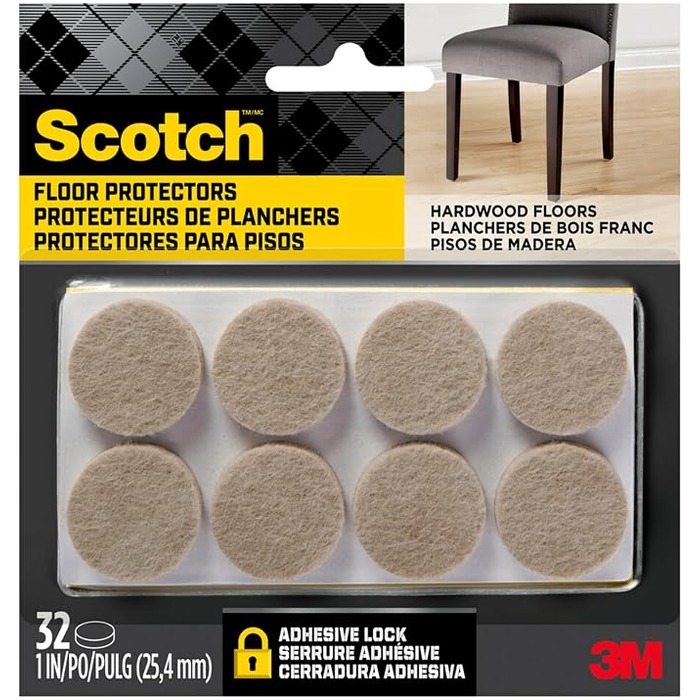
Scotch SP802-NA felt pads, 32 pads of one inch
A pack of 32 beige, round, self-adhesive pads measuring one inch across. 3M lists polyester as the material and includes vinyl among the surface types. It is a sliding felt pad rather than an anti-slip grip, and it is not an approval for every LVP floor.
- Role: Amazon consumer option
- 32 pads, one inch round
- Self-adhesive polyester felt
- 3M lists vinyl as a surface type
- MOQ: Check current listing
Scotch SP845-NA is a 162-piece assortment of self-adhesive felt pads. 3M’s product page includes vinyl among its intended floor surfaces. The assortment is worth considering when you have several suitable contact sizes to cover, but the total piece count does not tell you how many pads match your dining chairs. Check the package breakdown before buying. [7]
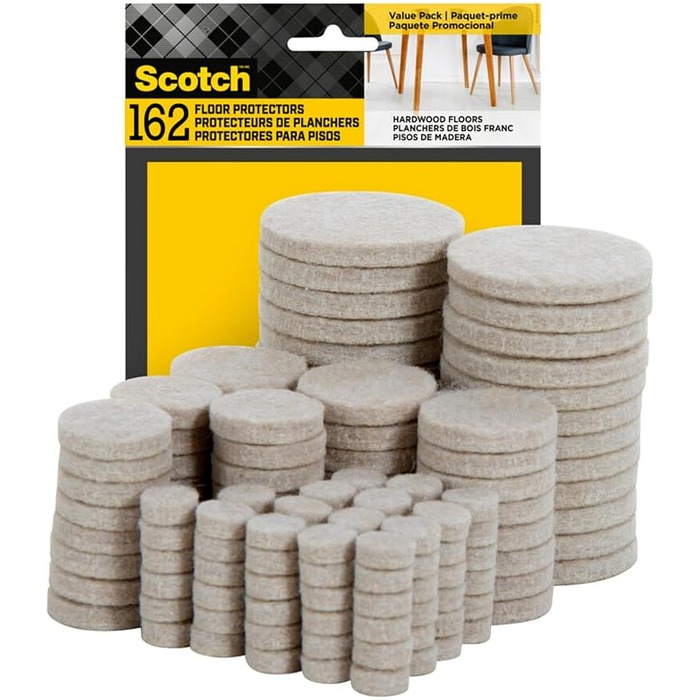
Scotch SP845-NA felt pad assortment, 162 pieces
A 162-piece assortment of self-adhesive felt pads, with vinyl among 3M's listed floor surfaces. It suits a household with several contact sizes to cover, but the total piece count does not tell you how many pads match your dining chairs, so check the size breakdown first.
- Role: Amazon consumer option
- 162 assorted round pads
- Self-adhesive polyester felt
- Check the count per size
- MOQ: Check current listing
Suppose six chairs each need four pads of the same diameter. That is 24 matching pads. A 32-pack in that exact size leaves eight spares. An assortment with a much larger total count could still contain too few of the required size. This is a purchasing example, not a recommendation that one-inch pads fit your chairs.
The useful comparison is therefore the quantity of suitable pads, not simply the price divided by every piece in the bag. Keep the model number when ordering replacements, and do not assume a different color or pack option has identical dimensions.
Check one chair in normal use before fitting the rest
After confirming compatibility, fit one complete chair according to the protector’s instructions. Keep all its contact points consistent unless the chair’s design specifically requires different fittings. Examine the installed feet while the chair stands upright, not only while it is upside down.
Use a clean, dry area of the intended floor. Check for rocking, an edge that catches or a protector that shifts during ordinary movement. If anything is unstable or visibly misaligned, stop and correct the setup before someone relies on the chair.
This check is about immediate fit and behavior. It cannot certify long-term wear, indentation resistance or chemical compatibility. Those claims would need evidence beyond moving a chair a few times. It also does not justify dragging heavy furniture because the same product label lists tables or cabinets.
Once the chair works as intended, check the remaining chairs individually. Identical-looking furniture can have missing original feet or different wear. A complete set of matching new pads does not repair a damaged chair leg or a loose joint.
Replace by condition rather than a promised lifespan
There is no single replacement interval that fits every dining room. The amount of grit brought indoors, the chair’s movement and the installed protector all affect what you need to inspect. A product review reporting a year’s service is not a maintenance schedule for your home.
Make inspection easy by checking the feet when you clean under the table. Remove loose debris using the pad maker’s care instructions. Replace a protector if the contact face is worn through, damaged, displaced or holding debris that cannot be removed satisfactorily. Investigate new noises or marks when they appear.
Keep a small supply of the verified replacement size rather than an unrelated assortment bought later in a hurry. A saved photo of the package, chair foot and installed underside can prevent accidental changes to the contact material or attachment type.
For a dining chair on vinyl, choose the material in this order: follow the floor’s requirements, decide whether the chair should glide or grip, and select a protector that fits and remains maintainable. Felt often answers the daily sliding task. Rubber requires explicit compatibility attention. Neither label excuses an unsuitable or worn contact surface.
Sources
-
Karndean. Vinyl floor protection tips and advice. Manufacturer guidance, including rubber furniture feet. Source
-
Building and Construction Authority Singapore. Good Industry Practices for Vinyl Flooring. Maintenance section 4.1. Source
-
Shaw Floors. Luxury vinyl care. Source
-
Shaw. How to protect your resilient floor. Technical bulletin. Source
-
Floer. Why it is best to avoid using felt pads on a vinyl floor. Manufacturer specific alternative guidance. Source
-
3M. Scotch SP802-NA round felt pads. Product specifications. Source
-
3M. Scotch SP845-NA felt pad assortment. Product specifications. Source
Hook this up to your favourite commenting platform — Giscus, Disqus, or your own.
Continue reading
Dishwasher Baskets vs Clips for Small Lids and Bottle Parts
A basket contains small pieces; a clip holds one in position. Decide which problem you actually have before buying either.

1.0 vs 1.5 GPM Bathroom Aerators: Which Flow Should You Choose?
Compare the two ratings on measured flow, rinse time and hot-water waiting rather than on the litre-per-minute number alone.
Swivel Aerator or Faucet Extender for a Short Spout
Which attachment actually fixes a short spout: aiming the stream with a swivel aerator, or moving the outlet with an extender.