Swivel Aerator or Faucet Extender for a Short Spout
Which attachment actually fixes a short spout: aiming the stream with a swivel aerator, or moving the outlet with an extender.
 Lena Schmidt
Disclosure: We may earn a commission if you purchase through links on this page, at no additional cost to you.
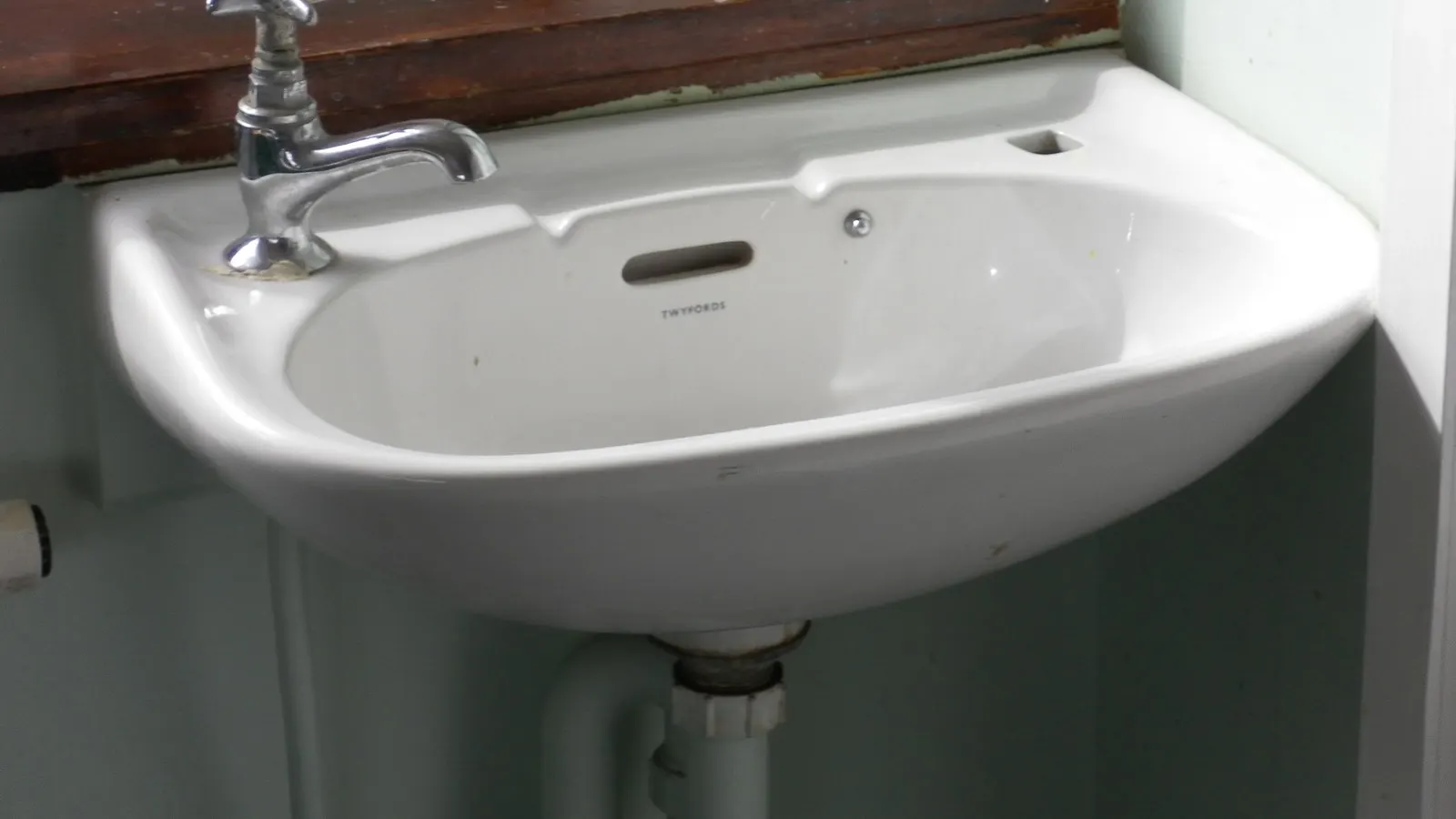
If washing your hands means knocking your knuckles against the back of the basin, choose an attachment by where it puts the outlet and stream. A compact swivel aerator primarily changes direction. An articulated extender can move the outlet itself, but its body and joints also occupy space beneath the spout. More movement is useful only if the resulting position makes your sink easier to use.
For a small aiming correction, start with a compatible adjustable aerator. For a larger distance between the existing outlet and your comfortable washing position, compare an extender’s actual dimensions and joint positions. Before ordering either, confirm the faucet connection, sketch the installed position and check the remaining space for your hands or usual container. Neither a rotation number nor a “universal” label answers those questions.
This comparison covers attachments fitted to a removable sink-faucet aerator connection. Pull-down heads, waterfall outlets and proprietary concealed fittings require separate compatibility checks. The aim is a usable stream within your existing basin, with connections that fit correctly and remain accessible for maintenance.
Decide whether you need to aim the stream or move the outlet
Watch the water at your normal handle setting. Is it a coherent stream landing too far back, or is it spraying unevenly from the outlet? An uneven discharge deserves a service check before you choose an extension. Changing reach and correcting a blocked or damaged aerator are different tasks, even when both produce water on the counter.
For a coherent stream, identify the position where you want to use it. Hold your hands comfortably over the bowl with the faucet off, then compare that location with the current stream. You may need only a small forward adjustment. You may instead need enough physical extension to bring the outlet beyond the rear slope of the basin.
An adjustable plate can redirect water while leaving the fitting nearly in its original position. Neoperl describes this approach in its SSR explanation. A ball-joint aerator pivots a larger outlet head. An articulated extender adds an arm between the faucet and head, allowing the discharge point to move as well as turn. Product names often overlap, so look at the actual joint arrangement.
Describe the task before comparing listings: “move the handwashing stream forward while keeping space below it” is more useful than “buy the most flexible aerator.” If your main task is rinsing a particular corner, record that position too. A product that reaches it only by obstructing the normal washing area may create a new daily inconvenience.
Measure the space your attachment will actually use
Take a side-on photograph and record three things: the current outlet position, your preferred washing position and the vertical room beneath the outlet. Include any adapter required by the candidate product. An adapter contributes to the installed assembly, even when a listing photograph shows the head attached directly to a faucet.
Mark the proposed head position on the photograph or make a simple cardboard profile with the water off. For an articulated product, check its working position and its folded position. Look for contact with the basin, faucet body, backsplash and drain control. Also check whether the normal handle movement remains unobstructed.
Consider a hypothetical measurement: you want the discharge point 35 mm farther forward, but the attachment hangs 45 mm below the original outlet. That may solve reach while leaving insufficient space for your hands. Those numbers are an example, not a recommended product size. Substitute your measurements and the manufacturer’s installed dimensions; package length is not a substitute.
Bring your usual glass, bottle or washing item into the check. A bottle needs room to enter beneath the head and be withdrawn without striking it. The space available with the attachment folded away does not necessarily describe the space available while water is running. If the seller provides no usable dimensions or drawing, ask for them before treating the attachment as a fit.
Measure from a consistent reference point: the original faucet connection. Compare the installed outlet position from that point, including the adapter, rather than comparing two products’ overall lengths. An angled inlet or elbow can make a longer product project less far forward than a shorter one. Save the drawing with your measurements so you can check the delivered part against the version you selected.
Understand what rotation numbers leave out
A head can turn around an axis without tilting far enough to send water forward. Likewise, an arm can have several rotating joints while still lacking the length needed to reach your preferred position. Angular movement and added reach are separate specifications.
Hibbent’s articulated extender description describes three adjustable joints and uses a combined 1080-degree designation. Read that as a description of the joint arrangement. It is not a dimension for forward extension, an assurance that the head clears your basin, or proof that every position is practical.
For a compact adjustable insert, the permitted correction can be modest. Neoperl lists a model-dependent SSR angle in its Cascade SLC range. Check the specific insert rather than applying one range to every product carrying the SSR name. A small correction may be exactly what a cramped basin needs.
Ask for a diagram showing the inlet, outlet and joints in the position you plan to use. Then compare the assembly’s forward projection and downward drop with your measurements. Product videos help explain how joints are operated, but a demonstration on a large sink cannot establish that the same motion will clear your smaller bowl. Reproduce the position on your own photograph before ordering.
Match the connection before considering the finish
Remove and identify the original aerator according to the faucet’s service instructions. Record the faucet model, whether the exposed connection has internal or external threads, and the complete thread designation. A close diameter measurement helps narrow the search, but does not establish thread pitch, sealing arrangement or compatibility by itself.
Keep the faucet and attachment sides clear in your notes. A female-threaded attachment usually needs a corresponding male-threaded faucet connection. If an adapter is necessary, identify both of its ends and the required seal. “Includes adapters” is useful only when one of those adapters matches the connection you actually have.
Concealed aerator threads deserve particular care. An insert that screws directly inside the spout is not automatically compatible with an attachment intended for an exposed housing. A removal key may fit the old insert while none of the included extension adapters fit the spout. Use the faucet manufacturer’s parts information to establish the available connection before buying a generic adapter assortment.
Also check physical access around the connection. The attachment’s shoulder or adapter may touch the spout before its sealing surface seats. If a part starts crooked, binds immediately or requires force to engage, stop. Do not use extra tightening or seal tape to compensate for incompatible threads. Follow the exact installation instructions for the gasket and tightening method.
Compare flow and spray modes separately from reach
An attachment can place water in a better position yet provide the wrong discharge for the task. A broad spray may help rinse the bowl, while an aerated stream may suit ordinary handwashing. Compare both modes where available, and check which setting the product retains between uses.
Keep the original faucet’s intended flow specification in the comparison. A kitchen attachment is not automatically an appropriate replacement for a low-flow bathroom aerator merely because the threads fit. Check the rated flow, faucet instructions and applicable local requirements. If the listing omits a flow rating, ask the manufacturer for it rather than inferring it from “water saving” or “high pressure.”
EPA’s current WaterSense bathroom-faucet guidance describes labeled bathroom faucets and accessories with a maximum flow of 1.5 gallons per minute and independent certification. A generic water-saving claim does not establish that a particular attachment has earned that label. Verify the exact model if WaterSense performance is part of your purchase requirement.
Test splashing in the intended working position, with both an empty basin and your hands or usual item under the stream. Check the backsplash and front rim. If the stream can be aimed beyond the bowl, choose a normal resting position that keeps discharge inside it. Treat an attachment’s convenient upward orientation as another position to assess, not an automatic reason to select it.
Choose the simplest structure that reaches your target
A compact adjustable aerator is the first structure to assess when the outlet is already near the right place. It may offer enough correction without a projecting arm. Check its tilt range and installed height. If your measurements show that it cannot deliver water to a comfortable position, compare a longer structure using the same target.
An articulated extender makes sense when moving the head itself solves the task and adequate space remains around it. Check how the joints hold position and how you will move them. If adjustment turns the whole attachment at the faucet connection, the connection may loosen rather than the intended joint moving. Follow the manufacturer’s adjustment procedure and inspect the joint after use.
A flexible attachment can offer a different motion, but compare its storage position and cleaning access as carefully as its reach. A loose hose draped across a small bowl may interfere with everyday use. Choose from the installed shape you need, rather than treating a longer hose or an additional pivot as an upgrade on its own.
If the faucet body is loose, the outlet connection is damaged, or every suitable attachment leaves the basin cramped, a faucet with an appropriate spout projection may be the more workable solution. In a rental, discuss modifications with the owner or manager. An attachment should remain a practical retrofit rather than a chain of adapters needed to rescue an unsuitable connection.
Check a candidate without buying the marketing claims
For the compact swivel route, the Hibbent chrome swivel aerator listing is a product to compare with your measurements. The listing specifies a 55/64-inch female connection and describes an included 15/16-inch male adapter. Check the complete thread specifications and current package contents before ordering. These are listing claims, and we have not independently tested the product on a sink.
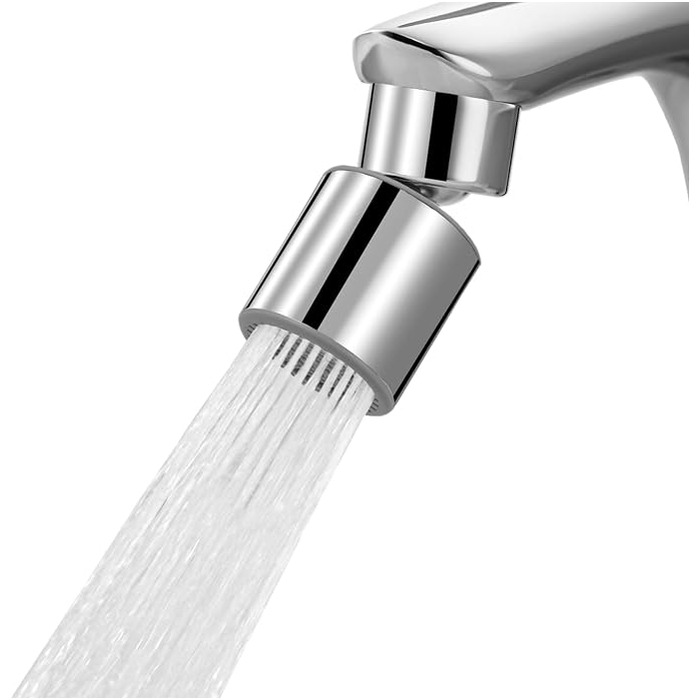
Hibbent chrome swivel faucet aerator
A chrome attachment listed with a 55/64-inch female connection and an included 15/16-inch male adapter, offered as a way to redirect the stream. These are listing claims rather than tested dimensions, so check the thread specification and pack contents against your own measurement before ordering.
- Role: Amazon consumer option
- 55/64-inch female connection
- Includes a 15/16-inch male adapter
- Redirects the stream, not an extension arm
- MOQ: Check current listing
Its role is changing outlet direction and offering stream or spray selection. It is not an articulated extension arm. Confirm the installed dimensions and flow rating for your chosen version; the listing title alone does not resolve those requirements. Do not transfer specifications from a similarly named finish or another listing in the brand’s range.
For an articulated option, apply the same standard: an identified current version, a dimensioned drawing, compatible adapters and a stated flow rating. If the title and description disagree about the number of joints or rotation, resolve the discrepancy with the seller before buying. A high review count cannot tell you which structure will arrive.
Read critical reviews for the exact version where possible. Look for repeated fit problems, connections that loosen during adjustment and changes in joint stiffness. Distinguish a documented defect from a purchaser ordering the wrong thread. Review totals are useful screening information, but may combine variants and do not prove that the attachment solves your particular reach problem.
Verify the result while the purchase can still be returned
Keep the original aerator, gasket and any model-specific key labeled together. Install the new attachment using its instructions, then inspect each connection for leaks at normal operating settings. Check again after moving the head through the positions you expect to use. Repeatedly tightening a leaking swivel joint is not a substitute for resolving an incorrect seal, damaged component or incompatible fitting.
Repeat the original task: wash your hands without contacting the basin, rinse the intended corner or fill the usual container. Check the counter and the space beneath the head afterward. A successful installation should pass the task that motivated the purchase; simply being able to screw the part onto the faucet is an incomplete result.
Try the normal resting position and the folded position several times. Confirm that another household member can operate the faucet and return the head to a sensible position. If the attachment needs frequent readjustment, blocks the drain control or brings the outlet uncomfortably close to the bowl, reassess its geometry while a return is still possible.
Retain the correct service instructions with the product details. Clean accessible parts using the method approved for that attachment and the faucet finish, and check whether removable screens or seals can be serviced separately. For a small aiming correction, a compatible compact aerator may be sufficient. Choose an articulated extender when the measured change in outlet position earns the space it occupies in your sink.
Hook this up to your favourite commenting platform — Giscus, Disqus, or your own.
Continue reading
Dishwasher Baskets vs Clips for Small Lids and Bottle Parts
A basket contains small pieces; a clip holds one in position. Decide which problem you actually have before buying either.

Felt vs Rubber Chair Pads for Vinyl Floors
Felt and rubber solve different problems on vinyl. Check the flooring maker's instructions, the movement you actually want, and the contact surface.
1.0 vs 1.5 GPM Bathroom Aerators: Which Flow Should You Choose?
Compare the two ratings on measured flow, rinse time and hot-water waiting rather than on the litre-per-minute number alone.