Do You Need a Cap Liner Insertion Machine?
A small-batch guide to manual, pre-cut and automatic cap lining
 Lena Schmidt
Disclosure: We may earn a commission if you purchase through links on this page, at no additional cost to you.
A bottle can have the right cap, the right liner and the right induction sealer—and still fail before sealing begins. If the liner is missing, upside down, off-centre, folded or contaminated inside the cap, the downstream machine cannot correct the preparation step. The practical buying question is not “how fast is the cap lining machine?” It is “which part of cap preparation is currently limiting my package, and what evidence would show that automation fixes it?”
This guide is for operators receiving unlined caps and separate liners or wads. It explains when hand insertion remains sensible, when a small automatic system starts to earn its footprint, and how to qualify a machine against the actual cap, liner and next process. It covers induction liners, pressure-sensitive liners, foam gaskets and similar inserts only as process components; material selection is a separate decision.
Scope boundary: this page selects and qualifies cap-liner insertion equipment. It does not choose the liner material itself, the induction sealer, or the final bottle capper.
The short answer
You probably do not need a cap liner insertion machine if lined caps are already available, the batch is small and irregular, and an operator can place the liner flat without slowing the rest of the line. You should investigate one when manual placement consumes a meaningful share of labor, creates repeated misalignment or contamination, or makes cap preparation the bottleneck between liner supply and capping.
| Your current situation | Most sensible first route | Why |
|---|---|---|
| Caps arrive pre-lined from a closure supplier | No separate inserter | You are paying for a process you already outsourced; qualify the supplied cap instead. |
| Small, changing batches with a few cap formats | Manual placement with a written check | Low setup cost and easy changeover; keep the acceptance rule visible. |
| One recurring cap/liner combination and manual placement is slowing the station | Single-head or compact automatic inserter | A fixed feed and insertion path can remove repetitive handling. |
| Many cap formats, strict hygiene or a continuous line | Automatic feeder, liner feed, detection and reject | The value is controlled preparation and traceability, not only nominal speed. |
There is no universal “caps per hour” point at which automation becomes correct. Compare labor, rejects, changeovers, space, maintenance and the cost of an incorrectly lined cap.
What a cap liner insertion machine actually does
A cap lining system prepares the closure before it is applied to the bottle. Depending on the design, it may orient and feed caps, feed pre-cut liners or unwind and punch liner material, place the insert, press or seat it, inspect for a missing or inverted piece, count the result and discharge the lined caps. Adeneli’s recent buyer explanation makes the same distinction: the machine handles cap and liner presentation, but it cannot make an incompatible liner fit a bottle finish.
The process is often called cap lining, cap wadding, liner insertion or gasket insertion. “Wadding” is common in supplier language and may refer to foam, foil laminate, paper, pressure-sensitive material or another insert. Ask the supplier to identify the actual material path and whether the liner arrives as pre-cut pieces, a reel, a stack or a hopper-ready component.
A machine that inserts an induction liner is not the same as an induction sealer. The first puts the liner into the closure; the second heats and bonds the liner to the bottle lip after capping. If a supplier combines both functions in one listing, split the quotation into the cap-preparation step, the capping step and the sealing step so that each acceptance test remains clear.
The first decision: buy lined caps, insert manually, or automate?
Buy lined caps when the preparation step is not your competitive problem
Pre-lined closures can be the cleanest route for a small brand that has limited formats and does not need to control liner placement itself. Ask how the supplier protects the lined caps, how the liner is retained during transport, and whether the liner construction matches your bottle finish and product. A lower machine price is not automatically cheaper than changing to a closure supplier that delivers a ready-to-run component.
Manual insertion is a process, not “doing nothing”
Manual work can be acceptable when the operator has a defined orientation, a clean work surface, a simple visual check and a batch record. The hidden cost appears when the operator must pick caps, pick liners, flip the liner, center it, press it in, remove rejects and keep the lined caps separate from unlined stock. Record the motion for a real batch; do not estimate labor from a short demonstration.
Automation earns consideration when it removes a repeatable failure
-
The same cap and liner are handled repeatedly, so a dedicated feed path can stay set for a meaningful run.
-
Operators report missing, inverted, folded or off-centre liners at the capping station.
-
Liner insertion is the slowest step, or it forces a second person to prepare caps in advance.
-
The product or environment makes open manual handling difficult to control.
-
You need a counted, rejectable stream of prepared caps for a downstream capper or sealer.
What must be specified before asking for a quote
1. Cap geometry and orientation
Send drawings or samples of the actual cap. Record outside diameter, height, skirt profile, thread or lug form, tamper band, dispensing insert and whether the cap must leave the machine in a particular orientation. A supplier’s “20–100 mm” range is not evidence that the bowl, chute and insertion tool will handle a short, tall, ribbed or child-resistant cap.
2. Liner construction and supply format
State whether the liner is pre-cut, reel-fed, die-cut, foam, pressure-sensitive, foil-laminated, paper-backed or a multi-layer induction structure. Ask whether the machine cuts the liner or only picks and inserts prepared pieces. A machine designed for reel stock can be a poor match for a cap program that changes between several pre-cut liner diameters.
3. The seating requirement
Define what “inserted” means. Is the liner simply retained inside the cap, pressed to a shoulder, glued, heat-tacked or seated against a specific land? Ask for an underside view of the finished cap. The liner must remain stable through cap handling and application; a cap that looks lined on the table may release the insert before it reaches the bottle.
4. Cap and liner inspection
Ask how the machine identifies a missing insert, upside-down liner, double liner, skewed liner or an empty cap. A camera, sensor, weight check or reject gate may be offered, but the supplier should explain what defect it can actually detect and how false rejects are handled. “Inspection included” is not a test method.
5. Changeover and cleaning
Request the change-part list, tool requirements, saved settings, clean-down steps and time for your two most common cap formats. If a cap feed bowl, chute or punch must be rebuilt for every size, the nominal range may be less useful than a narrower machine with a faster, documented changeover.
6. Utilities and service
Confirm voltage, air pressure and consumption, dust extraction if liner material is punched, floor or bench footprint, guarding, access for jam clearing, spare tooling and remote support. Ask for the exact model manual and nameplate. “PLC controlled” describes a control architecture; it does not establish that the liner is correctly placed.
Pre-cut liners versus reel-fed insertion
| Supply route | Useful when | Main risk to qualify |
|---|---|---|
| Pre-cut liners | Several liner materials or diameters; low-to-moderate recurring runs; you want to change material without a punching station. | Pick-and-place reliability, double picks, liner orientation and whether the stack or hopper presents pieces consistently. |
| Reel-fed and punched in the machine | One or a few repeatable liner specifications; the process benefits from continuous material handling. | Web tension, die wear, waste handling, liner diameter control and whether the punched piece matches the cap shoulder. |
| Manual placement | Samples, pilots, irregular orders or a cap supplier already provides a simple insertion aid. | Operator variation, contamination, hidden labor and poor separation of accepted and rejected caps. |
The right route follows the closure supply chain. Do not buy a reel-fed machine because a supplier advertises a higher speed if your liners are already delivered as pre-cut pieces, or if your business changes cap formats too often to keep the tooling productive.
A qualification trial that proves the machine is useful
Ask the supplier to run the exact cap and liner combination. A video of a similar cap can show that the mechanism moves, but it cannot prove retention, orientation or changeover on your closure.
| Trial step | What to check | Record |
|---|---|---|
| 1. Prepare samples | Use production cap, liner, liner lot and any adhesive or backing actually specified. | Cap drawing, liner construction, lot and quantity. |
| 2. Run the normal path | Include cap feeding, liner feeding, insertion, pressing, inspection, reject and discharge. | Machine model, tooling, settings and utilities. |
| 3. Inspect the underside | Check presence, orientation, centering, wrinkles, edge damage and seating depth. | Photos and a simple defect code. |
| 4. Challenge the process | Introduce realistic cap and liner variation, short pauses, restart and a changeover. | Missed insert, double insert, jam, false reject and recovery time. |
| 5. Follow the downstream path | Move lined caps through storage, cap feeding, capping and sealing as applicable. | Release rate, liner movement, seal result and rejects. |
| 6. Approve the exact setup | Approve only the tested cap, liner, tooling and settings. | Signed acceptance sheet and requalification trigger. |
The acceptance rule should distinguish a liner-presence result from a finished-package result. An inserter may place a liner consistently while the liner is still wrong for the bottle or product. Conversely, a correct liner can be damaged by a poor cap-feeding or capping step. Keep those decisions separate so a supplier cannot close an open problem with a vague “seal quality” statement.
How to read supplier numbers
| Listing language | Use it as | Do not treat it as |
|---|---|---|
| 20–100 mm cap range | A starting question about the supplier’s available tooling. | Proof that every cap in that range will feed, orient and seat correctly. |
| 30–80 or 50–120 caps/min | A model or seller claim under a defined setup, if one exists. | Staffed output after loading, inspection, reject handling and changeover. |
| Automatic detection | A feature to test with known defects. | Proof that inverted, double or off-centre liners will be rejected. |
| 1-year warranty / online support | A service term to clarify. | A substitute for spare tooling, response time or an acceptance clause. |
| Stainless steel / GMP design | A material or positioning claim. | A complete hygienic design or regulatory approval for your product. |
Supplier pages often combine product facts, marketing copy and generated descriptions. Save the exact variant, photos, model number and selected options with your request for quotation. If the seller cannot state whether the machine handles pre-cut pieces or reel stock, the candidate is not yet technically defined.
Sourcing candidates for a first comparison
The following Alibaba routes are screening candidates, not endorsements. This category is normally industrial equipment, so a direct Alibaba route is more relevant than a consumer marketplace listing. The visible rating, sold count and store signal are useful for triage, but they do not replace a cap-and-liner trial. Verify the live page, voltage, cap range, liner feed, tooling, price and shipping before ordering.
Candidate A — high-throughput plastic cap wadding machine
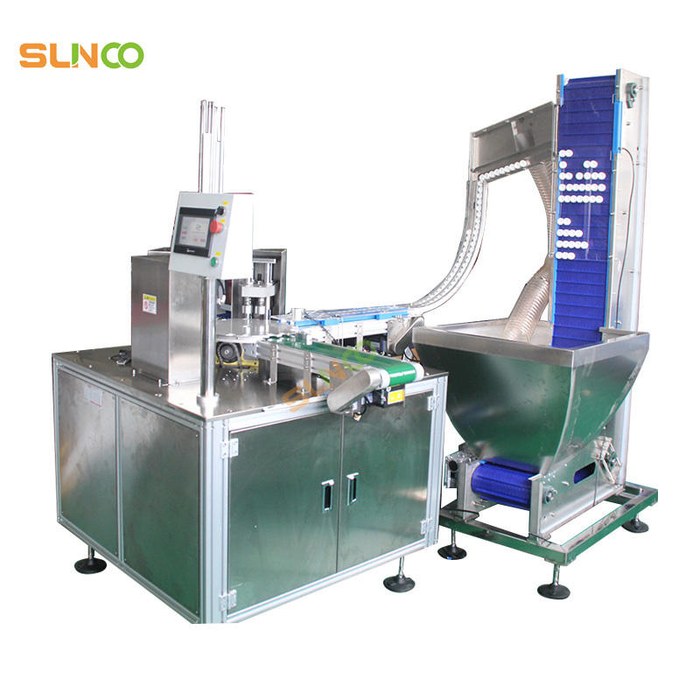
High-speed plastic cap wadding machine
A higher-throughput reference point rather than a small-batch default. The snapshot showed 5.0/5 from 6 product reviews and 33 sold, with 99.6% positive store reviews from 492 ratings, but the same snapshot showed a very low on-time dispatch signal. The listing described a 380 V automatic machine and a claimed 3,000–10,000 pieces per hour. Confirm exact cap and liner tooling, the real cycle definition, the reject system, installation, electrical supply, footprint and a package-specific factory acceptance test.
- Role: Alibaba sourcing candidate
- 380 V automatic format, claimed 3,000–10,000 pieces/hour
- On-time dispatch signal was low in the same snapshot
- Tooling, reject system and FAT must be specified in writing
- MOQ: Check current listing
Candidate B — aluminium cap liner insert machine
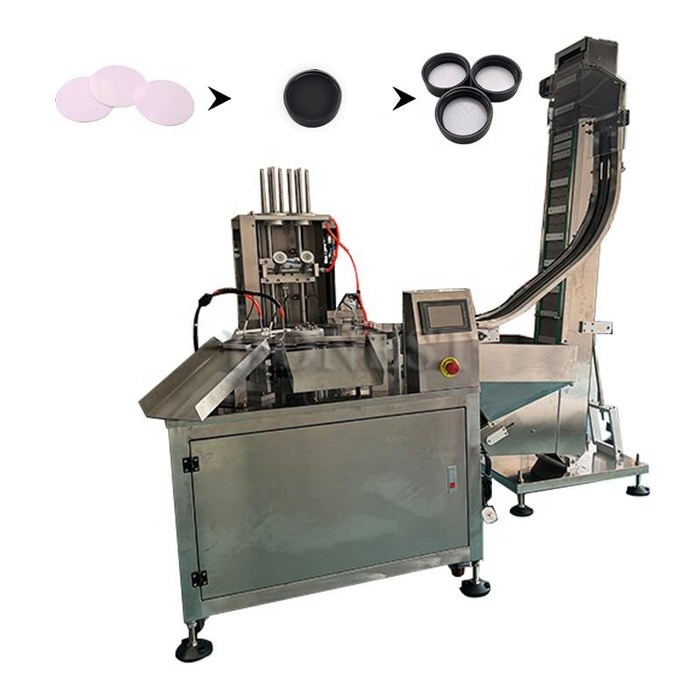
Factory-price aluminium cap liner insert machine
A lower-output format contrast for pre-cut liner insertion. The snapshot stated MOQ 1 set, 220/380 V options, roughly 30–40 pieces per minute, 300 kg and a one-year warranty, with no meaningful product-review signal visible. Treat it as a format comparison until the seller supplies model drawings, video, a tooling list, air requirements and test evidence.
- Role: Alibaba sourcing candidate
- Lower-output format, roughly 30–40 pieces per minute
- No meaningful product-review signal in the snapshot
- Use as a format comparison until drawings and video arrive
- MOQ: MOQ 1 set
RFQ checklist for a cap liner inserter
-
Cap drawings or samples: diameter, height, skirt, thread/closure type and orientation requirement
-
Liner construction, thickness, diameter, supply format and whether the liner is single- or multi-layer
-
Pre-cut or reel-fed operation; punching, gluing, pressing and scrap handling requirements
-
What defects are detected: missing, inverted, double, skewed, damaged or wrong-size liner
-
Exact change parts, tooling, saved recipes and changeover steps for the two main cap formats
-
Voltage, air pressure/consumption, footprint, guarding, dust control and jam-clearing access
-
Product-specific sample video and a written factory acceptance test with defect samples
-
Spare punch, pick head, sensor, bowl/chute and reject-gate pricing; warranty and response time
-
How lined caps are counted, packed and protected before the capping/sealing station
A useful RFQ does not ask only for “price and speed.” It forces the supplier to identify the closure, liner path, detection boundary and handoff to the next operation. Those are the details that determine whether a machine remains useful after the first delivery.
When not to buy one
-
Your closure supplier can deliver the correct lined caps with reliable retention and a reasonable lead time.
-
Cap formats change so frequently that tooling would spend more time being changed than running.
-
The real bottleneck is filling, capping, labeling or inspection, not liner placement.
-
The machine requires utilities, floor space or maintenance support your site cannot provide.
-
The supplier will not run your actual cap and liner, or will not define what a rejected liner looks like.
Manual insertion is not a failure if it is controlled, economical and honest about its limits. A machine becomes valuable when it removes a known, recurring variation and can prove that the improvement survives the downstream process.
References and evidence notes
Adeneli Packaging — What Is a Cap Liner Insertion Machine, and When Do I Need One?
ZONESUN — ZS-WIM02 automatic cap liner insertion machine (official product page).
ZONESUN — automatic plastic bottle induction cap lining machine.
Pres-On — cap liner insertion and extraction overview.
Hook this up to your favourite commenting platform — Giscus, Disqus, or your own.
Continue reading
Custom Printed Shrink Bands: Artwork, Minimums & Proofing for Small Brands
Printing on the band buys a message, not tamper evidence. Decide whether you need it, then walk the approval chain from unprinted fit test to a shrunk sample on your own container.
Shrink Bands for Mason Jars: Size, Fit & Tamper-Evident Setup
How to size a band for regular-mouth and wide-mouth Mason jars, decide whether it goes over the screw band, and test the setup before you buy in volume.
How to Choose a Handheld Induction Sealer for Small Batch Bottles
Match the cap, liner, output and process before you buy