How to Choose a Handheld Induction Sealer for Small Batch Bottles
Match the cap, liner, output and process before you buy
 Lena Schmidt

Disclosure: We may earn a commission if you purchase through links on this page, at no additional cost to you.
A handheld induction sealer is attractive when a small production run does not justify a conveyor line. It is also easy to buy the wrong one: the listing may promise a wide cap range, a large wattage number and “universal” compatibility while saying little about the liner, the bottle neck, the operating window or the operator’s actual work rate.
The useful buying question is narrower: can this exact sealer make a repeatable seal on your filled bottle, with your cap and liner, at the pace your operator can sustain? The answer comes from package fit and a controlled trial—not from wattage alone.
This guide covers equipment selection for manual, small-batch induction sealing. It is separate from our liner-material, size and troubleshooting pages, which answer different package questions.
The short answer
Choose a handheld unit when you are sealing one container at a time, can keep the cap and bottle aligned, and have enough time to verify the seal as you go. Before comparing brands, lock down five things: the liner and cap construction, the bottle-neck diameter and material, the head’s usable range, adjustable power and exposure time, and the machine’s duty and electrical requirements.
| If your situation looks like this | Start with this format | Why |
|---|---|---|
| Samples, pilot batches, seasonal or low-volume runs | Handheld | Lowest process commitment; the operator can inspect every piece. |
| Same bottle and cap, regular batches, moderate manual output | Handheld or benchtop | Choose by repeatability and operator fatigue, not by the lowest price. |
| Several hundred units per shift, fixed line layout or little tolerance for pauses | Benchtop or semi-automatic | A fixture, indexed position or conveyor can control alignment and pace. |
| Multiple sizes, continuous production or many operators | Automatic/conveyor system | The process needs controlled presentation, cooling and line integration. |
The boundaries above are workflow guidance, not a universal units-per-hour specification. Actual throughput depends on the package, operator, inspection method and machine instructions.
What the machine is actually doing
Induction sealing is non-contact heating. The sealer creates an electromagnetic field; a conductive layer in the liner heats, and the sealing layer bonds to the bottle lip while the cap holds the liner in contact. Enercon describes the result as a bond formed under cap pressure, not as a seal created by the machine head physically pressing the bottle.
That mechanism explains why a sealer cannot compensate for every packaging mismatch. The liner must be intended for the bottle material and product, the cap must hold it flat, the neck must be clean and reasonably uniform, and the field must be presented at the distance and alignment the equipment expects. Enercon identifies field strength, liner path or alignment, and exposure time as separate variables; increasing power is not a substitute for fixing the other two.
Plastic screw caps are generally the easiest starting point. Glass can be sealed, but the liner, finish and process need more careful qualification; metal closures may create a different problem altogether. Treat “works with plastic and glass” in a marketplace title as a lead for a sample test, not as a package approval.
First decide whether handheld is the right format
Handheld is a process choice, not just a small machine
With a handheld head, the operator presents each capped bottle to the sealing zone. That gives flexibility and a low entry cost, but it also makes alignment, dwell time and cap torque part of the operator’s job. If the bottle is held at a slightly different height each time, the machine may be perfectly healthy while the finished seal varies.
A benchtop fixture can be a better upgrade than a more powerful handheld unit. It can give the bottle a repeatable position, reduce wrist strain and make training easier. A conveyor or automatic system becomes relevant when the work is no longer limited by the sealer’s energy but by handling, inspection and the number of times a person can repeat the motion consistently.
A practical format screen
-
Choose handheld when your bottle and cap are stable, the operator can keep a repeatable presentation, and the batch is small enough for one-at-a-time checking.
-
Move toward a fixture when operators are compensating for bottle height, head alignment or inconsistent dwell by feel.
-
Ask for a benchtop or automatic quotation when the same package is run for long periods, several people share the station, or a missed seal has a costly downstream consequence.
The five specifications that matter
1. The package comes before the machine
Write down the bottle material, neck or land diameter, cap type, liner construction, product, fill temperature and whether the bottle is round, oval or irregular. A “20–100 mm” range only tells you the seller has chosen a nominal range; it does not prove that your specific liner will be heated evenly or that the head will be comfortable and stable at the smallest size.
Ask for the liner manufacturer or construction, not only “foil seal.” A one-piece liner, a two-piece liner and a pressure-sensitive layer can behave differently. For cosmetics, oils, sauces and powders, product compatibility is part of the seal decision: a leak-free bond on an empty bottle does not establish shelf-life performance with the filled product.
2. Head size and usable geometry
Check the actual sealing head included in the quote, its working diameter and the clearance around the cap. Enercon’s Super Seal Jr, for example, lists a standard head up to 83 mm and an optional head up to 120 mm; that is a model-specific configuration, not a universal handheld rule.
A wide range can hide a usability trade-off. A large head may be awkward on a small cap, while a small head may not cover the liner’s sealing area. Ask for a drawing or a photo showing the head over your bottle, and confirm whether a quoted diameter is the cap outside diameter, liner diameter or a recommended sealing diameter.
3. Adjustable power and exposure time
Look for independent control of power and time, a repeatable display or setting, and instructions that explain how to establish an operating window. “500 W” describes a nominal electrical rating; it does not tell you the energy delivered to your package or whether the machine can be tuned gently enough for a thin liner.
Enercon’s operating-window method increases power in small steps until the liner shows burning or wrinkling, then backs down; it also identifies a lower boundary by reducing power and building back up. This is a manufacturer-specific procedure, not a universal percentage recipe. The transferable idea is to find both a high limit and a low limit on production-equivalent samples, then run inside that window rather than copying a single seller-supplied time.
4. Duty, cooling and operator ergonomics
Ask how long the unit may run before a cooling pause, whether a fan is always on, and what the manual says about consecutive seals. A short listing claim such as “50 pieces per minute” is not a promise that one person can fill, cap, position, seal and inspect 50 production bottles per minute. It may describe a machine cycle under a different setup.
Weight, cable reach, handle shape, trigger or control layout and head visibility become real costs after the first few dozen repetitions. If your bottle is tall or unstable, the operator may need a bench support even when the seller calls the unit handheld. Record the motion in the sample trial; a seal that passes while the operator is concentrating is not enough if the station is uncomfortable.
5. Voltage, protection and service evidence
Confirm the destination voltage, frequency, plug, fuse or protection requirements and whether the quoted version is 110 V or 220/240 V. Enercon lists separate 120 VAC 60 Hz and 240 VAC 50 Hz versions for the Super Seal Jr. Do not infer that a similarly named marketplace unit has the same electrical configuration.
Overheat, over-current and over-voltage protection are useful safety features, but they are not proof of seal quality. Ask for the manual, a wiring or nameplate photo, the replacement-head policy, warranty terms and a video of the exact model sealing your cap. “CE” or “export quality” should be treated as a request for the applicable declaration and model identity, not as a substitute for package trials.
A qualification test that answers the buying question
The goal is not to make one attractive seal. It is to learn whether the machine has a repeatable operating window on the package you intend to sell.
| Step | What to do | Record |
|---|---|---|
| 1. Freeze the package | Use the production bottle, cap, liner, product fill and intended fill level. Do not qualify on an empty jar if the real product changes contact or handling. | Model, liner, product, fill and cap torque method. |
| 2. Check the fit | Confirm the liner sits flat, the neck is clean and the head covers the intended area without touching the cap. | Head, gap/alignment guidance and visible fit. |
| 3. Set the process | Use the supplier’s starting instructions, then change one variable at a time. Keep cap torque and bottle presentation consistent. | Power, time, operator, position and any cooling pause. |
| 4. Find the window | Make a small series at a lower setting, a middle setting and a higher setting. Stop if the liner burns, wrinkles or the package is damaged. | Seal appearance and failure mode at each setting. |
| 5. Repeat and inspect | Run enough pieces to expose handling variation. Cool them before opening or leak checks where the liner instructions require it. | Peel/opening behavior, leaks, channeling, wrinkles and rejects. |
| 6. Approve narrowly | Approve the exact bottle-cap-liner-product combination and operating range. Requalify after a material, supplier or closure change. | Signed setup sheet, sample photos and change trigger. |
Enercon’s manual tells operators to check the first containers and adjust torque, power and time for a firm seal without scorching. That sequence is useful because it keeps the machine setting connected to the closure and cap pressure. It does not establish a universal “good” time for every bottle.
For liquid products, add a practical leak or inversion check appropriate to the package and product. For powders, look for fine product in the seal path. For oily or aggressive formulas, include the relevant storage or compatibility evaluation. The acceptance rule should be written before the test, not invented after a convenient result.
How to read a marketplace listing without being misled
| Listing phrase | What it tells you | What it does not tell you |
|---|---|---|
| 20–100 mm | A stated nominal range for a version of the machine. | That your liner is covered evenly or that every cap in the range is comfortable to seal. |
| 500 W / 800 W / 1,200 W | A seller’s stated power or model rating. | How much usable energy reaches your liner, or whether more power is safer. |
| 5–50 pieces per minute | A claimed cycle or seller estimate. | A staffed, inspected output for your bottle, cap and operator. |
| Universal plastic and glass | A broad compatibility claim. | Evidence for your material, finish, liner and product combination. |
| Overheat protection | A stated protection feature. | A successful seal, service quality or regulatory approval. |
| High rating / many reviews | A marketplace signal worth investigating. | Reviews on the exact variant, long-run duty or your application. |
Treat the supplier page as a candidate record. Capture the exact product ID, voltage, head option, manual, quoted accessories, warranty and test video. If the page has multiple variants, take a screenshot of the selected option before asking for a quote. This prevents a low-priced 110 V listing or a small head from silently becoming the delivered version.
Sourcing candidates for a first comparison
The links below are included as sourcing routes, not as rankings or approvals. Product information and marketplace signals can change; verify the live variant, price, voltage, head, warranty and shipping terms before purchase. The Amazon route is shown as a raw product URL because no confirmed Associates tag was supplied for this article.
Candidate A — 20–100 mm handheld induction sealer
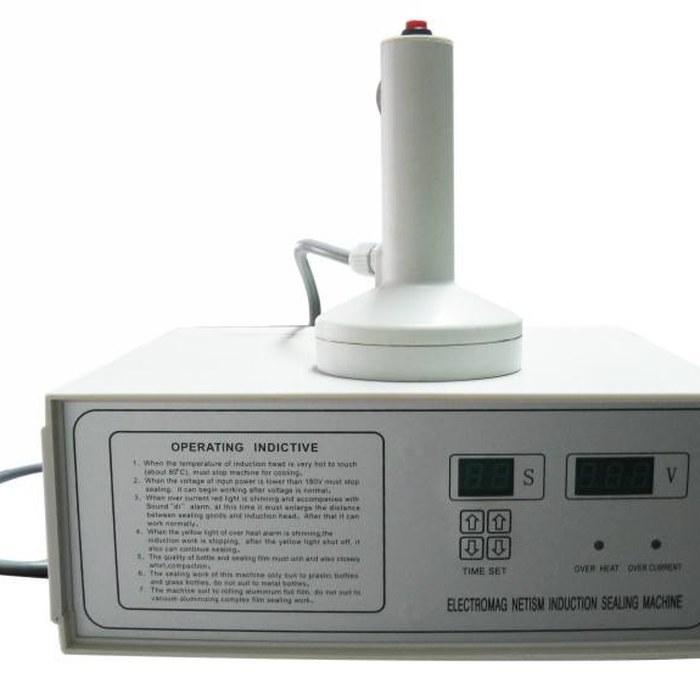
Handheld induction sealer, 20–100 mm range, 500 W
A handheld sealer route for sealing one capped container at a time. The listing snapshot showed a 20–100 mm range, 500 W, MOQ 1 and 110/220 V options, with a visible price around $90–$100. Store-level reviews are not product-level evidence, so ask for the exact model drawing, power label, the head that is included, the manual, a sample video and a package trial.
- Role: Alibaba sourcing candidate
- One container at a time, adjustable power and time
- Confirm the included head, power label and voltage version
- Request a sealing trial on your own bottle, cap and liner
- MOQ: MOQ 1
Candidate B — DL-800B handheld induction sealer
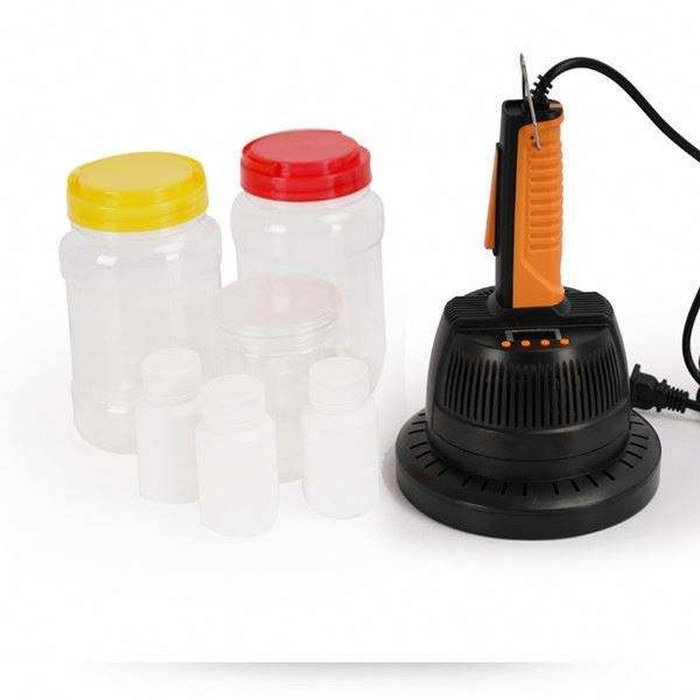
DL-800B handheld induction sealer
A second handheld route worth comparing on head geometry and controls. The search snapshot showed roughly $70–$90, MOQ 1 and 4.8/5 from 118 reviews, but it did not establish a complete seller profile or a package-specific test. Request the current listing, the model identity, the included head, the power rating, warranty terms and test evidence.
- Role: Alibaba sourcing candidate
- Compare head geometry and control layout against Candidate A
- Snapshot did not establish a package-specific trial
- Ask for the current listing and model identity in writing
- MOQ: MOQ 1
Hook this up to your favourite commenting platform — Giscus, Disqus, or your own.
Continue reading
Custom Printed Shrink Bands: Artwork, Minimums & Proofing for Small Brands
Printing on the band buys a message, not tamper evidence. Decide whether you need it, then walk the approval chain from unprinted fit test to a shrunk sample on your own container.
Shrink Bands for Mason Jars: Size, Fit & Tamper-Evident Setup
How to size a band for regular-mouth and wide-mouth Mason jars, decide whether it goes over the screw band, and test the setup before you buy in volume.
Do You Need a Cap Liner Insertion Machine?
A small-batch guide to manual, pre-cut and automatic cap lining