Does a Fertigation Stock Tank Need an Agitator
How to choose mechanical mixing recirculation or air agitation
 Lena Schmidt
Disclosure: We may earn a commission if you purchase through links on this page, at no additional cost to you.
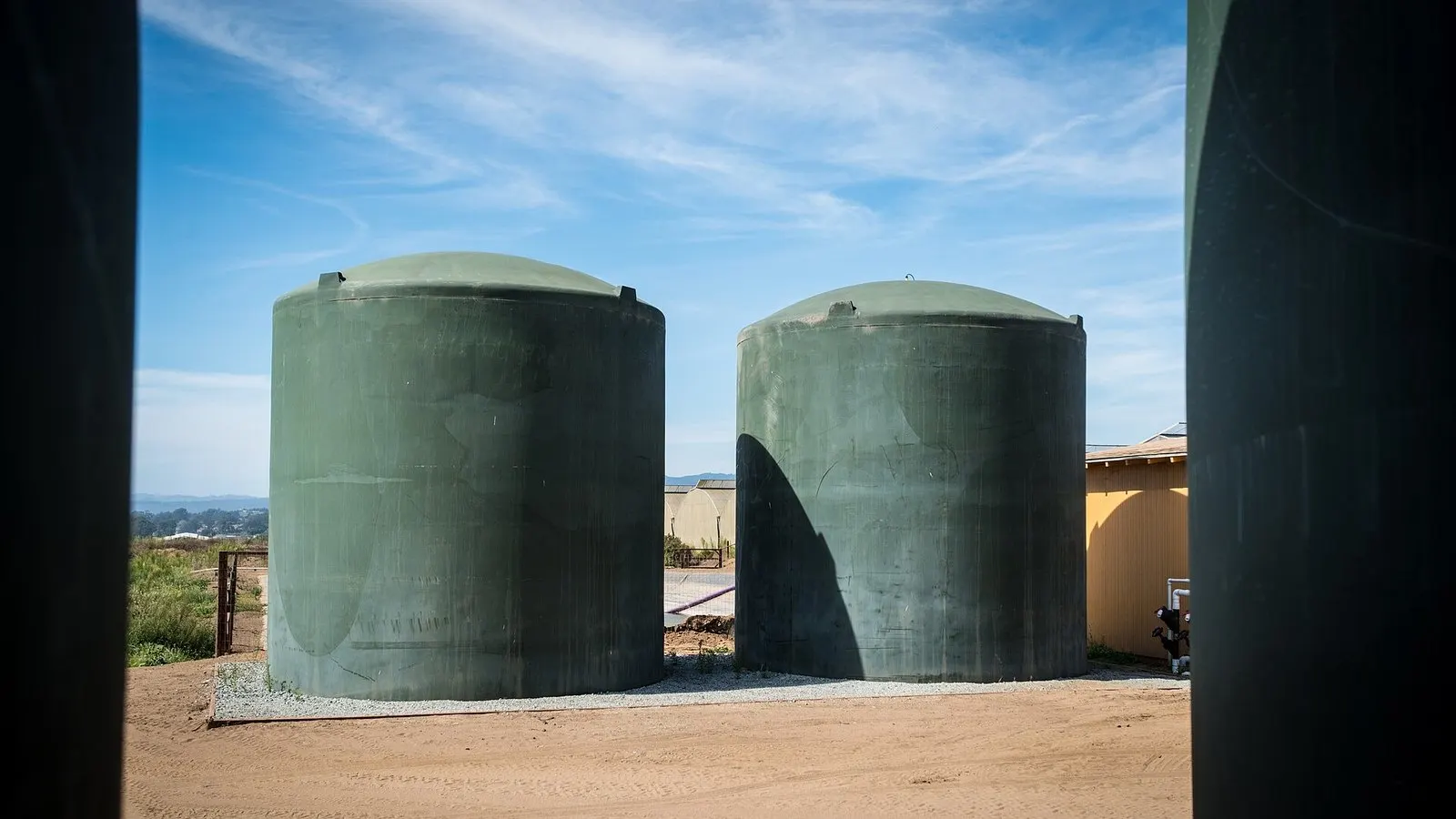
Not every fertigation stock tank needs a motorized agitator. A clear, fully dissolved liquid concentrate that is used promptly may remain uniform without continuous mixing. A large tank, a dry fertilizer, a formulation close to its solubility limit, a long hold time or a low intake point changes the decision. In those cases, the question is not whether the liquid looks calm; it is whether a sample taken at the injector intake has the same composition as the batch recipe.
This guide gives a practical selection method for greenhouse, nursery and field fertigation buyers. It separates three jobs that are often confused: dissolving fertilizer, keeping a solution uniform during storage and moving solution to the injector. Tank-capacity sizing and A/B channel architecture are separate decisions and are outside the scope of this guide.
The short answer
Use no agitator only when the fertilizer manufacturer confirms that the selected concentration remains fully dissolved and the batch is mixed immediately before a short injection event. Use mechanical agitation or recirculation when solids settle, the tank is large, the stock solution is held between irrigation events or the injector must draw from a consistent concentration. Use air agitation only when the formulation and tank materials tolerate aeration and the supplier can show that the bubbles mix the full working volume rather than only the surface.
University of Arkansas guidance says a large stock tank should be mixed well with an agitator before use, while North Carolina Extension notes that a mechanical screw or recirculation pump can help dissolve fertilizer. Those statements support a duty decision, not a universal requirement for every tank. [E01][E02]
Start with the fertilizer and the hold time
| Operating condition | Agitator decision | Reason to document |
|---|---|---|
| Fully dissolved liquid concentrate used soon after preparation | May be unnecessary after a deliberate pre-use mix | Record formulation, storage time and visual or EC uniformity |
| Dry fertilizer or visible settling | Required during dissolution and usually during withdrawal | Specify mixing method, intake height, drain and filter |
| Near maximum solubility | Usually required; reduce concentration if solids remain | Obtain solubility basis, water temperature and batch-test result |
| Large tank or several hours between batches | Use agitation or recirculation before and during draw | Prevent a representative top layer from masking a weak or concentrated bottom layer |
| A and B concentrates | Do not use agitation to justify combining incompatible concentrates | Keep channel assignment and compatibility evidence separate |
A mixer cannot repair a compatibility error, raise the solubility limit or turn an open storage tank into a pressure vessel. If a jar test produces crystals, haze or a persistent layer, resolve the chemistry and water-quality question before specifying a larger motor. [E03][E04]
Three ways to keep a stock solution uniform
Mechanical agitator
A shaft and impeller directly disturb the tank. This is the clearest option when the tank is tall, the solution contains suspended material or the buyer needs mixing during fertilizer addition. The design still depends on impeller position, shaft length, baffles, speed and the shape of the tank. A fast surface vortex can leave the lower cone almost untouched and can entrain air into the suction line.
For fertilizer stock, ask for a low-shear impeller and a mixing pattern that reaches the bottom working volume. The supplier should state whether the motor is rated for continuous duty, which wetted parts contact the solution and how the seal is protected from fertilizer salts.
Recirculation pump
A pump draws from a lower outlet and returns solution through a pipe or nozzle. It can be easier to remove for service than a shaft-mounted motor and can also transfer stock solution to a day tank. Its weakness is hydraulic: a return line pointed at the surface may only create a whirlpool, while a return nozzle that does not sweep the lower volume leaves dead zones.
Specify pump flow at the actual head, not only the nameplate flow. Ask where the suction strainer sits, whether the pump tolerates undissolved particles, how the return is aimed and whether the recirculation loop can be isolated from the injector line. Recirculation is a mixing method; it is not automatically a metering pump.
Air agitation
Air or compressed gas creates bubbles through a manifold or sparger. It has no rotating shaft in the tank and can be useful where mechanical seals are undesirable. It also introduces oxygen and foam, may accelerate oxidation or biological change in some formulations and can make a stable EC reading difficult while bubbles are present.
Use air only after the fertilizer supplier confirms that aeration is acceptable. The RFQ should state compressor pressure, air flow, sparger material, noise limits, condensate handling and whether the tank remains closed and protected from light. Do not substitute “air bubbler” for a mixing test.
When no agitator is the better choice
A mixer adds cost, power, seals and cleaning points. If the stock is a stable liquid concentrate, is opaque-protected, is consumed within a defined period and passes a top-to-bottom sample test, a passive tank can be the simpler and safer design. The test should be repeated after the longest planned hold time and at the lowest normal tank level.
The absence of a motor does not mean the tank is unmanaged. The operator still needs a marked final volume, a controlled mixing sequence, a raised suction intake, a cleanable strainer and a rule for rejecting cloudy or settled stock. University of Georgia guidance recommends mixing a large stock solution well before use and uses input/output or EC checks to separate a stock-mixing error from an injector error. [E05]
Match the symptom to the mixing failure
| Observed symptom | What it suggests | Next action |
|---|---|---|
| Clear liquid at the top and solids at the bottom | Incomplete dissolution or settling | Stop the draw, sample the lower zone safely and check solubility and water temperature |
| EC changes while the injector runs at a steady ratio | Nonuniform stock or a changing intake layer | Run the agitator or recirculation loop, then repeat timed tank and downstream samples |
| Motor creates a deep vortex but the bottom remains dirty | Surface circulation without bottom turnover | Change impeller depth, return-nozzle direction or baffle arrangement |
| Pump loses prime or the strainer plugs | Intake too low or undissolved material entering the line | Raise the intake, flush the tank and verify the pre-injection filter |
| Foam appears after air or high-speed mixing | Air entrainment or formulation sensitivity | Reduce air or speed and obtain the fertilizer maker’s aeration limit |
| A batch is uniform at preparation but not after overnight storage | Temperature shift, precipitation, evaporation or biological growth | Record temperature, tank level, light exposure and appearance before restart |
Do not diagnose all concentration variation as injector failure. If the injector passes an input/output test but the stock sample changes from top to bottom, the tank is the first control point. If the tank is uniform but the final irrigation sample is wrong, move to injector ratio, pressure and travel-time checks covered by the earlier articles.
A field acceptance test for a stock-tank mixer
-
Prepare a batch by weight and final volume. Use the fertilizer label or manufacturer recipe, and record source-water EC, temperature and the exact formulation.
-
Mix using the proposed method. For dry material, add fertilizer gradually to part of the water while mixing, then top up after dissolution. Do not add a bag to a full tank and assume the final volume is unchanged. [E04]
-
Mark three sampling heights. After the stated mixing time, take top, middle and lower samples without disturbing the tank between samples. Measure EC only after bubbles have settled, and use a laboratory or formulation-specific check where EC is not a reliable proxy.
-
Start the injector at normal flow. Record stock-tank level, draw rate, tank temperature and near-injection or far-end concentration at the beginning, middle and end of the event.
-
Repeat after the longest planned idle period and at the low operating level. Approve the mixer only if the supplier’s stated uniformity or the buyer’s concentration tolerance is met at both conditions.
-
Drain and inspect. The tank must have a practical clean-out route for sediment, a serviceable suction strainer and a way to flush the recirculation loop without sending concentrated residue into the crop line. UCANR places filtration between the stock tank and injection point when foreign material or undissolved fractions are possible. [E03]
Choose the method by duty
| Buyer duty | Preferred starting point | RFQ evidence |
|---|---|---|
| Small, clear liquid concentrate used immediately | Passive tank with pre-use mixing | Maximum hold time, storage temperature and uniformity check |
| Dry fertilizer added in batches | Mechanical agitator or recirculation with bottom reach | Mixing time, impeller or return geometry, drain and clean-out |
| Stock held for days with periodic dosing | Recirculation or slow mechanical agitation | Continuous-duty rating, turnover method and low-level response |
| No electrical power but compressed air is available | Air agitation, if chemistry permits | Air flow, sparger design, foam control and corrosion compatibility |
| Tank also transfers material to a day tank | Recirculation pump with separate transfer path | Flow at head, isolation valves, strainer and non-metering disclaimer |
| Concentrated A/B nutrient system | Separate tanks with independent mixing as required | Channel-specific recipe, materials, interlocks and no cross-return path |
For a quotation, describe the working volume rather than only the nominal tank volume. State the minimum liquid level at which the intake must remain submerged, the maximum solids loading, the expected batch temperature and whether the mixer must operate during injector draw. These details determine whether a low-cost agitator is a real solution or only a surface-motion accessory.
RFQ questions that reveal an underspecified mixer
Ask the supplier to provide a dimensional drawing showing tank diameter, liquid height, impeller diameter, shaft length, return-nozzle location and suction point. Request the recommended mixing time for your fertilizer formulation, the motor duty class, speed control range, power supply, wetted materials, seal type, corrosion allowance and spare-parts list.
For a recirculation option, request pump curves at the actual elevation and pipe length, not only a free-flow number. For air, request the compressor operating point, sparger material and a foam or aeration limitation. For every option, ask how the supplier verifies concentration uniformity and whether the test uses your fertilizer, water and working volume.
The answer “the tank has an agitator” is not a performance specification. Mixing, circulation and transfer are related but different duties; a transfer pump may empty the tank efficiently while leaving a concentration gradient behind.
Sourcing candidates for technical follow up
The following Alibaba listings are inquiry routes, not independent approvals. Each listing link was checked to confirm it reaches the matching Alibaba product page. This confirms destination identity only; seller authorization, exact delivered variant, stock, shipping and field performance remain separate checks.
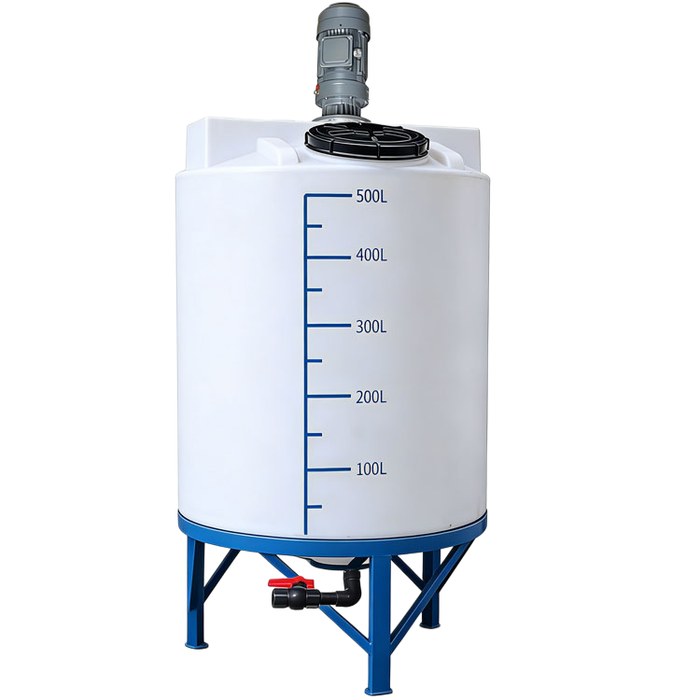
Sourcing Candidate A — 1500 L plastic tank with agitator
1500 L plastic mixing tank with agitator
A rotational-moulded plastic mixing tank route for liquid and fertilizer duty. The reviewed page shows a 1500 L LLDPE tank with a stainless-steel shaft and blade, a 1.5 kW motor and a cone-bottom design; ask for wall thickness, working volume, impeller drawing and a bottom-turnover test.
- Role: Alibaba sourcing candidate
- LLDPE tank with stainless-steel shaft and blade
- Cone-bottom design for drainage
- Request wall thickness and bottom-turnover test
- MOQ: Check current listing
Marketplace observations: the listing is a rotational plastic mixing tank for liquid and fertilizer applications. The reviewed page displays a 1500 L capacity, LLDPE tank with stainless-steel shaft and blade, 1.5 kW motor, 20–130 rpm range, cone-bottom design, 220/380 V options and a 9-year Alibaba supplier signal with 64 store reviews. These are supplier/platform fields, not independent performance evidence. Ask for the actual tank wall thickness, liquid working volume, impeller drawing, bottom-turnover test, seal material and delivered voltage before approval.
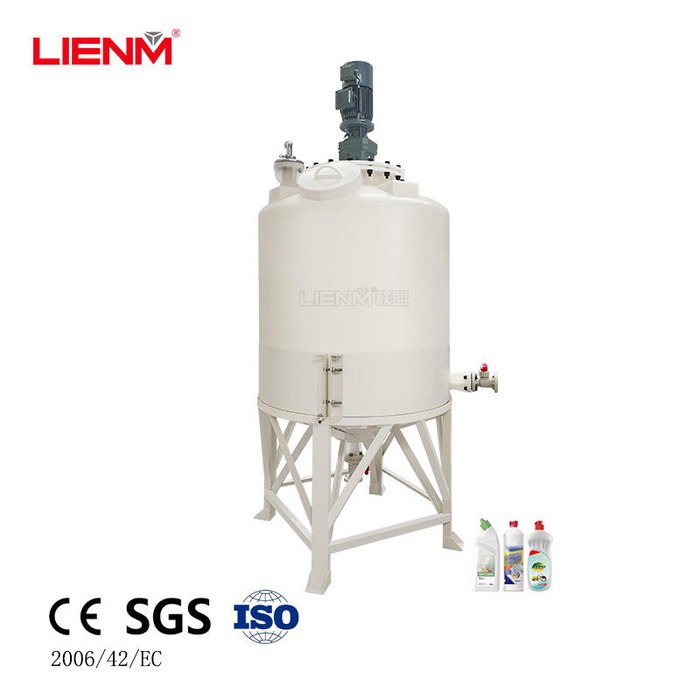
Sourcing Candidate B — 1000 L HDPE liquid-fertilizer mixer
1000 L HDPE agitator mixer for liquid fertilizer
A 1000 L HDPE tank-and-agitator route for liquid fertilizer. Ask for the tank wall specification, chemical compatibility, impeller geometry, motor voltage, bottom-drain arrangement, working temperature and a mixing test with your chosen fertilizer.
- Role: Alibaba sourcing candidate
- Tank-and-agitator role, not pressure-rated
- Confirm wall spec, impeller geometry and motor voltage
- Request a mixing test with your fertilizer
- MOQ: Check current listing
Marketplace observations: the listing is presented as a 1000 L HDPE agitator mixer for liquid fertilizer; the reviewed search result shows 16 store reviews and a 9-year Alibaba platform signal. The product page supports a tank-and-agitator role, but the reviewed evidence does not establish a fertigation-specific mixing curve, working volume or exact impeller configuration. Request those documents, plus polymer grade, temperature limit, motor duty and drain details. The platform-age and review fields are supplier signals, not proof of this exact configuration.
These candidates are deliberately not ranked. Candidate A provides richer visible geometry and motor fields; Candidate B is positioned more directly around liquid fertilizer but has less accessible technical detail in the reviewed result. Select by the acceptance test and the fertilizer formulation, not by the larger motor or marketplace language.
Questions buyers commonly ask
Can I use a submersible pump as an agitator
Sometimes, but only if the pump and return path create full-volume turnover without pulling settled solids into the injector. A pump that simply circulates from the bottom to the surface may produce a visible whirlpool while leaving corners or a cone dead. Treat it as a mixing system only after top, middle and lower samples agree.
Should the mixer run continuously
There is no universal run time. Continuous mixing may be unnecessary for a stable, fully dissolved liquid and can increase heat, foam or wear. Dry fertilizer and settling formulations need mixing during dissolution and normally before or during withdrawal. Set the duty from the fertilizer supplier’s stability information and the buyer’s acceptance test.
Does an agitator prevent precipitation
No. It can keep some solids suspended, but it cannot make incompatible salts compatible or exceed documented solubility. If precipitation appears, stop the system, isolate the formulation question and use the A/B architecture or a more dilute recipe where the evidence supports it.
Can I place the suction tube on the tank bottom
Do not assume that is safe. Arkansas guidance places the intake strainer and suction tube above the tank bottom to avoid drawing undissolved fertilizer salts. The exact height depends on the formulation and tank geometry, so state it in the drawing and verify it during commissioning. [E01]
References
- University of Arkansas Cooperative Extension, “Irrigation Systems and Water Quality.” Source
- North Carolina State Extension, “Plasticulture for Commercial Vegetables.” Source
- UC ANR, “Chemigation Injection Devices.” Source
- University of Georgia CAES, “Drip Chemigation: Injecting Fertilizer, Acid and Chlorine,” B1130. Source
- University of Georgia CAES, “Fertilizer Injectors: Selection, Maintenance and Calibration,” B1237. Source
- NSW Department of Primary Industries and Regional Development, “Horticultural fertigation — techniques, equipment and management.” Source
- ICL Growing Solutions, “How to get the most from your water-soluble fertilisers.” Source
- ITC Dosing Pumps, “The efficiency of agitation in fertigation.” Source
- Current Reddit discussions were used only to identify recurring operator language around settling, air mixing and storage; they were not treated as engineering evidence.
- Marketplace product fields are attributed to Alibaba listings and remain subject to RFQ, documentation and delivered-variant checks.
Hook this up to your favourite commenting platform — Giscus, Disqus, or your own.
Continue reading

Cotton Bag, Vacuum Bag or Plastic Bin for Cashmere?
A practical storage plan for moth prevention moisture control and small batch sourcing

Should You Use a Sweater Comb or Fabric Shaver on Wool and Cashmere?
A practical decision guide for removing pills without cutting away useful fibers.

How to Wash a Wool Sweater Without Shrinking It
A care-label decision guide for washing, drying and buying the right support tools.