How to Choose a Small-Batch Bottle Rinser
Air, water, or manual: match the cleaning job to the bottle and the next process
 Lena Schmidt
Disclosure: We may earn a commission if you purchase through links on this page, at no additional cost to you.
A bottle rinser is easy to misunderstand. A supplier may call a machine a washer, rinser, sanitizer, air cleaner or dust remover, while the real process may only blow loose particles from a new bottle—or may use water and a contact time that leaves you with a drying problem. The first decision is not the number of rinse heads. It is what must be removed, what must remain on the bottle, and what happens between rinsing and filling.
This guide is for small-batch food, beverage, cosmetic, chemical and laboratory packaging operations preparing empty bottles or jars before filling. It separates air rinsing, water rinsing, manual rinsing and true washing; then gives a sample-trial method for checking bottle support, contamination removal, moisture control and handoff to the filler.
Scope boundary: this guide selects a pre-filling bottle-rinsing method. It does not validate sterility, replace a cleaning validation program, or decide the product’s final sanitation requirements.
The short answer
Choose an air rinser when the main problem is loose dust or particles inside clean, dry containers and the process must stay dry. Choose a water or solution rinser when the bottle needs a wet rinse, but plan the drain, treatment, water quality and drying step as part of the same system. Keep manual rinsing when batches are irregular, the bottle set changes often, or a controlled operator method is still faster and easier to verify than installing a machine.
| Your actual bottle job | Start with | Reason |
|---|---|---|
| New, dry bottles with loose dust or static attraction | Filtered air or ionized-air rinser | Removes loose particles without adding rinse water, if the air path is controlled. |
| Bottles need a wet rinse or sanitizer application | Water/solution rinser with drain and defined downstream handling | The rinse medium is part of the process; drying and chemical control cannot be skipped. |
| Small, irregular batches and many bottle formats | Manual nozzle, sparger or documented hand-rinse method | Lowest changeover burden; keep the sequence and acceptance check visible. |
| Recurring bottle family feeding a filler | Semi-automatic or inline rinser | Bottle restraint, timing and transfer can become repeatable at the handoff point. |
These are process boundaries, not universal production cutoffs. A rinser is useful when it removes a measured problem without creating a larger moisture, hygiene or handling problem.
Cleaning, rinsing, sanitizing and drying are different jobs
Cleaning removes soil or residues. Rinsing removes loose material or carries a cleaning or sanitizing solution through the container. Sanitizing reduces microorganisms under a defined method; it is not proved merely because a bottle was sprayed. Drying or draining controls what remains before filling. A machine title that uses all four words does not prove that the equipment performs all four functions.
The distinction matters in real user discussions. Brewery operators debate whether new bottles need rinsing, whether used bottles need cleaning before sanitizing, and whether water or air introduces more risk before filling. Those are process questions, not arguments that one medium is universally right. A new bottle with dry dust and a returned bottle with dried product residue need different controls.
Write the objective in one sentence before you request a quote: “Remove loose particles from new 250 mL PET bottles without adding water before a liquid fill,” or “Rinse cleaned glass bottles with a defined sanitizer immediately before filling and keep the bottle interior wet only for the approved contact period.” The second sentence requires more than a simple air blower.
Air, water, or manual: what changes in the package process?
| Route | Good starting use | Main process risk |
|---|---|---|
| Air rinser | Loose dust, particles or static on clean, dry bottles; a dry product or dry handoff is important. | Compressed-air quality, filtration, static attraction, noise, particle re-deposition and whether the bottle is actually inverted or vacuumed. |
| Water or solution rinser | A defined wet rinse, sanitizer application or removal of soluble residue. | Water quality, chemical concentration, drainage, splash, drying time, carryover and microbial control of the rinse system. |
| Manual rinse/sparger | Small or changing runs, pilot work, or a bottle family that does not justify fixed tooling. | Operator variation, inconsistent contact, bottle-to-bottle timing and unclear separation between clean and unprocessed bottles. |
An air rinser is not a sterile-air claim unless the complete air supply, filter, maintenance and process are defined. A water rinser is not a washer simply because it uses a pump. The machine should be purchased against the contaminant and the accepted post-rinse condition, not against the broadest marketing label.
Choose the bottle handling method before the motor
Inverting versus upright vacuum or blow-through
Many rinsers invert the bottle over a drain or collection area so loosened material can leave instead of settling back inside. Others use a nozzle, air blast and vacuum while the bottle stays upright or on a conveyor. Ask the supplier to draw the air, water, particle and drain path. “Blows inside the bottle” does not tell you where the dislodged material goes.
Bottle support is part of cleaning performance
A neck gripper that touches a weak finish, a pad that scratches glass, or a rack that allows an oval bottle to tilt can create a handling failure that looks like a rinse failure. Send the bottle diameter, height, neck opening, shoulder and material. If bottles arrive nested, dusty or slightly distorted, include those conditions in the sample test.
No-bottle/no-rinse is not a minor feature
A no-bottle/no-rinse control can reduce water, chemical and air waste and prevent a jet from spraying into an empty station. Confirm how the sensor detects a bottle, what happens during a jam or short feed, and whether the system can be restarted without releasing an unprocessed container.
Specifications that deserve written answers
1. Contaminant and acceptance method
State whether the target is visible dust, loose glass, fibers, packaging debris, powder, water-soluble residue or a microbial-control step. Then define how you will inspect it: visual check under a consistent light, particle collection, rinse-water examination, swab, conductivity, chemical test or another method appropriate to the product. A machine cannot be approved against “clean.”
2. Air quality and filtration
For an air rinser, ask for the compressed-air pressure and flow at the nozzle, filtration stages, filter grade and change schedule, drain management and whether ionization is used. Ionized air may reduce static attraction, but it does not remove a particle by itself; the particle still needs a controlled exit path. Ask for a diagram and maintenance instructions rather than accepting “clean air” in a title.
3. Water or solution path
For wet rinsing, document the water source, filtration, tank or recirculation volume, drain, pump, nozzles, temperature, chemical concentration and permitted contact time. Ask whether the rinse medium is once-through or recirculated and how the system is cleaned between products. If the machine has a sanitizer option, request the exact operating range and verification method from the chemical and equipment suppliers.
4. Bottle range and change parts
Record the bottle opening, body diameter, height, shape, material and filled or empty condition. A listing that says “round and square bottles” may still need a rack, guide, gripper or nozzle change. Request the tooling list, drawing, adjustment points and changeover steps for your two hardest formats.
5. Drainage and post-rinse state
Define whether the bottle leaves dry, damp, inverted for drainage, or ready for an immediate sanitizer/fill step. A water rinser without enough drain time may move the problem into the filler. Ask how the machine prevents pooled water, splashback and recontamination when bottles are transferred to the next station.
6. Hygiene, access and service
Look at smooth surfaces, dead spaces, removable racks, drainability, filter access, nozzle cleaning and jam clearing. Confirm the materials that contact rinse water or product-side air, the manual, spare nozzles, replacement filters, seals, sensors and remote support. “304 stainless” is useful material information; it is not a complete hygienic-design certificate.
A small-batch qualification trial
A supplier demonstration should use your bottles and your intended medium. The trial should show not only that the machine runs, but that it removes the target contaminant without creating a new condition that the filler cannot accept.
| Trial step | What to do | Record |
|---|---|---|
| 1. Define the starting state | Use production bottles from the real packaging lot; include the actual dust, storage and handling condition. | Bottle material, format, lot, storage time and contaminant description. |
| 2. Run the normal route | Load, orient, rinse, drain or vacuum, transfer and fill exactly as the station will operate. | Nozzle/rack, air or water setting, timing and operator actions. |
| 3. Inspect the interior | Use the agreed visual, particle, chemical or microbiological check; do not rely on a single bottle. | Accepted/rejected units, defect type and sample photos or test records. |
| 4. Challenge the handoff | Test a pause, restart, short feed, changeover and the longest bottle format. | No-bottle behavior, splash, recontamination, jam recovery and setup time. |
| 5. Check the next process | Run the rinsed bottles through the filler or defined mock handoff. | Residual water, drip, bottle stability, fill result and downstream rejects. |
| 6. Approve narrowly | Approve the tested bottle, medium, air/water path, settings and post-rinse timing. | Signed setup sheet and requalification triggers. |
For a wet rinse, include a time-to-fill check. A bottle that passes an immediate visual inspection but stands open for several minutes may no longer represent the approved process. For an air rinse, inspect the filter condition and collect evidence that the air path is not simply moving dust from one location to another.
How to read bottle-rinser listings
| Listing phrase | What it may mean | What you still need to ask |
|---|---|---|
| Ionized air / negative ion | The machine may reduce static attraction while blowing or extracting dust. | Where the dust exits, the air filtration, the ionizer maintenance and the actual bottle-opening range. |
| 20–30 bottles/min | A model or supplier claim under a particular bottle and setup. | Whether loading, inversion, inspection, drainage and transfer are included. |
| Water washing / sterilizing | A broad process description. | Water quality, chemical method, contact time, validation boundary and post-rinse state. |
| Fits glass and PET | A category-level compatibility claim. | Bottle samples, neck support, scratching risk, shape limits and change parts. |
| No bottle, no rinse | A control feature. | Sensor position, restart logic and what happens to a bottle that missed the cycle. |
| 304 stainless steel | A stated construction material. | Drainability, cleanability, non-product-contact surfaces, filters and service access. |
Supplier pages often mix a machine’s nominal capacity with generated descriptions. Save the exact model, electrical version, air or water requirements, nozzle count, rack, filter and options. If the quote does not say whether the machine is an air rinser, a wet rinser or a combined unit, the candidate is not technically defined.
Sourcing candidates for a first comparison
These Alibaba routes are comparison candidates, not endorsements. A direct industrial-equipment route is more relevant here than a consumer bottle-washer listing. The visible signals help screen the candidate pool, but a bottle-specific trial is still required. Verify the live model, voltage, opening range, air pressure, tooling, price and shipping before ordering.
Candidate A — ZONESUN ZS-NIC1 negative-ion air rinser
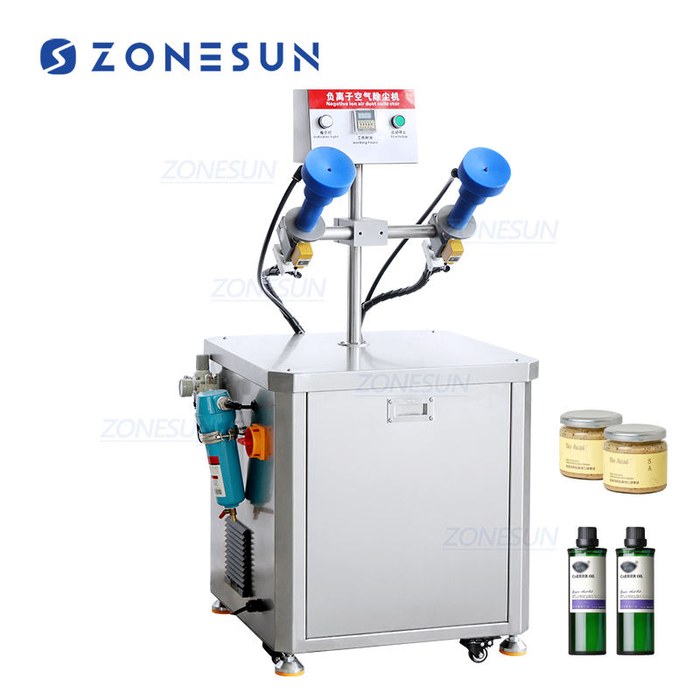
ZONESUN ZS-NIC1 semi-automatic negative-ion air rinser
A dry air-rinse route for dust removal and static reduction before filling. The checked product family described 110/220 V, compressed air, a customizable bottle-opening range and a one-year warranty. The product-review and sold signals were not strong enough to treat as proof: confirm the filter and ionizer details, the actual air flow, bottle support, noise, the no-bottle control and a dry-bottle trial.
- Role: Alibaba sourcing candidate
- Compressed-air rinse, 110/220 V options
- Confirm filter and ionizer details plus real air flow
- Run a dry-bottle trial before committing
- MOQ: Check current listing
Candidate B — semi-automatic small rinsing washer
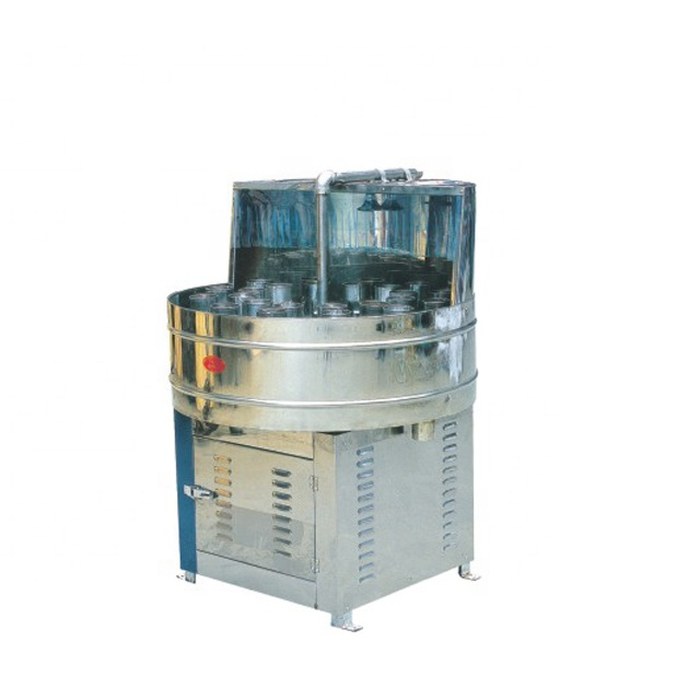
Semi-automatic small rinsing washer
A wet-rinse contrast to the dry air route. The snapshot showed no product reviews but a 100% positive supplier signal, 220/380 V, water processing, 2.2–18 kW and a one-year warranty, describing a small semi-automatic rotary washer. Confirm water consumption, drain and recirculation, the bottle range, the rack, rinse chemistry, drying and handoff, and what the stated capacity actually means. Treat the supplier signal as merchant evidence, not product validation.
- Role: Alibaba sourcing candidate
- Wet-rinse route, 2.2–18 kW, 220/380 V options
- Supplier signal is merchant evidence, not product validation
- Confirm water use, drain, recirculation and drying
- MOQ: Check current listing
RFQ checklist for a bottle rinser
-
Bottle drawings or samples: material, opening, body diameter, height, shoulder, shape and storage condition
-
Contaminant to remove and the acceptance method you will use after rinsing
-
Air, water, sanitizer or combined process; include filtration, pressure, flow, temperature and chemical details
-
Bottle orientation, gripper/rack, nozzle, vacuum or drain path, and no-bottle/no-rinse behavior
-
Exact change parts and settings for the two most difficult bottle formats
-
Post-rinse state: dry, damp, inverted, drained, sanitized or ready for immediate filling
-
Utilities: voltage, compressed air, water, drain, exhaust, noise and footprint
-
Filter, nozzle, seal, sensor and rack replacement plan; manual, warranty and remote support
-
Sample video and written factory acceptance test using the customer’s bottles and intended medium
Ask the supplier to write the post-rinse condition into the quotation. “Clean bottle” is too vague to enforce; “interior visibly free of loose particles, no standing water at the defined fill handoff, and accepted by the agreed inspection method” gives both sides something testable.
When not to buy a bottle rinser
-
The bottles are already supplied clean and protected, and your incoming inspection shows no recurring contamination problem.
-
Your real issue is residue or soil that needs a validated wash, brush, soak or CIP process rather than a short rinse.
-
The operation cannot control compressed air quality, water quality, drainage or the time between rinse and fill.
-
Bottle formats change too often for fixed racks, grippers or nozzles to remain productive.
-
The supplier will not demonstrate the exact bottle, contaminant and handoff condition you need.
The best small-batch rinser is not the one with the largest head count. It is the one that removes the defined contaminant, leaves the bottle in an acceptable state, and does not create a new failure at the filler.
References and evidence notes
Neostar Pack — semi-automatic bottle rinser for small-batch production.
VKPAK — inverting air and wet bottle rinsers, bottle handling and rinse paths.
E-PAK — air rinser and pre-filling particle removal.
ZONESUN — ZS-NIC1 negative-ion air bottle rinser.
Criveller — manual rinsers and spargers for small-batch producers.
Reddit / TheBrewery — small-run bottle preparation discussion.
Hook this up to your favourite commenting platform — Giscus, Disqus, or your own.
Continue reading
How to Choose a Handheld or Benchtop Screw Capper for Small Batch Bottles
Match the closure, bottle support and torque process before you buy

Why Candle Labels Wrinkle on Glass Jars
A geometry-first troubleshooting guide for small candle brands applying pressure-sensitive labels to glass jars.
How to Ship Candles in Hot Weather Without Treating Insulation as a Guarantee
A risk-based shipping and package test guide for small candle sellers.