Shrink Bands for Honey Jars: Size by Lid, Cork Fit & Tamper-Evident Sealing
Honey brings three problems a spice jar does not: sticky threads, a warm fill, and lids that are often cork or flip-top. Size from the closure you actually use, then band after the jar cools.
 Lena Schmidt
Disclosure: We may earn a commission if you purchase through links on this page, at no additional cost to you.
Quick answer. Size a honey-jar band from your own lid or neck, and treat the number in a product name with suspicion. One bee-supply seller names its bands by the lid they fit (43, 48 or 89 mm), while another gives the lay-flat width of a band cut for a specific 4 oz corked jar (52 mm). Those are different measurements. A band lies flat at half its circumference, so a 48 mm lid needs a lay-flat of at least about 75 mm. Measure the widest point of the closure, add the arithmetic, then buy a small pack before a case. Apply bands only to cooled, wiped, capped jars, because warm honey and sticky threads are the usual causes of poor results. Whether you need a band at all depends on your state and sales channel, so check those rules first.
Why honey is a different problem from other jars
Honey packaging gives a band three problems that a spice jar or a supplement bottle doesn’t. The containers are unusually varied: corked glass jars, screw-lid jars in several diameters, and squeezable bear bottles with flip-top caps. The product is sticky, so any drip on the threads follows the lid into the band. And honey is often warmed to make it flow, which means the jar may be warm at exactly the moment you want to shrink film onto it.
Each of those shows up in sizing, in preparation or in heat, so this page follows that order. For the general method of reading a lay-flat width, our size guide covers it. For regular-mouth jars sold as Mason jars, our Mason jar guide has the closure-specific details, and this page doesn’t repeat them.
The same number can mean three different things
The most common honey-band mistake is buying by the number in the title. Look at how two bee suppliers describe their stock. Lappe’s Bee Supply sells “48mm” bands described as fitting 48 mm honey-jar lids, along with 43 mm and 89 mm versions. Blythewood Bee Company sells bands for its 4 oz corked jar and gives the lay-flat as 52 mm wide by 45 mm cut length, noting that the 8 oz and 1 lb jars each have their own band. In the first case the number is a lid diameter. In the second it is the width of the flattened film. A 52 mm lay-flat band would be useless on a 48 mm lid.
A band lies flat as a tube whose width is half its circumference, so the arithmetic is the same whichever way a listing is worded. Convert everything into the minimum lay-flat your closure needs, which is π times the diameter divided by two.
| Listing says | The number refers to | Minimum lay-flat implied |
|---|---|---|
| 43 mm band (Lappe’s) | Lid diameter | about 68 mm |
| 48 mm band (Lappe’s) | Lid diameter | about 75 mm |
| 89 mm band (Lappe’s) | Lid diameter | about 140 mm |
| 52 x 45 mm band, 4 oz corked jar (Blythewood) | Lay-flat width x height | Opens to about 33 mm across |
| 66 x 25 mm band (marketplace seller) | Lay-flat width x height; seller says it suits caps 1¼ to 1½ in | Needs at least about 60 mm for a 38 mm cap |
The right-hand column is our arithmetic (πD ÷ 2), not a supplier claim. Lay-flat must be larger than the minimum so the band can slide on and still shrink down to the neck.
This is why the right-hand column is a minimum, not a recommendation. A band exactly as wide as the circumference won’t slide over the closure, and a band much wider will bunch at the neck. The published pairings give a feel for the margin: a 66 mm band against a 38 mm cap leaves a little over 10 percent of spare width, since the minimum there is about 60 mm. Treat that as a starting point for your own test.
Measuring a honey jar for a band
Measure what the film must clear, and what it must grip. For a screw-lid jar, that means the widest outside diameter of the lid, which is usually the rim or the knurled edge, and then the diameter of the neck below it. For a corked jar, measure across the cork’s flange or the widest part of the finish above the glass shoulder.
Work from the closure as it will be sold, with the cork or lid fully seated. A lid that sits slightly proud, or a liner that thickens the rim, changes the answer by a millimeter or two, and a millimeter matters when the band has a few millimeters of margin. Use calipers if you can; a flexible tape works if you measure the circumference and divide by π.
Height comes next. The band should cover the gap between lid and neck so the seal can’t be lifted without breaking the film, and should reach the glass or plastic below. Blythewood’s 4 oz band is 45 mm tall, and Lappe’s descriptions say the band slides over the lid and upper neck area. The practical test is to slide a sample over the closed jar and see where the lower edge lands: on a ridge or the shoulder is fine, hanging free in the air isn’t.
Buy a small pack in two neighboring sizes and keep notes. Honey jars from different glass suppliers vary slightly in finish, and a note about which jar you tested saves you from re-testing when you change supplier.
Corked jars and flip-top bear bottles
Corked jars. Blythewood describes its band as shrinking around the cork and the upper rim of the jar, holding the cork in place and giving a tamper-evident finish. That changes what the band is for: it is both a seal indicator and a retainer. It also means the band must cover the cork head completely, so the cork’s top and the jar’s rim set the height you need. As with any band, the supplier’s figure is a starting point and the cork you actually use decides the result.
Bear bottles. A flip-top cap has a hinged lid and a small spout, so the band has to sit around the cap’s base and neck without covering the opening you want customers to use. Bear bottles are also soft plastic, which makes heat more consequential than on glass. Retailers such as WebstaurantStore list bear bottles with induction liners under flip-top caps, which gives you a second seal under the lid. Whether a band is needed on top of that is a judgment about your channel and your customers, not something the bottle decides.
I did not find a reliable, independent source giving band sizes for bear-bottle caps, and one blog that does claim bear-specific bands is not a source I would rely on. Measure your cap and apply the same arithmetic as above.
Sticky threads and warm honey
Lappe’s guidance for its honey bands is to apply them after jars are filled, capped, labeled and cleaned, and to keep threads and lids clean so the band seals evenly. That ordering matters more for honey than for most products, because a thin film of honey under the band prevents the film from gripping and will creep under the edge later. Wipe the lid and neck with a damp cloth and dry them before the band goes on.
Temperature is the second issue. Honey is commonly warmed so it flows. One honey-equipment seller describes about 120°F (49°C) as a standard bottling temperature, and a heater manufacturer notes that packers may take honey up to about 150°F (65°C) briefly to strain and package it. Those are vendor figures, and your jars may be filled anywhere in that range. A packaging supplier, ePackageSupply, advises letting a product that is hot at bottling cool before applying bands. A warm jar of honey also makes the glass or plastic hot to touch just where you are about to aim a heat gun, which makes a bad shrink harder to correct.
The practical routine is simple. Fill, cap, let the jars cool to room temperature, wipe, label and then band. If you are in a hurry, test the shortcut on a few jars first and see whether the band shrinks evenly or the plastic bottle deforms. Wrinkles and splits in the film are covered in our troubleshooting guide, and the heat tools themselves are compared in our heat gun guide.
What goes wrong when the size is off
Each sizing error has its own signature, and knowing it saves a wasted carton.
Too narrow. The band stalls on the lid’s edge and won’t slide down. Forcing it stretches the film and often leaves a split along the perforation once heat is applied. If you have to push, stop and move up a size.
Too wide. The band slides on easily but doesn’t tighten evenly. You see vertical folds, a loose lower edge, or a band that can be rotated by hand. On a jar this looks careless, and a loose band can be lifted over the lid without tearing, which defeats its purpose.
Too short. The band covers the lid but stops above the neck, so it has nothing to grip. Container and Packaging warns that a container without a lip can let the band slip off, and the same applies to a band that doesn’t reach the ridge.
Too tall. The band reaches the label or shoulder and shrinks onto it, which can distort a printed label or leave a ring on the glass. Honey labels are often placed high, so check the gap between the lid and the label edge before choosing a height.
From the bottling bench to the market table
Honey jars travel: in boxes to a farmers market, in a crate to a shop, or in a parcel to a customer. A band that looks fine on the bench has to survive that handling. Before a first full run, pack a few banded jars the way you ship them and shake the box. Check that the perforation hasn’t started to split, that the band hasn’t slid, and that nothing has leaked under the lid.
If you sell online, ship a test jar to yourself. Blythewood notes that its band holds a cork in place as well as signaling tamper evidence, which is the kind of benefit that only shows up when jars are handled roughly. And if a band fails in transit, note which part failed (film, perforation or fit) before you change supplier, because the fix depends on the cause.
Do honey jars need a band?
The honest answer is that it depends on where and how you sell, and I could not find a rule that applies to all honey. State extension guides cover labeling, licensing and sales limits, and they differ Florida’s IN91 covers bottling and labeling for direct sales (Gentry & Ellis, n.d.). The Texas A&M AgriLife guide, for example, separates beekeepers who only harvest honey from cottage food operators and from operations needing a food-manufacturing license (Dittmar & Keck, 2024). The University of Florida guide describes the labeling that a Florida cottage food operation must carry. Neither guide, in the portions I read, says that a shrink band is mandatory.
Some commercial blogs state that tamper-evident seals are often required under cottage food laws. I could not verify that against a primary source, so don’t treat it as settled. Check your state department of agriculture or your cooperative extension office, and check the rules of each place you sell, because farmers markets, grocery buyers and online marketplaces set their own conditions.
Where no rule applies, a band is a presentation and trust choice. It shows that the jar has not been opened since it was packed, and it keeps a cork or lid from being loosened in transit. Those are real benefits, but they are different from a legal requirement, and you should not imply one on the label.
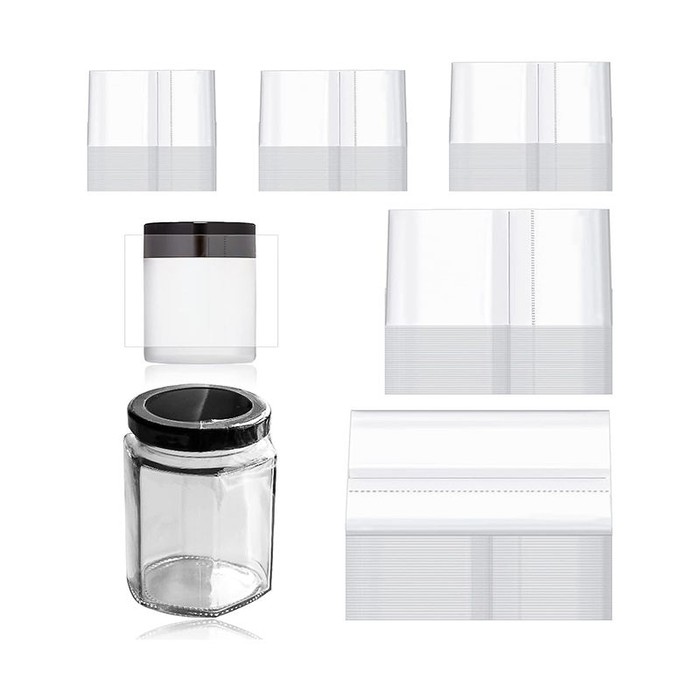
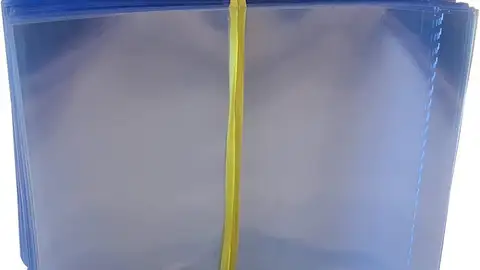
Clear perforated shrink band for jars, sized to your lay-flat
A clear perforated band listed for glass jars, quoted at 10,000 pieces and up with per-unit pricing well under a cent at the top tier. The listing sells by lay-flat width and cut height, so convert your measured lid diameter with the pi arithmetic in the sizing section before you pick a line.
- Role: Amazon consumer option
- Clear, perforated
- Sized by lay-flat
- From 10,000 pcs
- MOQ: Check current listing
A setup sequence that works for small runs
- Measure the finished closure. Widest lid or cork diameter, neck diameter, and the height you want covered.
- Compute the minimum lay-flat. π × diameter ÷ 2, then pick the next listed size up.
- Buy a sample pack. Test on three jars from the real batch, not on empty jars.
- Fill, cap and cool. Let jars reach room temperature before banding.
- Wipe and dry the lid and neck. Remove any honey from threads and the rim.
- Slide the band on and heat evenly. Rotate the jar and keep the heat moving; stop when the film is smooth.
- Check the opening. Tear the perforation on a test jar and confirm the lid or cork still comes off cleanly.
- Record the specification. Jar model, closure, lay-flat, height, film and heat setting.
Treat the record as part of the product. When a glass supplier changes a finish or a cork supplier changes a head, a one-line note tells you what to retest.
FAQ
What does “48 mm” mean on a band listing? It depends on the seller. Some use it for the lid the band fits, others for the lay-flat width. A 48 mm lay-flat band opens to about 31 mm across, far too narrow for a 48 mm lid.
Can I band a jar while the honey is still warm? I would not. One packaging supplier advises letting hot-filled product cool first, and warm honey makes the surface to be heated harder to judge. Let it cool, wipe it, then band.
Do I need a different band for each jar size? Usually, yes. Blythewood states that each of its jar sizes has its own band, and lids differ by diameter.
Perforated or not? For gift and retail jars, perforated bands let customers open without peeling at the label. Our perforation guide covers the trade-off.
Is a band required to sell honey? It depends on your state, your operation type and your sales channel. I did not find a single rule covering all honey; check with your state agriculture department.
References
Hook this up to your favourite commenting platform — Giscus, Disqus, or your own.
Continue reading
Shrink Bands for Lip Balm & Salve Tins: Size by Diameter, Height & Heat Budget
Tins and tubes have no neck bead, so the band has to wrap the body. Measure the widest diameter with the lid on, choose a seam band or a full wrap, and keep the heat low enough for the balm.
How Much Do Shrink Bands Cost? Price per Band vs. Cost per Sealed Jar
Bands run from about two cents to five cents each in retail packs and far less by the thousand. What decides your real cost is the film tier you buy, the spoilage on your first run, and the unit count.
Shrink Bands for Supplement Bottles: Size by Cap, Neck Bead & Seal Setup
A child-resistant cap is wider than its thread size suggests, so the band has to be sized to the closure. Measure the cap, confirm the neck bead, and test on filled bottles.