Shrink Bands for Lip Balm & Salve Tins: Size by Diameter, Height & Heat Budget
Tins and tubes have no neck bead, so the band has to wrap the body. Measure the widest diameter with the lid on, choose a seam band or a full wrap, and keep the heat low enough for the balm.
 Lena Schmidt
Disclosure: We may earn a commission if you purchase through links on this page, at no additional cost to you.
Quick answer. Tins and lip balm tubes are sized differently from bottles. There is no neck to grip, so the band wraps the container’s side and usually extends past the lid. Measure the container’s widest diameter, then work out the minimum lay-flat as roughly π times that diameter divided by two. Supplier pairings I checked leave a spare 4 to 15 percent of width above that minimum. Height is a separate choice: one supplier suggests a band 18 mm tall for a 16 mm tin and 72 mm for a 44 mm tin. Test with low heat, because balms and salves soften when warm. The only US cosmetic tamper-resistant rule I found covers liquid oral hygiene and vaginal products, not lip balm or salve, but check your sales channel.
Why tins and tubes aren’t bottles
A bottle band sits on a cap and a neck bead. A lip balm tin has neither. It is a shallow cylinder with a slip-on or slide lid, so the film has to hold the lid on by gripping the container’s own side wall. That is why the sellers who stock these bands describe them as wraps: one supplier calls its 84 x 54 mm band a full jar wrap rather than a lid-only seal, and another says its tube bands fit over the entire tube.
The consequences run through everything below. Sizing is driven by the container’s widest diameter and its height, not a finish or a lid code. The band can cover a printed label, so clarity and heat matter more. And because the product inside is often a wax-based balm or salve, the heat budget is smaller than it is on a glass jar of honey or a plastic supplement bottle. Our size guide covers the general method; this page covers what changes for tins and tubes.
Full wrap or lid band?
Two layouts show up in supplier recommendations, and the difference is height.
In the first, a short band spans the lid seam. Voyageur Soap & Candle suggests a 66 x 18 mm band for its 0.5 oz shallow tin, which is about 16 mm tall (5/8 inch). The band is a couple of millimeters taller than the tin. Its job is to cross the line between lid and body so the lid can’t be lifted without tearing the film.
In the second, a tall band covers the whole container and extends beyond both ends. The same supplier suggests 115 x 72 mm for a 4 oz deep tin that stands 44 mm (1.75 inches) tall. By the numbers, that leaves about 28 mm of extra film to fold over the lid and the base. Northwood Candle & Craft advises that when sealing a lid, the band should extend slightly above it so the film can shrink smoothly over the top.
Which is better depends on what you want the customer to see. A short seam band leaves the label and tin visible and uses less film. A full wrap shows more tamper evidence and covers both ends, but it hides some of the tin and needs more care so it doesn’t pucker on the top. Neither is wrong; test both on your actual tin and decide by the finish.
Sizing from your container
Measure the widest outside diameter of the container with the lid on. A band lies flat as a tube whose width is half its circumference, so the minimum lay-flat is π times the diameter divided by two. If a supplier gives the circumference (Voyageur lists 5 inches for its 0.5 oz tin), half of that is the minimum. Then compare what suppliers pair with their own containers.
| Container (source) | Band suggested | Minimum lay-flat | Spare width |
|---|---|---|---|
| 0.5 oz shallow tin, 5 in circumference (Voyageur) | 66 x 18 mm | 63.5 mm | about 4% |
| 4 oz deep tin, 2.5 in diameter (Voyageur) | 115 x 72 mm | about 100 mm | about 15% |
| Containers up to 2.25 in (Northwood) | 95 x 55 mm | about 90 mm | about 6% |
| Containers up to 3.25 in (Northwood) | 135 x 55 mm | about 130 mm | about 4% |
| Tubes up to 18 mm wide (US Plastic) | 30 x 64 mm | about 28 mm | about 6% |
Minimum and spare width are our arithmetic from the supplier’s stated container size, not supplier claims.
The pattern is useful: these suppliers leave roughly 4 to 15 percent spare. It is thin because the band has to slide on easily but then shrink tight against a straight wall, and extra width means loose film. Treat the pairing as the center of a test, not as a guarantee, because tins differ in lid height, rim bead and wall taper even at the same nominal diameter. If your container is tapered, measure at the widest point; the band must clear that to go on, and it will be loose at the narrow end.
Lip balm tubes: the “standard” isn’t standard
Tubes are where the most mismatches happen, because sellers use “standard” loosely. Three recommendations for a standard round lip balm tube, from three sellers, are 28 x 63 mm (Wholesale Supplies Plus), 30 x 70 mm (Northwood and Voyageur) and 30 x 64 mm (US Plastic, which lists a fit range of 10 to 18 mm in diameter). Each is correct for its own tube. They are not interchangeable.
The slimline problem is worse. Northwood states that its 30 x 70 mm band is not compatible with slimline tubes, which need 25 x 84 mm, and the reverse is also true. One buyer review on a marketplace says a listing that claimed to fit 13 to 22 mm tubes did not fit a 19 mm tube. That’s a single review and may reflect a mislabeled listing rather than a general problem, but it is a reminder to check the minimum for your own tube before trusting a range.
Check the opening, too. A Wholesale Supplies Plus reviewer notes that the perforation around the cap area gives no obvious place to start tearing. Our perforation guide covers tear tabs and vertical versus horizontal perforation; on a tube, test that a customer can find the start of the tear.
Slide tins and sliding lids
Slide tins, where the lid moves along a track instead of lifting off, add a wrinkle. Northwood lists a 38 x 54 mm band specifically for lip balm slide tins, which tells you the seller treats them as their own size rather than a variation of a round tin. The band has to cross the line where lid meets body, so the lid can’t be pushed open without tearing the film.
After shrinking, test the opening on a few units. Tear the perforation, then slide the lid; the film shouldn’t have fused to the track edges or left a ridge that makes the lid stick. If it has, reduce the heat or try a band with a different height, and note the result for the next order.
Why ounces don’t tell you the band size
Balm containers are sold by volume, and it is tempting to order bands the same way. That doesn’t work. Voyageur recommends the same 84 x 54 mm band as a full wrap for three different containers: a 2 oz deep metal tin, a 2 oz straight-wall PET jar and a 1/2 oz double-wall jar. Meanwhile a 1 oz aluminum round tin listed at 50 mm in diameter by Bulk Apothecary would need at least about 79 mm of lay-flat by the same arithmetic. Volume ratings describe how much fits inside, not how wide the outside is.
So work from millimeters. Keep a small sheet with each container’s measured diameter and height and the band you tested on it, and when you add a new tin or change supplier, measure again rather than assuming the old band carries over. It takes a minute with calipers and saves a box of unusable film.
Film thickness and shrink claims: read them carefully
Product pages in this category are inconsistent about thickness. Voyageur’s 84 x 54 mm page says both “2 mil thick” and “2 mm thickness”, which can’t both be right: 2 mil is about 0.05 mm, and 2 mm would be about forty times thicker than any other film on the pages I checked. Northwood’s page says “2 ml thick”, which is a typo for mil or mm. When a listing is unclear, ask the seller to confirm the film thickness in microns before ordering.
Shrink claims are repeated across sellers: Northwood, Wholesale Supplies Plus and Bulk Apothecary all say their bands shrink up to 40 percent. Identical phrasing suggests a shared source, so don’t take it as independent confirmation. What matters for you is the film’s rated shrink in each direction, which a seller should be able to state. Ask for it, and check the figure against the gap between your container’s diameter and the band’s opened-out diameter.
Heat and balms: a smaller budget
Wax-based balms, salves and solid perfumes soften when warm, and a metal tin conducts heat to whatever is inside. The advice from sellers varies. Wholesale Supplies Plus recommends gentle heat from a low-set hair dryer or a heat gun for its tin bands. Voyageur says to use a heat gun. One buyer says a heat gun, not a hair dryer, was what worked. Northwood advises directing the heat parallel to the film’s surface and stopping when the film is taut and wrinkle-free.
Those differences are partly film differences and partly technique. The common thread is to start with the least heat that works, keep the heat moving, and stop early. Fill and let the product set completely before you band, and don’t warm the tin to speed things up. Test a few units from the real batch and look inside after: a surface that has softened, sweated or pulled away from the wall tells you the heat was too much. Our heat tools guide compares the equipment.
Labels need testing too. Northwood describes the band as a protective cover over a label, which is only true if the heat hasn’t wrinkled the paper or lifted a corner. Run one banded sample through a few days of handling before you commit to a full batch.
Do lip balms and salves need a tamper-resistant band?
In the United States, the cosmetic tamper-resistant rule is 21 CFR 700.25, and its scope is narrow: it applies to cosmetic liquid oral hygiene products and vaginal products sold at retail. FDA’s compliance policy guide for cosmetic packaging points to the same rule (CPG Sec. 590.500). Lip balms, salves and body butters are not in those two categories on the text I read, so the federal rule does not by itself require a band on them. I am not a regulatory advisor, and your product’s claims, ingredients and sales channel could change the picture.
A band is still a common trust signal for products that go on the mouth or skin. Retailers, marketplaces and gift buyers may set their own requirements, and customers notice a loose lid. So ask the channel you sell through what it expects, and decide with that in mind. Outside the US, rules differ again, so check the market you ship to.
If you do print or label the seal, remember that the claim has to be accurate. A band that says “sealed for your protection” should be applied to every unit that leaves the bench.
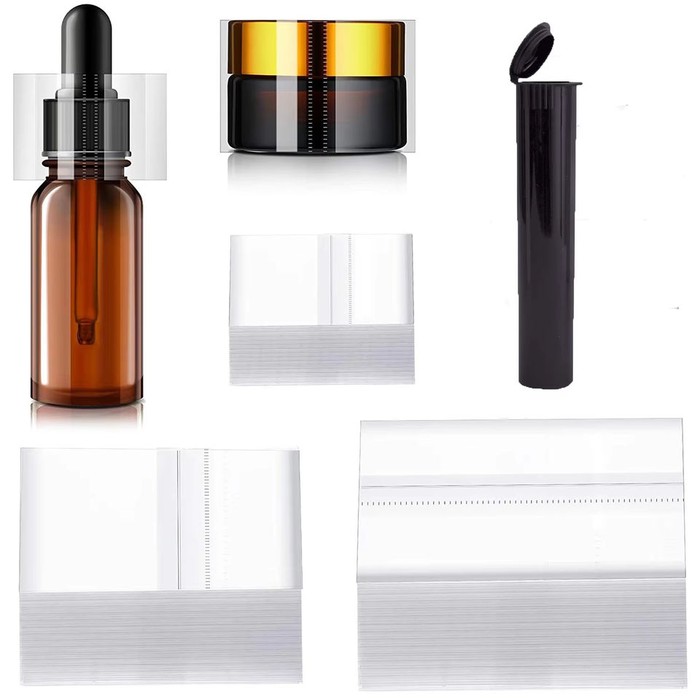
Perforated heat-shrink band, multi-size and clear
A clear perforated band offered across several sizes, which matters for tins because two suppliers can call two different bands standard for the same container. Quoted from 10,000 pieces; ask for the cut height you need rather than accepting the size named in the title.
- Role: Amazon consumer option
- Multi-size
- Clear, perforated
- From 10,000 pcs
- MOQ: Check current listing
A short test sequence for balm makers
- Measure the container. Widest diameter with the lid on, height with the lid on, and lid height separately.
- Calculate the minimum lay-flat. π × diameter ÷ 2, then choose the next listed size up with a few percent spare.
- Choose the layout. Seam band that crosses the lid line, or full wrap that extends past the ends.
- Buy two sizes in sample quantities. One at the minimum margin, one with more spare width.
- Use set, cooled product. Apply to finished units, not warm ones.
- Shrink with low heat. Keep the source moving and stop at the first smooth finish.
- Inspect after a day. Check the film, the label and the balm surface.
- Write down the specification. Container model, diameter, height, band size, heat source and distance.
FAQ
Can I use one band size for every tin I sell? Not usually. The minimum lay-flat scales with diameter, and the spare width suppliers leave is only a few percent. A 2 oz tin and a 4 oz tin need different bands.
Do bands go over a label? They can, and some sellers describe them as protecting a label, but test your label stock under the heat you intend to use before committing.
Why do two sellers recommend different bands for the same “standard” tube? Tubes vary slightly by maker, and the sellers measured different products. Use your own measurement.
Does a lip balm need a tamper-resistant band by law? In the US, the federal cosmetic rule I found covers only liquid oral hygiene and vaginal products. Check your own product category, channel and country.
Can a hair dryer shrink these bands? One seller says yes for its bands and another says use a heat gun. Test on your film and container.
References
Hook this up to your favourite commenting platform — Giscus, Disqus, or your own.
Continue reading
Shrink Bands for Honey Jars: Size by Lid, Cork Fit & Tamper-Evident Sealing
Honey brings three problems a spice jar does not: sticky threads, a warm fill, and lids that are often cork or flip-top. Size from the closure you actually use, then band after the jar cools.
Shrink Bands for Supplement Bottles: Size by Cap, Neck Bead & Seal Setup
A child-resistant cap is wider than its thread size suggests, so the band has to be sized to the closure. Measure the cap, confirm the neck bead, and test on filled bottles.

Custom Printed Shrink Bands: Artwork, Minimums & Proofing for Small Brands
Printing on the band buys a message, not tamper evidence. Decide whether you need it, then walk the approval chain from unprinted fit test to a shrunk sample on your own container.