Toilet Brush Refills: Check the Connection Before You Buy
A refill that will not fit is usually the wrong coupling, not a badly made brush. Identify the handle, compare the connector, and dry-fit before you trust the word universal.
 Lena Schmidt

Disclosure: We may earn a commission if you purchase through links on this page, at no additional cost to you.
When a toilet-brush refill will not fit, it is tempting to blame a badly made brush or a misleading product photo. Often the problem is simpler: “replacement” describes the job, not the handle it belongs to. A refill may screw onto the wand, clip in, or depend on a separate collar. Even among threaded heads, one measurement cannot establish that all the parts line up.
The word “universal” deserves the same scrutiny. A listing may mention a 12 mm rod, for example, and leave out thread spacing, socket depth, and whether an adapter is needed. That number may be useful, but only for the particular head whose seller supplied it. If the new part catches and stops, or turns on but rocks, do not make it fit with pliers or glue. Those are clear signs to stop and check the connection again.
The manufacturer pages make the point more clearly than generic product labels. OXO says the black screw coupling on the original wand has to stay because its replacement head attaches to it. tesa names compatible brush series. Kela describes its La Brosse system, while noting that some older sets may need a different head. All three give buyers a boundary; none says that every toilet brush uses one common connection.
People reach for the word universal because model numbers are easy to lose. In a Reddit cleaning thread, one buyer described an oversized refill as “HUGE” compared with the original. They later found the exact model; the post is a clue about the shopping problem, not a source for thread measurements. If your label is gone, photograph the bare connector and check the full head against the caddy before ordering. A refill must attach correctly and still fit the place you store it.
A product photo rarely shows the point where the head meets the handle. When shopping online, scroll for an underside or connector image and for a compatibility list. If every image shows only the bristles and caddy, ask for a close-up before ordering. The extra picture may answer the fit question faster than another round of guessing from the product title.
Why a replacement head can fail even when it looks right
A head can start onto a thread and still be the wrong part. It may turn once, then stop before sitting flush; or attach but wobble because the socket or thread spacing differs. On a brush that gets twisted during scrubbing, that looseness matters. The head should sit level and stay put. Do not keep tightening a joint that feels wrong.
The bowl and caddy add a second fit check. A longer neck may touch the holder base; a wider head may catch in a narrow opening. These issues do not show in a connector close-up. Compare the old head’s width and neck length with the new one, and look at the actual holder, especially if it has a lid.
The maker’s own pages show how varied the boundaries are. OXO says its black screw coupling must stay on the wand. tesa lists the brush series its head supports. Kela describes the La Brosse family and notes that some older sets differ. Those are model or system matches, not proof of one cross-brand size. When a listing says universal, look for the measurements behind the claim; a photo of a screw alone says little about pitch or seating depth.
A visual match at the brush head is not enough either. Bowl shape, head diameter, and neck angle affect access and storage. A wide head may clean the bowl well but fail to pass through a narrow caddy opening; a longer neck may seat in the handle and still hit the holder bottom. These checks are specific to your set, so compare the old part and holder together rather than measuring the head alone.
Start with the handle’s identity
Start with the handle. Check the shaft, underside of the holder, packaging, or an old order record for a brand and model. A short code is more useful than recognizing the color. Search that code with “replacement head” on the maker’s site; even a discontinued brush may have a parts page or support note.
If the label has gone, photograph the brush beside its caddy, then take a close view of the connector with the old head removed. Keep any ring or coupling attached unless the instructions say to remove it. A ruler in a side photo helps show scale, though not thread pitch. OXO’s instructions make this easy to miss: its black coupling has to remain on the original wand so the new head has something to attach to.
Do not decide from brand or shape alone. Manufacturers can sell compact and rim-cleaner brushes with different heads under the same logo. The model list, not the color, answers whether a particular refill fits. If you cannot find the code, ask the maker or seller before ordering and include the photos.
Look for codes on all the parts, not just the brush. Some makers print the model on a small label under the canister or base. If you contact support, include a clear picture of that label and the full set. A written model match is particularly helpful when a company sells several visually similar brushes. Save the answer or product code with the caddy; the next refill search is easier if the identification does not depend on memory.
If the model is unknown, compare the connection
Remove the old head the way its instructions describe. Some heads unscrew; others use a tab or collar. If it resists light hand pressure, inspect the joint before turning harder. A thin rod may bend, and a hidden lock will not release by twisting.
On a threaded handle, note the outside diameter of the post and how much thread is exposed. A caliper helps; a ruler beside the connector gives only a rough scale. Thread pitch is a separate measurement: the space between neighboring crests. A small pitch gauge can check it. Without one, ask the seller whether your exact model is supported and send a close, straight-on photo.
Also check how deep the head socket is and whether the old assembly includes a plastic ring, sleeve, or coupling. A head with the right diameter can bottom out before it reaches the shoulder. The replacement may not come with the small adapter that was on the original.
One four-head marketplace pack specifies a 12 mm rod and coarse thread. Those numbers describe that listing. They are a starting point only if your handle matches both. PHOS labels its M12 head for identified PHOS sets, while tesa lists named series; neither supports transferring a size to unrelated brushes.
When messaging a seller, ask for diameter, pitch, usable length, included adapters, and supported handle models. “Yes, universal” is not a useful answer unless the seller says what the head is universal for.
Check whether the exposed end is the male post or whether the head contains the female socket; listings sometimes describe one side but photograph the other. Also note whether the shoulder is flat or has a collar that the head must clear. Do not infer clockwise or counterclockwise direction from another brand’s instructions. If a thread direction or locking feature is unclear, the old head and its manual are better guides than a generic video.
Use a careful dry-fit, not force
Line the head up with the handle and start it by hand. Stop if it binds, goes on crooked, or spins without tightening. A mismatched thread can feel rough or cross instead of turning smoothly. Plastic can be damaged before the outside looks different, so leave the pliers in the drawer.
Once it seats, compare its position with the old head. It should not lean or leave a gap. If the brush uses an adapter, make sure the piece is still there and facing the same way. OXO specifically says to retain its black coupling; another maker may use a different part, so follow the instructions for that brush.
Then try the caddy. Lower the brush slowly. Does the head clear the rim? Will the lid close without pressing the bristles? Does the head touch the bottom? An attached head that catches in the holder will be inconvenient every time you use it.
If it loosens during a gentle twist, take it back off and inspect both pieces for worn or cracked plastic. A stripped connector will not improve with more tightening. Replace the damaged handle or complete set rather than modifying the joint with glue or a file.
Do the first fit before using any cleaner on the brush. A dry connection is easier to inspect, and a new head should not be judged by how it feels when slippery. Keep the test gentle: screw it on only until it seats, then turn the handle lightly to see whether it rocks. The aim is not to stress-test the part, only to catch an obvious mismatch before the brush is used.
How to choose between OEM and generic
If you know the brand and model, the maker-listed refill is usually the least uncertain route. It belongs to a named family, and its instructions may mention a required coupling. Still check the model list; one logo does not guarantee that all the brand’s brush heads interchange.
The linked Amazon product is a two-pack described as compatible with select OXO brushes. That is the seller’s fit claim, not an OXO guarantee. It belongs only on a matching handle, and its current compatibility details should be checked before checkout. OXO-compatible refill listing
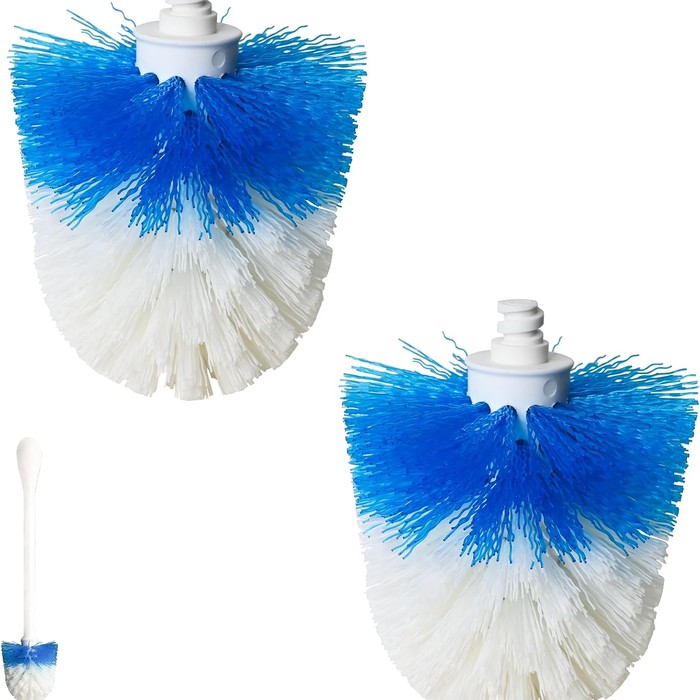
RIMAY toilet brush refills for OXO, 2-pack
A two-pack of replacement heads sold only for OXO toilet brushes. That is the seller's stated compatibility, so confirm your handle model and connector before ordering.
- Role: Amazon consumer option
- 2-pack
- For OXO brushes
- Threaded coupling
- MOQ: Check current listing
A generic refill may work when its listing provides the dimensions that matter: connector type, thread diameter, pitch or thread type, and usable socket depth. If those details are missing, ask for them first. A multi-pack can suit several identical brushes; for one unknown handle, it multiplies the cost of a guess.
If you are buying the whole set, search for its spare-head code before choosing. A maker that names compatible handles or sells a clearly identified refill makes later replacement easier than a product whose parts appear only under vague marketplace titles.
There is no universal price rule here. A named refill may cost more per head but save a return; a generic multipack may be cheaper if the fit is confirmed and you have more than one matching handle. Include shipping and pack size in the comparison. For a single brush that you cannot identify, the lowest listed unit price is not a meaningful saving until the seller confirms that its connector fits.
When a whole brush is the better buy
A new head helps only while the wand and joint are sound. If the plastic threads have worn smooth, the handle is cracked, or the maker’s coupling is missing, another refill will not secure the brush. A holder that no longer keeps it upright may also make a full set the better choice. Compare local prices before buying a multipack; the full brush can sometimes cost less than multiple unsuitable refills.
Use the bristles, not a calendar, to judge wear. Flattened or shedding bristles, or a head that no longer reaches the bowl area you clean, are practical reasons to replace it. Follow the care directions for your brush and let it drain as the holder is designed to allow. Use and storage vary too much for one interval to fit every household.
For a new set, look up its refill code before you buy. Does the maker name the handles it fits? Is the spare sold in your region? A reusable wand is useful only if its head can be identified later. For the brush you already own, order the named refill if the model is known. If not, send a photo and the measurements. A seller who repeats “universal” without answering those questions has not confirmed fit. The head should start by hand, sit straight, stay firm with a gentle twist, and return to its holder without force.
If you replace the set, retain the receipt or take a photo of the model label before disposing of the box. Keep the spare-head code with the cleaning supplies, or store the code in your household notes. This small record prevents the same compatibility hunt when the new head wears out. It also gives a retailer or manufacturer something concrete to check if a refill is discontinued.
Sources
-
OXO, Toilet Brush Replacement Head (manufacturer instructions; coupling requirement) Source
-
OXO, Good Grips Toilet Brush with Rim Cleaner (replacement availability) Source
-
tesa, Replacement Head for Toilet Brush (named compatible series) Source
-
kela, Replacement WC Brushes / La Brosse compatibility and older-model caveat Source
-
PHOS, WCBB-M12 replacement head (supplier-specific M12 thread and models) Source
-
YouTube, OXO Good Grips Toilet Brush Replacement Head (product video listing) Source
Hook this up to your favourite commenting platform — Giscus, Disqus, or your own.
Continue reading
Garbage Disposal Splash Guard Replacement: Check Fit First
Two guards can look identical in a photo and fit different disposers. Confirm the model, check whether the old guard lifts out at all, and treat universal as a seller's scope claim.

Dog Poop Bag Refills: Check Roll Fit Before You Buy
Bag width and length do not tell you whether a refill fits the dispenser. Compare roll diameter, usable width and the core before you buy a multipack.
How to Match Dishwasher Lower Rack Wheels Before You Buy
Match the part to the model number, not to a photo. Confirm which wheel failed, read the full model number, and check whether the listing is one wheel or a whole assembly.