Do Washing Machine Anti-Vibration Pads Stop Walking?
A pad that has shifted out from under the washer is a symptom, not the diagnosis. Check the machine is stable and the foot fits the cup before buying a grippier set.
 Lena Schmidt
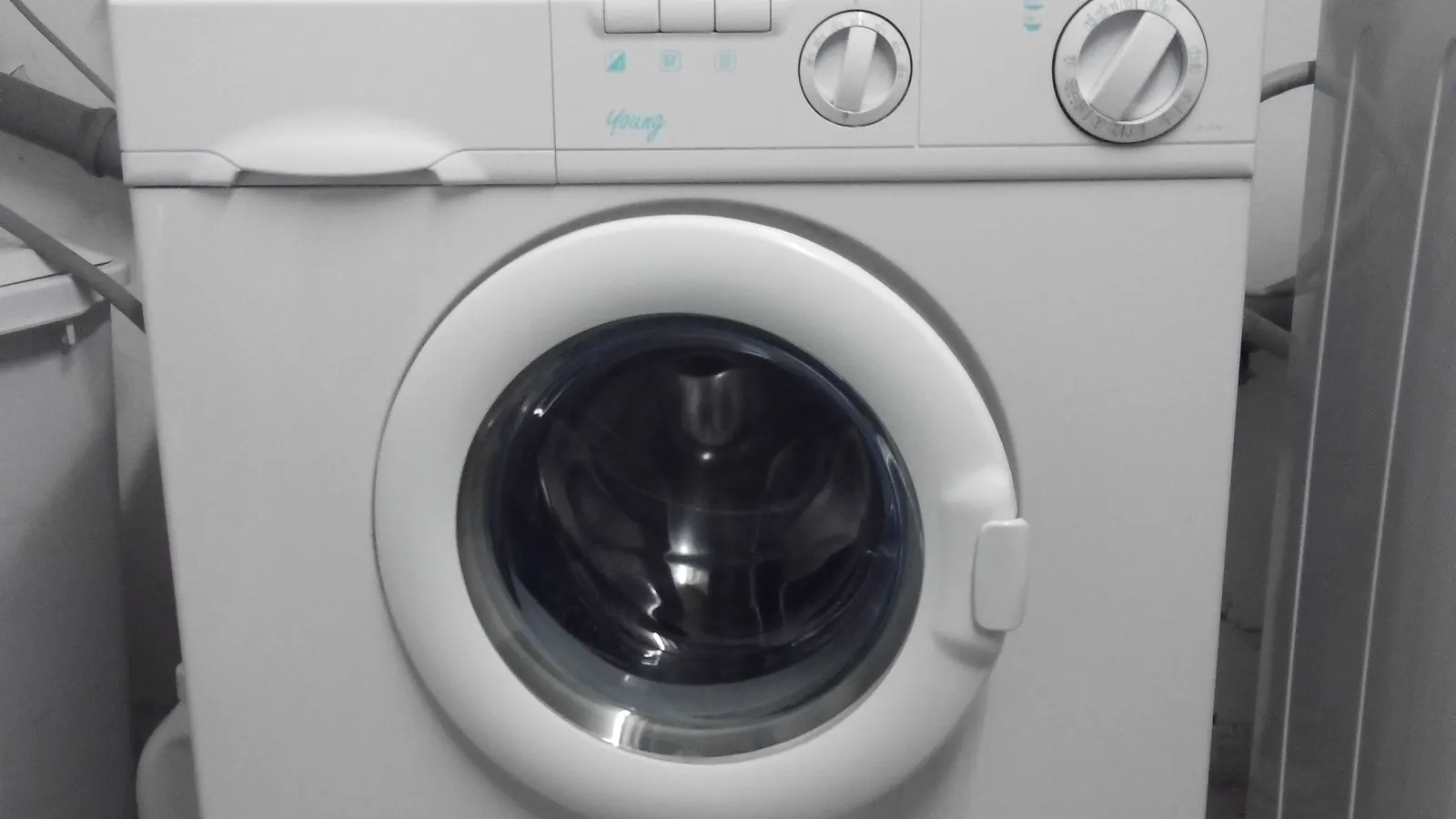
Disclosure: We may earn a commission if you purchase through links on this page, at no additional cost to you.
When an anti-vibration pad has shifted out from under a washer, replacing it with a grippier one is tempting. It may help, but only if the washer is installed correctly and the foot actually fits the pad. The pads work at floor contact; they cannot level a cabinet, balance a drum load, secure a weak floor, remove shipping bolts, or repair a suspension fault.
The decision is therefore two parts: is the washer stable enough for an accessory, and can this exact foot sit securely on this exact pad? The linked product is one example with a stated size limit and model exclusions. Its limits are useful precisely because a “universal” claim alone cannot tell you whether a washer will fit.
Why pads slide or fail to stop a washer
A foot cup that has moved to one side tells you that something shifted, but not why. It could have been placed off-center; the foot may be too large for its recess; or the washer may have walked far enough to push against the cup. The last case points back to the machine and floor, not to the pad’s tread pattern. A broad flat pad and a recessed cup also solve different fit problems, so their advertised grip cannot be compared without checking the foot shape.
Whirlpool’s troubleshooting page starts with installation and laundry: remove shipping materials, get all four feet in contact, level the washer, and avoid a tightly packed or single bulky load.[1] GE also names unbalanced loads as a cause and suggests an empty rinse-and-spin check to separate load-related shaking from movement that persists without laundry.[2] That order is sensible because a small accessory cannot correct those underlying conditions.
Floor behavior is another variable. On a firm tile floor, the washer may transmit a sharp vibration; on a flexible floor, the whole surface can move even when each cup stays put. If the washer rocks when pressed, or if the floor visibly flexes under it, the pad cannot provide a flat, stable base. A cup placed on an uneven or tilted foot can even make contact worse. The pad matters after the appliance has passed basic stability checks, not before.
Run a short diagnosis before buying anything
Watch for a pattern before deciding what to buy. If the washer only lurches with one heavy item, such as a bath mat, the load is a more useful lead than the feet. A machine that moves with an empty drum needs a different check. For a newly installed or relocated front-loader, look up the model’s shipping-bolt instructions first. Those bolts are removed according to the washer’s manual; their location and procedure are not safe to guess.
With the washer switched off, press gently on opposite top corners. A rocking cabinet means at least one foot may not be bearing firmly. Whirlpool’s support procedure asks owners to get all four feet in contact, level the washer, and tighten the jam nuts against the cabinet.[1] GE also warns that overextended legs can make the appliance shakier and recommends keeping them as short as possible while still level.[2] Pads cannot do that adjustment for you.
The floor deserves a look too. LG’s installation guidance calls for a solid, level surface and notes that some wood, metal, or steeply sloped floors can contribute to vibration.[3] The point is not that every timber floor is unusable; it is that the washer needs support that does not flex or sag. Drain pans, pedestals, and raised platforms introduce another interface. Confirm the washer maker’s rules before changing those supports.
If the manual permits it, run an empty rinse-and-spin cycle. GE recommends that check when trying to separate a load-balance problem from persistent vibration.[2] A quiet empty cycle followed by movement with a bulky load points back to loading. If the cabinet still jumps or bangs while empty, stop shopping for pads and ask the maker or a qualified repair technician to inspect it.
Measure the washer before choosing pads
A foot is not always a simple round puck. Some have a hexagonal or flanged base, and the part touching the floor may be wider than the threaded stem above it. Measure the widest portion that would enter a recessed cup. Compare that dimension with the pad opening, not with a vague “universal” label. If the seller gives no opening size, you cannot reliably predict a fit from the product photo.
Look above and behind the washer as well as underneath it. The added height can put a top-loader lid into a shelf or leave too little clearance beneath a stacked dryer. A closet may have just enough depth for the washer but not enough room to position a rear cup. Include the inlet hoses and drain hose in that clearance check; moving the appliance to fit the pads must not pull or kink them. A full-size mat requires measuring a different footprint than four small cups.
The linked ELEON/Empire of Electronics listing gives a specific limit: feet must be under 1.75 inches in diameter, the washer needs about one inch of clearance above, and several Samsung models are excluded, among them WA52DG5500AW and WA44A3205AW. These details apply to that listing only. Check your exact model number and measure its feet before ordering; a familiar brand name or similar-looking foot does not cancel the stated exclusions.
Check the pack count before checkout. Four pieces cover one machine with four feet; they do not automatically cover both a washer and dryer. And do not make a taller stack from spare rubber pieces to level one corner. Uneven support is exactly the condition the leveling procedure is meant to remove.
Choose a pad style for the problem you actually have
The cup-shaped pad’s job is to keep a foot from wandering off center. That only works when the foot drops into the recess cleanly; if it perches on the lip, the cup has become a rocking point. A textured flat pad has no cup to match, but it still needs enough surface area for the foot and enough grip on the floor. A mat under the whole washer avoids matching four individual cups, though it can be awkward to get under a machine in a narrow closet.
Think about the finished height before choosing thick rubber. More height can be useful if you need cleaning access, but it can foul a shelf, stacked dryer, or lid. The softer the support, the more important it is to confirm that it compresses evenly under the appliance. A marketing phrase such as “shock absorbing” is not a test result for your floor. The useful listing details are footprint, cup opening, material, height, capacity, and any model exclusions.
For a washer whose feet measure below its stated limit and whose model is not excluded, the linked four-pack is one candidate. The product page says a small bubble level is included. It is a convenience for a quick check, not proof that the floor is rigid or that all four feet carry weight evenly. Read the live listing before ordering; the specs, stock, and return terms can change.
Install without creating a new stability problem
Before moving anything, read the washer instructions and make sure the floor and pads are dry. Grit, detergent residue, or water can sit between the rubber and the floor. Place each foot on a separate pad and center it. A cup should surround the foot without the foot resting on the rim. The four supports should match: putting one corner on a different height invites rocking.
Getting the pads underneath is often the awkward part. A washer can weigh too much to hold up safely while you work, so do not try to balance it with one hand or wedge a tool under it by guesswork. Use the manual’s installation method or have an installer do it. A stacked unit or a washer with little hose slack is not something to pull forward hard just to reach the back feet. Keep clear of any appliance that is raised or tipping.
When the feet are down, press the cabinet gently and check for rocking again. Confirm that hoses have slack and that the machine is not touching the wall. Then run a normal, balanced load while you stay out of its path. A pad that shifts deserves a stop and a recheck; gluing it in place may damage the floor or make service harder without solving the movement.
How to tell whether the pads helped
A useful comparison separates movement from sound. Did the cabinet stay in its place? Is the floor still rumbling? Did the sound change? Those answers are not interchangeable: a pad might stop a scuffing foot while vibration still travels through a floor joist. If possible, use a similar load and cycle for the check. A quieter machine that still rocks or has a foot slipping out is not a stable installation.
GE’s front-load guidance says occasional movement up to one-quarter inch can be normal for its washers during an unbalanced load.[2] Use that only as GE’s model-family guidance, not as a general limit. If your unit is creeping farther each cycle, hits a nearby cabinet, pulls a hose, leaks, or starts a new grinding noise, turn it off and arrange service. A different brand of pad is not the next diagnostic step.
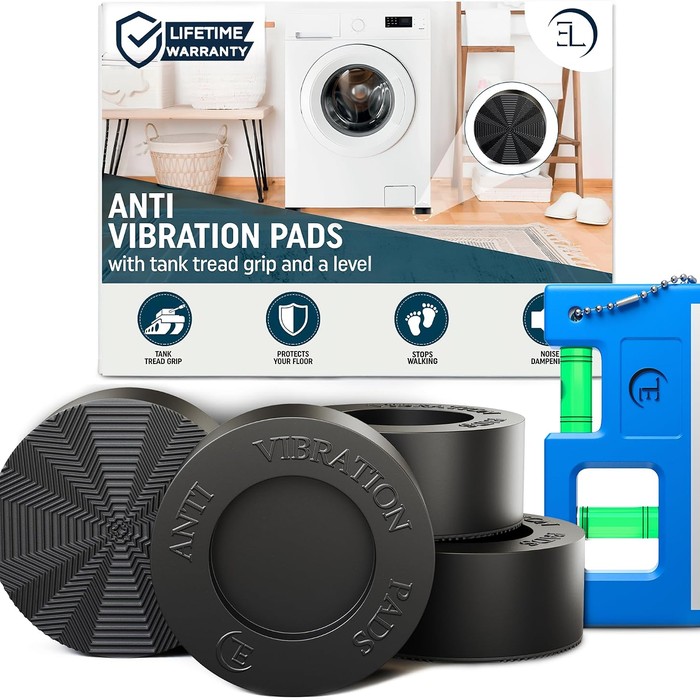
Empire of Electronics anti-vibration pads, 4-pack with level
A four-pack of cup-style pads with a tank-tread grip, sold with a small level. The listing limits use to round feet under a stated diameter and height, so measure before ordering.
- Role: Amazon consumer option
- 4-pack plus level
- Tank-tread grip
- For round feet
- MOQ: Check current listing
When anti-vibration pads are the wrong purchase
A pad cannot take the place of a missing leveling foot, remove a transport bolt, or quiet a washer whose empty spin bangs hard. A floor that visibly dips, or a loose pedestal under the washer, also calls for correction rather than thicker rubber. Whirlpool recommends contacting support or arranging service when its installation and load checks do not solve the movement.[1]
The simplest reason to pass is also the easiest to overlook: the pad does not fit your room. A cup that is too narrow will not capture a foot; a thick base may hit a shelf or reduce headroom under a stacked dryer; a tight closet may leave no safe access to the rear. If the seller does not state the opening, height, pack quantity, and exclusions, you do not have enough information to judge fit.
Cases that need a separate check
A washer can read level and still move during spin. The bubble is only one check: the cabinet also needs all four feet planted, a balanced load, and a floor that does not flex. If the level looks right but an empty cycle still bangs, the test has ruled out only some causes. Follow the model’s troubleshooting page before deciding the pads are the answer.
A stacked washer is a different installation from a freestanding one. The washer manual and stacking-kit directions need to allow pads beneath the feet, and the added height must not affect the dryer’s position or the available clearance. Loose pads do not belong between the washer and dryer. Where instructions are unclear, ask the installer who fitted the kit.
Adhesive is not an automatic fix for a cup that slides on tile. Glue may leave a mark or make it harder to level and move the washer for repair. Check whether the foot is too wide, whether it sits centered, and whether the machine is pushing the cup away. Use adhesive only if both the pad and floor makers approve it.
The sources reviewed do not give one replacement interval for every pad material. Inspect a set when cleaning or if the washer starts shifting again. A torn cup, compressed spot, split, or pad that no longer holds the foot centered is a reason to replace it, following the product maker’s directions.
A practical buying decision
Before buying, I would want three things to be true: the washer stays planted when gently rocked, the floor does not visibly flex, and the foot measurements fall inside the pad’s actual opening. Then check the extra height against the lid, shelving, stacked dryer, and hose route. If any of those checks fails, a different pad will not make the installation a safe fit. If it passes, install all four pads as directed and recheck the washer’s level.
The linked four-pack is worth considering only for that measured fit. Its listing says the feet must be under 1.75 inches, leaves about one inch of overhead clearance, and names Samsung models it excludes. Those limits make this a poor impulse buy but a reasonably checkable candidate. The listing’s measurements are the reason it appears here; it is not a fix for an unbalanced load, a flexing floor, or a washer that needs repair.
References
-
Whirlpool, “Washer Walking and/or Vibrating - Front Load Washer.” Source
-
GE Appliances, “Front Load Washer - Walking, Vibrating, Shaking, or Moving.” Source
-
LG, “Front Loader Installation Tips.” Source
-
Better Soundproofing, “Best Anti-Vibration Pads and Mats for Washing Machines and Dryers.” Used for category/product-format comparison; its recommendations are the publisher’s assessments, not independent test results. Source
-
GE Appliances installation video, “AntiVibration Pads Installation.” Source
Hook this up to your favourite commenting platform — Giscus, Disqus, or your own.
Continue reading

When a Silicone Faucet Mat Pools Water, Check the Fit and Drain Path
A mat that holds a puddle is failing at one of three points: the counter does not drain toward the bowl, the mat is set the wrong way, or its outlet is blocked.
How to Keep a Cutting Board From Sliding on a Countertop
Most boards move because of a film of water or oil, a warped corner, or an overhang, not because the board is light. Find the cause, then pick a damp cloth or a grip pad.

Window Screen Spline Keeps Popping Out? Match the Cord to the Frame and Mesh
The cord that holds the mesh is sized to the frame groove, not to the window. Read the failure pattern, measure the channel, and test a few inches before you roll a whole screen.