When a Silicone Faucet Mat Pools Water, Check the Fit and Drain Path
A mat that holds a puddle is failing at one of three points: the counter does not drain toward the bowl, the mat is set the wrong way, or its outlet is blocked.
 Lena Schmidt
Disclosure: We may earn a commission if you purchase through links on this page, at no additional cost to you.
The short answer
A silicone faucet mat that holds a puddle is usually failing at one of three points: the counter does not fall toward the sink, the mat is sitting in the wrong direction or is bowed, or water cannot pass the mat’s outlet into the basin. Start by removing the mat and watching where a teaspoon of clean water runs on the bare counter. If it runs away from the sink, a sloped mat may not overcome the counter’s shape. If it runs toward the basin, reinstall the mat without forcing it around the faucet, then test the drainage path with a small amount of water. That separates a fit problem from a slope problem before you cut, replace, or permanently seal anything.
These mats are small, repeat-use accessories, but “self-draining” is not a guarantee that every sink geometry will drain. A listing’s stated angle describes that product design; it is not a universal slope requirement for countertops. The right purchase is the one whose opening, depth, width, back edge, and outlets match your faucet and sink deck. A mat can catch splashes yet still leave water around the base if those pieces do not line up.
First work out what the water is doing
Dry the counter and mat completely. Then use the sink normally for a minute and observe the water source. A wet area that appears only after washing hands or rinsing dishes is probably splash or drips. A ring that returns while the faucet has been off may come from a faucet-base leak, a loose connection, or water trapped beneath the escutcheon. A mat is not a repair for a leak. If water reappears without splashing, remove the mat and inspect the faucet base and visible plumbing; stop using the fixture and seek repair if water is reaching the cabinet or the leak is worsening.
Next, test the bare deck. Put a few drops of water on the counter behind the faucet, away from the sink edge, and watch them rather than flooding the area. Note whether they travel toward the basin, toward the backsplash, or settle in a low spot. Wipe the counter dry after the test. A level or phone inclinometer can help compare surfaces, but do not treat a single reading as an installation specification. Countertop shape, seams, sink rim, faucet plate, and local dips matter more than a headline angle.
If the bare counter drains toward the bowl but the installed mat collects water, inspect the mat’s orientation and contact points. Many mats have a raised back lip or a curved edge intended to sit near the wall, while their lower front edge or channels point toward the sink. Rotate it only if the product instructions allow it. A mat placed backwards can create a tiny dam. A rolled corner, soap bottle underneath, or cord from a dispenser can also lift one side and redirect the water into a pocket.
Check fit before blaming the silicone
Measure the usable deck, not just the sink width. Record the flat depth from faucet center to the sink rim, the clear width to the left and right, and the distance from the faucet to the backsplash. Include soap dispensers, filtered-water taps, sink buttons, deck plates, and any curved transition in that measurement. A long mat may extend across the counter but still fail if its rear edge has to climb a rounded backsplash or if the ends cover fixtures. A short mat can be a better fit where the basin has a narrow rear deck.
Measure the faucet’s mounting base at the widest point. The hole in a mat must sit close enough to that base to avoid a moat, but it must not be so tight that it bunches, stretches, or prevents the faucet handle from moving. Check whether the faucet has a separate deck plate. A wide plate may be too broad for a mat designed to wrap around a narrow stem; cutting a larger hole does not fix the gap between plate and silicone. The Pilova compatibility guide, for example, publishes its own supported faucet-hole and clearance ranges and lists wide bases and side-faucet layouts among its incompatibilities. Those are product-specific limits, but they show why “fits most” is not a measurement.
Before buying, lay a paper template over the deck. Mark the faucet center, base outline, wall, sink rim, and nearby fixtures. Then compare that footprint with the product’s actual dimensions and cutout instructions. Look for photos of the underside and drain channels, not only a staged top view. If the center opening is adjustable, check whether it is designed to be trimmed and whether trimming is reversible; usually it is not. Do not cut until you have checked that the opening can clear the faucet base and still sit flat.
Trace the outlet instead of guessing
Water needs a continuous route off the mat and into the basin. Follow each shallow groove or spout by eye. Does it end over the sink bowl, or above the counter behind the sink rim? Does the sink rim sit higher than the mat’s exit? Is a raised lip blocking the channel? A product can have a visible slope and still discharge onto the counter if its outlet lands outside the basin. Where the faucet sits close to a wall or on a narrow ledge, a split or shorter mat may route water better than a single extra-long piece.
Try a controlled pour after drying the surface. Add a spoonful of water near the faucet base, then watch where it goes. Repeat once on the left and right sides. If it drains from one side but pools on the other, the deck may be uneven across its width, the mat may be twisted, or one outlet may be obstructed. If it pools everywhere while the bare counter drains normally, the mat may have insufficient clearance, a reversed orientation, or a molded channel that does not match the direction of fall. The test is diagnostic, not a durability test; do not pour boiling water or use cleaners as tracers.
If water runs to the edge and stops, lift the mat and check for a bead of water or debris underneath. Grease, soap residue, crumbs, or mineral deposits can alter contact and block shallow channels. Rinse the mat according to its care instructions, dry the deck, and reinstall it without stretching. If it continues to retain water after that, do not fill the gap with caulk: a removable accessory should stay removable for cleaning, and a bead of sealant can hide water at the faucet base or interfere with service.
Choose the right kind of guard for the job
A sloped silicone mat is intended to send small drips and splashes back toward the sink. It is useful when water lands on a mostly flat rear deck, the faucet opening fits, and the outlet reaches the basin. An absorbent fabric guard works differently: it holds water in the material and must dry between uses. A rigid tray or stone-style mat may absorb or collect water, but it will not correct a counter that slopes away from the sink. Select by water path, not by “quick dry” or “anti-mold” phrases in a listing.
A mat is also not a backsplash. If a pull-down sprayer sprays behind the faucet or water hits the wall, a thin horizontal pad cannot catch droplets that travel upward or backward. Change the spray angle or reduce pressure if the spray pattern is the cause; for a persistent splash zone, a vertical splash panel may be more appropriate. A basin rim that stands proud of the counter can also block a low outlet, so compare outlet height with the sink edge before assuming that a steeper-looking mat will solve it.
Product angle claims vary. The Home Depot listing for one LAIFUCAM model describes a 10-degree slope and a cuttable opening; WeatherTech’s FaucetMat page describes a forward/downward drainage design and a Duo option for asymmetric sink arrangements. Those descriptions illustrate different product geometries. They do not establish a minimum slope for every countertop, nor do they prove that either design fits your faucet. Use the selected model’s dimensions and return terms as the decision criteria.
A simple installation and maintenance routine
Wash and dry the counter before fitting a new mat. Set it around the faucet without pulling the opening wider than needed. Keep the mat flat, make sure the outlets face the basin, and confirm that handles or a pull-down hose can move through their full range. Put the soap bottle and sponge on only after the water test; heavy items can bend a thin mat and create a low pocket. Run the tap briefly, add a spoonful of water near the rear edge, and check both discharge and the underside. If it fails this test, return or reposition it before trimming.
Lift the mat regularly rather than treating it as a permanent seal. Rinse both sides, wipe the counter and faucet base, and allow the parts to dry. Follow the care directions for the particular material; some silicone products may be dishwasher-safe, while others do not state that. Do not assume dishwasher safety from the material name alone. If the mat is discolored, sticky, cracked, or permanently deformed, replace it. If it simply holds water because the counter runs the wrong way, a new mat with the same shape is unlikely to fix the cause.
A hands-on review by Simply Recipes reported that its tested sink splash guard caught most of the water around that reviewer’s faucet, but not every splash, and that it still needed periodic scrubbing and drying. That is useful as a practical limit, not a controlled performance guarantee. Your result depends on faucet height, water pressure, user habits, deck shape, and where the outlet lands. The goal is less wiping, not a maintenance-free or completely dry sink.
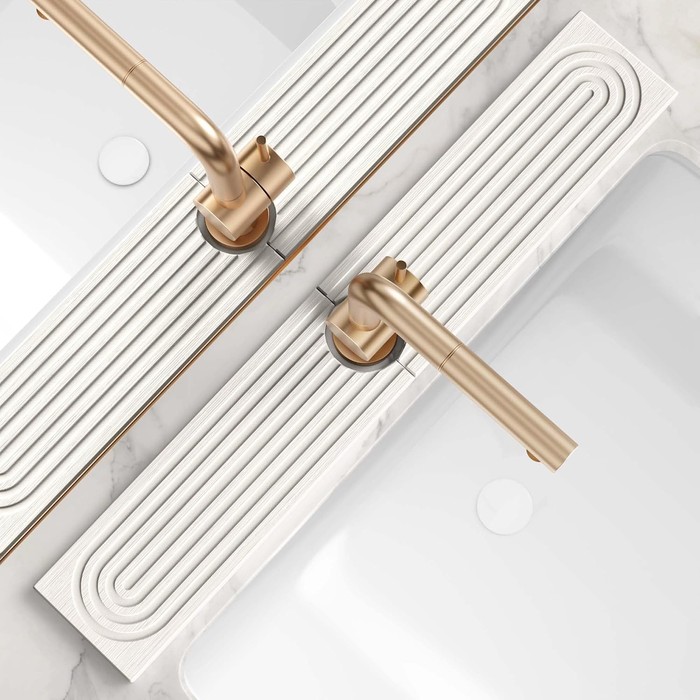
eormoe diatomite stone faucet mat, 23.6 x 3.9 in
An absorbent diatomite mat sized for the strip of counter behind a kitchen faucet. Measure the clear deck depth and the faucet base before ordering, since the opening is fixed.
- Role: Amazon consumer option
- 23.6 x 3.9 in
- Diatomite stone
- Cut-out for faucet base
- MOQ: Check current listing
When replacement makes sense
Replace the mat when it is cut too widely around a narrow stem, its edges curl, the channels are clogged or damaged, or its outlet cannot reach the bowl. Match the replacement to the actual constraint: a narrower profile for limited depth, two drainage ends if the faucet is centered and both sides discharge into the basin, a cut-to-fit opening only when the instructions support trimming, or an absorbent guard if water sits on the counter but no drainage path is available. For double basins or off-center faucets, check the outlet position carefully; a one-piece design may bridge the wrong part of the sink.
If the deck itself slopes away from the basin, pause before buying another mat. A flexible mat might conform to a small local variation, but the product’s claims cannot establish that it will overcome a reversed or dished countertop. If the area is newly wet, the sink or faucet was recently installed, or water is entering a seam or cabinet, investigate the fixture and countertop condition first. A splash guard can manage ordinary droplets; it cannot correct faulty installation or protect an active leak.
An absorbent option for a poor drain path
Where the bare-deck test shows no dependable route back to the bowl, an absorbent stone mat is a different tool from a sloped silicone guard. One current example is the Eormoe diatomite stone faucet mat. Amazon’s page currently shows a 23.6-by-3.9-inch option along with other size variants; verify the selected variant because listing options can change. This product type takes up small splashes rather than sending them down a channel, so it may suit a deck that will not drain toward the basin. It will still need care, and it will not fix water from an active leak.
Before ordering, measure the clear counter and faucet base, then compare those dimensions with the current listing’s opening and overall footprint. Stone is rigid, so do not assume that a larger cutout or a soft silicone wrap can flex around a deck plate. Check whether the piece separates or lifts into place without forcing it; read the care instructions and return terms. If the faucet mounting leaks, repair that first.
The practical decision
Use the bare-counter water test first. If drops run toward the sink but the mat pools them, correct its direction, flatness, opening fit, or outlet clearance. If the bare counter holds water or sends it away from the basin, the mat is unlikely to provide a reliable drain path; choose an absorbent guard with a drying routine or address the counter condition. If the water returns with the faucet off, treat it as a possible leak. Measuring the real deck and tracing the outlet are faster and cheaper than buying a succession of “universal” mats.
References
-
WeatherTech, “FaucetMat” product information (manufacturer description of forward/downward drain design and Duo option). Source Source
-
The Home Depot, LAIFUCAM 20 in. silicone sink splash guard listing (one model’s stated slope and cutout range; supplier-specific). Source Source
-
Simply Recipes, hands-on review of a sink splash guard (individual reviewer’s use and cleaning experience). Source Source
-
Pilova Splash Guard Installation & Compatibility Guide (product-specific fit limits and troubleshooting). Source Source
-
Kitchenguard, silicone drip-catcher demonstration on YouTube (a product demonstration, not independent performance testing). Source Source
Hook this up to your favourite commenting platform — Giscus, Disqus, or your own.
Continue reading
Do Washing Machine Anti-Vibration Pads Stop Walking?
A pad that has shifted out from under the washer is a symptom, not the diagnosis. Check the machine is stable and the foot fits the cup before buying a grippier set.
How to Keep a Cutting Board From Sliding on a Countertop
Most boards move because of a film of water or oil, a warped corner, or an overhang, not because the board is light. Find the cause, then pick a damp cloth or a grip pad.
Window Screen Spline Keeps Popping Out? Match the Cord to the Frame and Mesh
The cord that holds the mesh is sized to the frame groove, not to the window. Read the failure pattern, measure the channel, and test a few inches before you roll a whole screen.