Bouclé Sofa Discoloration: 6 Checks Before You Use Water, Foam, or a Spot Cleaner
A fabric-safe decision guide for dark seating areas, water rings, and compressed loops.
 Lena Schmidt
Disclosure: We may earn a commission if you purchase through links on this page, at no additional cost to you.
Quick answer. A light bouclé sofa can look dirty after only a few months, especially on the seat where skin oils, clothing dye, dust and flattened loops meet. The dark patch does not tell you which problem you have. It may be removable soil, dye transfer, a water ring, a change in loop direction, or a real colour change. Treating all five as “a stain” is how a small mark becomes a larger, flatter, more obvious patch.
Start with diagnosis, not a cleaner. The aim is to identify the least aggressive next step that fits the sofa’s care code, fibre blend, finish and cushion construction. A cleaner that works on a smooth polyester cushion can leave a nubby bouclé surface matted or ringed. Textile-care research also treats appearance retention and dimensional change as separate outcomes, so “the stain lifted” is not enough to call a treatment successful. [R1]
What a Dark Patch Can Mean
| What you see | Most useful first hypothesis | Safe first move |
|---|---|---|
| Even darkening on the main sitting zone | Oil, body soil or clothing transfer | Photograph, vacuum gently, then compare with an unused area |
| A sharp halo after spot cleaning | Uneven moisture or soil migration | Stop adding liquid; let it dry fully before reassessing |
| A lighter or darker patch that changes when brushed | Compressed or reversed loops | Restore direction gently; do not scrub |
| Colour on a white cloth after a hidden damp test | Loose dye or finish transfer | Stop wet treatment and ask the maker or a professional |
| Persistent change with no visible soil transfer | Possible dye/finish or fibre change | Pause home experiments and document the fabric |
These are working hypotheses, not remote diagnoses. Bouclé is a construction and appearance family, not one guaranteed fibre or finish. A product listing that says “100% polyester” may describe one sofa while another uses acrylic, linen or a blend. Find the care label, order confirmation or manufacturer specification before selecting a chemical or machine.
Check 1: Is the Colour Change on the Fibre or Only in the Loop Surface?
Take a photo in the same light from the same angle. Then use a clean, soft upholstery brush or the lowest suction setting on an upholstery attachment in one small direction. If the patch changes as the loops lie differently, texture is part of what you are seeing. If it remains the same from several angles, soil or colour change becomes more plausible.
Do not pull loops, rake aggressively or use a rotating brush. Bouclé’s visual character comes from its looped yarn structure; a rough tool can change the surface even when it removes no soil. Research on upholstery covers shows that fabric type and construction affect mechanical performance, which is a useful reason to keep mechanical action controlled rather than treating every nubby textile like a flat woven cloth. [R2]
A low-suction vacuum with a soft brush is a maintenance step, not a deep-clean claim. Move with the surface, keep the nozzle from dragging across loops, and stop if the yarn catches. Remove pet hair with a lint roller or a lightly dampened rubber glove only when the care instructions allow moisture.
Check 2: Is It Soil, Oil, or Clothing Dye?
Look at where the darkening sits. A broad, gradual patch on the seat and front edge is compatible with repeated contact soil; a blue, black or sharply edged mark after dark denim or a new garment raises a transfer question. Neither pattern proves the cause. The useful test is whether colour or residue moves to a white cloth under the sofa’s permitted care method.
Use an inconspicuous seam allowance or underside area. Follow the sofa maker’s stated dilution and method, if one exists. Apply the smallest amount, wait for the specified dwell time, then blot with a white cloth. Do not rub back and forth. If the cloth picks up the sofa’s dye, if the nap changes, or if a visible ring forms while the test dries, stop.
Do not jump to bleach, oxygen powder, alcohol, acetone, a solvent-based spot remover or a “colour restorer.” A formula that cuts oil may also disturb a coating, loosen dye or leave a light outline. For a high-value sofa, the cost of a professional assessment is usually lower than the cost of repairing a damaged panel.
Check 3: What Does the Care Code Actually Permit?
Find the permanent label under a cushion or frame, then record the exact code and the manufacturer’s wording. The code controls the decision tree. “Water-based,” “solvent-based,” “water-free” and “vacuum-only” directions lead to different treatments; a seller’s generic advice for “fabric sofas” cannot override the sofa maker’s instructions.
| If the instructions indicate | Your next decision |
|---|---|
| Water-based cleaning is permitted | Use a small hidden test, minimal liquid and controlled extraction |
| Solvent or professional cleaning is required | Use only a product explicitly compatible with that code, or call a professional |
| Vacuum-only or no wet cleaning | Stay with dry removal and ask the maker before applying chemistry |
| No code or conflicting advice | Treat as unknown; pause and request written instructions |
If the cover is removable, do not assume the inner cushion is washable. Bouclé covers can shrink, distort or dry unevenly, while foam and batting create a separate moisture problem. A cushion that is removable for access is not automatically approved for a home washing machine.
Check 4: Did a Previous Spot Treatment Create the “Stain”?
Water rings often look darker at the edge because liquid and dissolved soil did not dry uniformly. Foam can also leave surfactant residue when it is over-applied or not removed. If the sofa looked better before a home treatment and worse afterward, do not stack another product on top. Mark the treated boundary, allow the area to dry completely under normal airflow, and photograph it again.
This is where a portable extractor can help and where it can also create more damage. Extraction reduces residual moisture only when the fabric code permits the method, the nozzle is suitable, and the operator uses controlled passes. It does not reverse dye transfer or restore a permanently changed finish. Avoid steam unless the manufacturer explicitly permits it; heat and moisture can affect a textured surface in ways that a quick before-and-after photo will not show.
When a wet method is allowed, use a clean white cloth or compatible upholstery tool, keep the working area small, and remove as much liquid as the equipment instructions allow. Do not soak the cushion. Dry with ventilation, not direct high heat or a hair dryer held close to the loops. Check the underside and seams for moisture before returning the cushion to service.
Check 5: Is the Tool Matched to a Small Spot or a Whole Cushion?
Choose the least powerful tool that can complete the task under the care instructions. For a quarter-sized fresh spill, blotting and a hidden test may be enough. For a larger permitted wet-cleaning area, a portable extractor can reduce hand pressure and collect dissolved soil. For a fragile, unlabelled, down-filled or previously damaged cushion, a professional is safer than escalating tool power.
| Buyer situation | Tool role | Boundary |
|---|---|---|
| Small, uncertain mark | White cloth plus soft brush | No broad wetting until the hidden test passes |
| Permitted local wet cleaning | Portable extractor with upholstery tool | Use controlled passes; avoid saturation |
| Repeated darkening over the seat | Maintenance vacuum and fabric assessment | A machine cannot determine whether colour is permanent |
| Unknown code, loose loops or water rings | Professional inspection | Do not experiment on the visible panel |
Check 6: When Is a Sourcing Route Useful?
Sourcing volume is more relevant when you are building a care kit, buying repeated units for a showroom or cleaning service, or exploring a private-label foam product. It is not automatically the best path for one household spot. Ask for formula documentation, compatible fabric claims, SDS and packaging details, sample quantity, and a change-notification process. Do not copy a seller’s ingredient list into a safety claim.
The current candidate for a low-volume foam role is a 100 ml fabric-sofa foam cleaner listing. Its landing page shows MOQ tiers beginning at 3 boxes, a listed 3-year shelf life and a supplier shown as established for 6 years. Those fields are marketplace statements, not evidence of bouclé compatibility or regulatory approval. Request a sample and test it on a hidden swatch before any kit or private-label order.
A second candidate is a portable wet/dry upholstery spot-cleaner listing. Its role is scale-up or repeated service use, but supplier age and the complete specification should be rechecked on the live landing page before an inquiry. Treat it as a sourcing lead, not a verified machine specification.
For both sourcing paths, keep the buyer questions concrete: What exact fabric codes were tested? Is the formula intended for looped upholstery? What is the pH and solvent system? Can the supplier provide SDS, ingredient disclosure to the extent required for the market, packaging compatibility and batch traceability? What happens if the formula, pump or label changes?
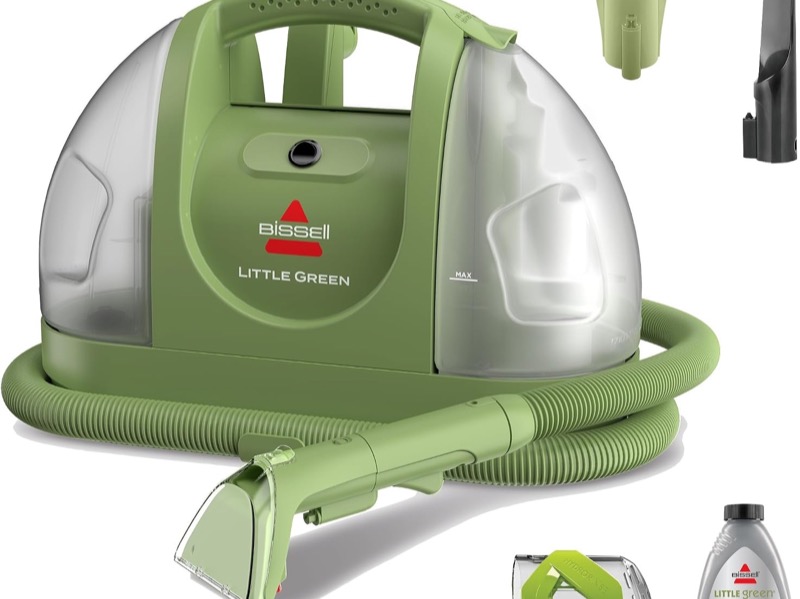
BISSELL Little Green Mini Portable Carpet Cleaner
A portable spot cleaner with a self-cleaning tool and a tough-stain tool, listed for carpets and upholstery. Use it only when the sofa's care code permits the method and the nozzle is suitable, with controlled passes rather than saturation. An extraction pass reduces residual moisture; it does not reverse dye transfer or restore a permanently changed finish. Confirm the current listing and instructions before buying.
Best for: A permitted local wet-cleaning task where the care code allows moisture and a hidden test shows no dye or texture change.
- Portable extraction cleaner
- Self-cleaning + stain tool
- Only when the care code permits moisture
- MOQ
- Retail single unit
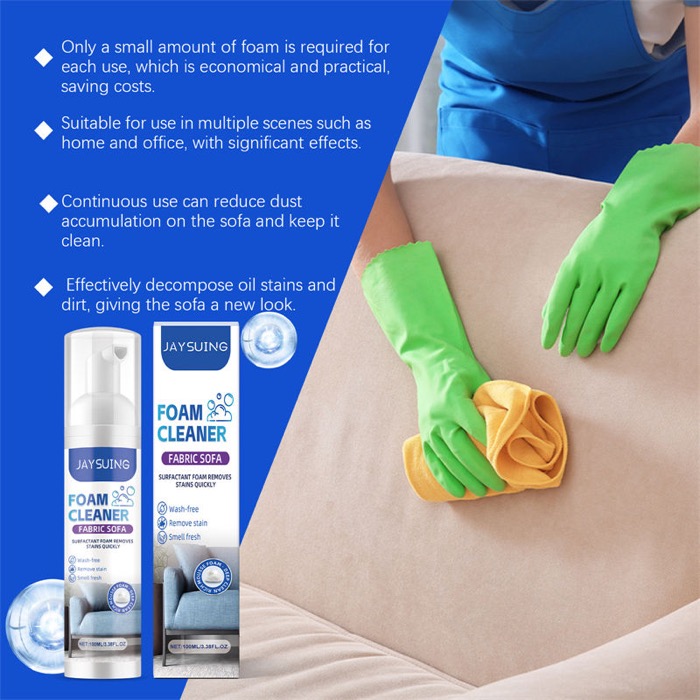
100 ml Fabric Sofa Foam Cleaner
A 100 ml fabric-sofa foam cleaner listing showing MOQ tiers beginning at 3 boxes, a listed 3-year shelf life and a supplier shown as established for 6 years. Those are marketplace statements, not evidence of bouclé compatibility or regulatory approval. Request a sample, test it on a hidden swatch, and ask for formula documentation and SDS before any kit or private-label order.
Best for: A low-volume foam role for a care kit or private-label exploration, pending documentation and a swatch test.
- 100 ml fabric-sofa foam
- MOQ from 3 boxes (listing-stated)
- Request SDS and swatch test
- MOQ
- From 3 boxes (listing-stated)
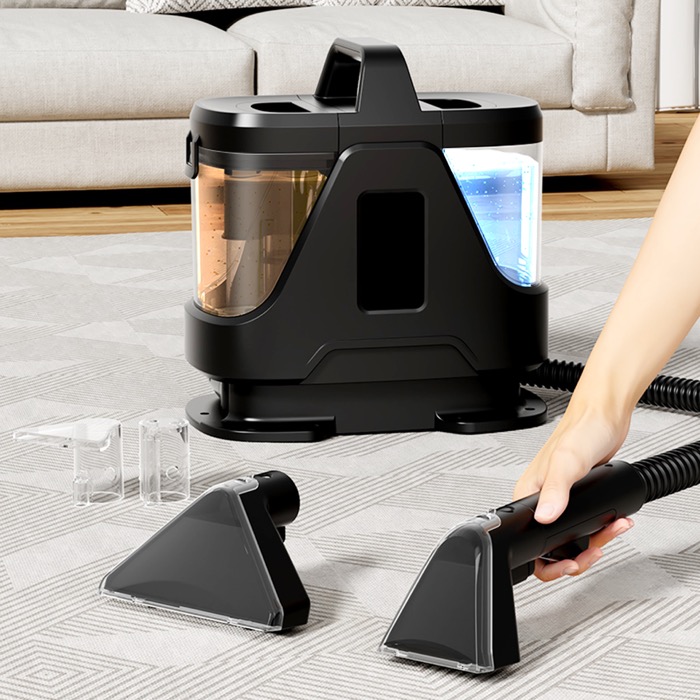
Portable Wet/Dry Upholstery Spot Cleaner, 18 kPa
A portable carpet and upholstery spot-cleaning machine listing (18 kPa class). Its role is scale-up or repeated service use, but supplier age and the complete specification should be rechecked on the live landing page before an inquiry. Extraction does not determine whether a colour change is permanent.
Best for: Scale-up or repeated service use; treat it as a sourcing lead rather than a verified machine specification.
- Portable wet/dry extractor
- Upholstery tool
- Recheck live specification
- MOQ
- Check current listing
A Practical Stop-or-Continue Decision
Continue with a local treatment only when the care code permits it, the hidden test shows no colour transfer or texture change, and the visible issue behaves like removable soil. Stop and escalate when any of these conditions appears:
- the care label is missing, contradictory or says no wet cleaning;
- the hidden test transfers dye, leaves a ring or changes the loop direction;
- the dark area is spreading, sharply outlined or linked to a coating or finish;
- the cushion is down-filled, difficult to dry or already smells damp;
- a previous cleaner made the mark larger or the texture rougher;
- the sofa is under warranty and the manufacturer has not approved the proposed method.
Document what you saw, what you applied, the amount, the tool, the date and the drying conditions. This record helps a professional distinguish a pre-existing issue from treatment damage and gives the manufacturer a useful history. If the sofa is new and the darkening appeared quickly, photograph it before cleaning and contact the seller; cleaning first can make a warranty assessment harder.
The Short Answer
A bouclé sofa turning dark is not a signal to reach for the strongest cleaner. First separate soil, dye transfer, water ring and surface-direction change. Read the care code, dry-remove loose material, and test the least aggressive permitted method on a hidden area. Use a portable extractor only when the fabric and cushion construction allow controlled wet cleaning. Use foam or sourcing candidates as inquiry options that require a sample and documentation review, not as proof that a formula is safe for every bouclé sofa.
The purchasing decision is complete only when the fabric identity, care instructions, treatment method and expected result are aligned. If you cannot establish those four points, preserving the surface and asking for expert help is the safer decision than trying another product.
References
R1. Chen-Yu, J. H., and Emmel, J. (2018). Comparisons of fabric care performances between conventional and high-efficiency washers and dryers. Fashion and Textiles, 5, 19. DOI: 10.1186/s40691-018-0135-3 R2. Lange, J., Ciura, A., Majewski, A., and Wojnowska, M. (2022). Study on the Influence of Selected Fabrics and Stitching on the Strength of Upholstery Covers. Materials, 15(11), 3854. DOI: 10.3390/ma15113854
Hook this up to your favourite commenting platform — Giscus, Disqus, or your own.
Continue reading
Should You Use a Sweater Comb or Fabric Shaver on Wool and Cashmere?
A practical decision guide for removing pills without cutting away useful fibers.
How to Wash a Wool Sweater Without Shrinking It
A care-label decision guide for washing, drying and buying the right support tools.

Chenille Sofa Pet Hair: 6 Tool Decisions Before You Scrape the Nap
A dry-first buyer guide for removing embedded fur while protecting a textured upholstery surface.