Why Your Dishwasher Top Rack Keeps Falling Off Track and What to Check First
A rack that slides out, sags on one side, or rocks is pointing at a different part each time. Check the rail stop, the wheels, then the adjuster.
 Lena Schmidt
Disclosure: We may earn a commission if you purchase through links on this page, at no additional cost to you.
A dishwasher’s upper rack can look as if it has “fallen off” for several different reasons. The whole rack may slide past a rail stop. One side may dip while the other stays level. A wheel may come out of its track, or the rack may simply bind when you pull it.
Those symptoms point to different parts. Replacing an adjuster will not fix an open track stop, and pushing a rack back in place will not repair a cracked wheel bracket. Before ordering anything, unload the rack and identify what moved: the rack, a wheel, an adjuster, a stopper, or the rail itself.
The quickest first check is at the front of both rails. If a stop is open or a wheel is visibly outside its track, the rack may have been reinstalled incorrectly or pulled past its stop. If one side sags even while the wheels remain on the rails, inspect the height adjuster and wheel supports. If the rack binds, look for debris or an obstruction before assuming a part has broken.
First, identify how the rack is falling
Pull the upper rack out only as far as it moves easily. Remove dishes first, and do not force a side that is jammed or hanging. Compare the two sides:
-
The rack slides out of the front of one rail. Check the rail stop at that side. It may be open, missing, or damaged.
-
One side drops or sits lower than the other. Look closely at that side’s wheel assembly and height adjuster. A broken attachment can let the rack tilt even if other wheels remain in place.
-
The rack rocks or a wheel pops out as you pull. Check that each wheel sits in its track and that its retainer or bracket is intact.
-
The rack stays on the rails but sticks. Look for debris in the wheels or track, and check whether a pan, utensil, or other item is interfering with movement.
These are clues, not a universal diagnosis. Rack designs differ by brand and model. Some use wheels on rails; others have different guides or height-adjustment hardware. Whirlpool’s help guidance, for example, says to check that wheels are engaged in the rail and the stopper is closed if the rack was just installed or removed. It also advises checking for debris or items that interfere with movement. [1]
Notice when the problem occurs. A rack that first slipped out after cleaning or removal points toward reinstallation or an open stop. A rack that suddenly begins to sag on one side suggests inspecting the hardware on that side. A rack that has always felt stiff may have an obstruction, alignment issue, or a design-specific adjustment step. Timing alone does not prove which part failed, but it helps you choose where to look first.
Check the rail stop before replacing a wheel
A rail stop—also called an end cap or track stop—keeps the rack from sliding off the front of its rail during ordinary use. On some designs, the stop flips or twists open to allow removal. If it is left open after the rack has been removed, the rack may pull free on that side.
With the rack unloaded, inspect both stops. They should look alike and sit in their closed position. If a stop is open but appears intact, close it only if the owner’s manual shows that it is user-operable. Whirlpool says a stopper left in the open position can let the rack pull out from that side; on the models covered by its guidance, closing the stop produces a click. The details vary, so do not rely on that sound or motion as a universal test. [1]
Look for a broken tab, a loose end cap, or a stop that no longer stays closed. A missing stop can make a sound wheel assembly seem like the problem: the wheel rolls normally, but nothing prevents it from leaving the rail. Replacing a wheel alone would leave the cause untouched.
If the stop is cracked or will not lock in place, identify the correct stop or rail assembly for the dishwasher model. The stop may be sold separately on some models and as part of a larger assembly on others. Check the parts diagram or manufacturer parts listing instead of assuming it is a standard clip.
Inspect the wheels and their attachment points
If a wheel has come out of its track, first check whether it is still attached to the rack. A wheel that is simply outside the rail may be able to be reseated; a wheel with a cracked hub, missing retainer, or broken bracket needs a compatible replacement part.
Inspect both sides rather than only the side that dropped. Compare the shape and position of the wheel assemblies. Look for a wheel that is loose, tilted, split, or missing, and for a support that has separated from the rack. Do not treat every plastic-looking component as interchangeable: wheel size, axle style, retainer shape, and mounting location can be model-specific.
Whirlpool describes its upper rack as riding on two side rails by wheels or rollers, with end stops at the front. Its removal instructions are explicitly model-specific and describe different stop designs. This is why an online video for one Whirlpool, KitchenAid, or Maytag family may not match another brand’s assembly—or even every model within a brand. [2]
If a wheel is intact but the rack continues to slip or sag, follow the assembly outward: wheel, support or retainer, adjuster, then rail. A wheel may be the visible point of failure while the piece holding it in place is what actually broke. Avoid pulling hard on an assembly to “test” it; visible looseness, separation, or cracking is enough reason to check the parts diagram.
When a height adjuster is the likely cause
A height-adjustable rack uses hardware on its sides to raise, lower, or hold the rack level. A damaged adjuster can leave one side lower, make the rack uneven, or stop it from staying at the selected height. On some designs, the wheel assembly and adjuster are connected or sold together; on others, they are distinct parts.
Remove the dishes and check whether both sides sit at the same height. If the rack is tilted, compare the left and right adjusters for a cracked housing, missing cover, loose connection, or parts that have come apart. If the rack moved after you adjusted it, use the owner’s manual to confirm how that model’s levers or buttons are meant to work. Do not force a lever that will not move.
Some adjustment procedures require both sides to be operated together. Whirlpool’s guidance for the rack models it covers says to remove dishes, use the adjusters on each side, and return the rack to a level position. That guidance is not a universal procedure for every dishwasher, so the model’s manual takes priority. [3]
A rack that drops on one side does not automatically mean the whole adjuster kit is needed. Examine the actual failure point and the parts diagram. If a manufacturer’s listing or diagram specifies a paired kit, replace it as directed; if it lists a single wheel or stop, do not assume a pair is required.
Do not overlook a bent or damaged rail
If the stops and rack hardware look intact but the rack repeatedly jumps, check the rail itself. Look for a rail that is visibly bent, loose, pulling away from its support, or different from the other side. Also check whether the rack sits evenly before loading. A damaged track or mounting point is a different repair from a replacement wheel.
Do not pry a rail straight or bend a stop back into shape just to make the rack stay in place. A bent metal tab or plastic stop may fail again, and a makeshift repair can make it difficult to tell which part needs replacement. If the rail is damaged or its attachment is inaccessible, use the manufacturer’s service instructions or arrange repair.
Reinstall the rack only if your model allows it
If you recently removed the rack and the parts appear undamaged, incorrect reinstallation is a plausible cause. But not all upper racks are designed for user removal. GE says removability depends on the model and directs owners to the model-specific manual; it also notes that some height-adjustable racks are not designed for consumer removal. [4]
For a model whose manual describes rack removal, follow that exact procedure. Whirlpool’s general instructions for the models they cover include unloading the rack, opening the stops, placing the rollers into the rail slots, and closing both stops during reinstallation. The stop design and order can differ on other machines, so treat those instructions as an example—not a universal set of steps. [2]
Once the rack is back in place, slide it in and out gently while empty. Check that both sides travel together, the rack remains level, and the stops are closed. If it tilts, binds, or slips off again, stop and inspect the part that moved instead of repeating the same reset.
How to buy the correct replacement part
Dishwasher parts are often model-specific even when listings use similar terms such as “rack wheel,” “roller,” “adjuster,” or “rail end cap.” Before buying, locate the full model number on the appliance’s rating plate and use it on the manufacturer’s parts site or in the owner’s manual. Record any suffix or series characters that appear on the label.
Then confirm all of the following:
-
The part name and position: upper rack, middle rack, left or right side, wheel or adjuster.
-
The model compatibility: the exact model number should appear in the manufacturer’s compatibility lookup or parts diagram.
-
The assembly included: a listing may be for one wheel, a pair, an adjuster kit, or a larger rack component.
-
The replacement numbers: if the listing gives superseded part numbers, compare them with the number on the original part or the model-specific diagram.
-
The return conditions: check the seller’s current policy before ordering if you cannot confirm the part from an official diagram.
Bosch’s official listing for rack wheel 10032849 identifies it for the upper rack, lists several replacement numbers, and asks buyers to check compatibility using the dishwasher’s E-Nr. That is a useful example of why a part number alone is not enough: the manufacturer still directs buyers to verify the appliance model. The listing’s compatibility and details apply to that product, not to dishwasher wheels generally. [5]
If you cannot identify whether the broken piece is a wheel, retainer, or adjuster, take a clear photo of both sides and consult the model’s parts diagram or manufacturer support. Ordering the first result that resembles the broken piece can lead to a part that mounts differently or fits another rack design.
A compatible kit example
For Whirlpool, Kenmore, and KitchenAid models in the W10350375/W10712395 fit family, the YEECHUN 11-piece upper-rack adjuster kit is one option. Amazon’s listing showed 4.6 stars from 3,016 reviews; the kit includes adjusters, positioners, track stops, and clips. Verify the full model number and original part before ordering. It is a third-party replacement, not a universal fit.
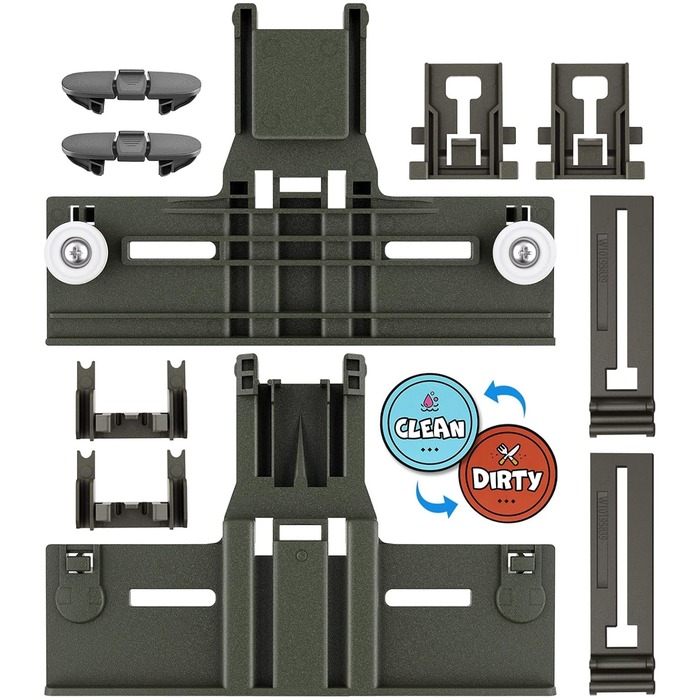
Upper-rack adjuster kit for W10350375 / W10712395
A third-party replacement set for Whirlpool, Kenmore and KitchenAid models in that fit family, including adjusters, positioners, track stops and clips. Confirm the exact model number and original part before ordering; it is not a universal fit.
- Role: Amazon consumer option
- Adjusters and track stops
- For one fit family
- Third-party part
- MOQ: Check current listing
Common questions
Can I keep using the dishwasher if the rack keeps coming off?
Unload the rack and do not keep pulling it past a stop or forcing a tilted side back into place. If it cannot travel smoothly and stay supported, identify the cause before loading it again. A loose rack can make loading unpredictable and may put dishes or rack hardware in the wrong position.
Is the top rack supposed to be removable?
It depends on the model. GE says its upper rack is not removable on every dishwasher and directs owners to the model’s manual. Some racks are designed to be removed; others may require service. Do not assume a video showing removal applies to your machine. [4]
If one wheel broke, should I replace all of them?
Not automatically. Confirm what the manufacturer sells and specifies for your model. A wheel may be listed individually, while an adjuster or support may come as a kit. Replace the components called for by the parts diagram or instructions, and inspect the matching side for damage before ordering.
Why does the rack keep sliding out after I push it back in?
Check whether the track stop is actually closed and intact, and whether the wheels are engaged in the rails. If the rack was removed recently, incorrect seating is possible. If it was not removed, a damaged stop, wheel support, adjuster, or rail may be letting it move out of position. Whirlpool’s guidance specifically identifies open stops and unengaged wheels as checks after installation or removal. [1]
When to stop troubleshooting
Do not remove an upper rack until the manual confirms it is user-removable. Stop if the rail is bent, the rack support is badly damaged, or you cannot identify the component without dismantling unfamiliar hardware. If a replacement wheel or adjuster does not match the model diagram exactly, do not force it into place.
The useful distinction is simple: a rack that slides out may have a stop problem; a rack that sags may have a wheel support or adjuster problem; a rack that binds may have an obstruction or rail issue. Identify which movement is failing, then use the full model number to find the part and procedure intended for that dishwasher.
References
-
Whirlpool Product Help, “Top Rack Falls Down - Dishwasher” Source
-
Whirlpool Product Help, “Removing the Top Rack from the Dishwasher” Source
-
Whirlpool Product Help, “Adjusting the Middle Rack - Dishwasher” Source
-
GE Appliances, “Dishwasher - Upper Rack Removal” Source
-
Bosch Home, “10032849 Dishwasher Rack Wheel” Source
Hook this up to your favourite commenting platform — Giscus, Disqus, or your own.
Continue reading

Garbage Disposal Splash Guard Replacement: Check Fit First
Two guards can look identical in a photo and fit different disposers. Confirm the model, check whether the old guard lifts out at all, and treat universal as a seller's scope claim.
Dog Poop Bag Refills: Check Roll Fit Before You Buy
Bag width and length do not tell you whether a refill fits the dispenser. Compare roll diameter, usable width and the core before you buy a multipack.

Toilet Brush Refills: Check the Connection Before You Buy
A refill that will not fit is usually the wrong coupling, not a badly made brush. Identify the handle, compare the connector, and dry-fit before you trust the word universal.