Shower Curtain Blowing In? Choose the Right Fix for Your Tub
Check the tub surface and the liner fit before buying anything. Weighted hems and magnets fail for different reasons.
 Lena Schmidt

Disclosure: We may earn a commission if you purchase through links on this page, at no additional cost to you.
The quick answer
If your shower curtain keeps drifting inward, first check whether the liner is simply too light or whether its magnets are failing to attach to your tub. Those are different problems. A household magnet that sticks to the tub wall indicates that a liner designed to anchor magnetically may work. If it does not stick, choose weight that hangs from the liner itself, such as a purpose-made weighted-stone hem, or use a heavier liner. Do not buy a magnet-only liner expecting it to hold against acrylic or fiberglass.
For a low-cost diagnosis, run the shower and watch where the liner first moves. If the whole bottom edge lifts, added hem weight may help. If one side pulls away, check the liner width, rod position, and airflow at that edge; more weight at the center will not fix a side gap. If the liner already has magnets, test the tub before replacing it. This small check can prevent buying the same ineffective feature twice.
Why a liner moves inward
The inward movement is often called the shower-curtain effect. It is tempting to explain every case as hot air rising or as a simple Bernoulli effect, but the physics is more involved. Scientific American describes a computer-modeling explanation in which the shower spray helps create a rotating air vortex and a lower-pressure area that draws a lightweight curtain inward. The article also notes that the explanation is not reducible to one universal cause. The practical point is that moving air and spray can shift a light, flexible panel; the exact balance depends on the shower and room. [1]
That is why two people can try the same “hack” and get different results. A powerful spray aimed toward the opening, a thin liner, a narrow stall, a nearby fan, and an open window can all change how much the curtain moves. A heavier edge can resist movement, but it cannot correct a liner that is too narrow, twisted on its hooks, or hung outside the tub. Treat weight as one part of the fix, not a guaranteed cure.
Test the tub before shopping
Use a small household magnet on the inside vertical wall of the tub, close to the height where the liner’s magnets would sit. Test the wall rather than assuming that a shiny or porcelain-looking surface is steel: finishes can hide the material underneath. If the magnet holds firmly, a liner with lower-corner magnets may anchor there. If it slides off or does not attract, those sewn-in magnets cannot hold the liner to that surface. Acrylic and fiberglass tubs are common nonmagnetic examples, but the simple test is more useful than guessing from appearance. [2]
There is an important distinction in product descriptions. Some liners have magnets intended to stick to a metal tub. Separate magnetic curtain weights can instead come as matched pairs that clamp onto opposite sides of the fabric, attracting through the liner and adding mass. In that setup, the pair does not need the tub itself to be magnetic. Read the item description closely: “magnetic” alone does not tell you whether the magnet is meant to grip the tub, grip another magnet, or do both.
Match the fix to the symptom
This order matters. Product roundups often move straight to a “best weighted liner,” but the right answer depends on whether the issue is bottom movement, a nonmagnetic tub, a side leak, or a bad fit. Recent Reddit discussions show the same distinction in ordinary language: people complain about the “sticky dance,” report that labeled magnets or weights did not hold, and then discover that tub type and liner construction affect the result. Those reports are useful for identifying recurring frustrations, not controlled product tests.
If you rent, start with a no-drill fix
Renters usually need a solution they can remove without leaving adhesive residue or risking damage to a tub surround. Start with the no-cost adjustments: make sure the liner hangs inside the tub, use all the hooks or rings provided, and point the showerhead away from the curtain opening if the spray is striking it. If the liner is very light, replace it with a weighted option before attaching anything to the wall.
Avoid hot glue, permanent adhesive strips, screws, or improvised metal pieces on a tub or shower enclosure unless the surface maker specifically permits them. An adhesive that appears secure while dry may loosen in a wet, warm room; removing it can also mark a finished surface. Suction cups are reversible but need a smooth, clean, nonporous area and may release on textured surrounds. If you try them, follow the accessory maker’s placement instructions and check that the liner cannot fall outward and spill water.
A YouTube how-to demonstrates a more elaborate arrangement using wall hooks, a retractable reel, and weights; the creator describes a way to stabilize the curtain without relying on a metal tub. That may solve a persistent side-opening problem, but it introduces adhesive hardware and a cord that has to be positioned correctly. For a renter, inspect the wall finish and the lease before copying that setup. The useful lesson is to separate “adding weight” from “anchoring to the wall”; they are different interventions. [3]
Choosing a weighted liner
For an acrylic or fiberglass tub, look for weight that remains part of the liner rather than relying on a magnetic pull against the tub. A weighted-stone or weighted-hem design hangs vertically and adds resistance along the bottom. It can reduce billowing on many light liners, but no product description can promise that it will eliminate movement in every shower. If your current liner is already thick and still swings, check for a fan draft, direct spray, or poor fit before buying an even heavier one.
One example is the AmazerBath 8G PEVA liner with three weighted stones. Amazon’s listing showed 4.6 stars from about 92,900 reviews and “10K+ bought in past month”. Its current listing describes a 72-by-72-inch option, three weighted stones, 12 rust-resistant grommets, and care by wiping with a damp cloth. The brand recommends using all 12 hooks, avoiding direct fan airflow where possible, and tucking the lower edge inside the tub. Those are product-specific details, not universal requirements. Check the listing’s available sizes and materials before ordering. [4]
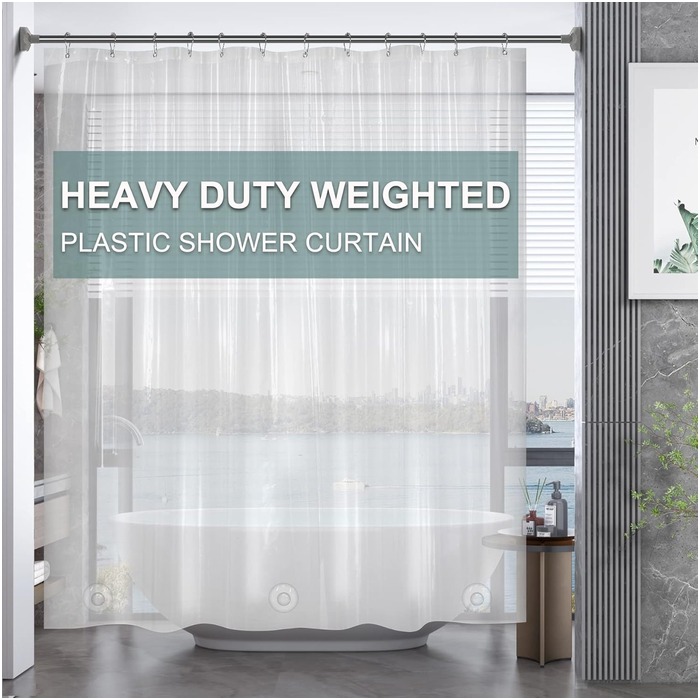
AmazerBath weighted-stone PEVA shower liner
A clear PEVA liner with three weighted stones in the hem, 12 rust-resistant grommets and a 72-by-72-inch option. The maker recommends using all 12 hooks and tucking the lower edge inside the tub. Its weight is in the liner itself, so it does not depend on magnets gripping the tub.
- Role: Amazon consumer option
- Three weighted stones in the hem
- 12 rust-resistant grommets
- Wipe-clean PEVA
- MOQ: Check current listing
The practical trade-off is straightforward: a clear PEVA liner keeps the tub visible and wipes clean, but it is not the same feel as fabric and it will not machine-wash unless the current care label says so. Confirm dimensions against your rod-to-tub drop and opening width. A 72-by-72-inch option is common, but shower stalls, extra-long rods, and curved rods may need another size. Measure the actual installation instead of treating a “standard” label as proof of fit.
When a magnetic fabric liner is a better fit
If the tub passes the magnet test and you prefer a softer fabric surface, a washable liner with corner magnets is a reasonable alternative. The magnets can attach at the bottom while the fabric hangs more naturally than a thin plastic sheet. On a nonmagnetic tub, those same magnets may contribute some weight but cannot anchor the hem to the tub wall. That limitation should be clear before purchase.
The ALYVIA SPRING 72-by-72-inch fabric liner was listed at 4.5 stars from about 61,800 reviews with “30K+ bought in past month”. Its listing describes polyester fabric, three magnets, a reinforced header, rust-resistant grommets, and machine washing; it advises using a laundry bag. It is a candidate for a buyer who wants a reusable fabric liner and has a tub that can attract the magnets. Its listing calls it lightweight, so it may not be the right answer for someone whose only priority is maximum mass at the hem. Review counts and availability change, and the current product page should take precedence over a saved snapshot. [5]
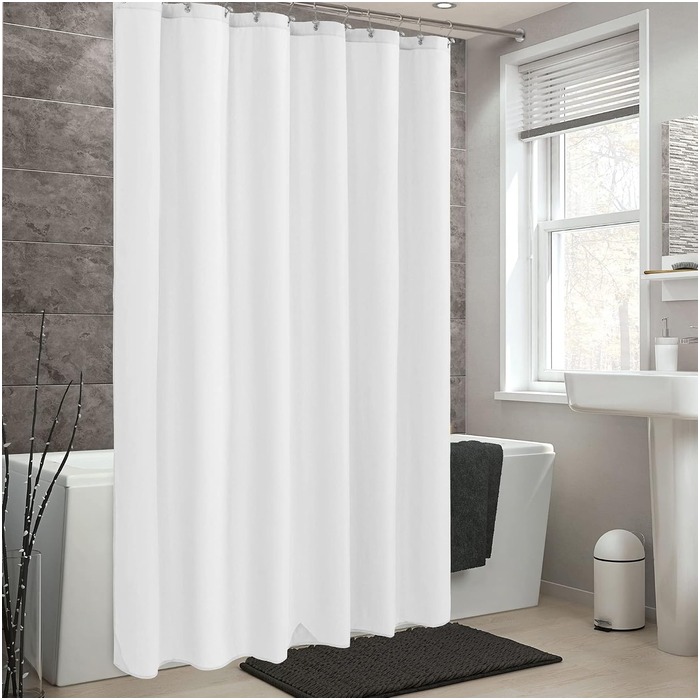
ALYVIA SPRING fabric shower liner, 72 by 72 inches
A polyester fabric liner with three magnets, a reinforced header and rust-resistant grommets, listed as machine washable in a laundry bag. It is the softer option when your tub passes the magnet test, but the listing calls it lightweight, so it is not the answer if maximum hem mass is the only goal.
- Role: Amazon consumer option
- Three magnets
- Machine washable in a bag
- Reinforced header
- MOQ: Check current listing
There is also a care trade-off. Fabric liners are washable, but they still need to dry between showers. After use, pull the liner open rather than leaving it bunched in a damp fold. Follow the care label for washing and drying; heat or harsh cleaning can damage a water-repellent finish. If you dislike laundering, a wipe-clean plastic liner may fit your routine better. Neither material is automatically more hygienic: how quickly it dries, how you clean it, and whether it is damaged matter more than the marketing label.
Install it so the feature can work
Before hanging a replacement, remove the liner from the packaging and let creases relax according to the product instructions. Confirm that the grommets fit your hooks and that the liner width covers the opening with enough fullness to move without pulling the ends inward. Hang the liner on the tub side of the decorative curtain, then place its lower edge inside the tub. If the product has magnets, align them with the tub wall and check that they actually attach; do not assume that small sewn-in weights are magnetic anchors.
If the liner uses weighted stones, distribute the hem evenly and use the hooks recommended by the maker. A single missing hook can create a loose panel that catches air differently. Keep the bottom edge from pooling on the tub floor, where it can stay wet or become a trip nuisance. The right length is the one that sits inside the rim without a large pile of material. There is no safe universal drop measurement for every rod and tub combination, so measure yours.
Run the shower for a short check before stepping in. Observe whether the movement starts at the center, a lower corner, or the side edge. Aim the showerhead more toward the wall opposite the opening if that is practical, and note whether the exhaust fan or an open window makes a difference. Change one variable at a time. If the weighted liner still blows inward, more mass may not be the answer; a side gap, a draft, or a rod that places the curtain too close to your body could be the remaining issue.
Troubleshooting without wasting another purchase
If magnets do not stick, verify the tub with the household test and stop buying liners on the assumption that “magnetic” means universally compatible. If the whole liner shifts despite a weighted hem, make sure the liner is not installed backward, missing hooks, or too narrow. If only one edge escapes, check the side overlap and the direction of the spray. If a suction cup fails, clean and dry the surface and confirm that it is smooth; a textured or grout-lined area may never provide a reliable seal.
If the curtain touches your body even when the bottom edge stays down, a curved rod may create more clearance, but it is not a guaranteed way to stop the airflow effect. It changes where the curtain hangs relative to you. A removable fix can also be enough: widening the curtain’s resting position, using a heavier liner, or reducing a draft may solve the comfort problem without permanent hardware. Homes & Gardens and Southern Living both mention weight and magnet compatibility, while user discussions emphasize that the result varies with the stall and the specific liner. [2, 7]
Do not add coins, loose metal washers, or sharp improvised clips to a wet liner. They can corrode, puncture fabric, scratch a finished surface, or detach. Use a product made for curtain weighting and follow its instructions. If the liner is torn, curling, or permanently stiff, replace it rather than attaching accessories to damaged material. The goal is a curtain that stays inside the bathing area without creating a new snag, surface, or maintenance problem.
What to buy
Choose the weighted-stone PEVA liner if you want a wipe-clean option and your tub is nonmagnetic or unknown; verify its size and accept that weighted edges reduce movement rather than guarantee a motionless curtain. Choose the magnetic fabric liner if you want a machine-washable cloth option and the tub passes a magnet test. If neither fits, first make a no-cost change to the spray direction or liner placement, then consider a removable side anchor compatible with the surface. For many people, the best first “purchase” is the magnet test and a tape measure.
References
-
Scientific American on the shower-curtain effect Source
-
Southern Living magnet test and practical fixes Source
-
YouTube demonstration of weights and removable side stabilization Source
-
AmazerBath weighted-stone PEVA liner Amazon listing Source
-
ALYVIA SPRING fabric liner Amazon listing Source
-
Homes & Gardens overview of fixes and compatibility Source
Hook this up to your favourite commenting platform — Giscus, Disqus, or your own.
Continue reading
Do Washing Machine Anti-Vibration Pads Stop Walking?
A pad that has shifted out from under the washer is a symptom, not the diagnosis. Check the machine is stable and the foot fits the cup before buying a grippier set.

When a Silicone Faucet Mat Pools Water, Check the Fit and Drain Path
A mat that holds a puddle is failing at one of three points: the counter does not drain toward the bowl, the mat is set the wrong way, or its outlet is blocked.
How to Keep a Cutting Board From Sliding on a Countertop
Most boards move because of a film of water or oil, a warped corner, or an overhang, not because the board is light. Find the cause, then pick a damp cloth or a grip pad.