How Many Dishwasher Pods Should You Use Per Load?
One pod per cycle is the normal starting point, but compact machines, hard water, and small loads each change what you should check before adding a second.
 Lena Schmidt
Disclosure: We may earn a commission if you purchase through links on this page, at no additional cost to you.
How many dishwasher pods should you use?
For a standard full-size dishwasher, start with one pod for one wash cycle, unless the detergent package or the manual for your exact model says otherwise. A dishwasher pod is already a measured dose; adding a second one because the load looks large, the food looks stuck, or the water is hard is not a dependable fix. Cascade says to place one ActionPac in the detergent chamber for a load, and Whirlpool likewise advises one pac per load for its guidance. [1][2]
The exception that catches people out is a compact or countertop dishwasher. These machines do not all use detergent the same way. A few compact models have detergent cups sized for measured powder, and their manuals warn that some tablets or gel packs may not dissolve fully. Check the model manual before putting a full-size pod in a mini machine. If the manual calls for a measured amount, use a detergent form that can be measured rather than cutting open a water-soluble packet. [3]
The quick rule by situation
| Situation | Practical starting point |
|---|---|
| Standard built-in dishwasher, regular cycle | One pod, if the label and model manual allow it |
| Lightly soiled load | Do not add a second pod. If you routinely wash small loads, consider a measured powder or gel and follow its label |
| Very dirty or full load | Keep to the pod label’s dose; use the appropriate cycle and load the dishes so spray reaches them |
| Countertop or compact machine | Read the exact model manual first; some compact manuals specify measured detergent or warn about packs |
| Detergent left behind | Check the dispenser, loading, cycle, and manual before changing the dose |
Why one pod is usually the starting point
Pods, pacs, and tablets are sold as premeasured units. Their convenience comes from not having to estimate a scoop for every wash. Cascade’s instructions call for one ActionPac in the detergent chamber. Whirlpool’s product guidance says one pac per load and points owners back to their specific appliance manual for model-level directions. That is a better baseline than advice such as “use two for a big dinner,” which may be based on somebody’s personal dishwasher rather than the label on yours. [1][2]
“One per load” is a dose instruction, not a promise that every pod works with every machine. Formulas, packet sizes, dispenser shapes, and cycle lengths differ. Bosch’s current-use instructions, for example, tell owners to follow detergent packaging and show a one-tablet quantity for listed cycles; the detergent table also gives separate measured quantities for powder. That illustrates why it is risky to turn one brand’s directions into a universal rule for every product and dishwasher. [4]
The same questions surface in owner discussions and how-to videos: people wonder whether a small machine needs less, whether a very dirty load needs a second pack, and whether it is safe to split one. Those posts help identify the decision points, but they are personal experiences, not controlled comparisons or model-specific instructions. A video showing a second pack is not enough to override your detergent label. [7]
If you have a full-size machine and a familiar detergent pack, the simplest routine is: use one only when both the detergent label and the machine’s instructions support it, put it in the recommended dispenser, and run the cycle suited to the dishes. A full rack is not, by itself, a reason to double the dose. Correct spacing and an appropriate cycle still matter.
Does a small or lightly soiled load need half a pod?
There is no reliable universal “half-pod” rule. If a light load is going into a regular full-size dishwasher, follow the pod label. Do not assume that breaking a packet will halve its dose cleanly. Multi-chamber or layered packs may not contain one evenly mixed detergent, and the water-soluble film is designed to remain intact until the wash. Cascade specifically says not to unwrap or puncture its ActionPacs. [1]
If you often run small loads, a measured detergent can be more practical. Powder or gel lets you change the amount within the detergent maker’s and dishwasher maker’s directions. Consumer Reports describes pacs as single-dose units and notes that gels and powders have to be measured; it also points out that smaller loads can use less gel. That is a dosing-control advantage, not a claim that powder will clean better in every machine. [5]
Do not put a half load in the machine just because you have pods to use up. Check whether your dishwasher has a half-load or small-load cycle and what detergent its manual permits. A cycle label tells you how the machine changes its wash program; it does not automatically authorize cutting a pod. If you use loose detergent, adjust it only by the package directions and your model’s manual.
What about countertop and compact dishwashers?
This is where generic advice most often fails. “One pod per load” may suit a conventional built-in machine but does not answer what a compact model’s manual allows. Compact units can have smaller detergent compartments and different cycle times. They may be designed around a measured amount of powder, or require a longer cycle when using a tablet.
For example, Danby’s manual for a six-place-setting countertop model says that some detergent tablets or gel packs may not dissolve and develop their full cleaning power in a compact dishwasher. That instruction is specific to that manual and model family, so it should not be generalized to every countertop dishwasher. It does show why the owner’s manual matters more than a broad internet rule. [3]
Before using a pod in a mini washer, look up the full model number and search its manual for “detergent,” “tablet,” “pack,” “pod,” and “cycle.” Follow the exact directions. If the manual gives a gram or spoon amount, use the detergent type and quantity it specifies. If it says packs are acceptable only with a particular cycle, use that cycle. If it rules them out or gives no clear instruction, contact the manufacturer or choose a dishwasher detergent that the manual explicitly supports.
Never solve a fit problem by forcing a large packet into a small detergent cup or by opening the packet and pouring its contents in. You can expose concentrated detergent to your hands and put the ingredients into the machine at a timing the pack was not designed for. Choose a compatible measured detergent instead.
Should you use two pods for a very dirty load?
Usually, no. If the package says one pod per cycle, doubling it ignores the product directions and may leave you with extra detergent rather than cleaner dishes. Hard water and heavy soil can change the amount needed when using a measured detergent; they do not automatically mean that a second premeasured pod is appropriate. Whirlpool’s dosage guidance explicitly says to follow the package and use one pac per load. [2]
For a heavily soiled load, first check the things that affect cleaning: scrape off large food pieces without pre-rinsing unless your detergent or machine calls for it, avoid nesting bowls, keep spray arms free to turn, and select a suitable normal, heavy, or pots-and-pans program. Use rinse aid if your manual and household results suggest it is needed. These steps address water contact, cycle choice, and drying; a second pod does not fix a blocked spray arm or a plate shielding another plate.
Do not copy a video demonstration or forum comment that puts one pod in the dispenser and another loose in the tub as a universal method. Those posts show what one person tried. The detergent maker’s instructions and your dishwasher manual are the proper sources for the dose and placement. If one labeled dose repeatedly fails, diagnose the machine, load, water, and cycle before increasing detergent.
Does hard water mean you need more pods?
Hardness can affect detergent performance, but a pod’s dose is fixed. GE’s hardness guidance gives different measured amounts of powder for softer and harder water and expressly frames those amounts for owners who are not using a pod, tablet, or packet. It would be inaccurate to take that powder chart and turn it into a recommendation to use two packs. [6]
For a pod user, check whether the detergent label says it is suitable for your water conditions and follow the manual. If glasses show mineral spots or a white film, verify the water-softener setting if your machine has one and check the rinse-aid instructions. Do not treat every cloudy glass as proof that the load needs more detergent: mineral deposits, etching, a blocked dispenser, poor loading, or a rinse-aid issue can look similar.
If you switch to powder or gel because you need dose control, begin with the amount listed for your model and product. Adjust only in the way the instructions allow, and change one thing at a time. That makes it possible to tell whether the change helped.
If a pod is left in the dispenser, should you add another?
No. A leftover or partly dissolved pod is a release or cycle problem to diagnose, not a signal to add a replacement pack on top. Cascade lists a blocked dispenser door, restricted water flow, or a pod sticking in the cup as possible reasons an ActionPac does not dissolve. Its troubleshooting page tells owners to check the loading pattern and water entry. [1]
Start with the simple checks: was the dispenser dry when you loaded the pack, did a pan handle or tall plate block the door, and did the cycle finish? On a compact machine, does the manual require a longer program for tablets? If the problem repeats, use the model-specific troubleshooting guide. Our separate guide to a dishwasher pod that does not dissolve covers that fault in detail.
How to compare cost when doses are fixed
For pods, compare package price ÷ number of pods to estimate the listed cost per dose. A 57-count package, for example, contains 57 single units; it does not mean 57 full-size loads in a model whose manual requires a smaller measured amount or does not allow packs. The product label and machine manual define compatibility.
If your dishwasher needs less detergent for small loads and you run those cycles often, compare a measured powder or gel by the amount you actually use, not just by bottle or box price. Consumer Reports notes that detergent type and formula matter to cleaning performance, while dose control can make loose detergent less wasteful in smaller loads. Do not compare products on a made-up number of “extra loads”; calculate from the label dose and your normal use. [5]
As one example of the standard pod format, Cascade Platinum Plus ActionPacs, Mountain scent, 57 count is the product link supplied for this article. It is a product example, not a claim that this formula is right for every dishwasher. Check the current package directions and your machine manual before buying or using it.
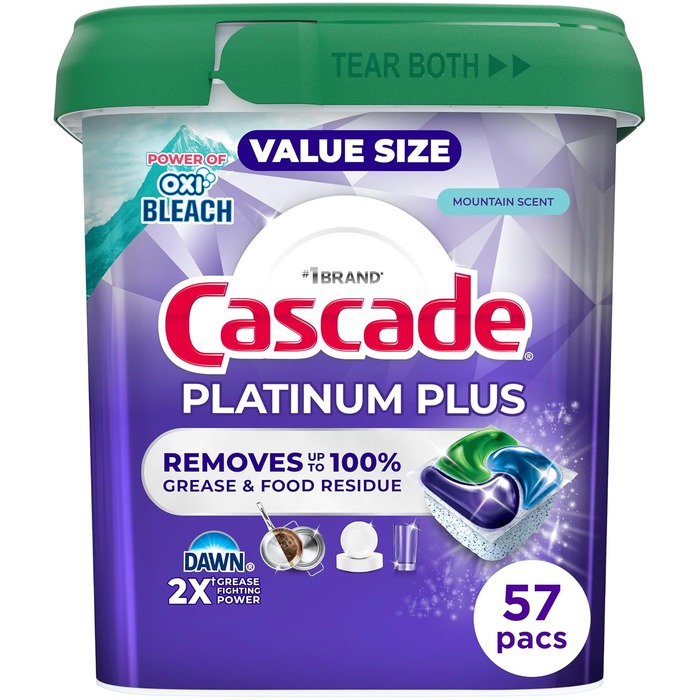
Cascade Platinum Plus ActionPacs, 57 count
A premeasured dishwasher pod in the standard format, used here as a like-for-like comparison when an older or damp supply may be the reason a pod fails to dissolve. It does not repair a blocked dispenser, a spray arm, or a fill problem.
- Role: Amazon consumer option
- 57 premeasured pacs
- Mountain scent
- Check cycle and fit in your manual
- MOQ: Check current listing
A practical decision in three checks
Before starting a cycle, ask:
-
What does my detergent label say? If it says one pack for a load, do not add a second just because the dishes look dirty.
-
What does my exact dishwasher manual allow? This matters especially for countertop, drawer, and compact models.
-
What problem am I actually seeing? Poor cleaning, residue, spots, and an undissolved packet have different causes. More detergent only answers a dosage problem when the instructions say the measured dose should change.
For a standard built-in dishwasher, one labeled pod per cycle is the sensible starting point. For a recurring small-load or compact-machine problem, switch to the detergent type and dose the appliance maker specifies rather than improvising with half or double pods.
Frequently asked questions
Can I put two dishwasher pods in for a large load?
Only if the package for that exact product or the dishwasher manual explicitly calls for two. Otherwise, follow the one-pod direction and choose an appropriate cycle. A large load still needs correct spacing so water reaches each item.
Can I cut a dishwasher pod in half?
Do not cut, puncture, unwrap, or pour out a water-soluble pack unless its manufacturer expressly instructs you to do so. For adjustable dosing, use powder or gel that your dishwasher manual permits and measure it according to the label.
Should the pod go in the dispenser or on the dishwasher floor?
Follow your dishwasher manual and the detergent label. Whirlpool recommends the dry detergent dispenser for pods and warns that loose placement can release detergent at the wrong point in a cycle. Some appliance manuals may specify another location for their design, so confirm the exact model. [2]
Is one pod enough for baked-on food?
Use the dose on the package and choose a cycle suited to the load. Some products are marketed for stuck-on food, but the claim belongs to that product and its directions. Do not assume a second pod will compensate for poor loading, an unsuitable cycle, or a machine fault.
What if the pod does not fit the detergent cup?
Do not crush it or unwrap it. Check the manual for approved pack sizes and placement. If it will not fit or the manual specifies measured detergent, choose a compatible powder or gel.
Sources
-
Cascade, “How to Use Cascade ActionPacs”. Source
-
Whirlpool, “Detergent Usage Guidelines” and “How to Use Dishwasher Pods”. Source
-
Danby DDW631WDB / DDW631SDB countertop dishwasher manual. Source
-
Bosch dishwasher instructions, detergent section. Source
-
Consumer Reports, “Dishwasher Detergent Buying Guide”. Source
-
GE Appliances, “Detergent Use and Water Hardness”. Source
-
DIY Pinto, “How To Use Dishwasher Pods” (YouTube). Source
Hook this up to your favourite commenting platform — Giscus, Disqus, or your own.
Continue reading

Garbage Disposal Splash Guard Replacement: Check Fit First
Two guards can look identical in a photo and fit different disposers. Confirm the model, check whether the old guard lifts out at all, and treat universal as a seller's scope claim.

Dog Poop Bag Refills: Check Roll Fit Before You Buy
Bag width and length do not tell you whether a refill fits the dispenser. Compare roll diameter, usable width and the core before you buy a multipack.

Toilet Brush Refills: Check the Connection Before You Buy
A refill that will not fit is usually the wrong coupling, not a badly made brush. Identify the handle, compare the connector, and dry-fit before you trust the word universal.