Do Dishwasher Pods Clog Drains? What to Check First
A pod used as directed is designed to dissolve during the wash. Standing water and a backed-up sink point at the drain path, not the film on the pod.
 Lena Schmidt
Disclosure: We may earn a commission if you purchase through links on this page, at no additional cost to you.
Do dishwasher pods clog drains?
Usually, no: a dishwasher pod used as directed is designed to dissolve in the wash, and its contents leave with the wastewater. A pod sitting in the dispenser, a film left on dishes, water standing in the tub, and a backed-up sink are four different clues. None, by itself, proves that the pod film has clogged the household drain.
There is one important qualification. Using too much or the wrong kind of detergent can create excessive suds, and GE notes that oversudsing may interfere with draining. A machine that will not drain can also have food debris in its filter or sump, a blocked or kinked hose, a sink or disposal connection problem, or a pump issue. Start by identifying where water remains; do not pour a drain opener into the dishwasher. [1][2]
Match the symptom to the likely problem
| What you see | What it points to first |
|---|---|
| Pod still in the dispenser | The door may not have opened, or the pod may have stuck or missed water; check loading and the model manual |
| Film or detergent residue on dishes | Check release timing, cycle, water contact, and the detergent instructions |
| Water at the bottom of the dishwasher | Check the filter, sump, hose, sink connection, and whether that amount is normal for your model |
| Sink drains slowly or backs up when the dishwasher drains | Check the sink/disposal and shared drain path; the problem may be in the household plumbing |
What happens to a pod during a normal cycle?
The water-soluble film around many detergent packs is made to dissolve in the wash. Cascade explains that its film dissolves in water, and the American Cleaning Institute (ACI) says detergent-pack film is designed to dissolve during the cycle. ACI represents the cleaning-products industry, so treat its broad “pods do not clog pipes” statement as an industry position rather than an independent plumbing survey. The practical point supported by manufacturers is narrower: a pack placed and used according to its label is meant to release detergent into the wash, not to travel intact down the drain. [1][2]
The dishwasher then pumps used wash water through its drain hose to a sink connection, disposal, or air gap, depending on the installation. Once the film has dissolved, there is no intact pod envelope moving through the household pipes. That is why the question “Can a dry or partly dissolved pod be flushed down a drain?” has a different answer: do not put detergent packs directly into the sink or drain. Use the product in the dishwasher as directed.
Placement also affects how well the detergent works. Whirlpool advises placing a pod in the dry detergent dispenser and checking the appliance manual for the correct location. If a pack is loose in the tub and dissolves too early, it can reduce cleaning performance; that is not the same thing as a pipe clog. A local KENS 5 report asked plumbers about a viral clog claim. One residential plumbing manager interviewed said he had not received a call in ten years where dishwasher pods were the culprit. That is useful context, but one plumber’s experience is not a controlled study or proof that a pod can never be involved in a particular failure. [3]
Why might a dishwasher stop draining?
When water remains after a completed cycle, the appliance makers’ troubleshooting pages point first to the drain path. GE lists food or other debris in the filter or sump, a kinked or blocked hose, a clogged sink drain, a blocked air gap, and a disposal connection issue. Whirlpool’s guide adds a jammed drain pump and incorrect hose routing to the checks. [4][5]
Detergent can still matter in a narrower way. GE says the wrong detergent or too much detergent can cause oversudsing that prevents proper draining. That does not mean the pod’s water-soluble film has formed a plug. It means the amount or detergent type may be interfering with the wash or drain operation. If you see a tub full of foam, stop adding detergent and follow the manual’s steps for your model. [4]
Use only detergent marked for automatic dishwashers. Hand dishwashing liquid and laundry detergent are made for different jobs; GE warns that the wrong detergent can create excessive suds. If there is a lot of foam, the useful question is “What product and how much went in?” rather than “Did the pod wrapper block the pipe?” The same applies if someone added extra detergent after seeing a dirty load. Reset to the label dose once the machine is clear and the cause is understood. [4]
Also avoid treating every drop at the bottom of the tub as a clog. GE notes that some of its models normally retain water around the sump, and the amount considered normal depends on the filter design. Check the manual for your exact dishwasher before deciding that standing water is abnormal. [4]
The timing can help locate the problem. If the dishwasher has always drained slowly since installation or since a disposal was changed, hose routing or the disposal inlet deserves attention. GE and Samsung both flag a kinked drain hose and a disposal connection that was not opened correctly; Whirlpool also describes a high loop or air gap as protection against water returning to the tub. If the machine previously drained normally and the sink now backs up too, look at the shared sink-side path before blaming a detergent change. [4][5][6]
A safe check you can do before calling for service
Work from the easiest checks to the ones that need service. Turn the dishwasher off before removing a filter or looking near the pump. Follow the manual: filter locks, covers, and cleaning procedures vary by model, and broken glass can collect near the pump.
-
Look at the sink first. If the dishwasher drains into the kitchen sink or disposal, run water in that sink and see whether it drains normally. Samsung advises checking the connected sink; if it does not drain, the issue may be in the home plumbing rather than inside the dishwasher. [6]
-
Check the tub and filter area. Remove visible food debris. If the manual allows the filter to be removed, clean and reinstall it exactly as instructed. Do not reach blindly into the pump area.
-
Check the air gap or disposal connection. If your installation has an air gap, the manual may tell you how to inspect it. A recently installed or replaced disposal can also have a drain inlet plug that was not removed; GE lists this as a cause to check. [4]
-
Look at the drain hose without disconnecting it. Under the sink, check for an obvious kink, crush, or sag. Do not pull on the hose or dismantle plumbing if you are unsure how it is installed.
-
Review detergent use. Confirm that the product is automatic-dishwasher detergent, that you used the labeled amount, and that the pod was placed where the manual says. Do not add a second pod to “push” a clog through.
If the sink backs up, the hose is damaged, water leaks, or the dishwasher repeatedly leaves substantial water after the model-specific checks, stop and contact a plumber or appliance technician. A pump, valve, installation, or house-drain issue needs diagnosis beyond changing detergent.
Is the problem in the dishwasher or the house drain?
Try the connected sink while the dishwasher is idle. If the sink itself drains slowly, that points toward the kitchen drain or disposal rather than a detergent problem inside the appliance. Samsung recommends checking the sink drain and says a sink that does not drain normally can indicate a household plumbing issue. If the sink works normally but water remains in the dishwasher, begin with its filter, sump, hose routing, and manual. If water spills from an air gap when the dishwasher pumps out, Whirlpool identifies that as a sign to inspect the hose-to-drain path or sink plumbing. [5][6]
These checks narrow down where the restriction may be; they do not prove which component failed. A clog can sit in the appliance, the connection under the sink, or farther along the home drain. Avoid repeatedly running full wash cycles when water is backing up. Stop if water leaks into the cabinet or onto the floor, and get the connection inspected before more water is pumped into it.
What social posts and videos get right—and where they stop
Search results and homeowner threads show why the claim keeps circulating: some people report drain problems after switching to pods, while others say a plumber found food debris, a poor hose run, or another existing restriction. These are accounts of individual homes, not a way to establish cause. A post that says “I changed detergent and the sink backed up” does not show whether the filter, disposal, pipe slope, or drain hose was already restricted.
The KENS 5 video is more useful than a rumor because it interviews plumbing and home-service professionals. It still covers a few expert conversations, not a measured comparison of hundreds of drain systems. The manufacturer troubleshooting pages are stronger for diagnosing a specific dishwasher because they describe the components and checks used for that machine. Put the sources together this way: there is no sound basis for assuming that ordinary pod use is the cause of a clog; if drainage fails, inspect the actual drain route and detergent conditions. [3][4]
One repeated online suggestion is to put the pod directly on the dishwasher floor to avoid a stuck dispenser. Do not treat that as a universal fix. Whirlpool’s placement advice is the dry dispenser, and the exact model manual takes precedence. Early release can leave dishes dirty even if the machine eventually drains. If the pod is not dissolving, use a dedicated troubleshooting guide rather than trying random placement changes. [5][7]
Do not pour a chemical drain cleaner into the dishwasher
Chemical sink and drain openers are not dishwasher cleaners. GE explicitly says not to use chemical drain cleaners in a dishwasher because caustic products can damage internal rubber parts. If the dishwasher will not drain, use the appliance maker’s filter, sump, hose, and air-gap instructions. If the sink drain itself is blocked, handle that plumbing problem separately or call a plumber; do not send a dishwasher pod, concentrated detergent, or drain opener through the appliance to clear it. [8]
Is switching from pods to powder the answer?
Not automatically. Switching detergents can help if your machine manual requires a measured product, if a compact model has trouble with a pack, or if you have been using more detergent than the label allows. It will not clear a blocked filter, kinked drain hose, clogged air gap, or obstructed sink connection. Diagnose the location first, then choose a detergent the manual permits.
If your model manual allows a brush on the removable filter, a soft nylon dish brush can help loosen residue from accessible surfaces. The Dawn soft-nylon dish brush is one option; use only the bristle head, and keep its scraper away from mesh and pump parts. Filter materials differ: GE recommends a sponge for its ultra-fine filters and says a soft brush or sponge may be needed for stubborn soil on some fine filters. Follow your own manual if it is more restrictive. The brush is optional and will not clear a blocked hose. [9]
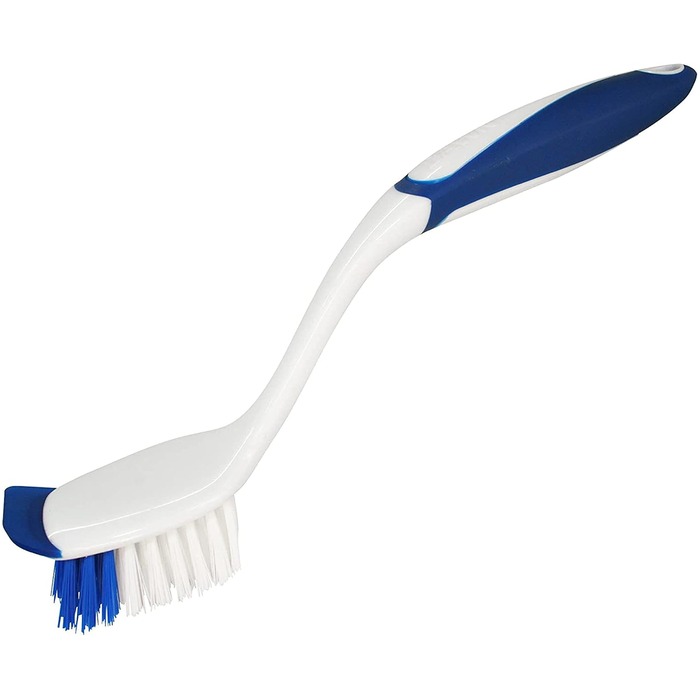
Dawn soft-nylon dish brush
A soft-bristled brush for loosening residue from accessible filter surfaces when your manual allows it. Use the bristle head only and keep the scraper away from mesh and pump parts.
- Role: Amazon consumer option
- Soft nylon bristles
- Built-in scraper
- Optional, not a drain fix
- MOQ: Check current listing
Frequently asked questions
Can dishwasher pods clog a sink drain?
When used as directed in a working dishwasher, the pod’s film is designed to dissolve during the wash. If the connected sink backs up when the dishwasher drains, check the sink, disposal, air gap, hose, and plumbing rather than assuming the pod film caused the blockage.
What if I find a pod in the filter?
Do not run another pod to push it through. Turn the machine off, use the owner’s manual to inspect the filter area safely, and check whether the dispenser opened and the wash water reached the pack. If the pack is intact or the issue repeats, follow the manufacturer’s troubleshooting steps.
Is it normal to have water left at the bottom?
It depends on the model and where the water sits. Some dishwashers retain a small amount in the sump area; water covering the tub floor or remaining in a large amount can indicate a drain problem. Use the manual’s guidance for your exact model.
Can I use a dishwasher pod to unclog a drain?
No. A detergent pod is for a dishwasher wash cycle, not for a household drain. It is not a drain opener and should not be placed in a sink, disposal, or drain line.
Should I stop using pods if I have an older home?
Age alone does not establish that pods are causing a blockage. If clogs recur, have the drain route and dishwasher installation checked. You can use a measured powder or gel if your manual allows it, but changing detergent does not repair a damaged or obstructed line.
Sources
-
American Cleaning Institute, “Laundry & Dishwasher Pods Explained”. Source
-
Cascade, “PVA Smart Film”. Source
-
KENS 5, “Can dishwasher pods clog up your pipes?” (YouTube). Source
-
GE Appliances, “Dishwasher Not Draining”. Source
-
Whirlpool Product Help, “Dishwasher Not Draining”. Source
-
Samsung Support, “What should I do if my dishwasher stops draining?”. Source
-
Whirlpool, “How to Use Dishwasher Pods”. Source
-
GE Appliances, “Use of Drain Cleaner”. Source
-
GE Appliances, “Dishwasher - How to Clean Fine and Ultra Fine Filters”. Source
Hook this up to your favourite commenting platform — Giscus, Disqus, or your own.
Continue reading
Do Washing Machine Anti-Vibration Pads Stop Walking?
A pad that has shifted out from under the washer is a symptom, not the diagnosis. Check the machine is stable and the foot fits the cup before buying a grippier set.
When a Silicone Faucet Mat Pools Water, Check the Fit and Drain Path
A mat that holds a puddle is failing at one of three points: the counter does not drain toward the bowl, the mat is set the wrong way, or its outlet is blocked.
How to Keep a Cutting Board From Sliding on a Countertop
Most boards move because of a film of water or oil, a warped corner, or an overhang, not because the board is light. Find the cause, then pick a damp cloth or a grip pad.