Shrink Band Problems and Fixes: Wrinkles, Holes, Loose Bands and Crooked Tears
A symptom-by-symptom guide for people shrinking bands by hand: what each fault looks like, which cause the supplier instructions actually name, and which fixes are reasoning rather than a sourced rule.
 Lena Schmidt
In this guide
- The application method the sources agree on
- Heat source: what the sellers actually say
- Symptom-by-symptom fixes
- Wrinkles: heat, folds and size
- Holes and burn marks
- Slipping, loose bands and caps that still turn
- Crooked or hard-to-start tears
- A practice plan that costs under a dollar
- When to change the band, not the technique
- Wet, sticky or cold surfaces
- Heat and the contents of the bottle
- Mistakes that waste bands
- The heat source this guide assumes
- FAQ
- References
Quick answer. Most hand-applied band faults come from five things: the wrong size, no bead on the neck, heat that is too close or too long, a heat source that is too weak for the film, and a wet or sticky surface. Uline’s instructions say to rotate the container, apply heat evenly around the whole circumference, start and finish at the perforation, and not hold heat on one spot. TricorBraun advises staying 6 to 12 inches away from the bottle. A listing for PVC bands says shrinking begins at 125 °F and recommends 200 to 320 °F, and that hair dryers do not get hot enough, though other sellers say a hair dryer works for their film. Change one variable at a time and log each trial.
The application method the sources agree on
Before troubleshooting, make sure the basic method is right, because several packaging suppliers publish nearly the same one. TricorBraun’s guide says to fill the container and apply the closure, slide the band over the neck and closure, and apply heat evenly with a heat gun until the band has shrunk. Uline’s instruction sheet adds two details: hold the band in position with your hand and rotate the container so the shrink is even, and start the heat gun about 12 inches away, moving closer as needed. The band shrinks to fit within a few seconds.
Distances vary a little. TricorBraun says to stay 6 to 12 inches away and warns that being too close can melt or deform plastic bottles, jars and closures. Glassnow suggests a low or medium setting at 6 to 8 inches, moving the gun slowly around the band and rotating the bottle if needed. A hot sauce maker on a forum reported using a gun set to 360 degrees about 4 inches from the bottle. That is one user’s setup for one film and one bottle, not a recommendation.
Uline also states a rule that matters for tamper evidence: shrink bands must grip both the bottle cap and the bottle neck to be considered tamper evident. A band that only hugs the cap is a cover, not a seal. Keep that in mind in the faults below.
Heat source: what the sellers actually say
The most argued point is whether a hair dryer will do. The published statements do not agree, and the disagreement tracks the film. A PVC band listing on epackagesupply.com says shrinking begins at 125 °F, recommends 200 to 320 °F, and states that a heat gun is required because hair dryers do not get hot enough. A Cork Store help page gives 180 to 260 °F as the ideal range for PVC shrink capsules with a handheld heat gun. A listing for a 0.04 mm PETG band says heat guns shrink it fast and hair dryers barely work.
On the other side, Lappe’s Bee Supply says its 63 mm safety bands can be applied with a standard heat gun or a hair dryer, Dadant says a hot-air hair dryer works for its honey container bands, and Wholesale Supplies Plus reviewers describe soap bands shrunk with a hair dryer, though several say a heat gun gives a smoother result. Bramble Berry says a heat gun gives the best results.
Read together, the sources say a hair dryer can work on some thin PVC bands and fails on others, and that a heat gun is the safer choice. The lesson is to test your heat source on your film before you order, and to ask the supplier which tool the film is designed for. A heat gun’s nozzle can be far hotter than the surface temperature of the film. One supplier’s basic heat gun is specified at 600 °F on low and 1,000 °F on high at the nozzle, which is why distance and movement matter.
Symptom-by-symptom fixes
The table lists nine faults. “Sourced” means a supplier instruction, manual or buyer comment says it. “Reasoning” means the conclusion is inferred from how the film and the container behave, and it should be tested before you rely on it.
| Symptom | Likely cause | What to try | Basis |
|---|---|---|---|
| Wrinkles, uneven or “striped” shrink | Heat applied unevenly, or band much wider than the neck | Rotate the container; heat all the way round; start and finish at the perforation; check size against the lay-flat rule | Sourced (Uline); size link is reasoning |
| Holes or burn marks | Heat too intense or held too long | Move the nozzle farther away or turn the dial cooler; keep moving | Sourced (Uline gun manual) |
| Band curls up at one point | Heat held in one spot | Keep the gun moving slowly round the band | Sourced (Glassnow) |
| Band stays loose | Heat source too weak for the film, or band too wide | Try a heat gun; test a narrower band | Sourced for heat; size is reasoning |
| Band slides off | No bead or lip on the neck, or band does not grip cap and neck | Check the neck bead; try a taller or narrower band; test on that bottle | Sourced (TricorBraun, Uline, buyer review) |
| Cap turns inside the band | Band is hugging the cap but not gripping the neck | Same as above; do the pull and twist test | Sourced (buyer review) |
| Crooked tear line | Band not fully opened before shrinking | Open the band fully; start shrinking on the folds so they flatten | Sourced (buyer review) |
| Container or cap distorts | Gun too close | Stay 6–12 inches away; test on empty containers | Sourced (TricorBraun) |
| Patchy shrink over a sticky area | Product residue under the film | Wipe the cap and neck dry before banding | Reasoning |
Wrinkles: heat, folds and size
Wrinkles are the most common complaint, and the sources point to two causes. Uline’s sheet says bands burning or shrinking unevenly is solved by applying heat equally around the entire circumference of the band, starting and finishing at the perforation. A buyer of a hot sauce band wrote that, when putting a band on, you should fully open the flat film and ideally start shrinking on the folds, to help them relax and flatten, which gave the straightest perforated rip line.
The second cause is size. A band that is far wider than the container has to shrink a long way, and a long shrink produces more material to bunch up. The percentages in earlier articles are a guide: published pairings usually leave 4 to 15 percent spare width over the container, while soap-band ratings for sleeves run higher because the film is stretched round corners. If you are getting wrinkles with a good technique, measure the container and compare the lay-flat width with the half-perimeter. That is reasoning from the geometry, not a sourced rule. A narrower band may fix it.
Holes and burn marks
Uline’s heat gun manual lists “holes are forming in the shrink film when applying heat” as an operating issue, and its answer is that temperature or duration of heat is too intense: move the nozzle farther from the film, or turn the dial to a cooler setting. A buyer of a bulk hot sauce band wrote that they occasionally get a few that develop large holes and have to be discarded. That can be a technique problem or a film defect, and the way to tell is to change one thing at a time.
Keep a running count. If one in fifty bands has a hole at the same temperature and distance, it may be the film; if one in five does, it is almost certainly the heat. Write the rate down for each setting. With a two- to six-cent band, a few spoiled pieces cost less than a bad habit.
Slipping, loose bands and caps that still turn
A band holds only if it shrinks under something. TricorBraun’s band pages say the bottle must have a neck bead to hold the band in place, and Uline says the band must grip both the cap and the neck to be tamper evident. A buyer of a hot sauce band reported that, because of the cap’s shape, the band gave the cap a hug but the cap could still be unscrewed with the band on. Another buyer said the band slides off a straight-sided container because it has nothing to hang onto.
These faults are not fixed by more heat. If the bottle has no bead, a hotter gun makes a tighter loop that still slides off. The fix is a different band height, a different band size, or a different container. Our sizing guide covers the lay-flat arithmetic, and the container guides in this series list what the sellers say about specific neck shapes. Always run the pull test: slide the band upward without tearing it, then try to turn the cap.
Crooked or hard-to-start tears
The perforation is a manufacturing feature, but how you apply the band changes how it behaves. The buyer quoted above found that opening the flat tube fully and starting the shrink on the folds gave the straightest rip line. Two other buyers of hot sauce bands said the perforation is not great, one adding that the part customers pull to break the seal is the weak point. That is a product issue, and no technique will fully cure it.
If you cannot get a clean tear with good technique, order a sample of a different perforation style from a second supplier before you buy a case. Our perforation guide covers the designs. Tear the band on several finished bottles, and tear one after a night in the freezer or a day in the sun if your product travels, since film stiffness changes with temperature.
A practice plan that costs under a dollar
The same buyers say the first few bands take practice. One wrote that the first three took a bit of learning with the heat gun on its low setting, another that it takes a bit of practice to get right. Plan for it. Buy a sample pack, take ten empty bottles with the closures you will ship, and run a short series.
Use a log with five columns: band size and film, heat tool and setting, distance, time per bottle, and result. Change one variable at a time: first distance, then time, then tool. Rotate the bottle by hand and finish at the perforation, as Uline advises. Stop when ten bottles in a row pass the flat, tight, pull-and-twist test. Then repeat the series on filled bottles, because liquid, wet glass and warm product change how the heat behaves.
When to change the band, not the technique
If a good technique still gives wrinkles, change the size. If a good technique still gives slipping, change the height or the container. If a good technique still gives holes at every setting, ask the supplier about the film. And if the tear line is bad, change the supplier. The temptation to keep adjusting the heat gun wastes bands. Before you order a case, make sure each fault has a cause you have actually tested.
Wet, sticky or cold surfaces
Nothing in the supplier sheets reviewed addresses residue under the band, so this section is reasoning from how film behaves, not a sourced rule. A band shrinks onto whatever is under it. If the cap rim has dried sauce, syrup or wax on it, the film can bond to the residue in patches and shrink unevenly around it. If the neck is wet from filling or condensation, the surface can interfere with how the band settles. Wipe the cap and neck dry before banding, and let a bottle that came out of a fridge or hot-fill line return to room temperature if your process allows it.
Test this on purpose. Band five bottles with a clean, dry neck and five with a lightly damp one, using the same heat setting and distance, and compare the results in your log. If the damp ones look worse, you have a process fix that costs nothing.
Heat and the contents of the bottle
The sources describe the heat as aimed at the band, but none gives a safe surface temperature for a particular bottle material or for what is inside it. TricorBraun warns that excess heat can melt or deform plastic bottles, jars and closures, which is a reason to test on empty containers of the same plastic first. For filled bottles, the cautious approach is to keep the gun moving, avoid lingering on one side, and check the product after a trial run: touch the glass, look for changes in a delicate product such as a cosmetic oil or a fresh juice, and ask your product’s supplier whether brief surface warming matters. I cannot give you a threshold for any of these, and the temperature figures quoted above are seller statements about their films, not safety limits.
Mistakes that waste bands
The same few habits show up across the buyer comments and instruction sheets. Starting too close is the commonest, and the cure is to start far and move in. Heating one side for a long time causes curling and holes. Skipping the pull test means you only find out about a loose band when a customer does. Changing three things at once makes it impossible to learn which one mattered. And buying a full case before testing a sample of the exact bottle and closure turns a cheap experiment into an expensive one.
A small habit that helps is to keep a finished reference bottle on the bench. Compare every new batch against it by eye and by hand: is the film flat, is the perforation straight, does the band hold when you push it upward, does the cap stay put when you twist. If the answer to any of these changes between batches, check the band lot, the heat setting and the room temperature before blaming the technique.
The heat source this guide assumes
Most of the fixes below depend on the heat source, so this is the tool the sections refer to: a small dual-temperature gun rather than a paint stripper.
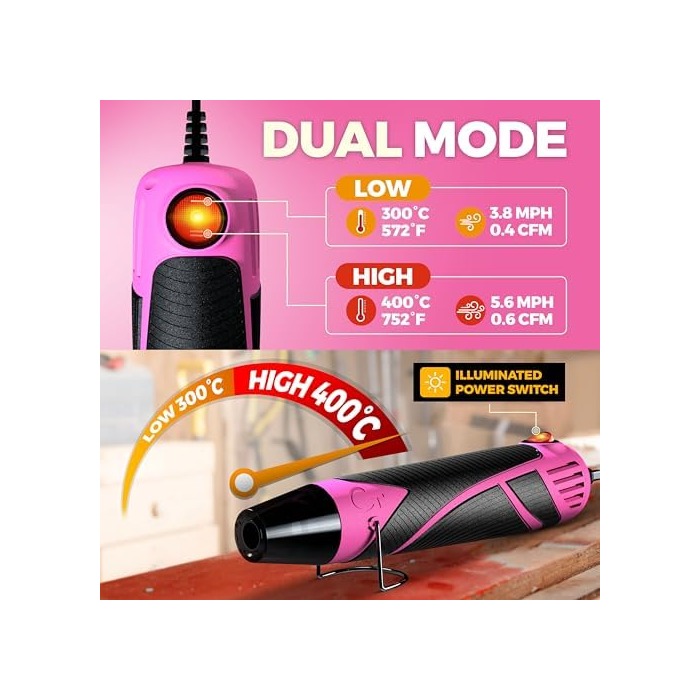
Dual-temperature mini heat gun for shrink film
A small gun with a low and a high setting, which is the range the fixes here assume.
- Role: Amazon consumer option
- Dual temperature
- Mini size
- For shrink film
- MOQ: Check current listing
FAQ
Why is my shrink band wrinkling? The likely causes are uneven heat or a band much wider than the neck. Rotate the bottle, heat evenly all the way round, start and finish at the perforation, and check the size.
How far should the heat gun be from the bottle? TricorBraun says 6 to 12 inches, Glassnow suggests 6 to 8 inches on low or medium, and Uline starts about 12 inches away and moves closer. Start far and move in.
Can I use a hair dryer? It depends on the film. One PVC listing says no, while other sellers say yes for their bands. Test your film.
Why does my band slide off? Most often the neck has no bead for the band to grip. A hotter gun will not fix that.
Why won’t the band tear straight? Open the flat band fully and start shrinking on the folds. If the tear is still poor, try a different perforation style.
References
Continue reading
Shrink Bands for Handmade Soap and Bath Bombs: How to Size the Wrap
A soap band is an open-ended sleeve, so the sizing starts from the bar’s perimeter rather than from a cap diameter. Here is the halving rule, why cured bars measure differently from fresh ones, and how loose the published soap band sizes really are.
Shrink Bands for Candle Tins: Sizes for 8 oz and 16 oz Slip-Lid Tins
On a slip-lid tin the band bridges the lid and the body, so the maths starts from the tin’s diameter rather than a bottle cap. Here are the bands two suppliers pair with their own tins, the two-line check you can do yourself, and why their suggested bands are taller than the tin.
Shrink Bands for Juice and Cold Brew Bottles: Do 38 mm Caps Need One?
Most 12 oz juice and cold brew bottles ship with a tamper-evident cap that already carries a breakaway ring. Here is how to tell whether you need a band at all, which 38 mm sizes suppliers stock, and what the cold chain changes.