Shrink Bands for Handmade Soap and Bath Bombs: How to Size the Wrap
A soap band is an open-ended sleeve, so the sizing starts from the bar’s perimeter rather than from a cap diameter. Here is the halving rule, why cured bars measure differently from fresh ones, and how loose the published soap band sizes really are.
 Lena Schmidt
In this guide
- A soap band is not a neck band
- The perimeter rule
- Measure after the bar has cured
- Sizes sellers publish
- Heat and the product underneath
- Labels, perforation and tamper evidence
- What the band costs
- When you need a fully covered product
- Keeping reorders consistent
- A twelve-bar trial
- Mistakes that make a band fail
- The band used for the trial in this guide
- FAQ
- References
Quick answer. Measure the bar’s perimeter, halve it, and choose a band whose lay-flat width is at least that. For a rectangular bar the perimeter is twice the width plus the thickness, and for a round bath bomb it is pi times the diameter. A listing for a 102 x 102 mm soap band rates it for bars of about 8 inch perimeter, and Wholesale Supplies Plus told a customer with a larger bar that the flat band needs to be at least 160 mm. Soap bands leave two sides open, which the sellers say suits cold-process soap that needs to breathe. Keep the heat gun on low and moving, and measure bars after they have cured.
A soap band is not a neck band
The other guides in this series are about bands that sit on a closure and grip a neck. A soap band works differently. It is a flat tube of PVC film that you slide over the whole bar, so the film wraps the long sides and leaves the two ends open, and then you shrink it with heat. Bramble Berry’s usage instructions say to place the soap in the band, trim off any excess plastic, and set a heat gun to low, aimed at the wrap for one to two seconds.
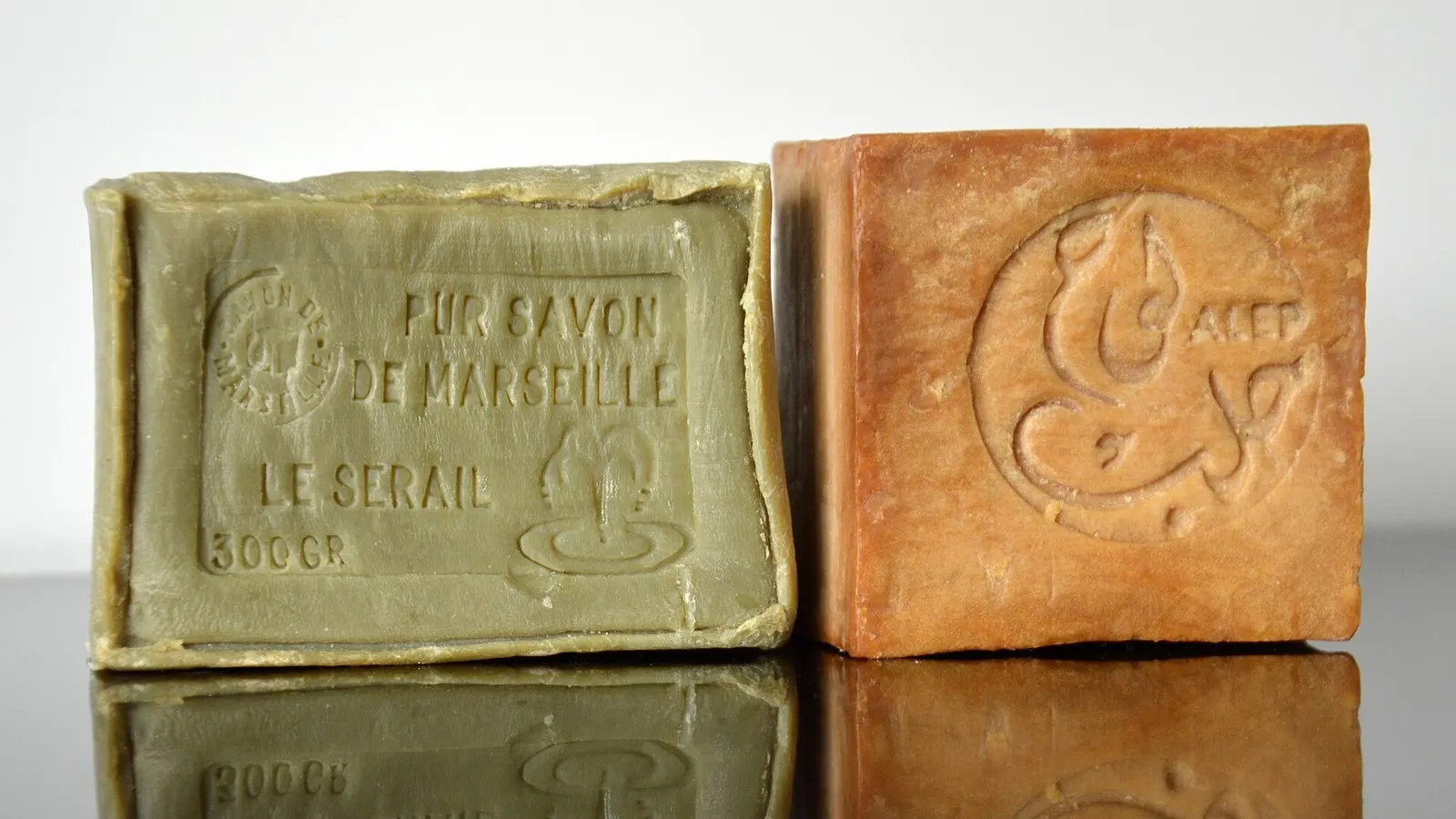
The open ends are a feature. Wholesale Supplies Plus explains that cold-process and hot-process soaps keep curing and losing water, so they need to breathe, and says shrink bands work well for them because two sides of the bar are left open to the air. Reviewers on its soap band page say the same, adding that the open ends let customers smell the soap and that the perforation gives an easy way to open the pack. The same supplier says melt-and-pour soap is different, and a visitor on a soap-making site wrote that they wrap melt-and-pour bars in craft-store cellophane because they worried about melting from the heat.
Because there is no cap and no neck bead, the question that governs everything on this page is simple: can the film go round the product? That is a question about perimeter.
The perimeter rule
A flat band of width W becomes a tube with a circumference of 2W. The product you slide in must have a perimeter no larger than that, so the lay-flat width must be at least half the perimeter. For a rectangular bar, the perimeter around the cross-section is two times the width plus the thickness. For a ball, it is pi times the diameter.
Take a bar that is 3 inches wide and 1 inch thick. Its perimeter is 8 inches, about 203 mm, so the band must be at least 102 mm wide. That matches a listing for a 102 x 102 mm soap band, which says it works best with soaps of 8 inch circumference but still works if bars are somewhat larger or smaller. A bar from a customer’s question, 3.5 inches wide and 2 5/16 inches thick, has a perimeter of about 11.6 inches, or 295 mm, and needs a band at least 147 mm wide. In a similar answer, Wholesale Supplies Plus told another soap maker that a flat band must be at least 160 mm and suggested the 170 x 55 mm size.
There is little spare width here. For a neck band the lay-flat width has to clear a rigid cap, so earlier guides looked for 4 to 15 percent spare. A soap band is thin film that can stretch around corners, but the rating of 8 inches for a 102 mm band is also the geometric limit. A bar at the top of the rating will go in tightly, so test the largest bar in your batch.
Measure after the bar has cured
A blog on soap packaging makes a point that is easy to miss: handmade soap can shrink during curing, so a band chosen from an early measurement may fit badly later. Measure the width and thickness of finished, cured bars with a caliper, take the largest bar in a batch, and compute the perimeter from those numbers. If you cut bars from a loaf, thickness and width can vary a few millimetres from bar to bar.
The Sage, a soap supplier, sells a jumbo decorated band for bars up to 3.75 inches wide and a maximum circumference of 10 inches, and says bands are sold in packs of 100. Another seller, Bramble Berry, sells large and medium soap bands, and says its medium band works with bars from its 9, 18 and 36 bar birchwood moulds and a 2 lb loaf mould. That is useful if you use the same mould, and unhelpful if you do not, which is why the perimeter rule is the reliable method.
Sizes sellers publish
| Band | Seller | What the seller says it fits | Half-perimeter it covers |
|---|---|---|---|
| 102 x 102 mm | Wholesale Supplies Plus; Bulk Apothecary; a marketplace listing | Soap bars of about 8 in perimeter (marketplace listing) | about 102 mm |
| 115 x 55 mm | Wholesale Supplies Plus | A 60 mm (2.4 in) round bath bomb; 4 oz jars | 115 mm |
| 135 x 55 mm | Wholesale Supplies Plus; Northwood | 2.75 in bath bomb mould; 2.5–3.25 in containers | 135 mm |
| 155 x 55 mm | Wholesale Supplies Plus | Jars of 2.6–3.7 in | 155 mm |
| 95 x 55 mm | Northwood | 1.75 in bath bomb mould; 1.5–2.25 in containers | 95 mm |
“Half-perimeter it covers” is the lay-flat width.
The ball maths shows how loose the ratings can be. A 60 mm bath bomb has a perimeter of about 188 mm and needs a band at least 94 mm wide, so the 115 mm band recommended for it leaves about 22 percent spare. A 2.75 inch ball, 70 mm across, has a perimeter of about 220 mm and needs at least 110 mm, so a 135 mm band leaves about 23 percent, and a 155 mm band 41 percent. Wholesale Supplies Plus told one customer the 155 x 55 mm band would be a little large for a 2.75 inch bath bomb but was the only size it carried that would fit.
Northwood’s 95 x 55 mm band, rated for a 1.75 inch bath bomb mould, is about 36 percent wider than the half-perimeter of a 44.5 mm ball, which is why its range extends to 2.25 inch containers, where the spare is under 10 percent. Bulk Apothecary says its soap band can shrink up to 40 percent of its original size. A band that is 20 to 40 percent wider than the product should shrink down, but the more oversize it is, the more likely it is to wrinkle at the open ends, so test your size.
Heat and the product underneath
Soap and bath bombs are the products most likely to be hurt by the heat that shrinks the film. Wholesale Supplies Plus’s guidance for cold-process and hot-process bars is to lay the bar front side down, use a hair dryer or heat gun on low until the band shrinks tightly, then turn the bar over and heat the other sides, being careful not to melt the soap or burn your fingers. Bramble Berry says a hair dryer works too, but a heat gun gives the best results.
Reviewers disagree on the tool. One says a heat gun makes the bands shrink better and more smoothly than a hair dryer, another is satisfied with a hair dryer, and a third plans to buy a gun to speed things up. All of them are describing soap, not bath bombs. No source was found on what heat does to a bath bomb’s surface, so this part is reasoning and not advice: apply heat briefly and at a distance, keep the tool moving, and test on a bar or ball you do not plan to sell.
Labels, perforation and tamper evidence
A band is also a packaging surface. Bramble Berry’s medium band has a tear strip for easy removal, and the Wholesale Supplies Plus bands carry a perforation. One reviewer says a shrink band solved the problem of creating a label that would show off the top of the soap. A soap maker writing for Soap Queen made a label about the size of a business card and attached it to one side of the bar, so the swirl on the other side stays visible.
If you want the band to double as a tamper-evident signal, check that the perforation sits where the customer will tear it. Northwood describes its bath bomb bands as tamper-evident, and sells them in sizes for tubes, containers and moulds. As in other categories, a seller’s description of tamper evidence is not a regulatory statement, and this guide did not research soap labelling rules for any country. Check them for your market.
What the band costs
Wholesale Supplies Plus lists its 135 x 55 mm band at about 7 cents each in packs of 50 and its 120 x 55 mm band at about 6 cents. Bramble Berry lists 250 of its large soap bands at $12.00, or 4.8 cents each, and 250 of the medium band at $12.99, about 5.2 cents. These are the prices those retailers publish, not quotes.
At around 5 to 7 cents and a scrap rate of 10 percent while you learn the heat step, a band costs roughly 5.5 to 8 cents before labour. For a bar of soap that sells for several dollars that is small. The bigger cost is time: every bar is turned and heated on each side. Time a dozen bars before you decide that every product in your line gets a band.
When you need a fully covered product
A band leaves the ends open, which is a drawback for bath bombs, whose fizz and fragrance people want to protect. A customer on one soap-making blog asked for a completely covered bath bomb with no open sides. A band cannot do that. Bulk Apothecary sells flat shrink bags, for example a 4 by 6 inch size, where you place the product in the bag, tape the open side shut with a small piece of tape and apply heat. That closes the product, but it also removes the breathing and sniffing advantages that soap makers like about bands.
No source was found comparing how well a band and a closed bag protect a bath bomb from humidity, so this guide does not claim one is better. Choose by what you promise: an open-ended band for a bar that needs air and a scent you want customers to smell, a closed wrap for a product you want sealed. Whichever you choose, say on the label how the product should be stored.
Keeping reorders consistent
Soap bars change a little from batch to batch, and so do moulds. Keep a one-line record for each product: the largest cured bar’s width and thickness, the calculated half-perimeter, the band size and seller, the heat tool and time per bar. When a reorder arrives or you change moulds, measure three bars before you open the next pack of bands.
If the half-perimeter moves by more than a few millimetres, run the twelve-bar trial again. It takes an afternoon and prevents a batch of bars that are tight, wrinkled or loose at the open ends.
A twelve-bar trial
Take twelve cured bars from a normal batch and measure the largest with a caliper. Wrap six with the narrowest band that clears the largest perimeter, and six with the next size up. Shrink them with the tool you plan to use. Check that the band is flat, the film is not wrinkled at the open ends, the label is visible, and the surface of the soap shows no gloss or softening from the heat.
Then ship two wrapped bars to yourself and open them as a customer would. Record the band size, the bar measurement, the tool and the time per bar. For bath bombs, repeat with a ball from your own mould, and inspect the surface for any change after a day.
Mistakes that make a band fail
The first is ordering by mould name when your mould is different. The second is measuring a fresh bar and ordering before it has cured. The third is using a band rated for several sizes at the wrong end of its range. The fourth is applying too much heat to one spot and leaving a shiny patch. The fifth is wrapping melt-and-pour soap the same way as cold-process soap, when the supplier says they behave differently.
The band used for the trial in this guide
One LISTING below is the stock this guide pairs with the twelve-bar trial. It is a general-purpose band rather than a soap-specific sleeve, so measure the half-perimeter of your own bar before you cut or order.
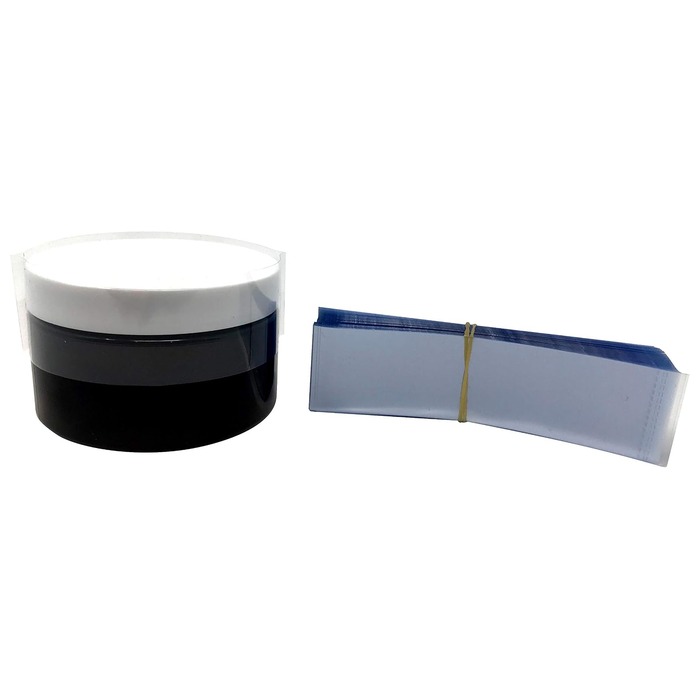
Clear perforated shrink band, 250 pack
A stock band sold for jars with 2 1/2 to 2 3/4 inch lids, 250 to a pack.
- Role: Amazon consumer option
- 250 pack
- Perforated
- Clear film
- MOQ: Check current listing
FAQ
What size shrink band fits a bar of soap? Compute the perimeter of the bar’s cross-section, halve it, and choose a band at least that wide. A 3 x 1 inch bar needs about 102 mm.
What size band fits a bath bomb? Use pi times the diameter, halved. A 60 mm ball needs at least about 94 mm, and sellers recommend 115 mm for it; a 2.75 inch ball needs at least about 110 mm.
Can I use a hair dryer instead of a heat gun? Sellers and reviewers say a hair dryer works but a heat gun gives smoother results.
Does cold-process soap need to breathe? One supplier says it does while it cures, which is why open-ended bands suit it.
Is the band recyclable? A seller lists its PVC soap bands as recyclable, but that is a seller claim; our recyclability guide explains why you should not repeat it.
References
Continue reading
Shrink Bands for Candle Tins: Sizes for 8 oz and 16 oz Slip-Lid Tins
On a slip-lid tin the band bridges the lid and the body, so the maths starts from the tin’s diameter rather than a bottle cap. Here are the bands two suppliers pair with their own tins, the two-line check you can do yourself, and why their suggested bands are taller than the tin.
Shrink Band Problems and Fixes: Wrinkles, Holes, Loose Bands and Crooked Tears
A symptom-by-symptom guide for people shrinking bands by hand: what each fault looks like, which cause the supplier instructions actually name, and which fixes are reasoning rather than a sourced rule.
Shrink Bands for Juice and Cold Brew Bottles: Do 38 mm Caps Need One?
Most 12 oz juice and cold brew bottles ship with a tamper-evident cap that already carries a breakaway ring. Here is how to tell whether you need a band at all, which 38 mm sizes suppliers stock, and what the cold chain changes.