Shrink Bands for 38 mm Caps: 66, 68 or 70 mm Lay-Flat?
A 38 mm band does not fit a 38 mm cap. The number you need sits in the high sixties, and the height matters more than the width difference.
 Lena Schmidt
In this guide
- What does “38 mm” describe?
- Where do 38 mm closures turn up?
- Which bands do suppliers sell for 38 mm caps?
- 66, 68 or 70 mm: what is the difference?
- How tall should the band be?
- Does the bottle need a neck bead?
- Which perforation should you pick?
- What do they cost?
- How do you apply one on a jug?
- Do you need a band on a 38 mm cap at all?
- Mistakes that waste a bag of bands
- Where to buy the bands
- A five-minute fit check
- FAQ
- References
Quick answer. For a standard 38-400 cap, suppliers sell bands with a lay-flat width of 66, 68 or 70 mm. All three open wider than the cap, so the choice comes down to how bulky your closure is: 66 mm for plain caps, 68 to 70 mm for ribbed, flip-top or taller closures. Choose a 25 mm height to cover a plain cap and the top of the neck, or 50 to 56 mm for long necks and dispensing lids. The bottle needs a neck bead or shoulder for the band to grip. Never order by the cap size alone, because a band listed as “38 mm” may be 38 mm lay-flat and far too small.
What does “38 mm” describe?
The thread, not the outside of the cap. A closure written as 38-400 fits a neck whose thread measures 38 mm across; the second number is the thread style [2]. The cap wraps around that thread, so its outside is wider than 38 mm, and wider again if it has ribs, a flip-top lid or a metal shell.
Bands are measured in a third way. The first figure on a band is its lay-flat width, the width of the tube pressed flat. Double it and you have the distance around the open band. One supplier puts this in its listings: the measurements are taken when the bands are flat, before application [3].
So a “38 mm” band is 76 mm around and opens to a circle about 24 mm across. It will not go near a 38 mm cap. That is the reviewer’s mistake in numbers.
Where do 38 mm closures turn up?
More places than most sizes. One distributor’s catalogue pairs 38-400 caps with a 1.75 litre drink-mixer bottle and a 16 oz hot-fill decanter, and describes its 38-400 metal caps as typically used on glass bottles, jars and jugs [7]. A food-service supplier sells 38/400 flip-top lids in several colours for squeeze bottles [4]. So the same thread appears on a syrup jug, a cold brew bottle, a sauce decanter and a squeezable condiment bottle, each with a different cap sitting on it. That variety is the reason one band width cannot serve them all.
Which bands do suppliers sell for 38 mm caps?
| Lay-flat x height | Style | What the seller says | Source |
|---|---|---|---|
| 66 x 25 mm | Clear, perforated or not | Fits 38 mm cap | WebstaurantStore [4] |
| 66 x 28 mm | Clear, non-perforated | Caps 1 1/4 to 1 1/2 inches | Uline [5] |
| 66 x 50 mm | Clear, non-perforated; also with tamper message | Fits 38 mm cap | WebstaurantStore [4] |
| 66 x 56 mm | Black, single vertical perforation | Great with 38-400 standard caps | TricorBraun [6] |
| 68 x 25 mm | Clear, single vertical perforation | For 38-400 standard caps; another seller says 38 and 41 mm caps | The Cary Company [7], Aaron Packaging [3] |
| 68 x 50 mm | Black, perforated | Fits 38 mm cap | WebstaurantStore [4] |
| 70 x 50 mm | Black, vertical double perforation | For 38 mm caps and bottles with longer necks | The Cary Company [7] |
Three widths and four heights, then, all sold for the same thread size.
66, 68 or 70 mm: what is the difference?
Start with what each one opens to. A band’s opening is its lay-flat width doubled and divided by 3.14.
-
66 mm lay-flat opens to about 42 mm.
-
68 mm opens to about 43.3 mm.
-
70 mm opens to about 44.6 mm.
The steps are small, a little over a millimetre each. All three are several millimetres wider than a 38 mm thread, which is the point: the band has to slide over the outside of the cap. A distributor’s formula gives a useful floor. Measure the circumference, halve it and add 2 mm [8]. Applied to a bare 38 mm circle that comes to about 62 mm. Real bands start at 66 mm because real caps are wider than their thread.
How to choose among them follows from that. One seller rates its 68 mm band for both 38 mm and 41 mm caps [3], which tells you 68 mm has room in hand on a plain 38 mm cap. A reviewer of a 68 x 50 mm band calls it the perfect size for a 38/400 threaded cap [4]. And one distributor adds the line that settles most cases: measure the circumference of the widest part of your closure, and test the fit [6].
The reading taken here, which is inference and not a supplier’s rule: use 66 mm for a smooth, low-profile cap, and step up to 68 or 70 mm when the closure has deep ribs, a flip-top hinge that sticks out, or a metal shell. If a band has to be forced on, it is too narrow. If it slides down past the cap and sits loose on the shoulder, go narrower or shorter.
How tall should the band be?
Heights fall into two groups: about 25 to 28 mm, and about 50 to 56 mm.
The distributor’s guide suggests a band should extend roughly 5 mm beyond the closure at the top and the bottom, so that it grips the neck as well as the cap [8]. Measure your cap’s height and add 10 mm. If the answer is near 25 mm, the short band fits. If your cap is taller than about 15 mm, the short band covers the cap and little else.
The tall bands exist for specific reasons. One distributor describes its 70 x 50 mm band as for 38 mm caps and bottles with longer necks [7]. Dispensing closures are another. A food-service supplier lists 38/400 flip-top lids alongside its 38 mm bands [4], and a band on a flip top has to reach over the lid to stop it opening. We cover that requirement in [shrink bands as an Amazon FBA double seal].
A tall band also hides more. On a clear bottle it covers the fill line and any gap under the cap, and on a printed black band it becomes part of the look. The cost is a longer tear for the customer and more film to shrink evenly.
Does the bottle need a neck bead?
According to one distributor, yes. Its listing for a 38 mm band says the bottle must have a neck bead to hold the seal band in place [6]. A bead is the raised ring of glass or plastic just under the thread. The band shrinks in beneath it and cannot ride up.
This matters on some jugs and smooth-necked bottles. If the neck is a plain cylinder below the cap, a short band has nothing to lock under. It may still grip by friction when new, but it can be worked upward. Run a fingernail down the neck under your cap. If you feel a ridge, a 25 mm band will usually catch it. If you do not, choose a taller band that reaches the point where the neck widens into the shoulder.
On jugs with a handle or finger loop moulded close to the neck, check that the band clears it. A band that lands half on the handle will shrink unevenly. That is a practical observation of ours, not a sourced one.
Which perforation should you pick?
The listings show four options.
-
Single vertical perforation. One tear line from top to bottom [6][7]. The whole band comes off.
-
Vertical double perforation. Two parallel lines, as on the 70 x 50 mm band [7]. This reads as a tear strip: the customer pulls out the strip between the lines. The listing does not describe how it opens, so confirm with the seller.
-
Non-perforated. Sold in the same sizes [4][5]. The customer needs a blade or strong fingernails. Suitable where the product is opened with tools anyway.
-
Printed tamper message. A food-service supplier sells 66 mm bands with a tamper message printed on them, in non-perforated form [4].
For a retail drink or sauce, a perforated band is the considerate choice. One buyer praises a band whose perforation does not come apart in ordinary handling and takes a deliberate effort to open [1], which is the balance you are looking for. More in perforated vs non-perforated shrink bands.
What do they cost?
| Listing | Price when checked | Per band |
|---|---|---|
| 66 x 25 mm clear perforated, bag of 250 [4] | $7.99 | about 3 cents |
| 68 x 25 mm black non-perforated, bag of 250 [4] | $7.49 | about 3 cents |
| 66 x 50 mm with tamper message, bag of 250 [4] | $8.59 | about 3.4 cents |
| 66 x 28 mm clear non-perforated, per 1,000 [5] | $20 | 2 cents |
At these prices the difference between widths and heights is a fraction of a cent. Choose on fit. One distributor notes that it does not accept returns on shrink bands [6], so a wrong guess costs you the whole bag. Buy the smallest pack first. See how much do shrink bands cost for larger quantities.
How do you apply one on a jug?
Suppliers’ instructions are short: slide the band over the capped bottle and apply heat with a hair dryer or heat gun for a few seconds [9]. A few points specific to larger containers, from the reasoning here reasoning:
-
Tighten the cap first. The band holds the cap where it is, loose or tight.
-
Dry the neck. Condensation on a cold-filled jug stops film sitting evenly.
-
Seat the band with its lower edge under the neck bead, or on the shoulder if there is no bead.
-
Heat the lower edge first so the band locks in place, then work up and around. On a jug, turn the heat gun around the neck instead of turning a heavy container.
-
Try to twist the cap. It should not move without the film tearing.
If a band splits or wrinkles, see shrink band problems and fixes. For chilled products, ask the supplier which film it supplies for cold fill, since PVC stiffens in a chiller.
Do you need a band on a 38 mm cap at all?
Not always. Some 38 mm closures carry their own evidence: a food-service supplier sells 38/400 lids with heat induction liners, which seal the mouth of the bottle under the cap [4]. If you use those, a band is a second layer. That may still be what a retailer or Amazon wants, or it may be a cost you can drop. Our comparison of shrink bands vs induction seals covers the trade-off.
On the legal question, no source was found for a general US federal rule requiring tamper-evident packaging on ordinary foods and drinks; see are shrink bands required by law. State rules and stockists’ terms may differ.
Mistakes that waste a bag of bands
-
Ordering by the cap size. The reviewer above did exactly this [1]. Look for the lay-flat width in the specification.
-
Assuming every 38 mm cap is the same. A smooth plastic cap, a ribbed one, a metal cap and a flip top all share a thread and differ on the outside.
-
Choosing a short band for a tall cap. If no film reaches the glass or plastic of the neck, the cap and band turn together.
-
Ignoring the neck. No bead and no shoulder within reach means nothing for the band to lock under [6].
-
Buying non-perforated by accident. Several 38 mm listings are non-perforated by default [4][5]. Check the word is there.
-
Skipping the trial. Bands are cheap, but one distributor will not take them back [6].
Where to buy the bands
The listing below is the shape this page works through: PVC neck bands sold by the thousand, with the width and height to be specified.
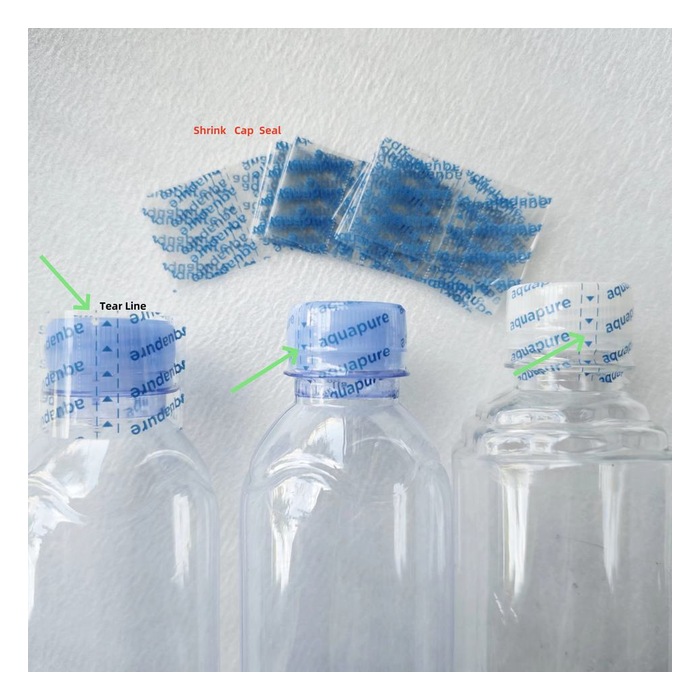
PVC shrink neck bands for bottle caps
Clear PVC neck bands in 25 to 110 micron film, sold from 1,000 pieces with the lay-flat width and height set to your neck.
- Role: Alibaba sourcing candidate
- PVC
- 25–110 micron
- Custom size
- MOQ: From 1,000 pieces
A five-minute fit check
-
Cap a filled bottle the way you will sell it.
-
Wrap a strip of paper around the widest part of the cap and mark where it overlaps. Measure the length.
-
Halve it and add 2 mm [8]. That is the smallest lay-flat width to consider.
-
Measure the cap’s height and add 10 mm for the band height.
-
Feel for a neck bead. If there is none, add height until the band reaches the shoulder.
-
Compare with the table above, and order one bag.
FAQ
Will a 66 mm band fit a 38-400 flip-top lid?
Possibly not. Flip tops are bulkier than plain caps. Measure the widest point and expect to need 68 or 70 mm and a taller band.
Is a 66 mm band the same as a “38 mm band”?
In some catalogues, yes. One distributor names its product a 38 mm shrink band, meaning a band for 38 mm caps [9]. In others, 38 mm is the lay-flat width [1]. Read the specification, not the title.
Can I use a hair dryer?
One distributor says a conventional hair dryer or a heat gun will do [9]. Results vary with the dryer, so test.
Do the same bands fit 38 mm snap caps on dairy-style jugs?
No source was found for a listing that addresses those closures. Measure the cap as above.
What thickness are these bands?
One seller gives 0.05 mm [3], which matches the 2 mil PVC that is standard for stock bands.
References
- Buyer reviews of clear perforated shrink bands listed as 38 x 28 mm, marketplace listing viewed via Desertcart. desertcart.com (individual reviews).
- SKS Bottle & Packaging, Selecting a Cap (explanation of cap size codes). sks-bottle.com (packaging supplier).
- Aaron Packaging, 68 x 25 mm Clear Flat-Cut Shrink Bands, single vertical perforation, fits 38 mm to 41 mm. aaronpackaging.com (packaging supplier).
- WebstaurantStore, shrink bands for 38 mm caps: 66 x 25, 66 x 50, 68 x 25 and 68 x 50 mm, clear, black and tamper-message versions, with one buyer review. webstaurantstore.com (food-service supplier; prices as displayed).
- Uline, Safety Shrink Bands 66 mm x 28 mm, Non-Perforated (S-16284). uline.com (retail listing; price as displayed).
- TricorBraun, 66 mm x 56 mm Black PVC Pre-Cut Shrink Band with Single Vertical Perforation, product page and Q&A. tricorbraun.com (packaging distributor).
- The Cary Company, 38mm 68 x 25 Clear Perforated Shrink Band and 38mm 70 x 50 Black Perforated Shrink Band. thecarycompany.com (packaging distributor).
- TricorBraun, Shrink Bands for Bottles & Jars: A Sizing Guide. tricorbraun.com.
- Berlin Packaging, 38 mm PVC 1 in Shrink Bands (clear and black). berlinpackaging.com (packaging distributor).
Continue reading

Stand-Up Pouches: Fill Weight, Gusset and Usable Height
A pouch is listed by three numbers and none of them is the fill volume. Width, height and gusset describe a flat sheet of film, not the space left after the seal.
Spice Shaker Caps: Hole Size, Fit and Product Match
A shaker cap is three parts that are usually sold separately: the base, the rotating or flapping lid, and the liner. Buy them apart and the hole size is the last thing you check.
Metal Balm Tins: Fill Weight, Lid Type and Label Area
The ounce stamped on a balm tin is a trade size, not a fill weight. A 1 oz tin holds about 28 g of wax, and a little less of anything with oil in it.