Shrink Bands for 10 ml Roller Bottles: Reading Size Listings Without Guessing
Roller-bottle bands are listed in confusing ways: width and height swap places, and the thread code tells you nothing about the cap. Here is how to read a listing, what sellers publish, and what to test.
 Lena Schmidt
In this guide
- Why a roller bottle is its own sizing problem
- Which number is the width?
- What sellers publish for small bottles
- The thread code is not the band size
- Check whether the cap already seals
- Why the bands are so tall
- Heat and a bottle full of oil
- What the reviewers say
- A twelve-bottle trial
- Cost and when to skip the band
- Questions to ask a supplier
- Handling a bottle this small
- Labels, boxes and the band together
- The band pack used in this guide
- Common mistakes with roller-bottle bands
- FAQ
- References
Quick answer. For 10 ml roller bottles, sellers publish bands such as 35 x 68 mm (Container and Packaging) and 36 x 68 mm (one dropper-bottle seller), and one listing gives 3.3 by 1.3 inches without saying which number is the width. The width matters most: a band lying flat at W opens to a tube of circumference 2W, so 36 mm opens to about 72 mm, enough for a 22 mm cap with about 4 percent to spare. A 33 mm width opens to roughly 21 mm in diameter. Confirm which number is the width, measure your cap, remember that the thread code is not the band size, and check first whether the cap already has a built-in tamper band.
Why a roller bottle is its own sizing problem
A 10 ml roller bottle is small, but it is not a small dropper bottle. It has a cap that threads over a roller-ball fitment, and the whole assembly is narrow and tall. Most of the band listings for these bottles are long and thin: a 68 mm height against a width of 35 mm, for example. The band is often meant to cover the cap and a good length of the neck, not just the seam.
A separate guide covers dropper bottles of 5 to 30 ml. Many of the same bands fit a roller bottle, since the cap diameters are similar, so read that guide alongside this one. What differs is the closure, the leak risk at the ball, and the number of ways a listing can be misread.
Which number is the width?
One marketplace listing describes a pack of 200 perforated PVC bands for 10 ml roller bottles as measuring 3.3 inches by 1.3 inches. It does not say which is the width. A band 33 mm wide lying flat opens to a tube of about 66 mm circumference, roughly 21 mm across. A band 84 mm wide would open to 168 mm, about 53 mm across, far too large for a 10 ml roller. So the sensible reading is 84 mm tall by 33 mm wide, but that is an inference from the arithmetic, not a statement in the listing.
Container and Packaging adds a different wrinkle. Its M136 band for 10 mL bottles is listed as 35 mm by 68 mm with a diameter of 1.378 inches, which is 35 mm. In other words the page uses the word diameter for the lay-flat width. It is not the diameter of the bottle that the band fits. Convert the lay-flat width to a diameter with the formula, 2W divided by pi, and compare that with your cap, not with the number on the page.
What sellers publish for small bottles
The table collects the bands tied to 10 ml bottles or to a cap diameter small enough to be comparable. The minimum lay-flat width is calculated with the halving rule, pi times diameter divided by two, plus the slack. The stated fits are the sellers’ words.
| Band (seller) | Stated fit | Min. lay-flat | Spare | Unshrunk dia. |
|---|---|---|---|---|
| 36 x 68 mm (dropper-bottle seller) | 10 ml; standard 22 mm dropper bottles | 34.6 mm | 4.1% | 23 mm |
| 40 x 69 mm (same seller) | 15/20 ml; 24 mm plastic droppers, up to 25 mm | 37.7 to 39.3 mm | 6% to 2% | 25 mm |
| 35 x 68 mm M136 (Container and Packaging) | 10 mL bottles; fit not stated by diameter | Not stated | Not stated | 22 mm |
| 84 x 33 mm (marketplace listing; orientation inferred) | 10 ml roller bottles | Not stated | Not stated | 21 mm |
| 45 x 23 mm (Supplement and Supply) | Lids 3/4 to 1 in (19 to 25 mm) | 30 to 40 mm | 51% to 13% | 29 mm |
Minimum lay-flat, spare width and unshrunk diameter are calculated from the lay-flat figures.
The pattern is a close fit. The 10 ml pairing leaves about 4 percent, and the 15/20 ml pairing between 2 and 6 percent. That is tighter than the generic bands built for a range of lid sizes, and it is the reason these bands look smooth on the right bottle and impossible on the wrong one.
The thread code is not the band size
The seller of the 36 x 68 band says so directly: the neck size of the bottle is just the screw thread of any cap that will fit, and it is not the size of shrink band you will require. It asks buyers to measure the bottle with a vernier caliper, because the bottle should be within a few millimetres of the maximum fit size. Its table puts 10 ml dropper bands at a standard 22 mm diameter, 15 and 20 ml bands up to 25 mm, 50 ml up to 39 mm and 100 ml up to 46 mm.
The same warning applies to roller bottles. The cap that covers a roller ball may be wider than the neck thread suggests, and a ribbed or knurled cap is wider again. Measure the closed bottle at its widest point, either the cap or the shoulder.
Check whether the cap already seals
Kaufman Container sells tamper-evident glass roll-on bottles whose screw cap has a hidden tamper-evident band inside, in single and double wall versions, aimed at essential oils, CBD oils and perfume oils. If your bottle comes with a cap of that kind, a shrink band is redundant. The point holds for any closure: read the listing, because some roller caps are plain and some are not.
If the cap is plain, a band is the usual fix. A buyer of a 45 x 23 mm band for beard-oil bottles reports it did not close and cover the snap-top lids he uses, and that his rule of thumb is to burn one and keep one. That is one user and one lid shape, and it shows a failure mode: a snap-top or domed cap can defeat a band that was designed for a screw cap.
Why the bands are so tall
A 68 mm band is a lot of film for a 10 ml bottle. The 36 x 68 band is nearly twice as long as it is wide. the listing does not say how the sellers intend it to sit, but there are two readings. It may cover the cap and a long stretch of neck, so that the film grips the glass for tamper evidence. Or it may be meant to be centred over the cap, with the surplus shrinking down over the shoulder. Either way, the film that hangs below the cap shrinks onto the glass, and the glass must be narrow enough for that to work.
Test both placements on your bottle and see which looks neat and holds. A band that stops short of the shoulder grips less, and a band that reaches the shoulder may wrinkle. This is reasoning from the shapes, not a supplier statement.
Heat and a bottle full of oil
No source addresses heat on a filled roller bottle, so this section is reasoning. A small glass bottle with a plastic fitment and a few millilitres of oil does not have much thermal mass. A gun held close can warm the cap, and warm oil may seep round the ball. Start far away, keep the gun moving and finish within seconds. Glassnow notes that its bands can be shrunk with a heat gun or a conventional hair dryer that reaches 200 to 250 degrees Fahrenheit, and adds that each band is designed for a specific bottle and closure combination and that the buyer is responsible for testing. Reviewers of the roller bands say they shrink quickly and smoothly.
After banding, stand a bottle upside down on paper for an hour. Any oil on the paper tells you the heat or the cap is a problem. That test costs nothing.
What the reviewers say
Reviews of the roller-bottle band are positive but modest. One says the fit on a 10 ml rollerball is close and smooth, another that it shrinks fast without tearing and that the folds disappear, a third that the fit was okay, not perfect, but does the job. A review of a different band says a hair dryer will work, while the beard-oil review above warns of burn-throughs. Taken together, the sources suggest the bands can work well on the right bottle and need practice on others.
A twelve-bottle trial
Order two sizes: the one your arithmetic suggests and the next one up. Band six empty bottles of each, then fill six and repeat. Check for flat film, a tight fit on the cap, a band that does not slide when pushed, a straight tear, and no oil seeping at the ball. Keep a log of band, heat tool, distance and time. Ship one banded bottle to yourself in your usual mailer.
Cost and when to skip the band
Small bands are inexpensive. Wholesale Supplies Plus shows a 48 x 27 mm band at 100 pieces for 2.28 dollars, which it states as 2 cents each, and Uline prices a 48 x 56 mm band at 19 dollars per 1,000 at the lowest quantity, about 1.9 cents. Those are retail prices for different bands, not the roller bands above, whose prices were not found. If your roller cap already has a tamper feature, skip the band. If you sell at markets where customers test the scent, consider a sticker instead; our comparison covers it.
Questions to ask a supplier
Ask which number is the lay-flat width and which is the height. Ask what cap diameter the band was made for, in millimetres, and whether it is measured on the cap or the neck. Ask for samples of two sizes, and ask whether the film suits a heat gun or a hair dryer. And ask whether the roller cap you intend to use has been tested with the band.
Handling a bottle this small
A 10 ml bottle is awkward to hold under a heat gun. Hold it by the base with your fingertips, not by the cap, and rotate it steadily so that the heat reaches every side. Uline’s general instruction is to start about a foot away, move closer only as needed, and rotate the container so the shrink is even. On a bottle this small, a few seconds is usually enough, and extra seconds are how holes and curled edges happen. If you are batch-banding, set the bottles in a block with a hole drilled for each, so your hand is away from the heat. That is a practical suggestion, not a sourced rule.
Work from a clear surface and keep a finished bottle nearby for comparison. When the film is flat, the cap is tight inside it and the tear line runs straight, stop. Heating longer rarely improves a band that already looks right.
Labels, boxes and the band together
Roller bottles are often sold in small boxes or sleeves, and many carry a wrap label on the body. A tall band that runs down the neck can collide with a label that begins high on the shoulder. Decide the order before you buy: either band first and place the label below the film’s edge, or choose a shorter band that stops above the label. Lay a label and an unshrunk band on an empty bottle to see how they overlap, since the unshrunk length is greater than the finished length.
If the bottle goes into a printed box, check that the banded cap still fits through the opening. Film adds a fraction of a millimetre at most, but the folds at the top of a poorly shrunk band can catch.
The band pack used in this guide
The arithmetic below assumes a short, narrow band rather than a tall one, and the listing this guide pairs with is a general-purpose pack of that shape.
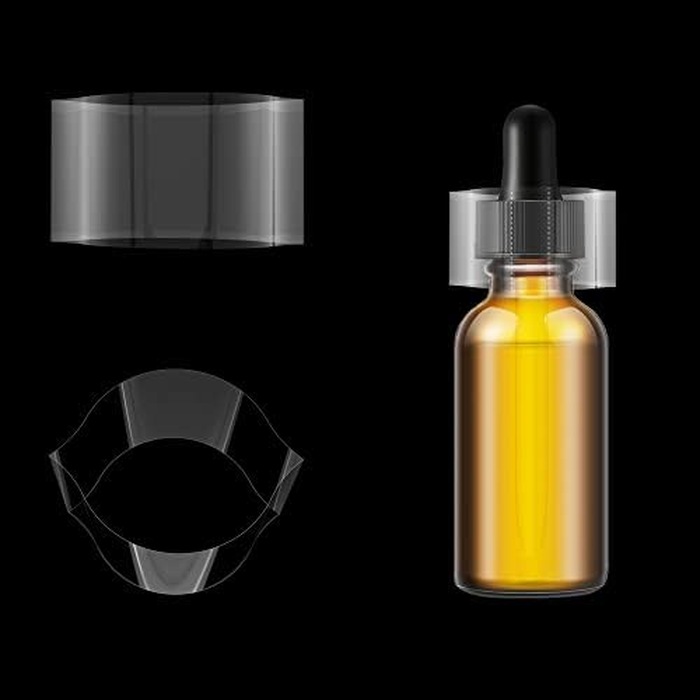
200 clear perforated PVC bands
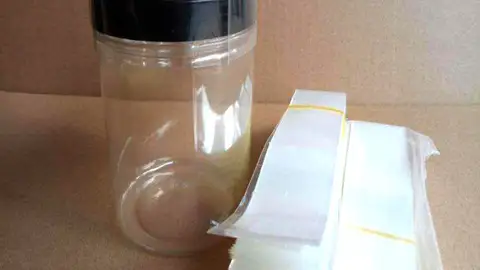
A 200-piece pack of clear perforated PVC bands sold for small bottles, listed at roughly 3.3 by 1.3 inches.
- Role: Amazon consumer option
- 200 pieces
- Perforated PVC
- Small bottles
- MOQ: Check current listing
Common mistakes with roller-bottle bands
The first mistake is reading the listing as height by width when it is width by height, or the reverse. The second is copying a dropper-bottle size onto a roller because the ounces match, without measuring the cap. The third is buying a case for a bottle you have not tested. The fourth is assuming that a snap-top or domed cap will behave like a screw cap. The fifth is applying more heat to cure a loose band when the problem is that the band is too wide; our troubleshooting guide covers how to tell which it is.
Keep a note of the bottle supplier, cap type, band size and heat setting on the box of bands. When you reorder bottles from a different factory, remeasure a few caps before you reorder bands, because two bottles sold as the same 10 ml roller can differ by a millimetre or more at the cap.
FAQ
What size shrink band fits a 10 ml roller bottle?
Sellers list bands around 35 to 36 mm wide and 68 mm tall. Measure your cap before you buy.
How do I know which number is the width?
On tall bands like these the smaller number is usually the width, but on short wide bands it is the reverse, so ask the seller. A 33 mm width opens to about 66 mm, which fits a cap near 21 mm.
Does the neck thread tell me the band size?
No. One seller states that it does not. Measure the closed bottle.
Do I need a band if the cap has a tamper ring?
Probably not. Read the cap’s listing first.
References
Continue reading
Shrink Bands for Child-Resistant Caps: How to Size Them
A push-and-turn cap is wider than a plain screw cap, so the band that fits the thread size usually does not fit the closure.
Shrink Capsules for Wine Bottles: Sizes, Heat and Fit
A capsule is sized by diameter, not lay-flat width, and that one difference causes most wrong orders. Here are the sizes sellers publish, how to measure your own bottle, which heat source works by hand, and what goes wrong.
Shrink Bands for Lip Balm Tubes: Sizes and Perforations
The width is the easy part. Height and the direction of the perforation decide how the tube opens and whether the cap comes off cleanly, and listings rarely say which you are buying.