Shrink Bands for Lip Balm Tubes: Sizes and Perforations
The width is the easy part. Height and the direction of the perforation decide how the tube opens and whether the cap comes off cleanly, and listings rarely say which you are buying.
 Lena Schmidt
In this guide
- Which sizes are sold for lip balm tubes?
- How tall should the band be?
- Vertical line or cap line: which perforation?
- Label under the film, or on top?
- How do you shrink the band without melting the balm?
- What usually goes wrong?
- Do round and oval tubes take the same band?
- What do they cost?
- Is a band required on lip balm?
- Where to buy the bands
- What to check before you order
- FAQ
- References
Quick answer. For a standard 0.15 oz lip balm tube, round or oval, sellers offer bands 28 to 30 mm wide (lay-flat) and 63 to 70 mm tall, in 2 mil clear PVC. Slim-line tubes take 25 x 84 mm. Choose the perforation on purpose: a vertical line lets the whole sleeve come off, while a line at the cap leaves the body sleeve in place over your label. Let the band stand a little above the cap, use the lowest heat that works and keep the heat moving, because the product inside is mostly wax.
Which sizes are sold for lip balm tubes?
| Listed size | What the seller says it fits | Source |
|---|---|---|
| 28 x 63 mm | Standard round tubes; the seller confirms oval tubes too, and that it covers the entire tube | Wholesale Supplies Plus [1] |
| 28 x 66 mm | The seller’s own white and pink lip balm tubes | TKB Trading [5] |
| 28 x 70 mm | Oval lip tubes | Wholesale Supplies Plus [2] |
| 29 x 70 mm | Oval lip balm and lip gloss tubes | Wholesale Supplies Plus (Rustic Escentuals) [2] |
| 30 x 64 mm | Standard lip balm, roll-on and dram vials | Premium Vials [6], U.S. Plastic [7] |
| 30 x 70 mm | Standard round and oval 0.15 oz tubes; not slim-line | Northwood [3], Voyageur [4] |
| 25 x 84 mm | Slim-line tubes only | Northwood [3] |
The first number is lay-flat width, the width of the band pressed flat. It is not the diameter of your tube. One listing says so in plain terms and gives the working range for its 30 x 64 mm band as caps of 13 to 19 mm across [8].
The arithmetic bears that out. A band 30 mm wide when flat has a circumference of 60 mm, so it opens to about 19 mm. A 28 mm band opens to roughly 18 mm. One buyer measured their tube at 16 mm across and 67 mm tall including a 17 mm cap, and reported a good fit [9]. On a 16 mm tube, a 30 mm band has to close by about 16 percent and a 28 mm band by about 10 percent. Sellers say this film shrinks up to 40 percent [3], so either width has plenty in reserve. Width, in other words, is seldom where things go wrong.
How tall should the band be?
Height causes more complaints than width. Two reviews point in the same direction. One buyer found the sleeves were exactly the length of the tube, so they could not wrap under the dial at the base and also cover the top of the cap [9]. Another learned over time that if the sleeve does not come up slightly over the top of the cap, the film is very hard to remove once shrunk [1]. Northwood’s instructions agree: let the band extend a little above the lid so it forms a secure seal [3].
So measure your filled, capped tube from base to cap top and compare it with the band height. If the tube in that review is typical at 67 mm, a 63 or 64 mm band leaves part of the tube uncovered, and a 70 mm band gives a few millimetres to fold over the cap. That is one tube from one review, not a standard, so measure yours. Decide which end matters more to you. An overhang at the top makes the seal easier to open. An overhang at the bottom stops someone twisting the dial in the shop.
Vertical line or cap line: which perforation?
This is the real decision, and listings are often vague about it.
Vertical perforation. A line runs the full length of the sleeve. Voyageur describes a single vertical perforation that the customer pulls to open [4], and U.S. Plastic lists its 30 x 64 mm tube band the same way [7]. The whole sleeve comes away in one piece. It suits a tube whose label is printed or stuck directly on the plastic and needs no protection after sale.
Perforation at the cap. Wholesale Supplies Plus sells a version it calls T-perf, where the line sits only at the cap. Tear off the cap portion and the rest stays on the body. The seller states the area above the line is 16 mm [1]. A marketplace pack describes the same idea in inches: a sleeve 2 3/4 inches long, perforated 3/4 inch from the top [10]. One reviewer prefers this style because the film keeps protecting the label in a pocket or bag [2].
Check that the cap section on the band matches your cap. If the line is 16 mm or 19 mm from the top and your cap is 17 mm tall, it will land close to the join. If your cap is much shorter or taller, the line will sit on the cap or on the body, and the tube will be awkward to open.
One more review is worth knowing about. A buyer of a cap-line band wrote that there was a perforated line around the cap but nowhere to start tearing [1]. Open a few sealed samples yourself with dry hands before you commit. For the wider subject, see the shrink band perforation guide(/blog/shrink-band-perforation-guide) and perforated vs non-perforated shrink bands.
Label under the film, or on top?
With a full-length sleeve you have to choose an order of work. Northwood lists “protective cover for labels” among the common uses of its tube band [3], which means labelling first and sleeving second. That works well with a cap-line perforation, because the sleeve stays on.
With a vertical perforation, the sleeve is thrown away, so a label under it is simply uncovered once the tube is opened. That is fine if the label can cope with handling. What does not work is putting the label on the outside of a sleeve that the customer will tear off, because the branding and ingredients leave with it. We did not research cosmetic labelling rules for this article. If your ingredient list is on that label, make sure it stays on the product.
How do you shrink the band without melting the balm?
The sellers’ instructions differ, and the difference is instructive.
-
Wholesale Supplies Plus tells a customer to use the lowest setting on a heat gun, or a hair dryer [1].
-
Premium Vials says a heat gun is required and that a blow dryer cannot be used. It gives numbers: its 200 gauge PVC band begins to shrink at 125°F, with a recommended range of 200 to 320°F [6].
-
Several marketplace packs say a heat gun or a hair dryer will do [10], and one seller adds that a heat gun gives a faster, more even result [9].
Those statements fit together if you assume hair dryers vary. A film that starts to move at 125°F can be coaxed by a hot dryer, but slowly and unevenly, while a heat gun reaches the recommended range with ease. That is the reading taken here, not something a source states.
The risk is the contents. At least one buyer reported that a pack “did not shrink wrap well” and melted the lip balm [10]. It is a single review and may reflect technique as much as product, but the caution is fair, because a balm softens at temperatures a heat gun passes in a second. A sensible routine, which we have not tested, looks like this:
-
Let poured balm cool and set completely, ideally overnight, and cap the tubes before sleeving.
-
Slide the band on with the overhang where you want it. Stand the tube upright on a heat-safe surface, or hold it by the base with tongs.
-
Use the lowest heat setting. Northwood suggests aiming the heat so it runs along the surface of the film instead of straight at it [3].
-
Start at the cap end, sweep down and around, and stop when the film is taut and free of wrinkles [3]. A tube should take a few seconds.
-
Stand the tube aside to cool before you box it. Open one from each batch and check that the surface of the balm has not slumped.
If you band more than a few dozen at a time, the heat gun vs hair dryer vs heat tunnel comparison covers the next step up.
What usually goes wrong?
-
Film creeps up or down the tube as it shrinks. Heat reached one end first and pulled the sleeve toward it. Hold the sleeve in place with a fingertip on the far end for the first second, then finish.
-
Wrinkles along the body. Too much heat in one spot, or the tube was not turned. Lower the setting and rotate.
-
A cloudy patch. The film was overheated. Replace the band; it will not clear.
-
The cap line sits on the body. The band’s cap section is longer than your cap. Choose a different band, or switch to a vertical perforation.
-
The customer cannot open it. There is no overhang and no start point. Use a taller band or ask the seller for a tear notch.
These fixes follow from how heat-shrink film behaves and from the reviews above. They are not test results. More cases are in shrink band problems and fixes.
Do round and oval tubes take the same band?
Mostly, according to sellers. Northwood lists its 30 x 70 mm band for both standard round and oval tubes [3], and Wholesale Supplies Plus confirms its 28 x 63 mm round-tube band can be used on oval tubes [1]. The band only cares about the distance around the tube, not the shape. Oval-specific listings are a touch taller, at 70 mm [2]. Slim-line tubes are the exception. Northwood states its standard band does not fit them and sells 25 x 84 mm for that format [3].
What do they cost?
Small packs run from about 4 to 9 cents a band. Premium Vials lists a 250-pack at 4 cents each [6]. On Wholesale Supplies Plus, a 100-pack of 29 x 70 mm works out at 5 cents, the T-perf version at 7 cents and a 50-pack of 28 x 70 mm at 8 cents [1][2]. A Canadian retailer shows 9 cents for single bands [11]. Prices were as displayed at the time of checking. On a tube that sells for a few dollars, the band is a small cost, but it is a real one if you price at craft-fair margins. Our the cost section below has more on quantity breaks.
Is a band required on lip balm?
Not by the federal tamper-evident rules reviewed here. Those cover over-the-counter drugs and two narrow cosmetic types, and ordinary lip balm is neither; the page on whether shrink bands are required by law sets out the detail. There is one thing to check. A balm sold with a sun-protection claim may be treated as a drug and not a cosmetic. We did not research how the tamper-evident rule applies to such products, so ask a regulatory adviser before you rely on a plain band. Shops and markets may also set their own packaging conditions.
For most makers the band is there for a simpler reason. A lip product goes on the mouth, and a buyer wants to see it has not been opened or tried.
Where to buy the bands
The listing below is the shape this page describes: clear perforated PVC bands, sold by the thousand in the common tube sizes.
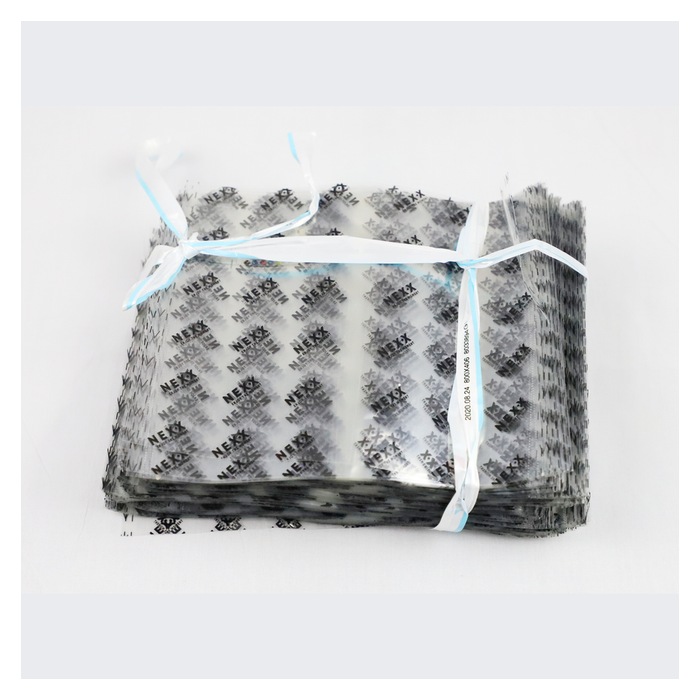
PVC perforated heat shrink bands for tube closures
Clear perforated PVC or PET bands in the lay-flat widths used for small tube closures, sold with the perforation direction to be agreed with the…
- Role: Alibaba sourcing candidate
- PVC or PET
- Perforated
- 0.03–0.12 mm
- MOQ: From 1,000 pieces
What to check before you order
-
Lay-flat width and height in millimetres, stated as lay-flat.
-
Perforation direction: full-length vertical, or at the cap, and how far the cap line sits from the top.
-
Film and thickness. Most listings say 2 mil PVC [2][7].
-
Your own tube: diameter, total height with cap, and cap height.
-
Whether your tube is standard, oval or slim-line.
-
A small pack first. Shrink five, open five, and carry one in a pocket for a week.
FAQ
Will these bands fit a deodorant or salve tube?
Not the larger ones. A 30 mm band opens to about 19 mm. Measure the distance around your tube, halve it, and look for a lay-flat width a little above that figure. Our shrink band size guide explains the method.
Can I use a hair dryer?
Some sellers say yes and one says no [1][6]. Try yours on a spare. If the film wrinkles before it tightens, move to a heat gun on low.
Why did my band leave a ridge at the top?
Probably an overhang that folded over the cap. That is normal, and by one reviewer’s account it makes the band easier to remove [1].
Can the bands be printed?
Only clear stock bands for tubes in small packs, and one retailer says it carries clear only [2]. Custom printing is a separate order; see custom printed shrink bands.
References
- Wholesale Supplies Plus, Shrink Wrap Bands 28 x 63 Round Lip Tube, and Shrink Band 28 x 63 mm T-Perf, product pages with customer reviews and Q&A. wholesalesuppliesplus.com (craft-supply retailer; reviews are individual buyers).
- Wholesale Supplies Plus, Shrink Wrap Bands 28 x 70 mm Oval Lip Tube, and Rustic Escentuals 29 x 70 mm Oval Lip Balm Tube Shrink Bands, product pages with reviews and Q&A. wholesalesuppliesplus.com.
- Northwood Candle and Craft, 30 x 70 mm and 25 x 84 mm Shrink Wrap Bands, product pages with instructions and size chart. northwoodcandleandcraft.com (craft-supply retailer).
- Voyageur Soap and Candle, Shrink Bands 30 x 70 mm for 0.15 oz Round Lip Balm Tubes. voyageursoapandcandle.com (craft-supply retailer).
- TKB Trading, Shrink Band 28 mm x 66 mm. tkbtrading.com (cosmetic-supply retailer).
- Premium Vials, Tamper Evident Shrink Wrap Band for Lip Balm Tubes, 30 x 64 mm, pack of 250. premiumvials.com (packaging retailer).
- U.S. Plastic Corp., 30 mm W x 64 mm Hgt. Clear Shrink Tubes with Vertical Perforations. usplastic.com (packaging distributor).
- Marketplace listing, 30 x 64 mm Clear Perforated Shrink Band for Lip Balm Tubes (Supplement and Supply).
- Marketplace listings and buyer reviews for lip balm tube shrink sleeves (500-piece packs), viewed via Desertcart. desertcart.com (individual reviews).
- Marketplace listings and buyer reviews for 100- and 400-piece clear shrink bands for lip balm tubes, viewed via Desertcart. desertcart.com (seller text and individual reviews).
- Windy Point Soap Making Supplies, Shrink Wrap Band, Round Lip Balm Tube, 28 x 63 mm. windypointsoap.com (craft-supply retailer, Canada).
Continue reading
Shrink Bands for Child-Resistant Caps: How to Size Them
A push-and-turn cap is wider than a plain screw cap, so the band that fits the thread size usually does not fit the closure.
Shrink Capsules for Wine Bottles: Sizes, Heat and Fit
A capsule is sized by diameter, not lay-flat width, and that one difference causes most wrong orders. Here are the sizes sellers publish, how to measure your own bottle, which heat source works by hand, and what goes wrong.

Shrink Bands for 10 ml Roller Bottles: Reading Size Listings Without Guessing
Roller-bottle bands are listed in confusing ways: width and height swap places, and the thread code tells you nothing about the cap. Here is how to read a listing, what sellers publish, and what to test.