Shrink Bands for Child-Resistant Caps: How to Size Them
A push-and-turn cap is wider than a plain screw cap, so the band that fits the thread size usually does not fit the closure.
 Lena Schmidt
In this guide
- Why is a child-resistant cap a different sizing problem?
- What do supplier charts say?
- Why does a “38 mm child-resistant cap” not settle the size?
- How do you measure your own cap?
- Does the band make the cap harder to open?
- Who is responsible for compliance?
- What about the neck bead?
- A test that includes weak hands
- What do these bands cost?
- Questions to ask the seller
- Common mistakes
- FAQ
- Sources
Quick answer. A shrink band goes over a child-resistant cap, but it needs more width than the same thread size in a plain cap. Supplier charts add anywhere from nothing to 25 mm of lay-flat for the child-resistant version, and two charts disagree on several finishes, so the thread size alone is not enough. Measure the widest point of your actual closure, halve the circumference, add about 2 mm, and order samples. The band does not make the package child-resistant, and the cap’s own certification is a separate matter. Test with weak hands as well as strong ones, because the film is one more thing between the customer and the product.
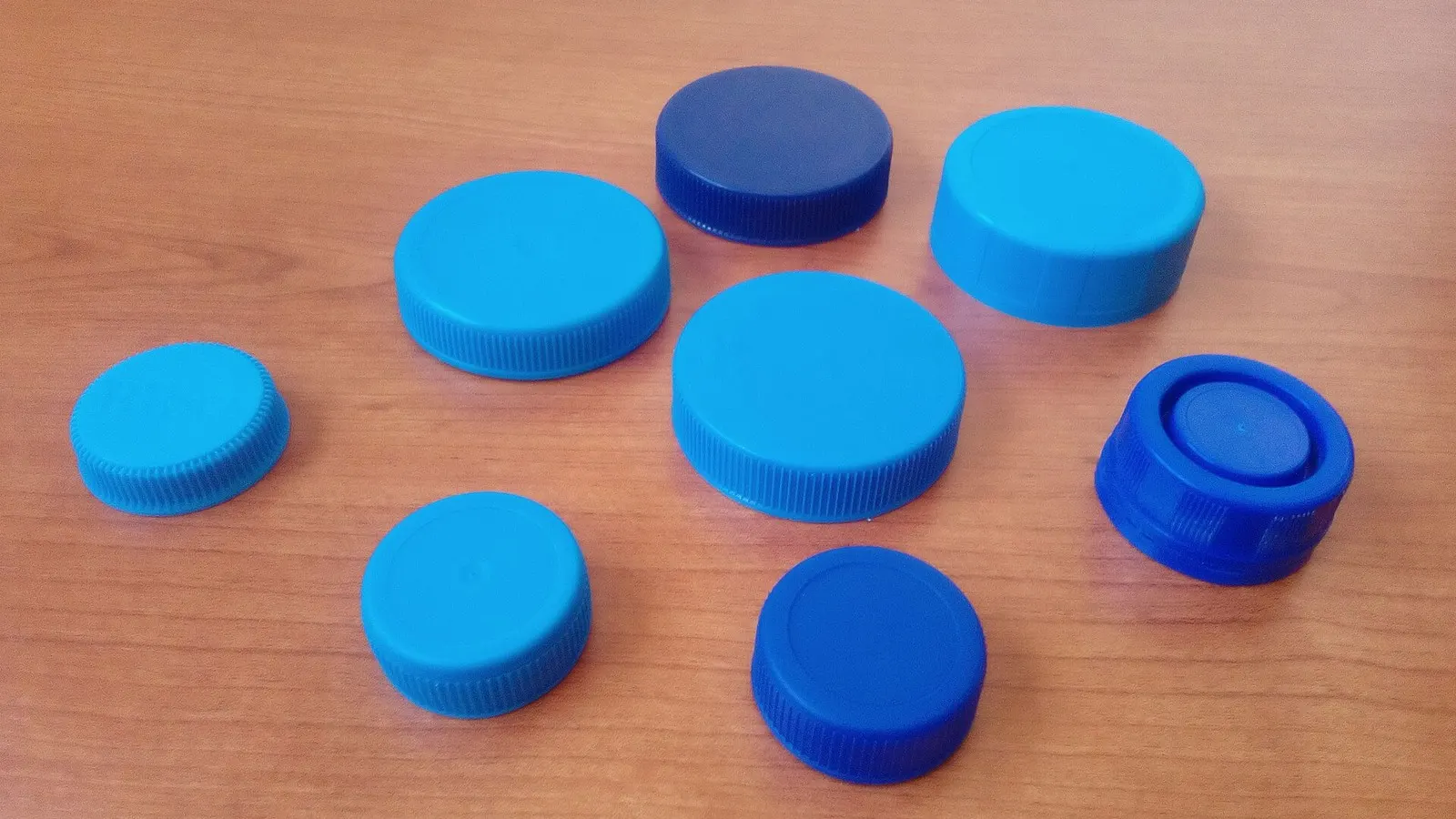
The usual advice for sizing a shrink band starts with the thread size printed on the bottle: 24/410, 28/400, 38/400. That works for a plain screw cap. It fails quietly for a child-resistant one, because the number describes the neck, and the band has to wrap the closure sitting on it. A push-and-turn cap is a cap inside a shell, and the shell is larger.
If you sell tinctures, supplements, balms or anything else that has to be kept from small children, you have probably met this already: the band that fit your sample bottle slides off the real cap, or the one that fits is a size nobody listed. This page is about choosing the size, checking it, and making sure the film does not turn an awkward cap into an impossible one. Which products need a child-resistant package is a legal question, covered briefly on the guide to whether shrink bands are required by law.
Why is a child-resistant cap a different sizing problem?
Child-resistant closures work by asking for two movements. One supplier describes the common versions as push down and turn, and squeeze lock [3]. Many are built from two parts: a continuous-thread inner cap that does the sealing, and an outer shell that you press and twist [4]. The shell adds diameter. It also adds a second surface that has to move freely, which matters later.
The same supplier notes that push-down-and-turn closures usually need bottle necks with non-standard dimensions [4]. So the bottle, the cap and the band come as a set. Change one and the others may no longer line up.
Retailers that sell the caps say the same thing from the band side. One packaging distributor adds a note to its child-resistant cap listings that these caps require a larger shrink band, and confirms that bands can be used on its pictorial child-resistant caps [5].
What do supplier charts say?
Two suppliers publish sizing charts that separate continuous-thread caps from child-resistant ones. They are set side by side below. Heights are shown only where the supplier gives them.
| Finish | US Plastic, plain cap | US Plastic, child-resistant | TricorBraun, plain cap | TricorBraun, child-resistant |
|---|---|---|---|---|
| 18/400 | 38 mm | 38 mm | 35 x 25 mm | 38 x 25 mm |
| 20/400 | 38 mm | 46 mm | 38 x 25 mm | 42 x 24 mm |
| 22/400 | 46 mm | 46 mm | 42 x 24 mm | 45 x 25 mm |
| 24/400 | 46 mm | 50 mm | 45 x 25 mm | 52 x 25 mm |
| 28/400 | 50 mm | 66 mm | not read | not read |
| 33/400 | 66 mm | 77 mm | not read | not read |
| 38/400 | 66 mm | 77 mm | not read | 72 x 35 mm (product page) |
| 45/400 | 90 mm | 90 mm | not read | not read |
Sources: U.S. Plastic Corp. sizing chart [1]; TricorBraun sizing guide and 72 x 35 mm product page [2][6]. All figures are lay-flat width x height in millimetres. “Not read” means the row was not visible in the page text that could be opened.
Three things stand out. First, the child-resistant version is not always bigger. On the US Plastic chart it adds nothing at 18/400, 22/400 and 45/400, then 8 mm at 20/400, 4 mm at 24/400, 16 mm at 28/400 and 11 mm at both 33/400 and 38/400 [1]. Second, TricorBraun’s jumps are smaller at the narrow end, between 3 and 7 mm, though its chart cannot be compared row for row because it gives heights and rounds differently [2]. Third, the two disagree about the actual number: for a 20/400 child-resistant cap one says 46 mm, the other 42 mm [1][2].
A third seller lists a 40 x 30 mm perforated band for child-resistant caps on an 18 mm neck, and a 50 x 33 mm one for child-resistant lids on 22 to 24 mm necks [7]. Beside the table, that is three suppliers giving three answers for the same thread. None need be wrong; they are probably describing different caps.
Why does a “38 mm child-resistant cap” not settle the size?
Because the label names the thread, and the caps on that thread vary. The Cary Company lists two 38-400 child-resistant caps with outside diameters of 1.62 inches and 1.76 inches [5]. In millimetres, that is 41.1 and 44.7.
Use the rule TricorBraun gives for custom sizes: measure the circumference at the widest point, divide by two, add 2 mm [2]. For the smaller cap the circumference is about 129 mm, which gives a lay-flat of roughly 66.6 mm. For the larger one it is about 140 mm, which gives about 72.2 mm. That is a difference of nearly 6 mm between two caps sold under one name, and the larger result lines up with the 72 mm band TricorBraun recommends for 38 mm push-and-turn closures [6]. The arithmetic here is based on the listed diameters; the cap’s real shape, a flared skirt for instance, may change the answer.
So a chart is fine for a first guess, but the order should come from a ruler.
How do you measure your own cap?
- Assemble the closed container exactly as it will be sold, with the liner and cap fully tightened.
- Find the widest point of the cap. On a two-part cap that is usually the outer shell, near the base or the middle depending on the shape.
- Wrap a flexible tape around that point, or a strip of paper, mark where it overlaps, and measure the strip. Record the circumference in millimetres.
- Halve it and add 2 mm. That is the lay-flat width to ask for [2].
- Measure the cap height and check the band’s height against it. TricorBraun says the film should extend about 5 mm above and below the closure so it can grip the neck [2].
- Order samples in the calculated size and the next size up. Do not skip this step.
The distributors reviewed all tell the buyer to test for fit before committing [2][6]. TricorBraun adds that it does not allow returns on shrink bands, so a wrong case is yours [6]. It also offers free samples, which is the cheapest way to avoid that [2].
Does the band make the cap harder to open?
This is the question that matters more than the size. A child-resistant closure is only worth having if an adult can still open it without trouble. The US Consumer Product Safety Commission defines special packaging as packaging that is significantly difficult for children under five to open but relatively easy for adults [8]. Its FAQ gives the pass levels for the child test: at least 85 percent of the children tested must fail to open the pack in the first five minutes, and at least 80 percent over the full ten [8].
The relevant rule for testing says that any tamper-resistant feature on the pack is removed before the test, unless it is part of the child-resistant design [9]. A shrink band is not part of a push-and-turn design. So a cap certified on its own tells you about the cap on its own. It does not tell you whether a band over the top changes how it behaves. That conclusion is a reading of the rule, not a statement from the CPSC.
The same FAQ lists further requirements, among them that the package keeps working for the life of the product and is not rendered ineffective by interference [8]. The readable extract stops before saying what the interference is, and nothing found addresses tamper bands directly. It would be wrong to argue either that a band breaks the rule or that it is exempt. Ask your closure supplier, in writing.
There is also the practical side. A patent on a different tamper-evident cap system complains that push-and-turn closures are notoriously frustrating for many users and that adding tamper features makes it worse [10]. That is a designer making a case for his own invention, so treat it as colour rather than evidence. Still, anyone who has watched a relative struggle with a pharmacy bottle knows the point. A band that has to be torn off before the cap can be turned adds one more step for a person with weak hands.
Who is responsible for compliance?
The CPSC says it does not approve, certify or endorse any specific package, and that it does not perform pre-market approval [8]. Certification comes from testing, and the FAQ has a section on who must ensure the finished product meets the rules. That text could not be read, so it is not summarised here. If your product falls under the Poison Prevention Packaging Act, that section is the one to read, together with the list of regulated substances in 16 CFR 1700.14 [8].
What can be reported is what cap sellers say. One distributor describes its child-resistant caps as certified under Title 16 part 1700 and adds that the customer is responsible for choosing the right container for the product and application [5]. In plain terms: the closure maker’s certificate is a starting point, and the bottle, the contents and anything you put on top are your decision.
A band is therefore not a compliance feature. The guide to whether shrink bands are required by law says the same from the tamper-evidence side: a band can show that a pack was opened, and it does not make a pack child-resistant.
What about the neck bead?
TricorBraun’s product pages carry a line that applies to every band, not only to these: the bottle must have a neck bead, a ridge below the closure, or the band has nothing to hold it in place [6]. The page does not say what to do if there is none.
Check this early, because bottles made for child-resistant caps often have unusual necks [4]. A bottle that works with a plain cap may not have the bead position a tall shell leaves exposed. Put a dry-fit band on a sample bottle and look at where the lower edge lands.
A test that includes weak hands
Most small brands test a band for looks. Here, test it for opening too. This is a suggested method, not a standard.
- Band ten finished containers with the sample size. Keep five unbanded as controls.
- Ask three adults, including one with arthritic or weak hands if you can, to open a banded and an unbanded container. Time them and note where they struggle.
- Record whether the film tears where the perforation sits, and whether the tear stops when it reaches the shell.
- Check that the shell still depresses and turns freely after the film has been torn open, with a torn edge still caught on the cap.
- Reclose a used container and look for a ragged edge that catches on the shell.
If the band takes longer to remove than the cap does to open, or leaves a strip hanging on the shell, change the size or the perforation before changing anything else. The perforation guide covers the options, and the sample testing checklist covers the rest of the sample routine.
What do these bands cost?
TricorBraun’s 72 x 35 mm clear perforated band, 2 mil, was shown at $4.70 for a case of 250 at the time of checking, falling to $3.54 a case at 40 cases [6]. That is about two cents per band at one case and under a cent and a half at forty. The page rounds these to $0.02 and $0.01, which hides the gap. The prices come from one page on one day and may have changed.
In practice the film is a small line in the cost of a child-resistant pack. The expensive mistake is a case of the wrong size, which the seller above does not take back.
Questions to ask the seller
- What is the outside diameter and height of this exact closure, with the shell?
- Which band size do you recommend for it, and have you shrunk that band on this cap?
- Can I have samples of the band and the cap together before I order a case?
- Is the perforation vertical, and where does it sit relative to any pictogram or arrow on the cap?
- Has this cap been tested with a shrink band on it, and can you say so in writing?
- What is your policy on returns for shrink bands?
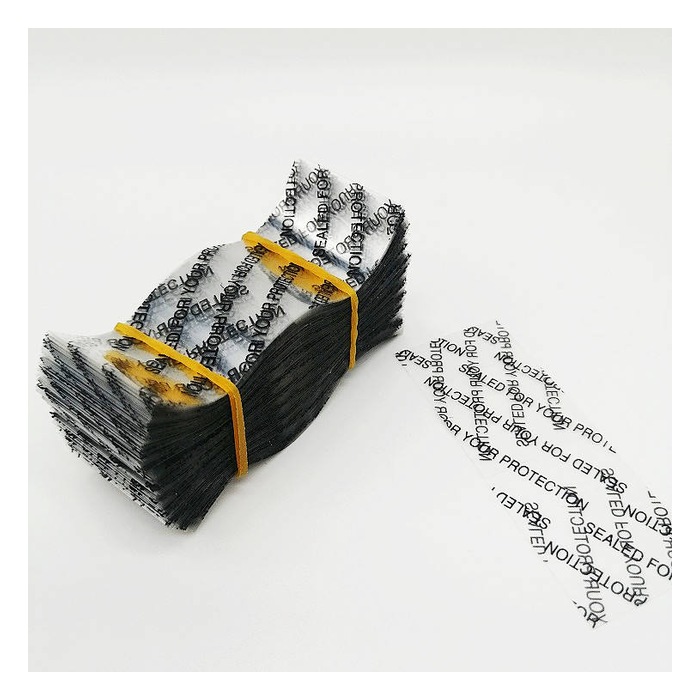
Custom PVC/PET heat-shrink wrap
A supplier listing for custom PVC or PET heat-shrink wrap, the film you size from the widest point of the closure.
- Role: Alibaba sourcing candidate
- Custom width and height quoted
- PVC or PET film
- Ordered by quantity, not by the case
- MOQ: Check current listing
Common mistakes
- Ordering by thread size alone. Shown above: the same thread can need very different widths.
- Measuring the bottle, not the cap. The band wraps the closure and the neck below it, and the widest point is usually on the shell.
- Assuming a snug band is a good band. A caution: a band that grips the shell tightly could stop it from depressing, so test the movement.
- Ignoring the neck bead. Without it the band can slip.
- Treating the cap’s certificate as covering the finished pack. The testing rule removes tamper features before the test [9], so the certificate says nothing about yours.
FAQ
Do I need a bigger band for a child-resistant cap?
Usually, yes. Sellers of these caps say so [5], and the charts add width on most finishes [1][2]. Not every finish, though.
Can I use the same band for a plain cap and a child-resistant cap on the same bottle?
Only if you measure both. The widths differ on most finishes, and the cap is what matters.
Does a shrink band make a package child-resistant?
No. The two are regulated separately. See whether shrink bands are required by law.
Should the perforation sit at a particular spot?
No supplier guidance was found. Test it against any arrow or pictogram on the cap.
Is there a band made only for child-resistant caps?
Several sellers list bands for them, with sizes such as 40 x 30 mm and 50 x 33 mm [7]. The cap still has to be measured.
Sources
- U.S. Plastic Corp., Shrink Band Sizing Chart (PDF). usplastic.com (packaging distributor; lay-flat widths by finish and type).
- TricorBraun, Shrink Bands for Bottles and Jars: A Sizing Guide. tricorbraun.com (packaging distributor; chart partly readable, custom-size rule, 5 mm overhang, free samples).
- C. L. Smith Company, Child Resistant closures and Bottle and Closure Compatibility. clsmith.com (packaging distributor; description of closure types).
- C. L. Smith Company, Child Resistant (category page). clsmith.com (note on special neck dimensions).
- The Cary Company, 38mm child-resistant pictorial caps (several product pages, including the 38-400 white cap with induction liner and the 68BCR5 cap). thecarycompany.com (packaging distributor; diameter figures as listed).
- TricorBraun, 72 mm x 35 mm clear PVC shrink band, 42 mm x 24 mm clear PVC shrink band, 52 mm x 25 mm white PVC shrink band. tricorbraun.com (product pages; prices as displayed).
- Container and Packaging, M174 (40 x 30 mm) and M177 / M20054CL (50 x 33 mm) clear PVC perforated bands for child-resistant caps. containerandpackaging.com (packaging distributor).
- U.S. Consumer Product Safety Commission, Special Packaging (PPPA) FAQs. cpsc.gov (government guidance; partly readable).
- 16 CFR 1700.20, Testing procedure for special packaging (copy on chanrobles.com; the official text is on eCFR).
- U.S. Patent 6,382,444, Tamper-evident plastic closure system with snap-on band. patents.google.com (patent text; inventor’s statements).
Continue reading

Shrink Capsules for Wine Bottles: Sizes, Heat and Fit
A capsule is sized by diameter, not lay-flat width, and that one difference causes most wrong orders. Here are the sizes sellers publish, how to measure your own bottle, which heat source works by hand, and what goes wrong.

Shrink Bands for Lip Balm Tubes: Sizes and Perforations
The width is the easy part. Height and the direction of the perforation decide how the tube opens and whether the cap comes off cleanly, and listings rarely say which you are buying.

Shrink Bands for 10 ml Roller Bottles: Reading Size Listings Without Guessing
Roller-bottle bands are listed in confusing ways: width and height swap places, and the thread code tells you nothing about the cap. Here is how to read a listing, what sellers publish, and what to test.