How to Choose a Bathtub Hair Catcher for a Pop Up Stopper
A catcher that works with a raised pop-up stopper sits over the drain, not inside it. Identify the mechanism, then measure the flat area and cap height before ordering.
 Lena Schmidt

Disclosure: We may earn a commission if you purchase through links on this page, at no additional cost to you.
A bathtub hair catcher that works with a pop-up stopper usually sits over the drain instead of inside it. That distinction matters more than the material or the number of holes. A mushroom-style insert needs an open drain throat; a stopper post, crossbar, or lift mechanism can block it. If your stopper stays in place and rises above the tub floor, start with a low-profile dome or cover designed to bridge over it. If the stopper can be removed and the opening is clear, an in-drain catcher becomes an option.
For a common tub with a raised stopper, the OXO Silicone Shower & Tub Drain Protector is a practical starting point: OXO says its 4.5-inch-wide, 1.75-inch-tall silicone-and-stainless protector is shaped to accommodate flat and pop-up drains. It rests on the tub surface rather than relying on the open drain underneath. That makes its fit logic different from a TubShroom-style insert. It is not a universal fix, though. Measure the flat area around your drain, check how far the stopper rises, and test whether you can still operate the stopper without shifting the catcher.
Start with the stopper, not the product name
A listing may say “tub drain hair catcher” while showing a device that only fits after the factory stopper is removed. Before comparing products, look at the drain while the stopper is open. Identify what is physically there: a round cap that pushes down and pops up; a lift-and-turn knob; a trip-lever assembly controlled from the overflow plate; or a simple flat strainer. A pop-up cap often sits on a post, while a crossbar may remain across the opening below it. Those pieces occupy the space an insert needs.
This is why an in-drain cylinder can be the wrong purchase even when its diameter seems right. The maker of TubShroom states that its standard insert requires direct access to the drain opening and is not compatible with a pop-up stopper unless the stopper is removed. Its current compatibility guide describes models that are lifted out and swapped with the stopper when the tub needs to hold water. Both statements can be true: the catcher may fit the bare opening, but it does not necessarily fit around the attached mechanism.
Community questions show the same mismatch in ordinary language: people describe a raised plug, a post in the center, or a crosspiece that leaves nowhere for the insert to sit. Those posts are useful as reports of real bathroom layouts, not as universal plumbing advice. One Reddit thread also includes a company representative; treat its product suggestions as commercial guidance and verify the geometry at home. The practical takeaway is simple: distinguish a removable stopper from a stopper that merely looks removable, and do not force an insert around a fixed assembly.
Choose the style that matches what is actually removable
Raised stopper that you want to keep
Use a surface catcher with a tall, open dome when the stopper remains in the tub during showers. The dome creates clearance over the cap; a weighted top and a soft rim can help the unit stay planted on the tub. OXO describes its model 13140900 this way, with a tall dome for flat and pop-up drains, a stainless-steel weight, and edges intended to sit flush against the tub. These are the manufacturer’s design claims, not a guarantee that it will seal on every curved or textured tub floor.
A surface catcher leaves hair visible, but that makes it easy to inspect and wipe away. Lift it, rinse both sides, and set it back down. In a household with long hair, clear it during the shower if strands begin covering the openings; no screen can keep water flowing once it is packed with debris.
A flat mesh disc is another surface option, but it needs a nearly flat ring around the drain and clearance for the stopper to move. A raised dome usually gives more room over a tall cap; a thin screen may not. Avoid assuming a suction cup will solve every raised-stopper problem. It needs a smooth, clean landing surface, and a textured tub, grout-like surround, or sloping recess can weaken the hold. Danco notes that its suction-cup style works best on smooth surfaces without cracks, bumps, or decorative texture.
Stopper that can be removed without altering the drain
If the stopper unscrews or lifts out using its intended method, an in-drain catcher may sit below the tub surface and keep collected hair less exposed. Confirm the opening after removing the cap: some assemblies leave a post or crossbar in place. Measure the usable inner diameter at the narrow point, not the outer trim ring. Then compare that measurement with the product’s own fit range. Do not use a sink catcher as a shortcut; sink drains are smaller and their stopper arrangements differ.
Think through bath use before choosing an insert. A catcher can occupy the opening that the original stopper used to close. Some models are designed to be lifted out and swapped for the stopper; others sell a separate plug or a combined catcher-and-stopper. TubShroom’s compatibility page describes this swap for its standard models and a separate plug option for stopping water. That adds a small routine, but it is usually safer than expecting an open strainer to hold bathwater.
Stopper needs replacing or no catcher clears it
A replacement stopper with a built-in strainer combines both jobs, but it is a plumbing part: the connection, drain diameter, overflow arrangement, and stopper style must match. If the mechanism is corroded, difficult to remove, or connected to a trip lever, check instructions or ask a plumber before unscrewing it. This is not a casual first experiment for renters or tubs with unknown hardware.
Measure the tub before ordering
Take three measurements with the stopper open: the diameter of the flat landing area around the drain, the width of the stopper cap, and the height from the tub floor to the top of the raised cap. A ruler is enough for a first pass; a photo from directly above and from the side helps you compare the shape with the product images. If the drain sits in a recessed bowl, note the bowl’s width and slope. A 4.5-inch catcher needs a continuous surface to rest on; its stated width does not mean every 4.5-inch drain assembly is compatible.
For an in-drain product, measure the inside opening, including any obstruction that reduces the usable space. Do not measure the decorative flange and assume the catcher will fit the same diameter. If a crossbar spans the hole, measure the gap beneath it as well as the opening. Product pages sometimes state a standard drain size, but “standard” is not a measurement of your particular tub. When the listing does not explain whether the number refers to the drain, the cover, or the product’s outside diameter, use the manufacturer’s drawing or contact the seller before purchasing.
Test the stopper’s travel: a cap may need to rotate, depress, or lift. A dome can fit physically yet block the motion needed to close the drain. Decide whether moving it for baths is acceptable, and keep the loose catcher somewhere it cannot become a slipping hazard.
What to check before you buy
The product description should say whether the catcher sits over the drain, fits inside it, attaches around a post, or replaces the stopper. Check whether the maker names pop-up drains, what surface supports the device, and how you will still plug the tub. If any answer is vague, treat fit as unconfirmed; a product photo cannot settle the question.
Read reviews for the failure mode that matches your bathroom, not just an overall star score. Search within reviews for “pop-up,” “slips,” “doesn’t sit flat,” “stopper,” and “water backs up.” A reviewer with a flat drain can have a good experience while your raised cap prevents the same model from seating. Likewise, a complaint that hair is visible may matter less to you than a catcher that stays in place and lifts off easily. Reviews help reveal use conditions; they do not establish a universal fit.
Be cautious with promises such as “fits all drains,” “never clogs,” or a specific percentage of hair captured. The manufacturers examined for this guide publish dimensions and broad compatibility claims, but they do not provide an independent test rate showing how much hair each catcher intercepts under a controlled shower flow. That means it is responsible to compare geometry, material, and cleanability, but not to claim that one shape catches a precise percentage more hair than another.
Will a hair catcher slow the tub drain
Any screen adds resistance, especially when hair and soap residue cover its openings. If water pools, clear the catcher first and see whether the tub returns to its usual draining speed. Drainage also depends on the plumbing, so do not wait until the cover is packed before cleaning it.
A catcher prevents some new hair from traveling down the drain; it does not remove an existing clog below the stopper. If the tub remains slow after the catcher is clean and lifted away, the obstruction may be at the stopper, in the trap, or farther downstream. Bath Fitter’s care guidance specifically tells users to inspect and clean hair from a pop-up stopper when drainage slows. That is a useful first check, not proof that every slow drain is a hair problem. If more than one fixture drains poorly, or the tub repeatedly backs up, stop treating the surface catcher as the repair and investigate the plumbing.
Keep it clean without making it a chore
For a surface dome, lift it after each shower or when strands begin bridging the holes. Peel hair off with tissue or a gloved hand, rinse away soap film, and dry the underside before putting it back. For a cylinder insert, pull it straight out and remove hair without pushing it deeper into the drain. Avoid sharp tools that can scratch a coated tub or damage silicone. Follow the product’s cleaning directions; do not assume that boiling water, bleach, or a dishwasher is safe just because the catcher is small.
If it shifts, clean the contact area and silicone rim before repositioning. Do not add adhesive or modify the stopper. A curved floor or tall cap may call for another shape; persistent movement signals a fit problem. Check it during the first few showers.
A practical pick for a raised pop-up drain
For a raised pop-up stopper that stays installed, compare the OXO Good Grips Silicone Shower & Tub Drain Protector. OXO lists pop-up drains and gives dimensions of 4.5 by 1.75 inches. Its weighted stainless accent and silicone edge are designed to keep the dome in place. Hair remains visible on top, but the device does not need an open drain throat.
Check the fit before ordering: measure the surrounding flat area, compare the dome height with your stopper, and confirm that the stopper can still move. Then check the current Amazon listing to review availability and buyer feedback. Product availability and marketplace details can change, so confirm the listing still identifies OXO model 13140900 before checkout. If your tub has a narrow ledge, deep recess, fixed crossbar that prevents surface coverage, or unusually tall cap, do not treat this recommendation as a guaranteed fit. A replacement stopper-and-strainer or a plumbing change may be more appropriate, but only after checking the assembly.
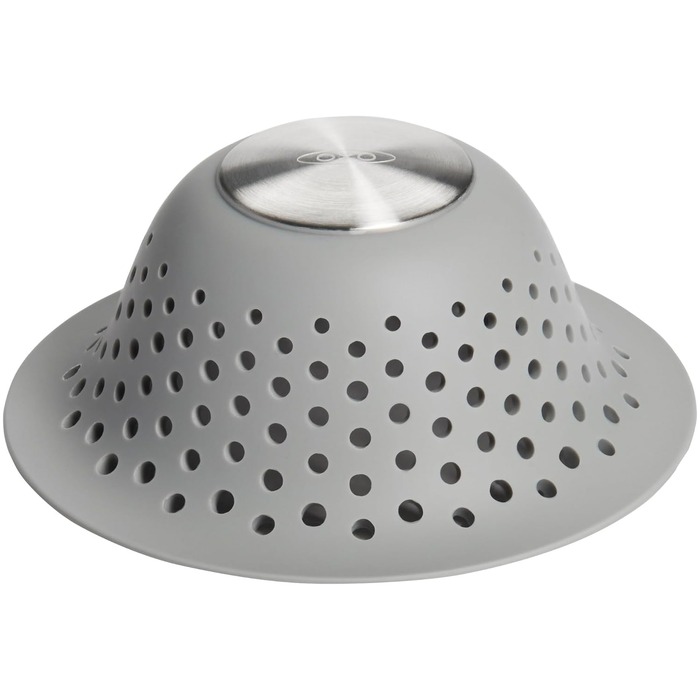
OXO Good Grips silicone tub drain protector
A surface dome that rests on the tub instead of sitting in the drain throat, so a raised pop-up stopper can stay in place. OXO lists it at 4.5 by 1.75 inches and describes it as fitting flat and pop-up drains.
- Role: Amazon consumer option
- 4.5 x 1.75 inches
- Silicone with weighted rim
- Measure the flat area first
- MOQ: Check current listing
The short decision
If the stopper remains raised in the drain, choose a catcher that sits over it and leaves enough room for the stopper to operate. If the stopper comes out and exposes a clear, measured opening, an insert-style catcher can work, but plan how you will plug the tub. If the drain is recessed, textured, or crowded by a crossbar, stop shopping by diameter alone: the support surface and free space matter just as much. A few measurements can prevent the common mistake of buying a catcher that fits the product category but not the drain in front of you.
No hair catcher eliminates maintenance. The useful one is the design that fits your stopper, stays put on your tub, keeps water draining at a usable rate, and takes only a moment to clean. For the typical raised pop-up setup, a low dome that explicitly accommodates pop-up drains is the simplest place to start; for a removable stopper, compare in-drain models only after you confirm the opening is truly clear. That decision is more reliable than choosing by a broad “universal” label.
Sources
-
OXO product page for model 13140900 and maker-stated size/materials/fit Source
-
TubShroom compatibility guide for stopper and insert requirements Source
-
TubShroom instruction and troubleshooting guide Source
-
Danco guide and product demonstration links for surface and suction-cup styles Source
-
Bath Fitter care guide for inspecting pop-up stoppers when drainage slows Source
Hook this up to your favourite commenting platform — Giscus, Disqus, or your own.
Continue reading
How to Choose a Zipper Repair Kit That Fits Your Zipper
A number on the slider is only part of the match. Identify the chain type, confirm the size, then check direction, slider function and end parts before buying a kit.

How to Choose a Stove Gap Cover for Uneven Counters
Measure the seam at the front, middle and back on both sides, then match the profile. A strip bridges a gap; it does not level a range that sits too high.

How to Choose Dishwasher Rack Tine Caps for a Rusty Rack
Tine caps only work when the rust is limited to a few exposed tips and the wire is still firm. Check the opening, length and shape of the tine before ordering a pack.