Why Drawer Liners Keep Sliding and How to Keep Them in Place
Before you reach for glue, work out whether the sheet, the contents or the drawer front is moving. Then clean, dry, fit and only then add restraint.
 Lena Schmidt
Disclosure: We may earn a commission if you purchase through links on this page, at no additional cost to you.
Quick answer
If your drawer liner slides every time you open the drawer, do not reach for glue before checking the liner type and which surface is moving. A smooth-top liner is made to let objects glide across its surface; a grip-style liner is designed to resist movement. Duck Brand says Duck Brand FAQ that the rougher side of its EasyLiner should face down, and Duck liner video guide distinguishes Select Grip for drawers from Smooth Top for places where you want to move items easily. Start by confirming you bought the kind of liner that matches your drawer. [1][2]
Then remove the liner, clean and fully dry the drawer bottom, trim the sheet to lie flat, and reinstall it with the correct side down. If the mat itself still shifts, try a grip-backed style before adding any adhesive. Use small pieces of compatible, removable tape only when a nonadhesive liner is otherwise working and you accept the risk of residue or finish damage. Avoid permanent glue as a first fix. Some liners can react with particular cabinet finishes; Duck specifically warns that its EasyLiner can bond to lacquer or urethane finishes.
First find out what is actually sliding
Open the drawer slowly and watch the front edge of the liner. If it comes forward with the drawer contents, the sheet is moving against the drawer bottom. If the sheet stays put but utensils, jars, or organizers skate over it, the upper surface is too smooth for the items you are storing. Those are different problems, so a “non-slip” label alone does not tell you whether the product will solve yours.
A third pattern is bunching: the liner moves a little, catches on an item, and folds into a ridge. Look for curled corners, a ripple down the center, or a sheet that has been cut too wide and is pressing against the drawer walls. A liner that is too short can also migrate because there is no edge to keep it aligned. Remove the contents and place the mat on the bare drawer floor. If it still creeps when you slide a hand across it, the lower grip or the drawer surface is the main issue.
This distinction also explains why people suggest different fixes. In one r/organization thread, users mention corner tape, poster tack, silicone liners, and non-slip mesh; another commenter notes that tape can leave a raised bump. These are anecdotal experiences, not controlled product tests, but they reveal the practical trade-off: easy removal matters to some people as much as absolute hold.
Choose the liner surface for the drawer
For a drawer where you want items to stay put, look for a liner with grip on the top and underside, often sold as a nonadhesive or nonslip drawer liner. Duck drawer guide describes its Select Grip product as having grip on both faces and lists it for drawers and utility cabinets. Gorilla Grip product description describes its powerGRIP liner as a nonadhesive mat intended to reduce slipping and bunching. Treat those as product-specific claims, not guarantees that every roll will grip every finish or load. [1][2]
A smooth-top liner can still be useful in a cabinet where you regularly slide plates, bins, or small appliances across the shelf. In that case the top is deliberately slick, while the underside is intended to grip the shelf. Duck drawer guide separates those two goals: Smooth Top makes it easier to slide stored items, while Select Grip is the better fit when both the mat and the things on it should resist movement. For a cutlery drawer, tool drawer, or narrow organizer tray, that difference may be more important than the color or pattern. [2]
Do not confuse shelf liner with peel-and-stick contact paper. A nonadhesive liner rests in the drawer and can be lifted out for cleaning; adhesive paper bonds to the surface and may be harder to remove. Adhesive is not inherently a better answer. It can hold well on a compatible, clean surface, but it can also leave residue or affect a finish when removed. If you rent, have a finished wood drawer, or want to wash the liner, start with a removable grip product.
Clean, dry, and measure before you reinstall it
Take everything out and lift the liner fully. Vacuum crumbs from the corners and wipe the drawer floor with a cloth that will not leave lint. Use a cleaner suitable for the drawer material, then allow the surface to dry completely. Duck installation guide similarly recommends to empty the shelf, clean it with a cloth and warm water, and let it dry before fitting the liner. Dust, grease, and cleaning residue can reduce the contact between the liner and the drawer, so pressing the sheet down harder will not correct a dirty surface. [3][4]
Measure the flat interior width and depth at more than one point. Older drawers may not be perfectly square, and the back can be narrower than the front. Cut a paper template first if the corners are rounded or the drawer has a notch around a runner. Duck installation guide recommends marking and trimming for a secure fit; another practical option is to test the fit with a little spare material before cutting the final piece. Aim for a flat sheet that covers the useful floor without buckling against the sides. [3]
Do not stretch or pull a flexible liner to make it fit. A stretched edge can relax later and curl upward. If a drawer has screws, rails, or a center support rising above the floor, make relief cuts instead of forcing the sheet over the hardware. Smooth the liner from the center toward the edges to press out air pockets and wrinkles. Then slide the empty drawer in and out several times before returning fragile items.
If the liner is sold as a roll and curls toward its original shape, let it relax flat before measuring and trimming. Do not assume that a curl will disappear just because the drawer contents weigh the middle down; corners can still lift and catch on objects. If the manufacturer permits it, flatten it using the method in its instructions. Avoid heating an unknown liner with a hair dryer or placing it in a clothes dryer unless its specific care guide says that is safe. Materials and heat limits differ by product.
If it still moves, add restraint carefully
Try the least permanent change that fits the drawer. First flip the mat if its maker identifies a grippier underside; then test the correct orientation. If the product has grip on both faces, rotate the sheet 180 degrees to see whether a curled end or uneven cut is causing the movement. This costs nothing and keeps the drawer finish untouched.
If only one corner lifts, a tiny piece of double-sided mounting tape or a purpose-made liner tab at that corner may be enough. A Lowe’s Q&A for Duck Solid Grip suggests trying double-sided tape in the corners if lining the full drawer does not stop movement. Hunker guide likewise describes mounting tape as a fix for a loose drawer lining. These suggestions apply to compatible surfaces and liners; they are not permission to use any tape on any finish. Test in a hidden spot, read the tape maker’s removal instructions, and check the drawer finish before committing. [5][6]
Avoid putting thick tape under multiple points of a soft, cushioned liner. Raised spots can create lumps, and the liner may still slide between them. Avoid hot glue, silicone caulk, or spray adhesive if you need the liner to come out cleanly; these can turn a removable setup into a repair job. If tape does not bond to the liner’s textured underside, do not keep adding more. Switch to a liner designed for stronger grip or use an adhesive liner explicitly approved for that surface.
For a valuable or unknown finish, the safest choice is usually not to apply a new adhesive at all. Duck Brand FAQ warns that its EasyLiner contains plasticizers and may form a permanent bond with lacquer or urethane finishes, potentially lifting finish when removed. That warning is specific to Duck’s product, and other brands may use different materials. Still, it is a good reason to identify the drawer finish and check the exact liner’s care sheet before leaving a plastic or vinyl mat in place for months. [7]
Match the solution to the drawer you have
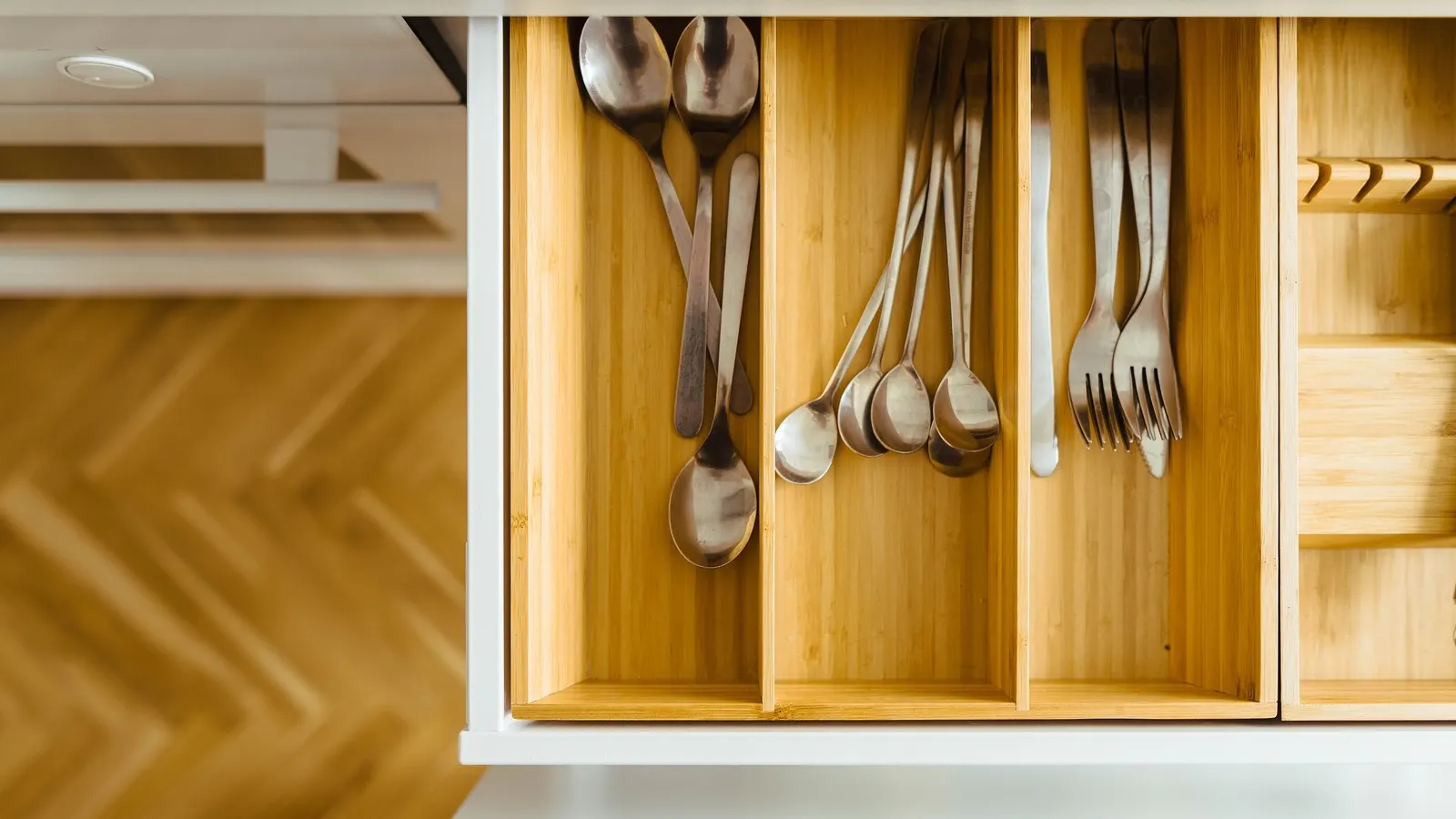
A kitchen cutlery drawer is opened frequently and often has lightweight items that move as the drawer stops. A dual-grip liner can help keep both the sheet and the contents from skating, but divider inserts may be the better answer if utensils keep colliding. For dishes and glassware, a cushioning liner can reduce direct contact with the shelf, but use a design that is easy to lift and wash so crumbs and spills do not stay trapped underneath. [4]
For bathroom or under-sink storage, water resistance and cleanability may matter more than a soft cushioned surface. A porous grip mat may hold dust or moisture; check the maker’s cleaning instructions and lift it periodically to inspect the cabinet floor. Under an oven, near a heater, or anywhere the drawer may become warm, follow the product’s temperature guidance. Duck says its vinyl EasyLiner can melt and gives a product-specific upper temperature limit of 170°F; do not treat that number as a universal rating for every shelf liner. [7]
Wire shelving needs a different kind of liner. A thin open mesh may grip the wire but will not stop crumbs or small objects from falling through. A stiffer liner made for wire shelves can provide a flatter base. Better Homes & Gardens likewise evaluates liners by use case, grip, structure, and cleanability. Match the liner to the surface and the items, rather than trying to make one roll solve every drawer in the house. [4]
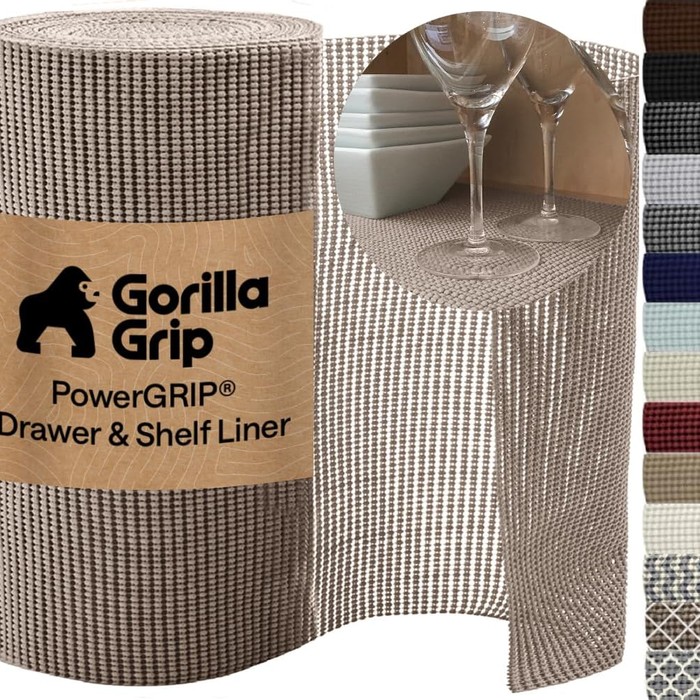
GORILLA GRIP powerGRIP drawer and shelf liner, 12 in x 10 ft
A non-adhesive roll for drawers and cabinets, sold in a 12-inch by 10-foot size. Check the roll dimensions against your drawer before cutting, and confirm which face carries the grip pattern.
- Role: Amazon consumer option
- 12 in x 10 ft
- Non-adhesive
- Grip pattern both faces
- MOQ: Check current listing
When to lift and clean the liner
A liner can hide crumbs, sticky drips, or moisture against the drawer floor. Lift it when you clean the drawer or sooner after a spill; wash it according to the product instructions and let it dry completely before reinstalling. Duck Brand FAQ recommends warm, sudsy water, rinsing, and air-drying for its EasyLiner. If the underside remains greasy, the sheet is torn, or curled edges will no longer lie flat after cleaning, replace it instead of trapping dirt beneath a sheet that has stopped doing its job. A removable liner should make upkeep easier, not become a layer you never inspect. [7]
What to check before buying another roll
Measure the usable drawer width and the length you need, then check the product’s actual roll dimensions. A “12-inch” liner may fit a 12-inch drawer only if its usable interior is at least that wide; do not assume the outside cabinet measurement is the inside floor measurement. If your drawer is unusually narrow, deep, or notched, look for a liner that can be trimmed cleanly and inspect whether its material frays, stretches, or tears when cut.
Read the product description for the grip pattern on each face. “Non-slip” may refer to preventing objects on top from sliding, preventing the mat from sliding underneath, or both. Prefer a listing that explains which side faces up and names the intended surface. If you store glassware, tools, or other items that can be scratched, check whether the liner is cushioned and whether its maker recommends it for that use. A smooth wipe-clean top and a fabric-like grip surface solve different cleanup needs.
One current example is the GORILLA GRIP powerGRIP drawer and shelf liner. The product is described as a nonadhesive roll for drawers and cabinets; the listing title identifies a 12-inch-by-10-foot option, but available colors, sizes, and seller details can change. Measure your drawer and confirm the selected variant before ordering. It is one possible grip-style replacement, not a promise that a particular liner will stay fixed on every surface. [1]
A practical decision in three steps
If the sheet moves, take it out, clean and dry the drawer, check that the rough or grippy side faces down, and trim it so it lies flat. If the sheet stays still but objects move, choose a top surface with more grip or use drawer dividers. If only a corner creeps, test a compatible removable tab or a small amount of double-sided tape after checking the finish and adhesive instructions.
If none of those changes works, replace the liner with one designed for the actual job instead of adding stronger glue to a mismatched product. A smooth-top sheet is useful when contents should slide; a grip-top sheet is useful when they should not. A nonadhesive liner is easier to clean and reposition, while a peel-and-stick product may hold more firmly but is harder to remove. That choice—not a generic “best” label—is what stops you repeating the same fix every week.
Sources
-
Gorilla Grip, Cushioned Grip Liner for Drawers and Shelves Source
-
Duck Brand, Drawers and EasyLiner product guidance Source
-
Duck Brand, How to Install EasyLiner Shelf Liner video guide Source
-
Better Homes & Gardens, The 7 Best Shelf Liners Our Editors Recommend Source
-
Lowe’s, Duck Solid Grip product Q&A on liner movement Source
-
Hunker, How to Keep a Drawer Lining From Sliding Within Drawers Source
-
Duck Brand, Frequently Asked Questions Source
-
Federal Trade Commission, Endorsement Guides: Affiliate or Network Marketing Source
Hook this up to your favourite commenting platform — Giscus, Disqus, or your own.
Continue reading
Do Washing Machine Anti-Vibration Pads Stop Walking?
A pad that has shifted out from under the washer is a symptom, not the diagnosis. Check the machine is stable and the foot fits the cup before buying a grippier set.
When a Silicone Faucet Mat Pools Water, Check the Fit and Drain Path
A mat that holds a puddle is failing at one of three points: the counter does not drain toward the bowl, the mat is set the wrong way, or its outlet is blocked.
How to Keep a Cutting Board From Sliding on a Countertop
Most boards move because of a film of water or oil, a warped corner, or an overhang, not because the board is light. Find the cause, then pick a damp cloth or a grip pad.