How to Keep a Cutting Board From Sliding While You Chop
A damp towel fixes an occasional slip in seconds. For daily prep, the setup has to hold a board flat, cover enough of its footprint, and survive raw-meat cleanup.
 Lena Schmidt
Disclosure: We may earn a commission if you purchase through links on this page, at no additional cost to you.
Quick answer
Before you pick up a knife, put a clean, damp paper towel or dish towel flat on a dry, level counter and set the cutting board on top. The towel should be damp, not dripping. Press down on the board and test it with your palm; if it still shifts, refold the towel so it lies flat or use a non-slip mat that covers enough of the board’s footprint. University of Illinois Extension and University of Maine Cooperative Extension both recommend a damp towel or non-slip layer for stabilizing a board. [1][2]
For a quick fix, the towel is usually enough. For daily cooking, a reusable grip pad is easier to keep near the board and does not need wetting each time. First make sure the counter and the underside of the board are clean and dry; crumbs, grease, water, a warped board, or a raised counter seam can defeat either solution. Stabilize the board before cutting, and clean the pad or towel after raw-meat prep.
Why a cutting board slides in the first place
A board moves when the contact surfaces cannot resist the sideways force of chopping. A glossy countertop and a smooth plastic or glass board can have very little grip between them. Water, cooking oil, tiny food scraps, and dried residue change that contact further. The board may feel stable when empty, then creep as you push through a firm squash, split a chicken joint, or work quickly with a knife.
The surface underneath matters as much as the board. A countertop protector, loose silicone mat, or uneven sink cover can shift as one layer. A board with rubber feet may still rock if a foot is worn or the counter is not level. A warped board can teeter even when its center is held in place. In those cases, adding a grippy pad can mask the symptom without correcting the unstable support.
Movement under a knife makes it harder to control the cut. Illinois Extension recommends a damp towel under the board and curled fingers on the hand holding food. Stability improves control, but it does not replace a sharp knife, a controlled stroke, or fingers kept clear of the blade. [2]
Diagnose the movement before adding another layer
Notice when the board moves. If it slides under light hand pressure, check the contact surfaces first. If it stays put until you chop, it may need more grip under the stronger push of dense food. Use a towel or mat that covers the contact area, then test again. If it creeps, look for grease, water, crumbs, or a moving counter cover.
A rocking board points to a different issue. Turn it over and check whether the feet are present, clean, and even; inspect the board for bowing or a raised edge. Place it on a known-flat area of the counter if possible. If the board rocks there too, a thin grip layer may only amplify the wobble. Replace a damaged board or use a flat, stable one instead of wedging folded cloth under the low side. A pad is designed to resist sideways slip, not to level an uneven surface.
Check whether the board or something beneath it is moving. A sink cover or counter mat can travel with the board. Remove that layer and test on bare counter; a grip pad cannot stabilize a surface that still slides.
Use the damp towel method first
This is the simplest test because it costs nothing and shows whether the problem is mainly a lack of grip. Lay a clean paper towel or dish towel on the counter. Add a little water and wring it thoroughly: you want it evenly damp without drops running from it. Smooth out folds, place the board on top, and press down at the corners. If the board rocks or slides, lift it and fix the layer before cutting.
The towel should not hang over the counter edge or make the board sit near the edge. For a small board, fold a paper towel so it lies flat beneath the board rather than making a thick ridge. For a large board, one towel may not cover enough area; use a larger clean cloth or a purpose-made mat sized for the board. The Kitchn and RICARDO describe the towel method, and a Martha Stewart YouTube demonstration shows the setup visually. The video is a demonstration, not a comparison of mat materials. [5][6][7]
Home-cook discussions mention both damp towels and reusable grip surfaces. They help surface everyday trade-offs, but personal comments are not controlled tests of grip or durability.
A towel is convenient for a one-off cooking task, a rental kitchen, or a board that gets washed between ingredients. It is less convenient if you cook often and dislike re-wetting or replacing paper. It can bunch if the board is dragged across it, and a saturated towel can make the work surface wet. Check that the counter stays dry around the board and wipe up any water before continuing.
When a reusable non-slip mat makes sense
A reusable mat is worth considering when the board moves repeatedly, the towel solution is getting in the way, or you want one stabilizing layer stored with the board. The University of Maine Cooperative Extension lists a non-slip mat alongside a damp paper towel or clean damp rag as ways to prevent board movement. [1] The choice is practical: a towel is free and disposable; a mat is reusable and ready to place, but it needs cleaning, drying, and storage.
Measure the board’s underside before buying. A grip sheet should support the board where it actually contacts the counter. A narrow strip may work under a small board, but a large board can pivot around a small central pad. If the board has feet, measure between them; a flat mat should not prop one foot higher than the others. If your board is very large or heavy, confirm that the product’s dimensions and intended use match the setup rather than assuming any drawer liner will work.
Check the material and shape as well as the advertised grip. A thin flexible sheet stores easily and can sit under more than one board, while a thicker pad may feel more substantial but can create a height difference if it catches only one foot. Avoid trimming a product unless its maker says it may be cut; cutting can expose edges or change the product’s intended construction. If the mat is too large, confirm that it still lies flat and does not become a loose corner under the board.
The linked product is CatTongue Grips’ 8-by-12-inch Gription pad. Its brand page identifies the Gription Pad as a non-adhesive product intended for temporary non-slip use, and its Amazon listing describes an 8-by-12-inch, double-sided pad marketed for cutting boards and other kitchen items. Those are product claims, not proof that it will hold every board on every countertop. Check the current listing, dimensions, and care details before ordering. [8]
How to test the fit before using a knife
Put the pad on the counter with the board in its normal position. Do not put the mat where it can overhang the counter, cross a seam, or catch a drawer edge. Set the board down flat, then use your open hand to apply gentle pressure at the center and at each corner. The board should not skate or rock. If it does, stop and inspect both surfaces for crumbs, grease, water, or uneven contact.
Next, imitate the motion you expect during prep without using a knife: press the board sideways with your palm in the direction you normally push while chopping. Do not push so hard that the board could fall off the counter. If the mat creeps, it may be too small, dirty, incompatible with the counter finish, or poorly placed. If the board rocks but the mat stays put, the board or counter may be uneven. A pad can reduce sliding; it cannot flatten a warped board or make a loose countertop panel safe.
Recheck after washing. Water or food residue under the board can change the feel, and mats vary in their material and care instructions. Follow the mat maker’s cleaning directions. The linked Amazon page lists a wipe-with-a-damp-cloth care instruction for this item, while the brand’s own product page should be consulted for current guidance. Let surfaces dry before storing the mat against a board, drawer, or countertop. [8]
Keep the grip layer clean without creating a food-safety problem
The towel or mat sits below the cutting surface, but it is still part of the prep area. After handling raw meat, poultry, or seafood, wash the cutting board and nearby surfaces. CDC guidance says to wash utensils, cutting boards, and countertops with hot, soapy water after preparing each food item, and it recommends using separate boards for raw animal products and foods that will be eaten without cooking. [3][4]
Remove the board and wash or replace the towel between messy tasks. Do not keep reusing a damp, soiled cloth as a grip layer because it is convenient. If a reusable mat picks up raw-food juices, crumbs, or grease, clean it according to its manufacturer’s instructions and dry it before putting it away. Do not assume that a textured or “non-slip” surface is antimicrobial or self-cleaning; the product listing does not establish that.
Before prep, clean the counter and board underside, place a clean grip layer, and press the board to test it. Between raw food and ready-to-eat prep, wash the board and contact surfaces. If the board rocks or the mat moves, fix that support before cutting; buying a gripper will not address an unstable base.
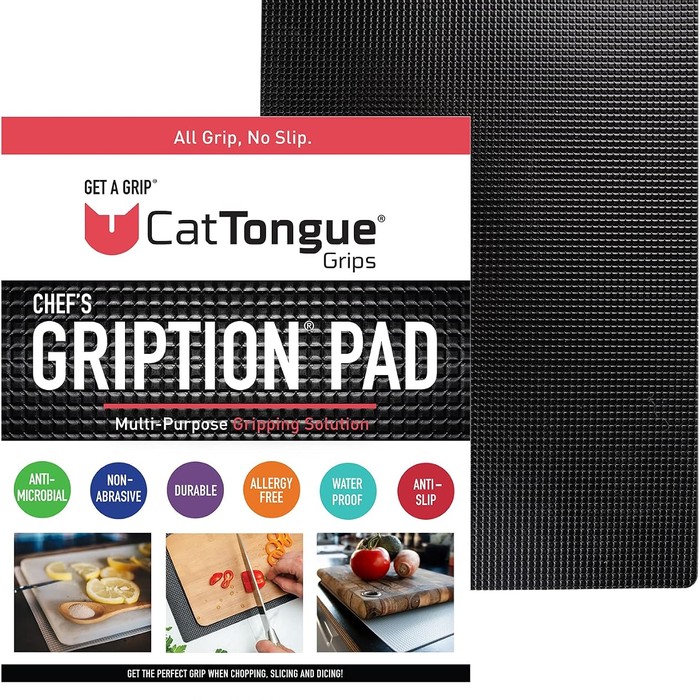
CatTongue Grips 8 x 12 non-slip mat
A non-adhesive 8-by-12-inch pad intended as a temporary grip layer under a cutting board or other kitchen item. Measure the board's underside first: a pad smaller than the contact area lets the board pivot.
- Role: Amazon consumer option
- 8 x 12 inches
- Non-adhesive
- Double-sided grip
- MOQ: Check current listing
What not to do
Do not start chopping while holding the board with your free hand. That hand then has to stabilize the board instead of controlling the food safely. Do not use a loose stack of towels, a folded corner, or a wet puddle that makes the board rock. A damp layer is meant to sit flat and provide friction, not to lift one side.
Avoid placing an adhesive grip product where it touches the food or changes the board’s cutting surface. Do not attach adhesive strips to the countertop or board unless the maker approves the material and you are comfortable with a permanent residue or finish risk. A temporary pad is a separate support layer; it should not be mistaken for a food-contact cutting surface.
If the board still shifts, stop and remove the knife before troubleshooting. A worn foot, warped board, uneven counter, or loose mat needs a different fix. Replace a cracked or deeply scored board when it can no longer be cleaned effectively; extra grip will not repair it. [1]
Common questions
Should the towel under a cutting board be wet or dry?
Use it damp and wrung out, not dripping. A flat, damp towel is the standard temporary method recommended by the University of Illinois Extension and University of Maine Cooperative Extension. If a particular board maker says otherwise, follow its instructions. [1][2]
Can I use a silicone mat instead?
A clean, appropriately sized non-slip mat can work under a board if it lies flat and does not slide on your counter. Check the material’s care instructions and test the board with your hand before using a knife. A mat marketed for drawers is not automatically suitable for repeated kitchen washing or food-prep environments.
Why does my board slide even with a towel underneath?
The towel may be too dry, too wet, bunched, dirty, or too small for the board. The counter may have grease or water on it, or the board may be warped. Lift the board, clean and dry both surfaces, lay the towel flat, then test again. If it still rocks, inspect the board and counter rather than adding more layers.
Do cutting boards with rubber feet still need a mat?
Not always. Feet can provide enough grip on a clean, level counter, but damaged or uneven feet may not. Test the board before each use. If it moves, use a clean damp towel or a suitable non-slip mat, then inspect whether the feet need replacement.
A reliable setup takes less than a minute
Use a clean, level counter and a board that sits flat. Try a wrung-out damp towel for an occasional slip; for regular prep, consider a washable reusable mat sized to the board. Press the board with your hand before taking up the knife, then clean the board and contact surfaces between food tasks. If either layer rocks or moves, fix the support before cutting.
Sources
-
University of Maine Cooperative Extension, Safe Cutting Boards: Materials, Usage, and Cleaning Tips Source
-
University of Illinois Extension, How to Safely Use Cutting Tools Source
-
USDA Food Safety and Inspection Service, Cutting Boards Source
-
CDC, Preventing Food Poisoning Source
-
Martha Stewart, How to Prevent Your Cutting Board from Slipping (YouTube video) Source
-
The Kitchn, The Best Trick for Keeping a Cutting Board from Slipping Source
-
RICARDO, How to Keep a Cutting Board From Slipping Source
-
CatTongue Grips, Non-Abrasive Gription Pad 8 x 12 Source
Hook this up to your favourite commenting platform — Giscus, Disqus, or your own.
Continue reading
Do Washing Machine Anti-Vibration Pads Stop Walking?
A pad that has shifted out from under the washer is a symptom, not the diagnosis. Check the machine is stable and the foot fits the cup before buying a grippier set.
When a Silicone Faucet Mat Pools Water, Check the Fit and Drain Path
A mat that holds a puddle is failing at one of three points: the counter does not drain toward the bowl, the mat is set the wrong way, or its outlet is blocked.
How to Keep a Cutting Board From Sliding on a Countertop
Most boards move because of a film of water or oil, a warped corner, or an overhang, not because the board is light. Find the cause, then pick a damp cloth or a grip pad.