How to Measure Chair Legs for Floor Protectors That Fit
Measure the interface, the shape and the contact angle, then read the chart for the exact variant before ordering a set.
 Lena Schmidt
Disclosure: We may earn a commission if you purchase through links on this page, at no additional cost to you.
A chair leg protector can look right in the package and still be wrong for the chair. The sleeve may slide over the wood but sit crooked. A square leg may stretch a round cap at the corners. Or the front legs may fit perfectly while the back two need another size.
For an external cap, start with the outside dimensions of the part it will cover. Measure a round leg across its diameter, and a square or rectangular leg across its sides. Then compare those measurements with the manufacturer’s range for that exact shape and model. Small, medium and large are not measurements.
The awkward cases deserve a little more attention before checkout. A tapered leg changes width above the floor, an angled leg changes how the base lands, and a hollow metal leg may need a different attachment altogether. None of those problems is solved simply by buying a larger pack.
Identify what the protector actually grips
Turn the chair over on a protected, stable surface and look at one foot. Is the proposed protector going around the outside, into an opening, or over an existing glide? Those are three different interfaces. Photograph the original arrangement before removing anything.
An external sleeve surrounds the leg. Its sizing instructions normally refer to the outside of the leg, although you must check the listing. An insert goes into a hollow tube. That opening has an inside dimension, but some insert suppliers specify the tube’s outside dimension together with wall thickness. Follow their convention rather than substituting one measurement for another.
An overglide fits an existing furniture glide. Here, the relevant shape may be the glide’s head rather than the chair leg above it. A threaded replacement foot introduces another requirement: matching the thread. A diameter measurement alone cannot establish compatibility.
Do not pull out a sound factory fitting just to make a sleeve easier to install. First establish whether the new protector is designed to cover it or replace it. If the old foot is broken, the chair maker’s replacement specification is a better starting point than a photograph of a similar cap.
Measure round legs across the center
Use a ruler marked in millimeters or a caliper. For a round leg, measure straight across the center of the section being covered. A ruler held off center gives a shorter chord and can make the leg appear smaller than it is.
With a caliper, bring the outside jaws into contact without squeezing a soft covering. Rotate the tool and measure again. If the readings change meaningfully, investigate whether the leg is oval, irregular or partly covered by an old fitting. Do not call it round just because it looks round from above.
A flexible tape wrapped around the leg measures circumference, not diameter. If that is your only practical option, divide the circumference by pi, approximately 3.142. A genuinely circular leg with a 94 mm circumference has a diameter of about 29.9 mm. That is a calculated example, not a recommended protector size.
Keep the tape level around the leg and avoid stretching it. A paper strip marked at the overlap can serve the same measuring purpose, provided it lies flat. Direct measurement across the leg is preferable when the surface or shape makes the wrap unreliable.
Write the result with the unit. A note saying “30 mm diameter at the bottom” is useful. A note saying “30” leaves room for mistakes when you return to a listing that mixes inches and millimeters.
Measure square and rectangular legs by their sides
Measure a square leg across two opposite flat faces. Do not measure corner to corner unless the manufacturer explicitly requests the diagonal. The diagonal of a true square is longer than its side, so those numbers are not interchangeable.
For a rectangle, record both dimensions. A 20 by 35 mm leg needs a product whose stated fitting envelope accommodates that shape. Averaging the two dimensions into 27.5 mm does not turn it into a round leg. The same warning applies to choosing a round cap merely because its opening looks generous.
Chair Caps Australia’s rectangular protector guidance asks for width and length in millimeters and advises checking front and back legs separately. That is a useful shopping habit even when all four legs appear identical. Rear legs can have a different profile or a different angle where they reach the floor. [1]
Rounded corners deserve a photograph alongside the measurements. A heavily rounded rectangle, an oval tube and a sharp rectangle can share the same maximum width and length while presenting different surfaces to the sleeve. When the chart does not address that profile, ask the supplier before relying on stretch.
A tapered leg needs more than one reading
On a tapered leg, the bottom measurement tells only part of the story. The sleeve also meets the leg above the bottom, where it may be wider. Measure the foot and record another reading at the height the proposed protector will reach.
That second height must come from the product’s geometry or fitting instructions. There is no universal distance above the floor that makes every sleeve fit. A shallow cap and a tall sleeve can encounter different widths on the same chair.
Send the seller both readings and the distance between them if the chart only lists one range. A short side photograph with a ruler beside the leg helps show the taper. Ask whether the stated range applies to the opening, the bottom section or the full gripping area.
Do not assume that a cap which starts onto the tip will seat fully. Conversely, an opening that grips higher up does not prove the bottom sits correctly. The useful question is whether the entire installed shape matches the manufacturer’s intended fit without folding, twisting or leaving an unintended gap.
Angled legs introduce a separate fit problem
A leg can have the correct diameter and still meet the floor at an angle the protector cannot accommodate. Look at the chair upright. Does the existing foot present a flat contact surface, or does the leg effectively stand on an edge?
Adding a flat felt base does not automatically correct that geometry. If the installed protector tilts or contacts the floor mainly along one edge, stop and check its suitability. Do not trim the chair or stack extra pads to compensate for a cap that was never designed for it.
Flexi Felt specifically cautions against using its clear sleeve range on highly angled legs. That is a product limitation, not proof that every angled chair requires the same solution. A manufacturer approved articulated glide or a chair specific replacement may be more appropriate. [2]
The distinction matters when reading demonstrations. A video showing a cap sliding easily onto a straight vertical leg answers an installation question for that example. It does not establish how the cap will sit on your splayed dining chair.
Read the range for your shape and exact variant
Find the actual model and selected variant before comparing numbers. Product pages often combine several sizes, shapes and pack counts. A title may describe the whole family while the selected option represents only one configuration.
Slipstick’s CB182 clear sleeve illustrates why shape matters. The manufacturer’s page specifies round legs of 16 to 22 mm and square legs of 15 to 21 mm. A 22 mm round leg is within that published round range; a 22 mm square leg is outside the published square range. “Fits round and square” does not mean both shapes share every limit. [3]
Keep units consistent. NIST defines one inch as exactly 25.4 mm. Therefore, 1¼ inches equals 31.75 mm and 1½ inches equals 38.1 mm. Those conversions help you check a listing rather than trusting two columns automatically. [4]
A small rounding difference may be harmless, but a substantial disagreement between inch and millimeter ranges needs clarification. Do not choose whichever column makes your chair appear compatible. Save a screenshot of the selected size and ask which range governs that variant.
At an endpoint, measure again rather than rounding toward a purchase. If your reading changes depending on where you hold the ruler, resolve that uncertainty first. Neither automatically sizing up nor automatically sizing down is a reliable rule for every material and sleeve design.
Before contacting a seller, prepare a short fit request. For example: “My rear legs are rectangular, 20 by 35 mm at the bottom, taper outward above the foot, and meet the floor at an angle. Which measurements do you need for this model?” These are illustrative measurements, not a product recommendation. A precise question is easier to answer than asking whether a cap fits an ordinary dining chair.
Include a bottom view and a side view with the chair standing normally. A photograph taken only from above can hide the contact angle. If the seller replies with a generic size chart that does not address your geometry, the uncertainty remains. Choose another design or request a sample rather than treating the reply as confirmation.
Also check whether a quoted dimension describes the chair leg it accepts or the protector itself. An external product width is not automatically its usable internal opening. The listing should make that distinction clear.
Two product pages worth checking against your measurements
The Slipstick CB182 is a candidate for smaller legs within its published shape specific ranges. Its manufacturer describes a clear sleeve with a felt base and an internal steel plate, including use on hollow steel legs. Check that exact construction and size against the chair rather than assuming every clear sleeve has the same reinforcement. [3]
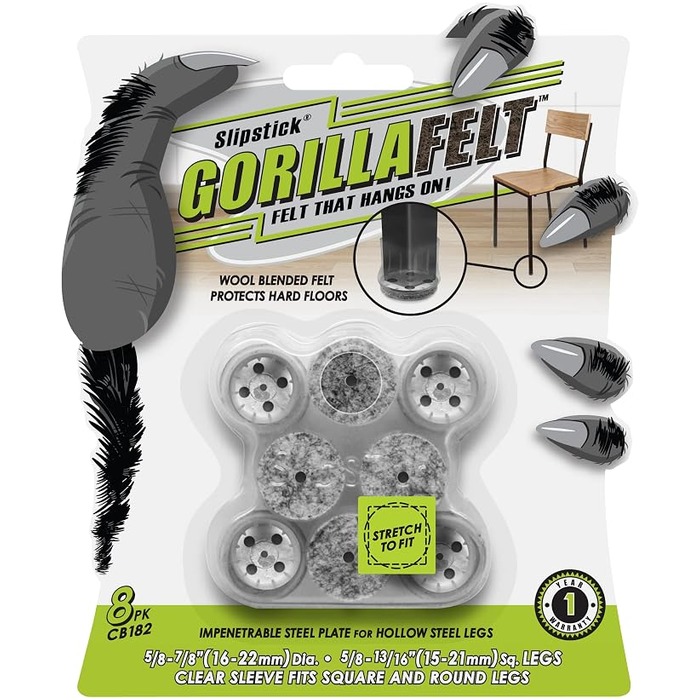
Slipstick GorillaFelt CB182 clear sleeve protectors
A clear sleeve with a felt base and an internal steel plate, published for round legs of 16 to 22 mm and square legs of 15 to 21 mm, including use on hollow steel legs. The two shape ranges are not identical, so a leg that fits the round chart can sit outside the square one.
- Role: Amazon consumer option
- Clear sleeve with a felt base
- Round 16-22 mm, square 15-21 mm
- Internal steel plate
- MOQ: Check current listing
BALEINE’s 16 piece Round Large listing is another candidate for a different size bracket. The retrieved listing specifies 1⅜ to 1½ inch round or square legs for that option. Confirm the selected variant before ordering; the same page describes other sizes with different limits. This is a fit based candidate, not a claim that it outlasts competing products.
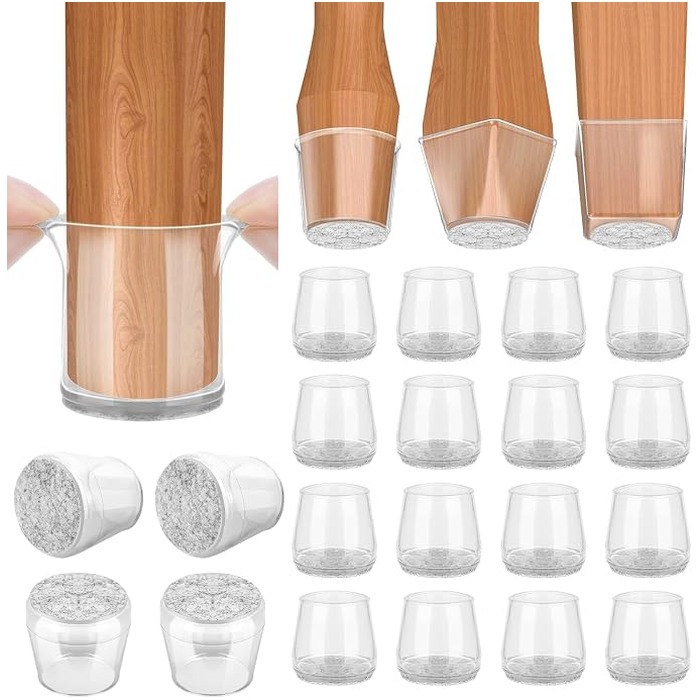
BALEINE silicone chair leg protectors, 16-piece set
A silicone cover set listed for 1-3/8 to 1-1/2 inch round or square legs in its Round Large option, sold as 16 pieces. The same page lists other sizes with different limits, so confirm the selected variant before ordering.
- Role: Amazon consumer option
- 16-piece silicone set
- 1-3/8 to 1-1/2 inch range
- Confirm the selected variant
- MOQ: Check current listing
Neither option becomes suitable simply because the listing has many ratings. A review of a different size, attachment type or chair shape may tell you little about your installation. Use the dimensions to establish eligibility, then read recent reviews that show a comparable leg and floor.
If neither chart fits, keep looking. Buying the nearest size is especially unhelpful when the mismatch is shape, taper or contact angle. A small sample order or a supplier’s fit confirmation can be more useful than a discounted pack for the entire dining set.
Test one chair before fitting the whole set
Install the protectors according to their instructions, without improvising lubricants, adhesives or heat. If they will not seat normally, revisit the size and geometry. Needing an unmentioned workaround is a reason to pause, not evidence that the fit is secure.
Fit all four feet on one chair, then place it upright on a clean, level area of the intended floor. Look for a folded sleeve, a tilted base or a cap that has not reached its intended seated position. Check whether the chair rocks differently from before.
If it appears stable, use it normally and move it a short distance while observing the feet. Stop if a protector rolls, shifts or begins to slip off. This practical check can reveal an obvious mismatch, but it is not a durability test or a guarantee against floor damage.
Inspect the underside as well. A cap may remain attached while its floor contact surface sits poorly. Keep grit away from the contact area and follow your flooring manufacturer’s advice on furniture protection. The National Wood Flooring Association recommends suitable furniture pads as part of wood floor care; fit does not remove the need for maintenance. [5]
Keep the measurements for the next order
Once you have a satisfactory fit, save the model, variant, leg measurements and a photograph together. Record front and rear legs separately if they differ. Include whether the measurements were taken over an existing fitting or on the bare leg.
Count protectors by the sizes required, not simply by the number of chairs. Four chairs need sixteen individual protectors, but that does not necessarily mean one sixteen pack is the right order. If front and rear legs need different variants, split the quantities accordingly.
Before reordering, compare the current product specifications with your saved record. Listings and variants can change, and a familiar product photograph is not a dimension check. A successful previous purchase is useful evidence only when the replacement is actually the same fitting.
The shopping decision becomes much simpler when you can state the interface, shape, dimensions and contact angle. Those details let you reject an unsuitable cap before it reaches your floor. Measure the chair you have, follow the chart for the exact product, and prove the fit on one chair before committing to the rest.
Sources
-
Chair Caps Australia. Rectangular silicone felt chair glides and measurement instructions. Source
-
Flexi Felt Australia. Clear floor protectors fitting guidance and limitations. Source
-
Slipstick. CB182 product specifications. Source
-
NIST. SI Units Length and the exact inch conversion. Source
-
National Wood Flooring Association. Problem Prevention. Source
Hook this up to your favourite commenting platform — Giscus, Disqus, or your own.
Continue reading

Do Washing Machine Anti-Vibration Pads Stop Walking?
A pad that has shifted out from under the washer is a symptom, not the diagnosis. Check the machine is stable and the foot fits the cup before buying a grippier set.
When a Silicone Faucet Mat Pools Water, Check the Fit and Drain Path
A mat that holds a puddle is failing at one of three points: the counter does not drain toward the bowl, the mat is set the wrong way, or its outlet is blocked.
How to Keep a Cutting Board From Sliding on a Countertop
Most boards move because of a film of water or oil, a warped corner, or an overhang, not because the board is light. Find the cause, then pick a damp cloth or a grip pad.