How to Stop a Duvet Insert from Bunching Inside the Cover
A fit and fastening guide for an insert that slides or gathers after you make the bed
 Lena Schmidt

Disclosure: We may earn a commission if you purchase through links on this page, at no additional cost to you.
If the whole insert slides toward the foot or one side of its cover, check the actual size of both pieces and connect every matching tie or loop before buying a gadget. If the corners stay aligned but the duvet still feels lumpy, look at the fill inside the insert: clips cannot repair fill that has migrated within its own shell.
That distinction matters because “bunching” describes two different problems. A loose insert can move as one piece inside the cover. Fill can also collect unevenly inside the insert itself. The first calls for fit and anchor checks; the second calls for care-label guidance or help from the maker.
First separate insert movement from fill migration
| What you notice | Likely problem | What to check next |
|---|---|---|
| The cover has an empty section at the foot or one corner while the insert has moved as a whole. | The insert is sliding inside the cover. | Compare the flat measurements and inspect all attachment points. |
| The corners remain connected, but the middle sags or shifts between them. | The available anchors may not control movement along the sides. | Look for existing mid-side ties or loops. Use only attachment points designed for that purpose. |
| The cover and insert stay aligned, but the duvet has thick and thin patches when laid flat. | The fill may be clumping or shifting inside the insert shell. | Check the insert’s construction and care instructions. Fasteners between cover and insert will not redistribute internal fill. |
| One edge is tightly stretched, the cover wrinkles, or a tie pulls hard at its seam. | The insert and cover may be a poor size match or the anchor is under strain. | Stop pulling. Recheck dimensions and avoid adding more tension to a weak point. |
A useful test is to lay the closed duvet flat and align the outer edges by hand. If the insert can be moved inside the cover while the cover stays in place, the two layers are not adequately anchored. If both layers move together but the fill remains lumpy, inspect the insert rather than adding clips.
Measure the insert and cover before adding fasteners
Lay each piece flat without stretching it. Measure width and length from seam to seam, then compare those numbers. Bed labels such as Queen or King are only a starting point; manufacturers can use different finished dimensions. The Company Store’s own size guide lists duvet covers by actual bed and insert categories, and its product guidance pairs cover ties with insert loops.
A cover that is substantially wider or longer gives the insert room to slide into the extra fabric. A cover that is too small can compress the insert and pull at the corners or seams. Do not solve either mismatch by tightening a tie until the fabric puckers. Choose a compatible pair using the published dimensions for the specific products.
Also check whether the cover has twisted around the insert. If one side seam no longer tracks the corresponding edge of the insert, open the cover and realign the pieces before changing hardware.
Connect the ties and loops already on the bedding
Turn the duvet cover inside out and spread it on the bed or another clean, wide surface. Place the insert on top, match the top and bottom edges, and align each corner. If the cover has ties and the insert has loops or tabs, connect all four matching corners. A firm bow or knot should hold during ordinary movement but still come undone when the cover needs washing.
The opening closure and the anchor ties do different jobs. Buttons or a zipper close the opening so the insert stays enclosed. Corner ties, loops, snaps, or compatible fasteners connect the insert to the cover and limit sliding. A secure zipper alone does not stop the insert from drifting inside.
Pottery Barn’s cover-filling guide likewise directs users to tie insert tabs to the cover’s corner ties when both are present. Follow the instructions for your own cover if its design uses a different fastening method.
When four corners are not enough
If all four corners stay fixed but the insert still gathers between them, check the inside seams for additional ties or loops at the middle of the sides. Connect those too if the cover and insert were designed with matching points. Bedding owners often describe this exact failure in community discussions: the corners stay put while the center shifts.
If there are no middle anchors, first decide whether the remaining movement is bothersome enough to justify altering the cover. A seamstress can add fabric loops to a sound seam in the removable cover. Keep any new loop broad enough to distribute force across the seam, and avoid sewing into a thin panel without confirming that the fabric can take the load.
Do not sew through a downproof insert shell or a filled baffle just to create an anchor. A new hole can compromise the shell, and a narrow tie can concentrate force on a small area. Check the insert maker’s instructions before modifying the insert. If the cover or insert is delicate, expensive, or already strained, replace the mismatched component or ask its maker for a compatible fastening option.
Choose a removable fastener only when the fabric can take it
A purpose-made duvet fastener is useful when the cover has no ties and you want a reversible fix. Fasteners differ: some clamp fabric, some use pins, and some attach with adhesive or snaps. Read the exact model’s instructions and inspect its contact point before use. A pin-style fastener can pierce fabric; an adhesive style can fail if its bond does not hold through use and laundering.
The magnetic clip set in the card below attaches with a magnetic key rather than a pin, so it does not pierce the cover. Consider it only for bedding whose cover fabric holds the clips in place. Test one clip on a hidden hem first, check the grip through a night of movement, and re-seat the clips whenever you change the cover.
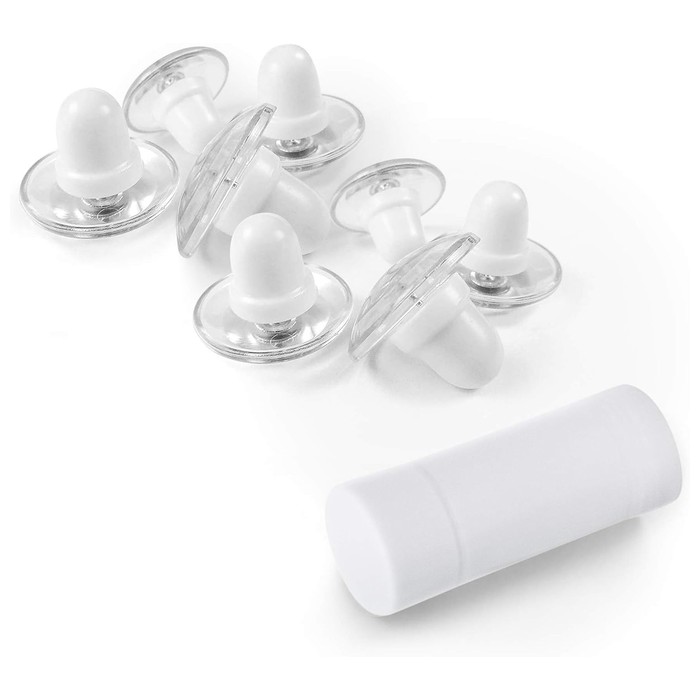
Clear magnetic duvet clips with magnetic key, 8-pack
These clips hold the insert to the cover magnetically, so they do not pierce a downproof or coated shell. The listing describes a pack of eight fasteners rated to hold up to 10 lb. Test one clip on a hidden hem first, check that it grips your cover fabric through a night of use, and remove them before laundering unless the maker says otherwise.
- Role: Amazon consumer option
- Magnetic attachment, no punctures
- Rated to hold up to 10 lb
- Test grip on a hidden hem first
- MOQ: Check current listing
If you want to avoid punctures, ties sewn to the removable cover are the more controlled option. If you do not sew, ask the cover maker whether a compatible clip or snap system is suitable. Do not use office binder clips as a permanent bedding fastener; their hard edges and concentrated pressure can catch or mark fabric.
Reset the duvet without pulling on one corner
After correcting the fit or anchors, open the cover and spread the insert across the full width. Hold corresponding corners together and work down the length rather than dragging one corner until the rest follows. Close the cover only after the edges sit evenly. A gentle shake can settle the layers, but it cannot compensate for a large size mismatch or missing attachment points.
When you change or wash the cover, untie the anchors before removing it. Before the next use, check that ties are not knotted around the insert filling and that no fastener is pressing into a person’s sleeping surface.
Quick answers
Do duvet clips stop an insert from bunching
They can reduce movement between the insert and cover when the two pieces are compatible and the fastener suits the fabric. They will not fix fill that has clumped inside the insert, and isolated clips may leave movement between their anchor points.
Why does my duvet still bunch after I tie the corners
The cover may have more room than the insert, the layers may not be aligned, or movement may continue between the corners. Check for matching middle ties or loops. If the outer layers stay aligned but the fill remains lumpy, the problem is inside the insert.
Should the insert be bigger than the cover
There is no single extra-inch rule that applies to every bedding set. Compare the maker’s finished dimensions and care instructions. The insert should fill the cover without being forced into it or leaving large pockets of empty fabric.
Can I use safety pins on a down duvet
Avoid piercing a downproof shell unless the insert maker explicitly allows it. A pin can leave a hole in the fabric that contains the fill. Use the cover’s existing ties or ask the manufacturer for a compatible attachment method.
References
The Company Store duvet cover sizing and tie guidance Source
Pottery Barn instructions for filling a duvet cover Source
Hook this up to your favourite commenting platform — Giscus, Disqus, or your own.
Continue reading

Do Washing Machine Anti-Vibration Pads Stop Walking?
A pad that has shifted out from under the washer is a symptom, not the diagnosis. Check the machine is stable and the foot fits the cup before buying a grippier set.

When a Silicone Faucet Mat Pools Water, Check the Fit and Drain Path
A mat that holds a puddle is failing at one of three points: the counter does not drain toward the bowl, the mat is set the wrong way, or its outlet is blocked.
How to Keep a Cutting Board From Sliding on a Countertop
Most boards move because of a film of water or oil, a warped corner, or an overhang, not because the board is light. Find the cause, then pick a damp cloth or a grip pad.