Why Your Fitted Sheet Keeps Coming Off an Adjustable Bed
A practical fit check for sheets that stay on a flat mattress but pull loose when the head or foot moves
 Lena Schmidt
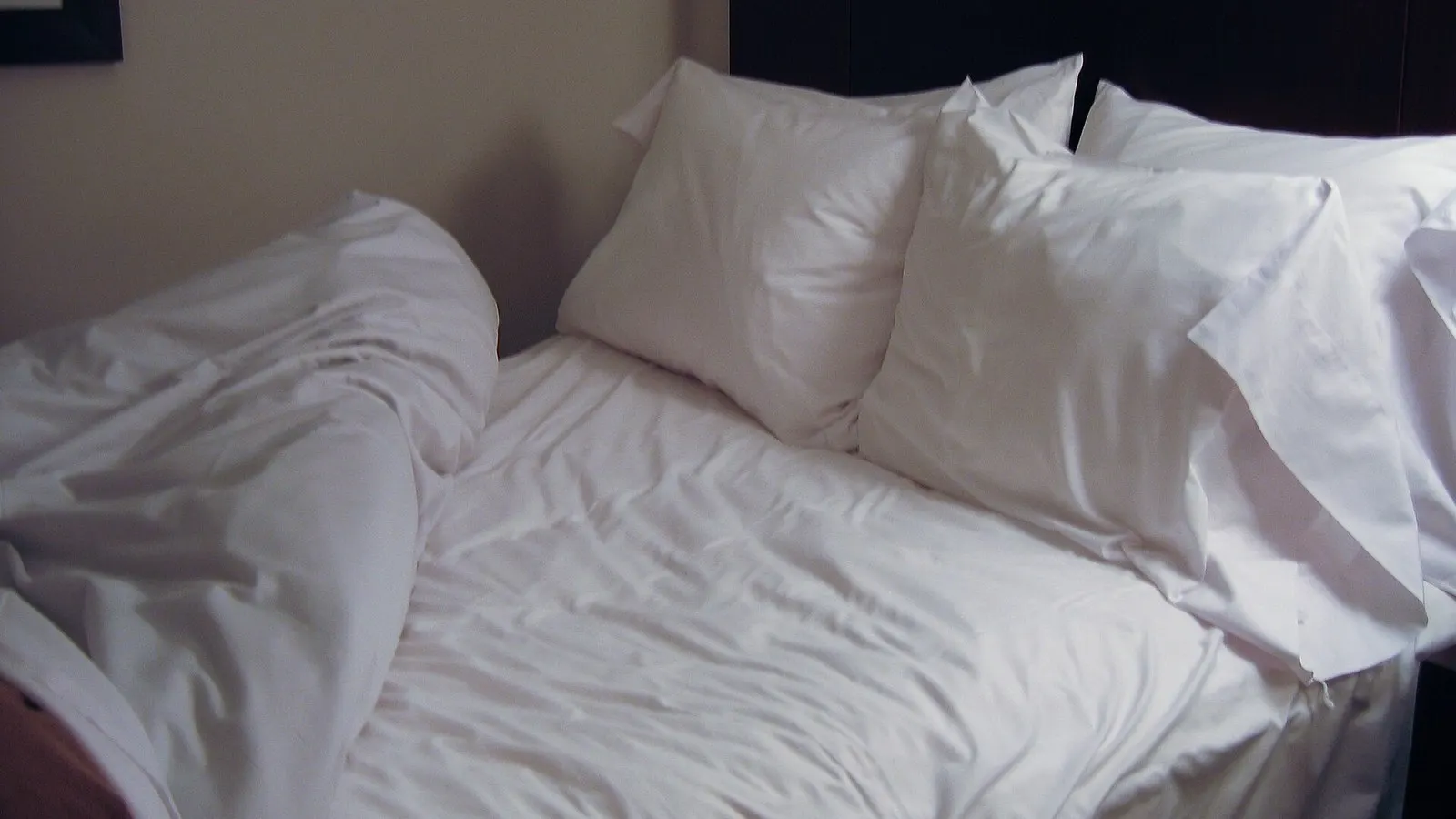
Disclosure: We may earn a commission if you purchase through links on this page, at no additional cost to you.
Quick answer
If a fitted sheet stays on while the bed is flat but slips when you raise the head or foot, first check the fit around the mattress and the full bedding stack: mattress, protector, and any topper. Then reinstall the sheet with each pocket seated fully under its corner. If the bed maker’s manual allows it, use the base’s preset positions to reach the corners and return the bed to flat after fitting. Test the head and foot separately so you can see which section pulls the sheet loose. Add sheet fasteners only after the sheet fits correctly on a flat bed, and keep straps clear of the base’s moving parts. A fastener cannot make a shallow, worn, or incompatible sheet fit correctly.
Tell whether the sheet slips in the flat position or during movement
A sheet that escapes while the bed is flat usually points to a fit or elastic problem. A sheet that holds when flat and releases only as the base moves needs a different check: the moving section may be pulling fabric toward a hinge or stretching one pocket beyond the amount it can hold. “Adjustable-bed compatible” on a package does not tell you whether a particular sheet will stay attached to your mattress and base combination.
Start with the corner that comes loose most often. Note whether it is at the head or foot, on the left or right, and whether it releases when the bed is lowered, raised, or both. If the same corner pops off every time, inspect its pocket and the way it sits under the mattress. If several corners loosen together, check the sheet’s overall depth, the elastic, and any change to the mattress stack.
Make one change at a time. If you tighten the sheet, add clips, and change the base position all at once, you will not know which change helped. A simple record—flat, head raised, foot raised, then flat again—turns a recurring annoyance into a visible fit problem.
| What you observe | Likely first check | Next step |
|---|---|---|
| A corner slips off while the bed is flat | Pocket depth, corner placement, worn elastic | Re-seat the corner and compare the sheet with the full mattress stack. |
| The sheet is secure flat but pulls loose when the head rises | Head-end pocket tension or sheet routed across a moving section | Check the base maker’s fitting guidance; test the head movement by itself. |
| The foot corner releases when the foot rises | Foot-end fit and how the sheet is tucked under the mattress | Reinstall at the foot; test the foot movement separately. |
| Several corners creep loose after a topper or protector was added | The sheet may no longer have enough usable depth | Measure the current stack and compare it with the sheet maker’s pocket-depth range. |
| The sheet feels slack everywhere, or elastic no longer contracts | Worn or oversized fitted sheet | Replace with a correctly sized sheet before adding more tension. |
Measure the whole mattress stack, not just the mattress label
A “Queen” or “King” label describes the bed size, not how much fabric a fitted sheet has to wrap under the mattress. Measure the mattress height at the side, then include every layer the sheet must cover: a mattress protector or encasement and any topper or pad. Use the finished stack that is actually on the bed. If the mattress has a pillow top or a non-rectangular profile, measure at a representative corner as well as along the side.
Compare that measurement with the sheet maker’s stated pocket depth or mattress-height range. Brands do not always define those terms the same way, so use the dimensions printed for the exact sheet rather than assuming a generic “deep pocket” label guarantees a fit. When the listing does not make clear whether its depth is a maximum mattress height or the fabric pocket itself, ask the seller before buying.
A pocket that barely reaches the underside may be under constant upward tension. A very loose pocket can also leave excess fabric that shifts during movement. The aim is a corner pocket that passes over the mattress corner and stays tucked beneath it without stretching the sheet hard or leaving a deep loose fold. Do not pull one corner so tight that the opposite edge lifts.
Recheck the measurement after changing a protector or adding a topper. That is a common reason a sheet that once worked begins to pop off: the mattress size has not changed, but the stack the sheet must cover has.
Put the sheet on with the base in the right position
Follow the adjustable-base manual first. Some manufacturers recommend raising the head to reach the upper corners, fitting the sheet, then returning the bed to flat so the fabric settles around the mattress. Ergomotion describes that sequence for its own bases; it is not a substitute for the instructions for another model. If your base has a “flat” preset, use it as directed and never reach near the hinge or linkage while the base is moving.
Before fitting, find the sheet’s orientation tag or corner label. Its location is brand-specific, so do not assume that every tag belongs at the same corner. Seat each pocket over the full mattress corner rather than leaving the elastic perched on the tip. Smooth the fabric toward the next corner and check that the side edge is not twisted around the mattress.
Once all four corners are seated, lower the base to flat if that is the manufacturer’s recommended fitting position. Smooth the side panels and check that the elastic is under the mattress around the corners. Then, if the manual permits, test the head and foot separately through a normal range of movement. Watch the sheet rather than pulling on it while the motor is running. If the sheet shifts at one point, stop and inspect that area with the base flat.
For a split king or split-head configuration, verify exactly where the mattress halves separate. A split-head king, a split king with two independent mattresses, and a standard king do not present the same sheet geometry. Check the fitted-sheet design against the actual mattress configuration and its dimensions; a shared top layer can bridge a split differently from two separate fitted sheets.
Choose a fix that matches the failure
If one corner releases on an otherwise correctly sized sheet, a corner fastener may help. Choose a design that grips the sheet without cutting or snagging it, and use only enough tension to keep the pocket seated. Metal clips and hard teeth can mark delicate fabric; test them on a hidden hem if the sheet maker permits it. Fasteners belong on the mattress and sheet only where the base maker’s instructions allow. Do not route a band through a hinge, motor, cable path, or under-bed linkage.
If the sheet comes loose at several corners while the bed is flat, buy a better-fitting sheet or replace worn elastic instead of adding multiple straps. If the sheet is secure while flat but pulls loose in motion, a set of four corner clips may not control movement along the long sides. In that case, look for a sheet made for the actual adjustable-bed configuration or a fastening system designed for that bed. Confirm its installation path and clearance before use.
Two options illustrate different ways to retain a correctly sized fitted sheet. Gorilla Grip’s four-piece corner holders use adjustable elastic straps and metal clips; its Amazon page showed 4.4 stars from 9,536 ratings and 2K+ bought in the past week. RayTour’s four-piece system uses adjustable three-clip holders; its page showed 4.4 stars from 56,304 global ratings and 2K+ bought in the past month when checked the same day. These signals show established listing activity, not proof either system fits every mattress, fabric, or adjustable base. Check the current variant and availability, and test clips on a hidden hem if the fabric maker permits it. Keep every strap clear of hinges, motors, cables, and moving linkages.
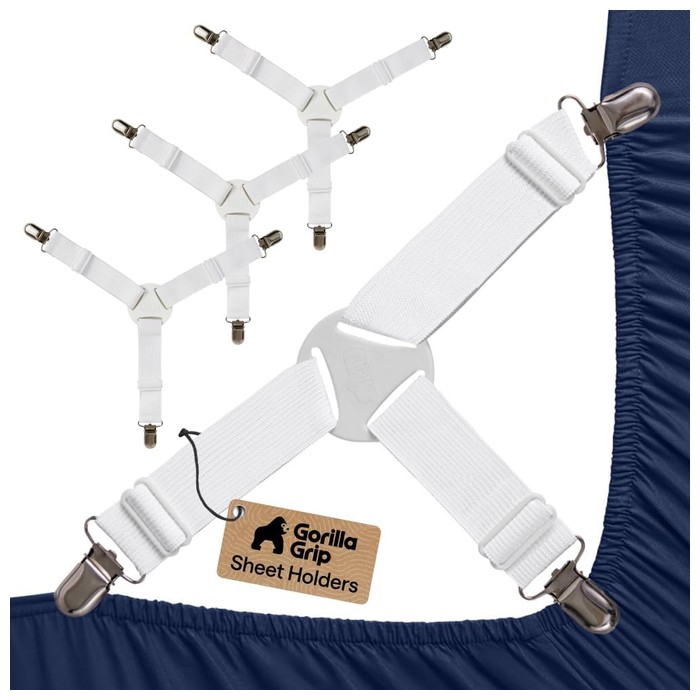
Gorilla Grip fitted sheet corner holders, 4-pack
Four corner holders using adjustable elastic straps and metal clips. The Amazon page showed 4.4/5 from 9,536 ratings and 2K+ bought in the past week. That is established listing activity, not proof the system fits your mattress stack, fabric or base, so check the current variant and test a clip on a hidden hem before relying on it.
- Role: Amazon consumer option
- Four corner holders with adjustable elastic
- Metal clips can mark delicate fabric
- Test on a hidden hem first
- MOQ: Check current listing
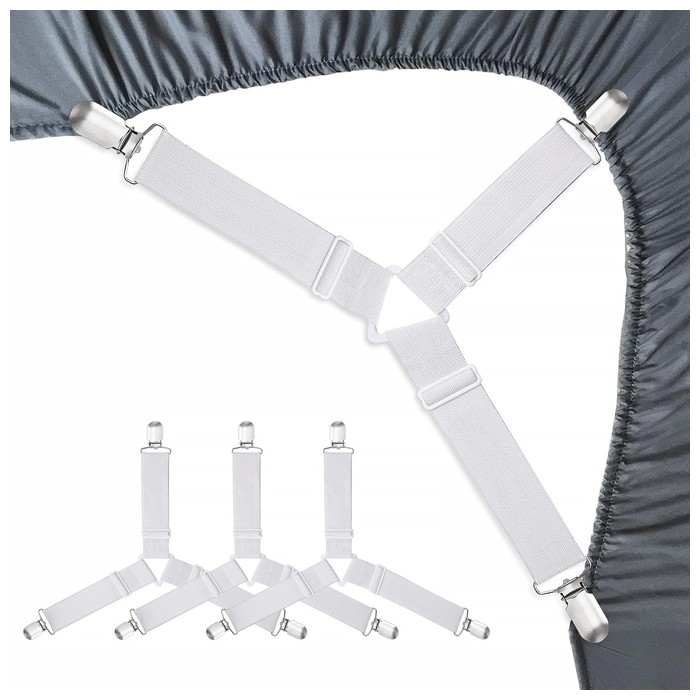
RayTour bed sheet holder straps, 4-pack
Four adjustable three-clip holders rather than corner-only clips. The page showed 4.4/5 from 56,304 global ratings and 2K+ bought in the past month. Check the current variant and availability, keep the straps clear of hinges, motors, cables and moving linkages on an adjustable base, and confirm the clip style suits your sheet fabric.
- Role: Amazon consumer option
- Three-clip holders, four straps
- Keep clear of hinges and moving linkages
- Check the current variant and availability
- MOQ: Check current listing
Do not clip a fastener to the sheet while the bed is moving. Fit and tension the hardware with the base flat and powered movement stopped, then follow the base and fastener instructions for any later test. If a clip slips off repeatedly, the answer is not to stretch the strap harder; reassess fit and compatibility.
Use this short check before replacing the sheet
| Check | Pass condition |
|---|---|
| Mattress and layers | The measurement includes the mattress, protector, and topper currently on the bed. |
| Sheet dimensions | The specific sheet’s pocket range covers the measured stack. |
| Orientation | Each corner pocket is on the intended corner and fully seated under it. |
| Elastic | The edge contracts and does not feel loose, brittle, or stretched out. |
| Movement test | The sheet stays in place during separately tested head and foot movement, where the base manual permits testing. |
| Fastener clearance | No strap or clip touches a hinge, moving frame, motor, cable, or other restricted area. |
Common questions
Should I buy a deeper-pocket sheet for an adjustable bed?
Only if the current pocket is too shallow for the full mattress stack or does not stay tucked under the mattress. “Deeper” is not automatically better; compare the exact sheet range with your measured setup and avoid excess fabric that cannot sit securely.
Do sheet suspenders solve the problem?
They can help retain corners when a sheet already fits and the fastener is compatible with the fabric and base. They do not correct an undersized sheet, worn elastic, or a strap routed through a moving mechanism.
Can I raise the bed while making it?
Only if the base maker’s instructions allow that position and the movement area is clear. A manufacturer may describe raising the head to reach a corner, but that guidance applies to the named base and setup.
What if the sheet comes off only on one side?
Check whether that side moves independently, whether the sheet is oriented correctly, and whether the pocket is fully under the corner. A consistent one-side failure is more useful evidence than the bed-size label: inspect that exact corner before adding fasteners to all four.
Sources consulted
Ergomotion: How to Keep Sheets on an Adjustable Bed Source
Casper: How to Keep Sheets on an Adjustable Bed Source
Good Housekeeping: If Your Fitted Sheet Keeps Popping Off Source
Hook this up to your favourite commenting platform — Giscus, Disqus, or your own.
Continue reading

Do Washing Machine Anti-Vibration Pads Stop Walking?
A pad that has shifted out from under the washer is a symptom, not the diagnosis. Check the machine is stable and the foot fits the cup before buying a grippier set.

When a Silicone Faucet Mat Pools Water, Check the Fit and Drain Path
A mat that holds a puddle is failing at one of three points: the counter does not drain toward the bowl, the mat is set the wrong way, or its outlet is blocked.
How to Keep a Cutting Board From Sliding on a Countertop
Most boards move because of a film of water or oil, a warped corner, or an overhang, not because the board is light. Find the cause, then pick a damp cloth or a grip pad.