How to Hang a Cashmere Sweater Without Stretching It
Fold it flat when the garment is wet or heavy; use a fold-over method only when closet space makes hanging necessary
 Lena Schmidt
Disclosure: We may earn a commission if you purchase through links on this page, at no additional cost to you.
Cashmere is often damaged by a very ordinary decision: putting a knit through the shoulders of a hanger because that is where every other top goes. The weight then concentrates at two small points, and the result can be shoulder bumps, a stretched neckline or a sweater that no longer sits at its original length. The safer default is to fold cashmere flat. When a closet has no shelf or drawer, the practical alternative is not a special hanger alone; it is a hanging method that supports the garment from its folded body rather than from the shoulder seams.
This guide separates three situations that are usually mixed together: a wet sweater after washing, a dry sweater being stored for days or months, and a dry sweater that must remain visible on a hanging rail. It gives a simple decision rule, shows the fold-over methods, and explains what to look for in a padded, velvet or rounded-shoulder hanger. It does not override a care label or promise that a hanger can make heavy cashmere safe to suspend indefinitely.
Scope boundary: this page covers daily closet handling and hanger-mark prevention. For wet drying, use the flat-drying workflow; for seasonal pest barriers, use a separate storage-container decision.
The short answer
Do not hang a wet cashmere sweater from its shoulders. Press out water without wringing, reshape it and dry it flat according to the care label. For a clean, dry sweater, folding in a drawer or on a shelf remains the lowest-risk choice. If a rod is the only available storage, fold the sweater lengthwise and drape the body and sleeves over the hanger bar so the weight is carried through the fold. A broad, smooth, non-slip hanger helps, but the method matters more than the word “padded” on the package.
| Situation | Best starting method | Why |
|---|---|---|
| Wet after washing or rinsing | Flat drying on a towel or mesh rack | Water adds weight; shoulder hanging can lengthen and distort the knit. |
| Dry, heavy or loose-knit cashmere | Fold flat in a drawer, shelf or breathable container | No concentrated hanger load and less chance of shoulder impressions. |
| Dry, lightweight knit and no shelf space | Fold-over or drape-over hanger method | The fold spreads load through the body instead of the shoulder seams. |
| Cardigan that must stay visible | Button it, fold the sleeves inward and support the folded body | Reduces slipping and keeps the front from pulling open on the hanger. |
This is a handling decision, not a claim that one hanger works for every cashmere construction. A dense, oversized or already stretched garment should move toward flat storage.
Why ordinary shoulder hanging creates the problem
A conventional hanger puts its narrow ends inside the garment’s shoulders. A knit has no woven shoulder seam designed to carry the entire garment’s weight in that position. Over time, the contact points can become visible as raised “bumps,” while the body and sleeves pull downward. A damp garment is more vulnerable because the water increases the load before the fibers and shape have recovered from washing.
Woolmark’s sweater-care guidance warns that drying on a hanger can make heavier garments stretch in length and produce shoulder humps. Cashmere care guides from clothing brands repeat the same practical rule: store knits lying flat rather than hanging. These sources support a conservative default, but they do not mean every dry, lightweight knit will be ruined by one brief fold-over hang. The useful boundary is load, moisture, duration and support.
Choose the method by garment state
| Garment state | Use | Avoid |
|---|---|---|
| Wet or cool and damp | Remove water with a towel, restore the original shape and keep the entire body supported while it dries. | Shoulder hanger, towel bar, narrow line, direct heat or a dryer setting not permitted by the label. |
| Dry but heavy or oversized | Fold flat; keep stacks low enough that you do not drag the bottom garment out by one sleeve. | Assuming a thick padded hanger removes the weight problem. |
| Dry, lightweight and worn again soon | Use a fold-over hanger only if the garment is clean, dry and not already distorted. | Leaving it on the rod for weeks because the method looks secure. |
| Loose, open or delicate construction | Fold flat and keep rough accessories away from the surface. | Velcro, sharp hooks, clips or a slippery hanger that makes the knit slide and snag. |
How to hang a dry sweater without shoulder bumps
Method 1: fold it over the hanger bar
Lay the clean, dry sweater flat with the front facing up. Smooth the sleeves, fold the sweater lengthwise so the sleeves align, then place the hanger with its hook near the armpit area. Fold the body over one side of the bottom bar and the sleeves over the other side. Lift the hanger by the hook and check that the load is balanced. The shoulder seams should not be carrying the garment.
This is the easiest method to test first because it leaves the sweater supported at its center. It is suitable for a dry, light or medium-weight knit when the closet has no shelf. If the sweater slides, use a soft non-slip surface or a hanger with a secure lower bar; do not solve slipping by inserting the hanger through the neckline.
Method 2: loop the folded body through a full triangle hanger
For a bulkier knit, fold the sweater lengthwise, position the hanger’s triangle over the folded body and loop the body and sleeves through the lower bar. The hanger should be strong enough not to buckle, and the lower bar should be smooth enough not to cut into the knit. This method is more secure in a crowded closet, but it still leaves a folded sweater hanging. It is not a substitute for flat storage during long-term seasonal storage.
Method 3: cardigan fold
Button the cardigan, lay it flat, fold the sleeves inward and bring the hem upward so the garment forms a compact rectangle. Drape that rectangle over the hanger bar. This avoids stressing the neckline and prevents the front panels from opening and pulling unevenly. Keep buttons, metal hardware and rough seams from rubbing against neighboring cashmere.
What makes a hanger suitable for a dry knit?
| Feature | What it helps with | What it does not prove |
|---|---|---|
| Rounded or wide shoulder contour | Reduces a sharp pressure point if the garment is hung by its shoulders briefly. | It cannot cancel the weight of a heavy cashmere sweater. |
| Soft padded or smooth velvet surface | Adds friction and reduces sliding or snagging during a fold-over method. | “Soft” does not prove dye stability, non-marking performance or long-term support. |
| Strong full triangle and lower bar | Supports a folded body without collapsing or bunching the knit. | A high weight rating for coats does not mean the shoulder geometry suits cashmere. |
| No exposed clips, burrs or sharp hooks | Reduces snag risk on fine yarns. | A non-slip coating can still transfer color or residue; inspect it before use. |
| Width that suits the garment | Keeps the folded load stable and prevents excess fabric from dragging. | A wider hanger is not automatically better; excess width can distort sleeves or crowd the closet. |
For a cashmere sweater, treat “no shoulder bump” as a design intention, not a performance guarantee. The first test should be on a less valuable knit. Check the garment after a short hanging period for a ridge, shine, color transfer, slipping or a stretched hem. If any of those appear, return to flat storage.
How to remove a small hanger bump
Take the sweater off the hanger and let it rest flat. If the care label permits light wetting, place a barely damp clean cloth over the affected area and reshape the knit with your hands; allow it to dry flat. Do not press a hot iron directly onto cashmere. Steam, heat and friction can flatten the surface, change sheen or make a small distortion harder to reverse. If the bump remains after the garment is dry and reshaped, repeated wetting is not a better diagnosis—stop and use a cleaner or textile professional for a valuable piece.
A bump that has become a stretched, shiny or thin area is not simply a crease. The correct decision may be repair or professional assessment rather than a stronger home treatment.
A closet decision when you have no shelves
| Closet constraint | Practical setup | Trade-off |
|---|---|---|
| Only one hanging rod | Use fold-over methods and leave a little vertical clearance between folded knits. | Slower to access than a drawer; inspect for slipping and crowding. |
| Rod plus door or wall space | Add a fabric hanging shelf or a small shelf insert so the heaviest knits can lie flat. | Uses more room but reduces repeated hanger loading. |
| Small apartment or shared wardrobe | Use a labeled breathable bag or low stack for clean, dry cashmere; keep seasonal items separate. | Requires a regular inspection routine; the container is not an infestation treatment. |
| Frequent outfit changes | Keep one “wear again” area for dry, clean items and fold immediately after the short hanging period. | Needs a simple routine; leaving knits on the rod defeats the purpose of the method. |
The goal is not to eliminate every hanger from a closet. It is to stop treating a soft knitted garment like a structured shirt. If the only reason to hang cashmere is visibility, a low shelf or hanging shelf is usually a better equipment decision than buying progressively thicker shoulder padding.
Product routes for a first comparison
The product choice should follow the method. A consumer may need a small set of padded or rounded hangers for dry, short-term fold-over use; a small clothing brand may want a consistent hanger specification for showroom or closet kits. Ratings, review counts and sold counts are useful screening signals, but they do not prove that a hanger will protect a particular cashmere knit. Test the geometry, surface and color on a low-risk garment first.
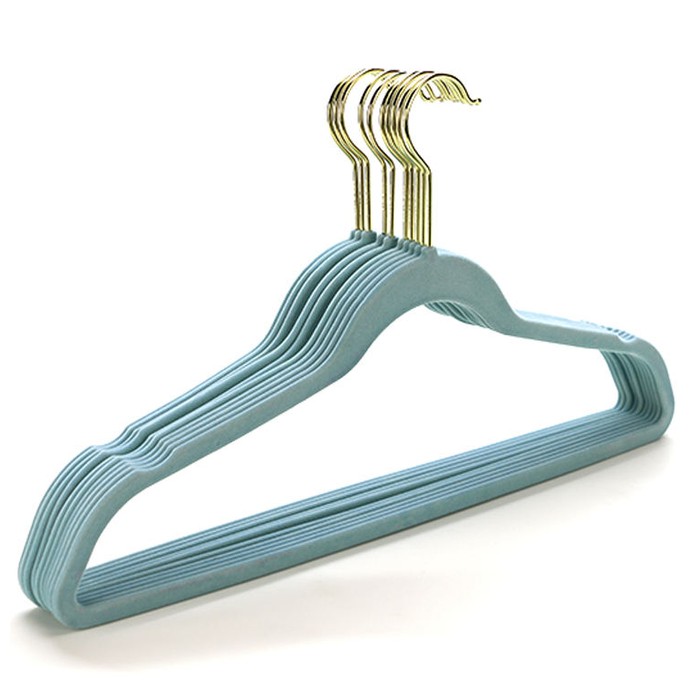
Velvet non-slip hangers with 360-degree swivel hooks
A flocked velvet hanger route for private-label or bulk orders. The checked category snapshot showed 387,600 sold, 4.8/5 from 20 reviews and a four-year supplier profile, which are merchant and listing signals rather than product tests. Verify the shoulder radius and width, the lower-bar strength, the coating composition, odour and dye transfer, the MOQ and a sample on your own knit.
- Role: Alibaba sourcing candidate
- Flocked surface with shoulder notches
- Confirm coating, odour and dye transfer
- Order a sample before a bulk run
- MOQ: Check current listing
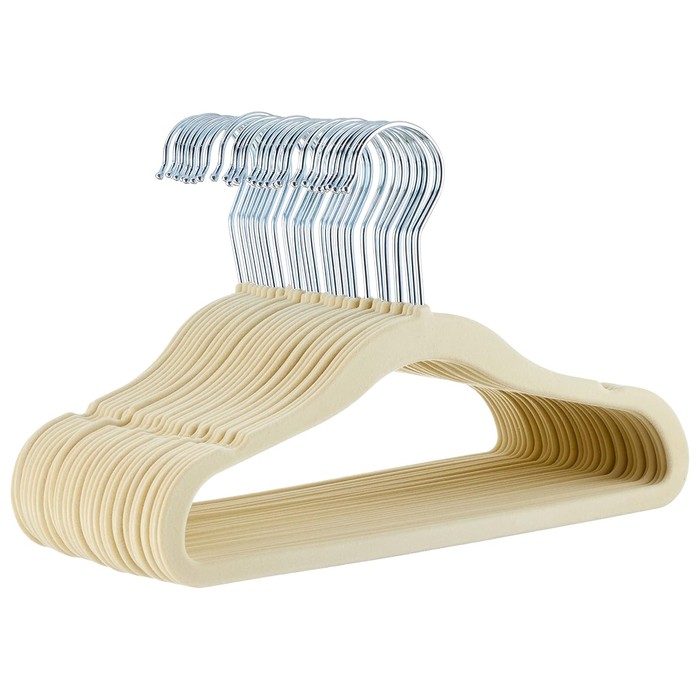
Amazon Basics kids velvet non-slip hangers, 30-pack
A low-cost velvet hanger set with shoulder notches and metal hooks. These are 11.6-inch children's hangers in beige, so check the length against adult knitwear before relying on them for a folded-over sweater. Use the fold-over method and keep the load on the bar rather than the shoulders.
- Role: Amazon consumer option
- Velvet non-slip surface, 30-pack
- 11.6-inch length suits children's garments
- Check the length against adult knitwear
- MOQ: Check current listing
If you are sourcing a small branded hanger
-
Send a real cashmere or wool sample, not only a garment photo. Specify the fold-over method and whether the hanger will ever carry a wet garment; the default answer for wet cashmere should be no.
-
Request shoulder width, shoulder radius, lower-bar diameter, total thickness, hook material, coating or fabric composition and exposed-edge drawings.
-
Test for snagging, sliding, surface marks, color transfer, odor and coating residue after repeated use. Keep a separate sample for packaging and transit inspection.
-
Ask for the minimum order, sample fee, logo method, packaging, carton dimensions, replacement rate and lead time. A low unit price can be irrelevant if the minimum order is larger than the wardrobe or kit you can sell.
-
Define acceptance in the purchase order: no sharp edges, no loose coating, stable hook, no visible shoulder imprint after the approved dry-hang period and no transfer to a light test fabric.
-
Treat a supplier’s years, reviews and sold count as continuity signals. They do not replace product-level tests or a written material declaration.
When not to hang the sweater
-
The garment is wet, cool and damp, freshly washed, or still holding water in the cuffs and seams.
-
It is heavy, oversized, loosely knitted, already stretched or showing shoulder shine or thin areas.
-
The hanger has a narrow shoulder, sharp corners, clips, exposed metal or a coating that feels tacky or transfers color.
-
You are storing it for a season and already have a shelf, drawer or breathable container that can support it flat.
-
You keep reaching for the hanger because folding feels inconvenient. The issue is closet layout, not a missing “cashmere-safe” hanger.
The practical decision is simple: fold cashmere flat whenever the garment is wet, heavy or stored for a long period. If a dry sweater must stay on a rod, fold it over the bar so the body carries the load. Buy the hanger for its geometry, surface and stability, then verify the result on the actual knit rather than trusting a “no bump” label.
References and evidence notes
Woolmark sweater care guide — wet weight, hanger distortion and flat drying. Source
Gocashmere care instructions — fold cashmere rather than hanging to preserve shape. Source
Hobbs cashmere care guide — avoid hanging because it pulls natural fibres. Source
The Spruce — four ways to hang sweaters and why the fold-over method changes the load path. Source
BHG — folding sweaters and the armpit-level fold-over method when a rod is unavoidable. Source
The Spruce — flat drying versus hanging, including the wet-sweater boundary. Source
Reddit / LifeProTips — user language around shoulder bumps and hanger impressions. Source
YouTube — sweater-hanging demonstrations using fold-over methods. Source
ObjectBrief — How to Dry Wool and Cashmere Flat Without Stretching Them. Source
Hook this up to your favourite commenting platform — Giscus, Disqus, or your own.
Continue reading
How Often Should You Wash Cashmere?
A wear-vs-wash decision guide for sweaters, cardigans and scarves

How to Choose a Reusable Pet Hair Remover for Clothes and Furniture
A clothes brush and a chamber roller solve different problems. Match the mechanism to the surface you actually clean, then check how it empties.

How to Choose Couch Grippers for Hardwood Floors
Match grippers to the sofa's feet, check floor compatibility, and choose between cut-to-fit pads, adhesive pads and a rug setup.