Why Bath Rugs Slide on Tile (and What to Check First)
A heavier rug does not fix a rug that creeps across a wet tile floor. Separate what is moving, match the fix to the floor material, and recheck after every wash.
 Lena Schmidt
Disclosure: We may earn a commission if you purchase through links on this page, at no additional cost to you.
A bath rug that moves when you step out of the shower is not fixed by choosing a heavier one alone. The rug has to grip the floor, the floor has to be clean and dry, and the backing must be compatible with the surface. Start by lifting the rug and checking which layer is moving. If the rug and any pad slide together, the floor side is failing. If the pad stays put while the rug shifts over it, the rug-to-pad contact is the problem. If the backing is cracked, sticky, curled, or shedding, another grip layer usually hides a worn rug. This guide is about a fabric bath rug placed on bathroom floor tile outside the tub or shower. A suction-cup mat used inside a tub is a different product with different safety requirements.
First, separate the rug problem from the floor problem
Lift the rug and feel the tile and the underside separately. Hair, lint, dust, dried soap, conditioner, body oil, and cleaner residue can form a thin layer between the backing and the floor. A rug may look clean from above while its underside is coated. Tile can also be damp from shower spray, a dripping towel, or a recently cleaned floor. A grippy backing cannot make stable contact through water or residue. Clean the floor with a cleaner approved for that tile and grout, rinse as directed, and let the area dry fully. Wash the rug only if its label allows it, then dry the backing before testing. Avoid fabric softener or spray treatments unless the rug maker permits them.
Now place the dry rug on the dry floor without a pad. Press the corners flat and nudge the rug sideways with your hand. This is only a preliminary check, not proof that it is safe under a wet foot. If it moves while dry, do not rely on it at the shower exit. If it moves after use, check for moisture or soap residue underneath. If only one edge lifts, check whether that edge lands across a grout joint, floor transition, or uneven repair. The pattern matters: whole-rug movement points to floor contact; a loose corner points to a local fit or backing issue; curling across the body suggests the rug itself may be distorted. General home-improvement guides also recommend pads, tape, grippers, and caulk, but the method has to fit the flooring and use conditions [3].
Match the fix to what is moving
When the rug and pad move as one, the pad is not gripping the floor. Confirm that it is intended for hard floors, that the correct face is down, and that the surface is allowed by both the pad and flooring makers. A pad for carpet may have a soft or adhesive face designed for a different job. If the rug moves on a pad that stays put, the two upper surfaces are a mismatch: the pad may be too smooth for the rug backing, or the rug may be too textured, loose, or lightweight for that pad. Repositioning the two layers or changing to a compatible single-piece rug can be more effective than adding tape underneath the pad.
If the rug itself has a rubberized or textured backing, inspect it after washing. Look for areas that have turned smooth, hardened, cracked, flaked, or become tacky. The product may be past its useful life, or it may have been washed or dried outside its care directions. Follow the rug’s sewn-in label for water temperature, detergent, and dryer use. When the backing is breaking down, retire the rug rather than layering new adhesive over loose material. Fragments can transfer to the floor, and an uneven underside can make the rug rock or bunch.
If only the rug corner shifts, a compatible corner gripper may be enough for a small, flat-backed rug. But a corner tab does not stabilize the middle of a long runner or a plush mat that moves across its whole width. For a full-footprint problem, compare a thin non-slip pad designed for hard surfaces or replace the rug with a model whose own backing is intended for the floor. Keep the fix simple: one rug and one compatible grip layer are easier to remove and inspect than a stack of tape, mesh, and adhesive tabs.
Choose by floor material, not by the word tile
“Tile” describes more than one surface. Glazed ceramic or porcelain, textured ceramic, natural stone, and resilient vinyl tile behave differently and have different care restrictions. Even within ceramic or porcelain, a polished face, matte face, grout layout, and cleaning residue change how a rug contacts the floor. Do not assume that a product labeled non-slip works on every surface or in every damp room. Check the rug label, the pad instructions, and the flooring manufacturer’s care guidance before leaving rubber, latex, PVC, or an adhesive product in contact with the floor.
Vinyl deserves particular caution. Armstrong’s residential flooring FAQ says its vinyl and luxury vinyl floors can be permanently stained by rubber- or latex-backed mats; it recommends colorfast, non-staining alternatives for its products [1]. Floor & Decor gives a similar warning for vinyl flooring [2]. Those instructions apply to the named flooring advice, not automatically to every tile floor or every brand. If you have sheet vinyl, luxury vinyl plank, or an older peel-and-stick floor, identify the floor first and follow its maker’s guidance before using a rubber-backed bath rug. A rug that grips well but leaves a permanent mark is not a good match.
For natural stone, sealed surfaces, newly refinished floors, or floors with radiant heat, confirm compatibility directly rather than inferring it from a generic package claim. Some grippers use rubber compounds, coatings, or pressure-sensitive adhesives that may react differently with a finish. A pad maker may exclude surfaces even when a pad is marketed for “hard floors.” Use only a floor-approved cleaner and follow the flooring maker’s restrictions over generic rug advice.
Size and placement are part of the grip
Measure the flat floor area where the rug can sit, not the whole room. Leave enough clearance for the bathroom door to open without catching the pile or a pad edge. Keep the rug outside the shower threshold unless it is made for that wet location. A pad should be smaller than the rug so it remains hidden, but the exact inset depends on the product’s instructions and the rug’s edge construction. Mohawk Home gives different inset guidance in two of its own resources, which is a reason to check the instructions for the exact pad rather than copy one measurement [4]. Mohawk Home, for example, describes a one-inch inset in one guide and at least two inches per side in its FAQ for its own pads. That variation is a reminder to follow the instructions for the exact pad rather than treating one measurement as a universal standard.
Avoid placing a small rug so that its edge is half on a grout line and half on a tile face if you have a practical alternative. A recessed joint or uneven tile can leave part of the backing unsupported. This is not a rule that every rug must fit inside one tile; bathrooms rarely offer that perfect geometry. Instead, choose a shape that lies flat across the available surface, without a curled corner, a raised transition, or a toilet-contour notch that catches a foot. A thin rug that clears the door and stays flat is often a more useful choice than a thicker one that bunches.
Why tape, caulk, and quick hacks often disappoint
Rug tape and adhesive grippers can help in some rooms, but bathroom humidity, cleaning, and repeated removal complicate the choice. Adhesive products need a compatible, clean surface and may leave residue or affect a floor finish. A renter should be especially careful about applying adhesive to tile, vinyl, or a refinished surface without written approval from the flooring or adhesive maker. Do not place ordinary packaging tape or plastic wrap beneath a bath rug. Social-media “hacks” may look plausible in a short video, but they do not establish reliable grip through repeated wet-foot use. In a reported test of the viral plastic-wrap trick, the rug still slipped on polished tile; the author noticed only a slight difference on matte tile. That is an anecdotal home test, but it is enough reason not to treat the trick as a safety fix [6]. In community discussions, people also report rubber-backed bath rugs sliding on sticky vinyl tile and adhesive tabs losing their bond; those accounts are useful for surfacing failure modes, not for proving which material will work in a particular bathroom.
Silicone caulk dots are sometimes suggested for area rugs, but applying a building sealant to a washable bath rug changes the product and may make laundering, removal, or floor compatibility worse. Caulk manufacturers define where and how their products should be used; a general home-improvement tip does not override those instructions. If you are considering an adhesive or coating, check both the rug care label and floor warranty first. If either maker does not approve it, choose a removable compatible pad or a different rug instead.
A short installation and recheck routine
-
Identify the floor material and find the flooring maker’s rug guidance.
-
Wash and dry the rug according to its label; clean and dry the tile with an approved method.
-
Inspect the backing for cracks, peeling, tackiness, or hardened patches.
-
Place the rug flat, with the door clear and no edge caught on a grout joint or transition.
-
If needed, add one pad labeled for that floor and for the rug’s size and backing.
-
Check both layers by nudging the rug and the pad separately. If either layer shifts, stop and change the combination.
-
Before someone steps out of the shower, make sure the mat and surrounding floor are dry and the rug has not moved.
Recheck after laundering, spills, or whenever the rug starts to creep. There is no universal replacement interval that fits every backing, wash cycle, floor cleaner, or bathroom. Replace or stop using the rug when the grip surface is visibly deteriorating, when it remains tacky after cleaning, or when it will not stay flat with a compatible pad. Do not wait for a near-fall to find out that a formerly stable rug has changed.
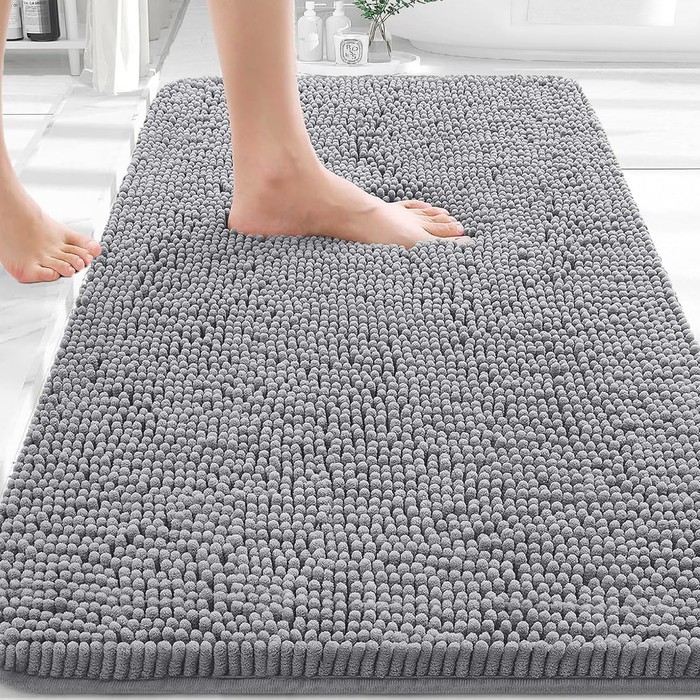
OLANLY 30 x 20 chenille bathroom rug
A 30-by-20-inch chenille bath rug with a soft pile. Compare the backing construction and the care directions with your floor maker's guidance before treating it as the fix for a sliding rug.
- Role: Amazon consumer option
- 30 x 20 inches
- Chenille pile
- Machine washable
- MOQ: Check current listing
A product example, with the limits made clear
If you are replacing a small rug rather than stabilizing the one you own, compare backing construction, size, care directions, and floor compatibility before comparing color or pile height. The OLANLY 30-by-20-inch chenille bath rug is one listing to inspect. Its product page describes a rubber backing and machine-washable care, but those are seller claims, not proof it will stay fixed on every tile. Better Homes & Gardens reported that its tested Gorilla Grip bath rug stayed stable in its test setup over a six-month period; that is useful evidence for that product and setup, not a guarantee for another rug, floor, or bathroom [5]. The OLANLY rug should not be used on a floor whose manufacturer disallows rubber-backed mats. Check the selected size and care label on the live listing before buying.
A separate rug pad can be a better choice when the current rug is in good condition and the floor maker allows it. Check that the pad grips both the tile and the rug underside, lies fully flat, and stays hidden inside the rug edge. For a bath rug that gets wet daily, inspect and dry the layers as often as the product instructions require; a pad that traps dampness underneath is not a useful upgrade. Amazon’s listing options and availability can change, so treat the product link as a place to compare the exact size and backing rather than a promise of fit.
When the safest fix is removing the rug
A loose rug is not required in every bathroom. If the room is too small to keep a mat clear of the door, if it crosses an awkward transition, if a household member has trouble stepping or balancing, or if you cannot keep the rug and floor dry, remove it while you choose a safer setup. A floor rug outside the tub is not a substitute for grab bars, a stable shower seat, or other accessibility equipment. CDC home-safety guidance recommends removing trip hazards and adding grab bars inside and outside the tub or shower [7]. Select any additional equipment for the person and bathroom rather than relying on a movable textile.
The useful test is simple: on the identified floor, does the rug stay flat and in place under a normal hand check after it is clean and completely dry? If not, do not add layers and assume the problem is solved. Identify the surface, choose a compatible backing or pad, and recheck it after care. If the right combination cannot be confirmed, a bare, dry, unobstructed route may be safer than a rug that shifts.
Sources
-
Armstrong Flooring, Residential Flooring FAQs, “Can I use rugs or mats on my vinyl floor?” Source
-
Floor & Decor, “Can I use rubber-backed rugs on my vinyl floors?” Source
-
Lowe’s, “How to Keep Rugs From Sliding on the Floor.” Source
-
Mohawk Home, “Why Buy an Area Rug Pad?” and FAQs Source
-
Better Homes & Gardens, “The 10 Best Bath Mats, Tested by BHG.” Source
-
Yahoo Life, “I Tried This Viral Plastic Wrap Hack in My Bathroom, and I’ll Never Use It Again.” Source
-
CDC, “Preventing Falls and Hip Fractures.” Source
Hook this up to your favourite commenting platform — Giscus, Disqus, or your own.
Continue reading

Do Washing Machine Anti-Vibration Pads Stop Walking?
A pad that has shifted out from under the washer is a symptom, not the diagnosis. Check the machine is stable and the foot fits the cup before buying a grippier set.
When a Silicone Faucet Mat Pools Water, Check the Fit and Drain Path
A mat that holds a puddle is failing at one of three points: the counter does not drain toward the bowl, the mat is set the wrong way, or its outlet is blocked.
How to Keep a Cutting Board From Sliding on a Countertop
Most boards move because of a film of water or oil, a warped corner, or an overhang, not because the board is light. Find the cause, then pick a damp cloth or a grip pad.