Flip-Top Caps: Built-In Tamper Band or Shrink Band?
A hinged lid can be opened without turning the cap, so the usual shrink band logic needs one extra check.
 Lena Schmidt
In this guide
- What are the ways to make a flip-top tamper-evident?
- What does a closure with a built-in band offer?
- When is a separate band the better choice?
- What does a band have to do on a flip-top?
- How do you size it? A worked example
- Who uses flip-tops, and does that change the answer?
- Where should the perforation go?
- What about heat and soft lids?
- What does each route cost?
- A test before you buy a case
- Questions to ask the seller
- Common mistakes
- FAQ
- Sources
Quick answer. A flip-top cap can be made tamper-evident three ways: buy a closure with a built-in tear band, put an induction liner under the lid, or shrink a band over the outside. The built-in band is the neatest but tends to be a special order with minimums. A separate band is the easy route for a small run, provided it is tall enough to reach over the front of the lid, because a lid that can be lifted through the film proves nothing. Size the width from the cap’s widest point, size the height from the cap plus about 5 mm at each end, and test on twenty real bottles before you buy a case.
A screw cap announces its own opening: you turn it, and the thread lets go. A flip-top does not. You lift the lid with a thumbnail and the cap stays exactly where it was. That is the whole appeal of the design, and it is also why a tamper-evident feature on a flip-top has to be planned rather than assumed.
The guides to honey jars, 38 mm caps and maple syrup bottles each touch on flip-tops in a paragraph. None of them settles the question a buyer actually has, which is whether to pay for a closure that arrives with its own tear band or to buy plain lids and a bag of film. This page deals with that choice, then with sizing the film if you pick it.
What are the ways to make a flip-top tamper-evident?
| Route | What it is | Cost signal | Catch |
|---|---|---|---|
| Closure with built-in band | Hinged cap with a wrap-around band and pull-away tab [1][2] | Quote only on the listing page [2] | Special order, minimums, limited sizes [2] |
| Induction liner under the lid | Foil seal on the bottle mouth, lid is plain [3] | Plain 38/400 lid with liner: about 12 cents each at case size [3] | Needs an induction sealer; hidden from the buyer until opened |
| Shrink band over the lid | PVC film shrunk around lid, cap and neck [5] | About 3 to 4 cents per band [3] | Must be tall enough to cover the lid edge |
Prices as displayed; see the cost section for the arithmetic.
The routes are not exclusive. A plain flip-top with an induction liner and a band on top is common on supplements, and the liner and the band answer different questions. The liner proves the bottle mouth was not breached. The band is what the shopper sees on the shelf.
What does a closure with a built-in band offer?
The idea is old. A trade item dated February 2001 describes a maker’s tamper-evident flip-tops for vitamin bottles: hinged LDPE caps with a wrap-around band seal and a pull-away tab, an induction liner inside, in five sizes from 33 to 58 mm [1]. The maker says the band replaces external shrink sealing and saves packaging cost, without giving a figure. A packaging trade site lists the same line under CCL Container [1]. Treat both as history; the range today may differ.
A current example is TricorBraun’s 45 mm white LDPE hinged flip-top, listed with a tear strip, a hinge guard and an induction liner printed with “Sealed For Your Protection” [2]. The listing is a special-order item: it says minimums apply, special orders start at $500 above stock, and the price is available by quote [2]. It does not explain how the tear strip works.
That is the usual pattern. The built-in route is clean, and it gives the shopper one obvious thing to break. But it is built for a buyer who orders by the pallet, and a small brand ordering a few hundred bottles will often find the closure harder to get than the film.
When is a separate band the better choice?
-
Small runs. A band is sold by the bag of 250. A tamper-evident closure is more likely to be a case, a quote or a minimum.
-
A cap you already like. If your lid has the orifice size or the look you want, changing it for a tamper-evident version may change how the product pours.
-
Mixed bottles. One bag of film will cover several sizes if their caps are similar.
-
Wanting a visible signal. A band is something the shopper can see from a metre away. A tear strip can be small.
The case against a band is the same as for any band: it is film that someone has to shrink, it can wrinkle, and it adds an item to every unit. If you fill thousands of bottles a month, the built-in version may save time that the film saves in cash.
What does a band have to do on a flip-top?
On a screw cap the band covers the seam where cap meets bottle. If someone unscrews the cap, the film tears. On a flip-top there is a second seam, between the lid and the base, and lifting the lid does not turn anything. A band that only wraps the base of the cap would not tear when the lid is opened.
So the film has to pass over the front edge of the lid, where a fingernail goes. When you lift the lid, you break the film. The guide to shrink bands as an Amazon FBA double seal makes the same point from a different direction. The height of the band is therefore set by the lid, not by the bottle neck.
This is a reading of how the closure works, not a supplier rule. The listings reviewed do not describe lid coverage, and the test below is how you check it.
How do you size it? A worked example
Take a 24/410 flip-top. Berry Global lists one with a cap diameter of 27.5 mm and a height of 22.3 mm [4]. TricorBraun’s rule for custom sizes is to measure the circumference at the widest point, halve it and add 2 mm [5]. The circumference is about 86.4 mm, so the lay-flat width comes to about 45.2 mm. That agrees with the 45 x 25 mm band TricorBraun pairs with 24 mm continuous-thread caps in the 400 and 405 finishes [5] and the 46 mm US Plastic suggests for a 24/410 plain cap [6].
Height is where the flip-top differs. TricorBraun’s guide says the film should overhang the closure by about 5 mm at each end so that it grips the neck [5]. For a 22.3 mm cap, that is about 32 mm. A 25 mm band would leave under 3 mm of overhang in total. The width is fine; the height is the trap. The sum here uses a listed cap and the supplier’s guideline. A different flip-top will give different numbers, and a lid that overhangs the base will need more.
The same arithmetic applies to 38/400 lids. The guide to shrink bands for 38 mm caps explains why a 66 mm band sometimes fits and why a bulky hinge may push you to 68 or 70 mm and a taller band. Retailers list 66 x 25 mm and 66 x 50 mm clear perforated bands next to their 38/400 flip-tops [3], which hints at the height difference without settling it.
Who uses flip-tops, and does that change the answer?
The caps turn up on squeeze bottles for lotions, oils, sauces and honey. One retailer’s customers confirm that its 24/410 flip-tops work on oils and lotions [8]. A manufacturer’s listing says the lid protects the contents from contamination before and after use [4], and a food-service seller describes the lid as resecuring itself with a stippled top that cuts the chance of accidental reopening [3]. Those are the selling points: one-handed use and a lid that closes again.
That second feature is what makes the band decision different. A band is a one-time signal. Once the customer tears it, the cap goes back to being a lid that opens and closes at will, and nothing tells the next person whether it has been opened. For a product used over weeks, such as a lotion or a bottle of cooking oil, the band’s job ends at the first use. For a single-serve or short-life product the signal matters more. Think about how long you need the evidence to last before you pay for more than the film.
Squeeze bottles raise a practical point as well. TricorBraun’s product pages say the bottle must have a neck bead to hold a band in place [5]. Soft plastic bottles are moulded in many ways, and not all have a clear ridge under the cap. Dry-fit a band on your own bottle before you trust a size chart.
Where should the perforation go?
No supplier recommendation was found, so this section is a suggestion and nothing more. There are two reasonable positions. Put the tear line on the side opposite the hinge, so that the customer starts at the front edge of the lid and pulls away from it. Or put it over the thumb notch, so the film is cut where the thumb already goes. The first leaves the hinge side intact; the second makes the tear and the opening one movement.
Try both on ten bottles and watch what people do. If the tear fails to reach the lid edge, or the strip catches on the hinge, change the position or the band. Our the perforation guide covers the film side.
What about heat and soft lids?
Flip-top lids are often thin polypropylene, and tamper-evident ones are described as LDPE [1][2], which is softer. No source was found on how much heat a hinged lid tolerates. One seller of small bands says a heat gun is needed, not a blow dryer, and gives a working range of 200 to 320 degrees Fahrenheit [7]. That figure is for its own film, not for your lid.
The practical risk is distortion near the hinge or the thumb notch. Heat one bottle slowly, look for a lid that no longer sits flat, then open and close it twenty times. It is a cheap test and a lid that sticks is a very visible failure.
What does each route cost?
Using prices as displayed in November 2026, a 38/400 white plastic flip-top lid with an induction liner was $198.99 for a case of 1,700, which works out at about 11.7 cents each [3]. A 66 x 25 mm clear perforated band was $7.99 for 250 and a 66 x 50 mm one $8.99 [3]: about 3.2 and 3.6 cents. So the band adds roughly a quarter to a third on top of the lid. At the small end, a 24/410 black flip-top was $2.76 for twelve, or 23 cents each, with no liner [8].
A tamper-evident closure had no public price on the page reviewed [2]. The comparison that matters is yours: the quote for the built-in version, minus the lid you would otherwise buy, against the film plus the labour of shrinking it. If a worker applies and shrinks a band in ten seconds, the labour can outweigh the film.
A test before you buy a case
-
Buy one bag of the band in the calculated size and one in the next height up. TricorBraun offers free samples [5]; Berlin Packaging says its bands are not eligible for them and advises testing every bottle and cap combination [9].
-
Fill and cap twenty bottles as you would for sale.
-
Shrink the bands with the same heat gun and distance you will use in production.
-
Open and close each lid ten times without tearing the film. Anything that moves is a miss.
-
Tear every band the way a customer would, then check the lid still opens cleanly.
-
Leave five bottles on their side overnight and check for creep or distortion.
This is a suggested routine. Our sample testing checklist has the longer version.
Questions to ask the seller
-
What are the diameter and height of this exact flip-top, hinge included?
-
Which band height do you recommend to cover the lid edge, and have you tested it?
-
Does the tamper-evident closure ship from stock or as a special order, and what is the minimum?
-
Is the band seamed on one side, and where does the perforation sit?
-
Can I get a sample of the cap and the band together?
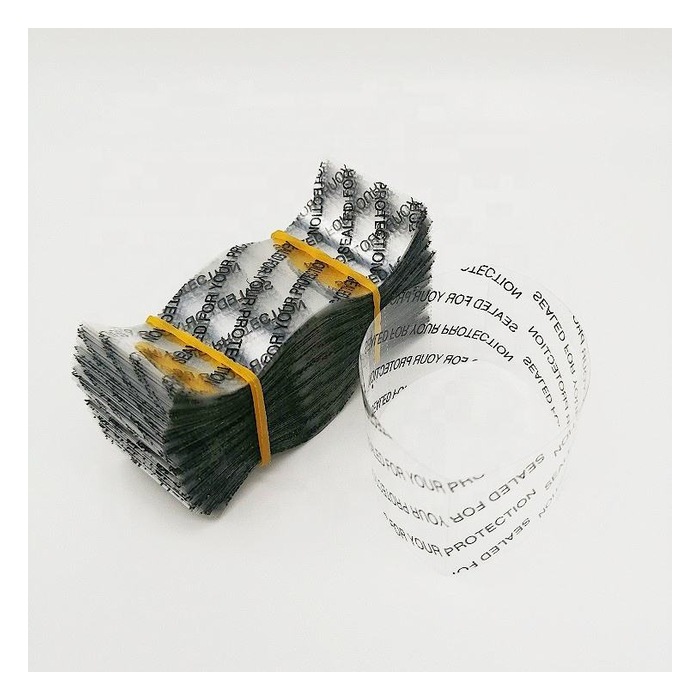
Clear PVC shrink band, printed
A clear PVC band printed with the tamper message, sold flat-cut and sized by lay-flat width and height.
- Role: Alibaba sourcing candidate
- Clear PVC film
- Printed tamper message
- Width and height chosen per order
- MOQ: From 50,000 pieces
Common mistakes
-
Ordering the height of a screw-cap band. The width may be right and the film too short to cover the lid.
-
Assuming the liner replaces the band. The liner seals the mouth. The shopper sees the lid.
-
Never opening the lid after shrinking. Check that the hinge still moves.
-
Reading old trade news as current stock. The 2001 item is background, not a catalogue.
FAQ
Can I use the same band on a flip-top and a plain cap of the same size?
The width, perhaps. Not the height. Measure both.
Does a shrink band cover the dispensing hole?
Only if it reaches over the top. We recommend keeping the film over the front edge and the thumb notch and testing whether the orifice stays usable.
Are tamper-evident flip-tops available in small sizes?
A 45 mm one is listed on a distributor’s page [2] and a range from 33 to 58 mm in a trade item from 2001 [1]. Smaller sizes need a supplier’s confirmation.
Is a band required on a flip-top?
Depends on the product and the sales channel. See whether shrink bands are required by law.
Sources
-
Packaging Insights, “Flip-top closures” (1 February 2001); PackWorld, CCL Container: TE flip-top closures. packaginginsights.com, packworld.com (trade news; the first item does not name the maker).
-
TricorBraun, 45 mm White LDPE Plastic Tamper Evident Hinged Flip Top Closure, SKU 138885. tricorbraun.com (packaging distributor; product page).
-
WebstaurantStore, 66 x 50 mm and 68 x 50 mm shrink band pages and “products you may need” lists for 38/400 flip-top lids and 66 x 25 / 66 x 50 mm bands. webstaurantstore.com (food-service supplier; prices as displayed).
-
Berry Global, 24/410 Flip Top Glossy, product 4837. berryglobal.com (manufacturer specification).
-
TricorBraun, Shrink Bands for Bottles and Jars: A Sizing Guide, and shrink band product pages. tricorbraun.com (custom-size rule, 5 mm overhang, neck bead note, samples).
-
U.S. Plastic Corp., Shrink Band Sizing Chart (PDF). usplastic.com (packaging distributor).
-
Premium Vials, Tamper Evident Shrink Wrap Band for Lip Balm Tubes. premiumvials.com (seller listing; heat range for its own film).
-
Wholesale Supplies Plus, 24-410 Black Smooth Flip Top Cap. wholesalesuppliesplus.com (retailer; price as displayed).
-
Berlin Packaging, PVC Shrink Bands. berlinpackaging.com (packaging distributor; testing advice and sample policy).
Continue reading

Shrink Bands for Child-Resistant Caps: How to Size Them
A push-and-turn cap is wider than a plain screw cap, so the band that fits the thread size usually does not fit the closure.
Shrink Capsules for Wine Bottles: Sizes, Heat and Fit
A capsule is sized by diameter, not lay-flat width, and that one difference causes most wrong orders. Here are the sizes sellers publish, how to measure your own bottle, which heat source works by hand, and what goes wrong.
Shrink Bands for Lip Balm Tubes: Sizes and Perforations
The width is the easy part. Height and the direction of the perforation decide how the tube opens and whether the cap comes off cleanly, and listings rarely say which you are buying.