Why Fitted Sheets Ball Up in the Dryer and How to Stop It
A practical troubleshooting guide for damp, twisted bedding
 Lena Schmidt

Disclosure: We may earn a commission if you purchase through links on this page, at no additional cost to you.
The short answer
A fitted sheet balls up because its elasticized corners keep catching the fabric as the load turns. Once the sheet folds over itself, pillowcases or smaller items can get trapped inside, restricting movement and airflow. The dryer may finish its timed cycle while the center of that bundle is still damp. The most reliable first steps cost nothing: separate sheets from bulky laundry, shake each piece open before loading, close duvet covers, and leave enough room for the load to tumble. If the problem continues with a properly sized load, a sheet-specific fastener may be worth testing. Dryer balls can help some households, but they do not reliably prevent a fitted sheet from swallowing the rest of a load. [1][2]
This guide focuses on the dryer problem: how to reduce tangling, how to tell whether a load is simply too large, and when a dedicated accessory makes sense. It does not promise wrinkle-free results or a shorter cycle. Those outcomes depend on the dryer, fabric, load, and settings.
Why fitted sheets are especially prone to tangling
A flat sheet has no elastic edge to hold a pocket open. A fitted sheet does. Its elasticized hem gathers fabric around the mattress corners, creating several places where pillowcases, a flat sheet, or a lightweight shirt can catch. As the drum rotates, the sheet can fold around those items and tighten into a bundle. Online discussions describe the familiar result: the outside feels dry, while a pillowcase or the middle of the sheet comes out damp. These posts are useful evidence of the problem language people use, not a measure of how often it happens across all households.
Load composition changes the odds. A fitted sheet dried with towels, pajamas, and pillowcases has more opportunities to trap smaller pieces. A king sheet in a compact dryer may also have less room to unfold than a twin sheet in a larger drum. That does not prove the appliance is defective. Appliance makers recommend avoiding overloading and shaking out large items because tumbling space matters. Check the appliance manual for its load guidance; drum capacity is not the same as the amount of bulky bedding that can move freely. [1][2]
Some dryers reverse direction or use a bedding cycle intended to reduce twisting. These features can help, but they do not guarantee a tangle-free load. If your dryer has a bedding or sheets cycle, follow the manual and try it with the fitted sheet alone first. If that cycle still produces a tight bundle, address load size and sheet handling before assuming a new appliance is necessary.
Start with the free fixes
-
Separate bedding from towels and clothes. Dry sheets as a bedding load. Towels are heavier and take longer to dry; mixing them with a large sheet can leave the load uneven and give the sheet more fabric to wrap around. If your washer produces a very wet, tightly twisted load, loosen the pieces before they go into the dryer. Do not cram in another set just because it fits through the door.
-
Shake each sheet open at the washer. Hold two corners and give the sheet a quick shake so the layers are not already knotted when the cycle begins. Check that pillowcases are not inside the fitted sheet. Whirlpool and other appliance guidance specifically recommends shaking sheets and other items before drying. This is a low-effort first test, not a guarantee: a sheet can still twist later in the cycle. [1]
-
Close duvet covers before drying. Zip or button the opening, and check that the closure is secure. An open cover can catch a sheet or pillowcase and pull it inside. If the cover’s care label permits machine drying, dry it with compatible bedding and enough drum space. Do not tie the opening with string or add makeshift fasteners that could snag fabric or catch in the drum. [1][2]
-
Reduce the load until the sheet can move. There is no universal number of sheets that fits every dryer. Fabric weight, size, moisture, and drum design all matter. A useful test is to dry one fitted sheet by itself, or with only its matching light flat sheet, then compare the result with your usual load. If tangling stops, add items back one at a time. This identifies a capacity or load-mix issue more clearly than changing several settings at once.
-
Use the care label and the right cycle. Choose the temperature and cycle recommended for the fabric and your dryer’s manual. Lower heat may help limit overdrying for some bedding, but it is not a mechanical anti-tangle setting; it may also require more time. Moisture-sensing cycles can stop when the load reaches the selected dryness level, but a sensor cannot reliably detect damp fabric trapped inside a tight bundle. If the load comes out twisted, open it and check the center before deciding it is dry. [1][2]
-
Pause once if the bundle forms. If you hear a heavy, repetitive thumping or know from past loads that sheets tangle, pause the machine, separate the items, and restart. This can rescue the current load, but it is a workaround rather than prevention. Repeatedly opening the door adds handling time and can extend the job. If the same sheet forms a ball on nearly every run, change the load method or test a sheet-specific accessory instead of relying on mid-cycle checks.
Do dryer balls solve it?
Wool or rubber dryer balls move among the items and may help separate fabrics during tumbling. Maytag and Whirlpool list dryer balls among possible ways to reduce clumping. Yet real-user reports are mixed: some people find them helpful, while others say their balls disappear inside a fitted sheet or do little to stop the sheet from wrapping around itself. [2]
That difference makes sense. Dryer balls are loose objects in the drum; they do not hold the fitted sheet open or connect its corners. They may improve movement in a small, light load, but a fitted sheet can still fold around the balls. If you already own them, test them with one sheet and compare against the same load without them. Do not buy a large set on the assumption that more balls will solve a geometry problem. Follow the product and dryer instructions, especially for heat-sensitive or delicate items.
When a sheet fastener is worth trying
A dedicated sheet detangler works differently from dryer balls. Depending on its design, it connects corners or keeps part of the sheet folded in a controlled way, limiting how much fabric can gather around smaller laundry. Appliance makers describe corner-connecting devices as one option for preventing fitted sheets from balling up or trapping other items. [1] That is a plausible role for an accessory when the free fixes have not solved a repeated problem. It is not a replacement for adequate drum space or correct care settings.
Before buying, inspect how the accessory attaches. Does it clip to the sheet, hold corners together, or connect two pieces? Will the attachment press on the elastic hem? Is it intended for use in both the washer and dryer, or only one? Check the manufacturer’s instructions for sheet sizes, fabric types, and any warnings about elastic edges. Product claims such as a fixed percentage reduction in drying time should be treated as manufacturer claims unless an independent test supports them; the result in your home will depend on your load and machine.
Also consider the setup cost in time. A reusable device only helps if you are willing to attach it before each load and remove it afterward. People who dislike handling small clips or who have sheets with thick, deep-pocket hems may prefer the free method of drying one fitted sheet separately. If you do want to compare accessories, judge each one on how it attaches, what it holds together, and whether you would actually use it before every load.
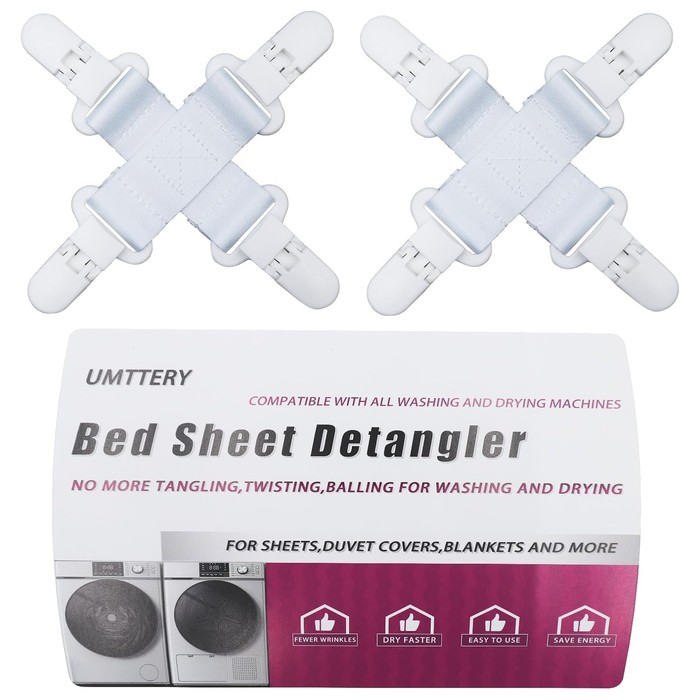
UMTTERY bed sheet detangler, 2-piece set
A cross-shaped clip device that holds the sheet corners spread apart so the load cannot fold itself into a pocket. The listing states compatibility with washing and drying machines and covers sheets, duvet covers and blankets. Measure your sheet against the current clip reach before relying on it.
- Role: Amazon consumer option
- 2 cross-shaped clip devices
- For washer and dryer loads
- Check clip reach against your sheet
- MOQ: Check current listing
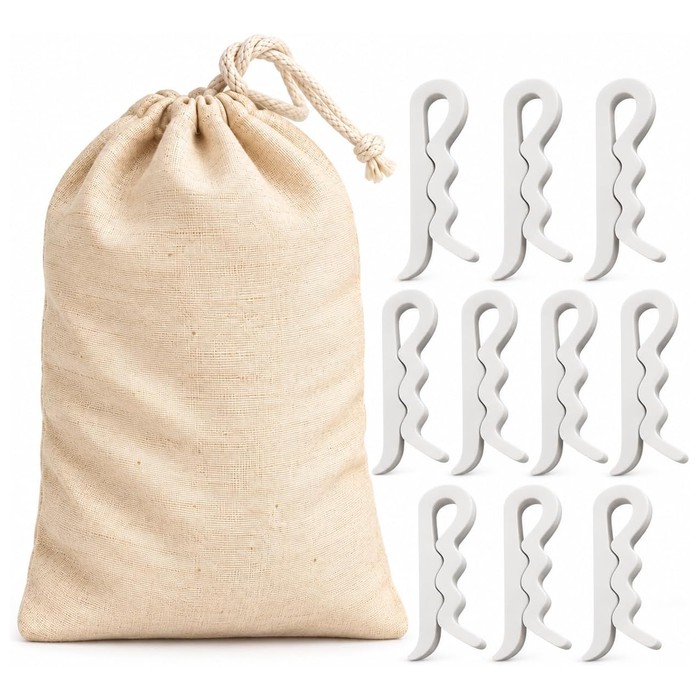
Laundry Buddy bed sheet detangler clips with storage pouch
A clip-based set supplied with a drawstring pouch. Each clip grips a sheet corner or edge so the sheet cannot fold in on itself, and the pouch keeps the clips together between loads. Check that the clip opening suits your sheet hem thickness before you rely on it.
- Role: Amazon consumer option
- Clip-based detangler set
- Includes drawstring storage pouch
- Check clip opening against hem thickness
- MOQ: Check current listing
A simple test that identifies the cause
Use the same fitted sheet for three loads, and change only one variable each time. First, dry it alone after shaking it open. If it stays open, the original issue likely involved load size or mixed items. Next, add its matching flat sheet and pillowcases. If those tangle it, keep the set together only if your drum has room; otherwise split the set across cycles. Finally, test your usual dryer setting and any bedding cycle your manual recommends. Record whether the center is damp, whether another item was trapped, and how long the cycle ran. This small comparison is more useful than trying a new temperature, dryer balls, and extra items simultaneously.
If one sheet tangles even when dried alone, check for a twisted elastic edge or a cover seam that is catching on itself. Shake it fully open and inspect whether any fabric is damaged. Try the bedding cycle if the appliance has one. If multiple large items tangle in every load, compare the load size with the manual and make sure the drum is not packed tightly. If the dryer also has unusually long cycles, weak airflow, or other performance symptoms, consult its troubleshooting guide; tangling alone does not diagnose a mechanical fault.
Avoid fixes that create a new problem
Do not knot sheets together or use improvised metal clips, safety pins, or cords inside the dryer. They can snag fabric, strike the drum, or create a new hazard. Do not overload the dryer to save a cycle; crowded bedding can tumble poorly and dry unevenly. Avoid increasing heat beyond the fabric label to force the damp center dry, because a trapped wet pocket is a circulation problem, not proof that the whole load needs higher heat. When the cycle ends, separate any bundled fabric and check the thickest folds before putting bedding away.
A damp center after one cycle does not automatically mean the dryer needs another full high-heat run. Open the sheet, distribute the items, check the care label, and use an appropriate setting for the remaining moisture. For delicate fibers or elastic components, follow the bedding and appliance care instructions rather than a general internet tip.
Check the sheet and load before changing the machine
A fitted sheet that has become twisted before it reaches the dryer can start the cycle already folded into a rope. When moving laundry from washer to dryer, separate the sheets instead of lifting out one compressed bundle. Find the elastic corners and shake the fabric open. If the sheet is very wet and heavy, check that the washer completed its spin correctly and that the load was not so crowded that it could not redistribute. Follow the washer manual if it repeatedly leaves bedding unusually wet.
Fabric also affects how a load behaves. A lightweight microfiber sheet and a heavier cotton sheet do not occupy or move through the drum in the same way. Deep-pocket construction adds fabric around the corners, which can create larger folds. These are reasons to test your own bedding rather than assume a universal load count. Keep the care label visible when choosing a drying cycle, and do not use an accessory unless its instructions allow your sheet material and the intended machine.
A useful comparison needs only a few notes: sheet size and fabric, what else was in the load, the cycle used, and whether the center was damp at the end. Change one condition at a time. If the sheet dries open when alone but tangles with pillowcases, the issue is likely the load combination. If it twists even alone, focus on opening it fully, using an available bedding cycle, or testing a compatible sheet fastener. This turns an annoying repeat into a solvable setup problem.
A practical decision rule
If the problem happens once in a while, start by separating bedding, shaking each sheet open, closing duvet covers, and reducing the load. If it disappears when the fitted sheet dries alone, load size or mixed items were likely the main contributor. Dryer balls are an inexpensive test if you already use them, but treat them as a secondary aid. If a correctly sized load still tangles repeatedly, compare a purpose-built sheet fastener with the extra time of drying the fitted sheet separately. Pick based on attachment design and sheet compatibility, not a promise that every load will dry faster.
The aim is simple: get enough room and separation for the fabric to tumble, then verify that no smaller item is trapped in the fitted sheet. A repeatable routine usually matters more than a single gadget.
References
-
Whirlpool, “Quick Tips for How to Stop Sheets from Balling Up in the Dryer,” Source
-
Maytag, “8 Ways to Stop Sheets From Balling Up in the Dryer,” Source
-
The Spruce, “6 Ways to Keep Sheets From Balling Up in the Dryer,” Source
-
Homes & Gardens, “7 Easy Ways to Keep Sheets from Balling Up in the Dryer,” Source
-
Real Simple, LaundryTok and Wad-Free review Source
-
Amazon Live, Wad-Free official how-to video Source
Hook this up to your favourite commenting platform — Giscus, Disqus, or your own.
Continue reading

Do Washing Machine Anti-Vibration Pads Stop Walking?
A pad that has shifted out from under the washer is a symptom, not the diagnosis. Check the machine is stable and the foot fits the cup before buying a grippier set.

When a Silicone Faucet Mat Pools Water, Check the Fit and Drain Path
A mat that holds a puddle is failing at one of three points: the counter does not drain toward the bowl, the mat is set the wrong way, or its outlet is blocked.
How to Keep a Cutting Board From Sliding on a Countertop
Most boards move because of a film of water or oil, a warped corner, or an overhang, not because the board is light. Find the cause, then pick a damp cloth or a grip pad.