Shrink Bands for Essential Oil Dropper Bottles: Sizes From 5 ml to 30 ml
Every bottle in a 5 to 30 ml dropper range can share an 18 mm finish and still need a different band. Here is how the finish number, the cap width and the bulb decide the size, with the stock pairings suppliers publish.
 Lena Schmidt
In this guide
- Why a dropper bottle is not a jar
- Two band styles, two different jobs
- What the finish number does and does not tell you
- Checking the fit with the arithmetic
- Child-resistant droppers need a different band
- The bulb problem
- A ten-bottle test before you order
- Keeping the band and the label out of each other’s way
- Keeping reorders consistent
- Common mistakes with dropper bands
- Where to source these bands
- FAQ
- References
Quick answer. For a dropper bottle with a regular (non-child-resistant) cap, a cap-and-neck band of roughly 38 to 42 mm lay-flat width and 26 to 30 mm height is the common stock size, and a separate, wider cap-and-body wrap exists for sealing the whole bottle. The number on the finish, such as 18-400 or 18-415, describes the thread, not the cap or the bottle body, so measure both. Supplier listings show that “30 ml” bottles vary in body diameter, from about 30 mm to 32 mm, and one retailer’s 30 ml wrap is rated for bottles up to 31 mm. One supplier also says its 38 x 28 mm bands will not fit child-resistant caps. Buy a sample pack and test on your finished bottle first.
Why a dropper bottle is not a jar
Most shrink band advice assumes a flat-topped cap on a jar or a bottle. A dropper bottle is different in three ways. The closure is a collar with a rubber bulb standing out of the top, so the top is not a surface a band can seal across. The cap sits on a very narrow neck, so the band has little thread and bead to grip. And the bottle range is wide: the same cap thread is used on 5 ml, 10 ml, 15 ml and 30 ml bottles, whose bodies differ in diameter even though the neck does not.
A manufacturer data sheet shows the pattern. For one glass essential oil bottle series, the screw diameter is 18 mm across the 5, 10, 15, 20 and 30 ml sizes, while the maximum body diameter rises from 19 mm at 5 ml to 30 mm at 30 ml and the height from about 47 mm to 76 mm. So the neck band can stay the same across the range, and the wider body is what changes the answer if you want a band that covers the shoulder.
Two band styles, two different jobs
A UK retailer that sells bands for dropper bottles lists two very different products. The first is a cap band, listed at 40.18 mm wide by 26.3 mm tall and 0.04 mm thick, for glass dropper caps. It is applied with a heat gun and described as gripping the cap and the bottle’s neck collar. A US supplier offers a similar item, an 18 mm cap band at 42 x 30 mm made for dropper caps.
The second product is a longer wrap that covers the cap and part or all of the body. The same UK retailer lists lay-flat sizes of 36 x 68 mm for 10 ml, 40 x 69 mm for 15 and 20 ml, and 51 x 80 mm for 30 ml bottles. It says the bottle’s height is less critical, because a band can be cut down before use and any overhang will shrink flat over the top or bottom.
| Style | What it does | Where it suits |
|---|---|---|
| Cap band (about 38–42 mm x 26–30 mm) | Grips the collar and the neck; the customer tears it to open | Glass droppers where the label stays visible and you want a low-cost seal |
| Cap-and-body wrap (about 36–57 mm wide, 68–90 mm tall) | Covers cap and part of the body; more film and more fit risk | Brands that want to cover more of the bottle or hide the cap seam |
Sizes from a UK dropper-band retailer and a US packaging supplier’s product listings.
For most small essential oil sellers the cap band is the default. It costs less, it needs less shrinking skill, and it leaves the label area alone. The wrap is a design decision, not a necessity.
What the finish number does and does not tell you
The first number in 18-400 or 18-415 is the neck finish diameter in millimetres, and the second describes the thread style. One supplier of tamper-evident droppers spells this out, explaining that the second number refers to the closure depth, style and thread. Neither number is the outside width of the cap. A UK retailer’s band page says the same thing directly: the neck size of the bottle is just the screw thread of any cap that fits the bottle and is not the size of band you need.
That matters for droppers because the same finish comes with several cap styles. A Cary Company 15 ml bottle with an 18-400 finish ships with a white child-resistant dropper, and the same company sells an 18 mm black cap with a poly cone insert for the same neck. A ribbed-skirt tamper-evident dropper in the 18-415 finish is sold for 1 oz Euro bottles. The thread is identical in all three; the caps look different on the shelf and measure differently with a caliper.
The reliable method is the one in our band sizing guide: measure the widest point of the finished cap or body, apply the lay-flat arithmetic, and add spare width. The next section does that for the published bands.
Checking the fit with the arithmetic
A flat band of width W wraps into a tube with diameter about 2W divided by pi, so a 40 mm band opens to about 25.5 mm. The smallest object it can cover is the reverse: the lay-flat width must be at least pi times the diameter divided by two. The table applies this to the UK retailer’s own stated limits.
| Band width | Opens to (2W/π) | Retailer’s stated max bottle | Minimum width for that | Spare width |
|---|---|---|---|---|
| 40 mm (15/20 ml) | 25.5 mm | 24 mm (plastic); 25 mm (glass 10 ml) | 37.7 mm; 39.3 mm | 6%; about 2% |
| 51 mm (30 ml) | 32.5 mm | 31 mm | 48.7 mm | about 5% |
| 57 mm (50 ml) | 36.3 mm | 36 mm | 56.5 mm | about 1% |
Calculated from the retailer’s lay-flat and maximum-diameter figures. Maximum diameters are the retailer’s statements, not independently measured.
The tight rows are a warning. In the other container guides on this site, supplier pairings usually left about 4 to 15 percent spare width. Here the 50 ml row leaves about one percent, and the glass 10 ml row about two. That is a stated maximum, not a comfortable fit, and a few tenths of a millimetre of body variation could stop a band going on.
The 30 ml row shows how real bottles vary. The retailer rates its 30 ml band for dropper bottles up to 31 mm in diameter. Lotion Crafter lists its 1 oz amber glass dropper bottle at 32.3 mm in diameter, and a manufacturer data sheet gives a maximum of 30 mm for a 30 ml bottle in its range. A 51 mm band needs at least about 50.7 mm to cover 32.3 mm, so it fits on paper with about half a percent to spare, but it clears the 30 mm bottle by about eight percent. Same capacity, same finish, different answer.
The cap band works the same way. A US reseller’s 38 mm band is sold for 18-400 half-ounce bottles and opens to about 24.2 mm, so a regular dropper cap narrower than that should pass. Its product page states that these bands fit regular dropper caps and poly-seal cone caps but will not fit child-resistant caps.
Child-resistant droppers need a different band
A child-resistant dropper cap has a double wall or an outer shell, and it is wider than a standard cap on the same thread. The reseller above says its 38 x 28 mm bands will not fit them. The US Plastic size chart covered in another guide here shows that a 38-400 child-resistant cap measures 77 mm against 66 mm for a standard one. The 18 mm range is smaller, but the principle holds: the finish stays the same while the cap grows.
So if you sell with child-resistant caps, ask for a wider band by name and test it on your actual cap. Measure the cap, not the bottle. If the supplier only quotes a finish number, ask for the cap diameter in writing.
The bulb problem
A dropper has a rubber bulb on top. A cap band that sits around the collar will show if someone has unscrewed the collar, because the perforation tears. It does not cover the bulb, and a collar band alone does not stop someone from squeezing the bulb or pulling out the pipette if the bulb is removable. That follows from how the parts are built, rather than from any published source, so check how your own cap assembles before you promise anything on the label.
The wrap style covers more, but the top of the bulb still needs a closed end on the band if you want it fully covered. The UK retailer says overhang shrinks flat over the top, which suggests a longer band can close over the bulb. Ask the supplier whether a given band is meant to be shrunk over the bulb and test it on one bottle before you order.
There is also a material issue. One US retailer of dropper caps advises storing oil bottles upright and swapping the dropper for a regular cap during storage, because rubber bulbs deteriorate, especially with myrrh or citrus oils. That is guidance about bulbs and oils, not bands, but it matters here: if a customer will store the bottle for months, a band that holds the dropper on over the bulb keeps the oil in contact with rubber. Using a solid cap for stock shipments and a dropper for the finished product is a design choice to consider.
A ten-bottle test before you order
Order a sample pack from two suppliers, not one. Apply bands to ten finished bottles with the caps you will really ship, including the closure you use on your largest size. Use the heat method you plan to use at volume; a heat gun is the common choice for small runs, and the retailer’s own instructions describe heating until the band shrinks around the cap and grips the collar.
Check each bottle for four things: the band goes on without forcing, it shrinks flat without wrinkles at the shoulder, the label area is not covered, and the band tears at the perforation without pulling the cap off. Write down the width, height and perforation style that worked, and keep the sample bag with the supplier’s name. That record is what lets you reorder without redoing the test.
If one of the ten fails, find out whether the fault is the band or the bottle. Measure the failed bottle’s widest point. If it is more than the others, the bottle supplier’s tolerance is the problem, and a wider band solves it. If the cap is simply a different style, the band is the wrong product for that cap.
Keeping the band and the label out of each other’s way
On a 15 or 30 ml bottle the label panel is small. A manufacturer listing for a 15 ml 18-400 bottle gives a label panel of 3.859 inches by 1.752 inches, and the bottle itself is under three inches tall. A cap band of 26 to 30 mm adds roughly an inch of film above the shoulder, so check that it ends above the label edge and does not catch it when the customer tears the perforation.
If you print your own labels, hold a finished bottle with the band applied and read every line you are required to show. A label that is legible with the cap off and hidden with the band on is a design fault you want to find on ten bottles, not on a thousand.
Keeping reorders consistent
Dropper bottles are a repeat purchase, which means the bottle, the cap and the band will be reordered several times a year, often from suppliers who change tooling without announcing it. Keep a one-line record for each product: bottle supplier and item number, measured body diameter, cap style and measured cap diameter, band supplier and lay-flat size, and the heat setting that worked.
When a reorder arrives, measure three bottles from the new lot before you apply any bands. If the body or cap differs from your record by more than a millimetre or so, run the ten-bottle test again. It costs an afternoon and avoids discovering a fit problem after the bottles are filled.
Common mistakes with dropper bands
The first is ordering by capacity. A band sold for “30 ml bottles” is made for a typical body, and as the table shows, bodies of the same capacity differ by a couple of millimetres. The second is ordering by finish number alone, which describes a thread. The third is ignoring the cap style: a regular, child-resistant and ribbed-skirt tamper-evident cap on one thread all need different bands.
The fourth is trusting a listing’s “fits” line without a diameter range. Good listings give a range, like the 1/2 to 7/8 inch figure printed on one 38 x 28 mm band, and a lay-flat size. Treat a listing with neither as a guess. The fifth is skipping the perforation. A tamper band that cannot be torn easily by an adult is a support request waiting to happen, and our perforation guide covers the tear designs.
Where to source these bands
The listings below cover the two shapes this guide describes — a 38 x 28 mm cap band, a sleeve cut for a 30 ml bottle, and a mixed set for testing more than one size.
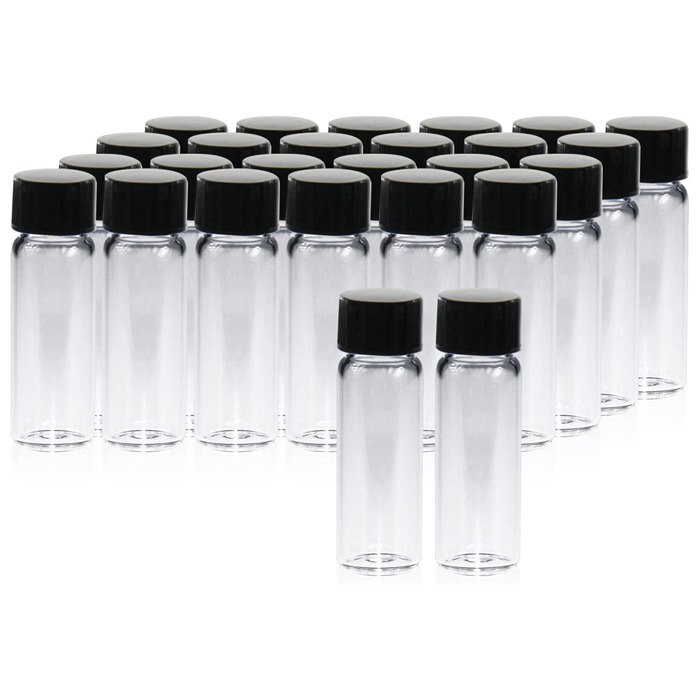
38 x 28 mm clear perforated band for dropper bottles
A stock cap-and-neck band in the 38 x 28 mm size that packaging suppliers list for small Boston rounds, dropper bottles and vials.
- Role: Amazon consumer option
- 38 x 28 mm
- Perforated
- For 18 mm dropper caps
- MOQ: Check current listing
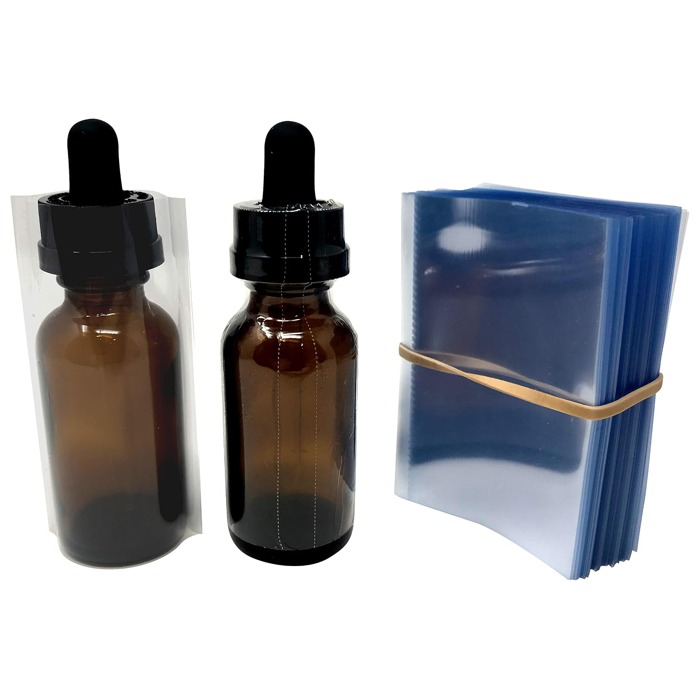
Clear perforated sleeve for 1 oz (30 ml) dropper bottles
A cap-and-body sleeve cut for a 1 oz (30 ml) dropper bottle, the wider of the two styles this guide describes.
- Role: Amazon consumer option
- Cut for 30 ml dropper bottles
- Perforated
- Cap-and-body coverage
- MOQ: Check current listing
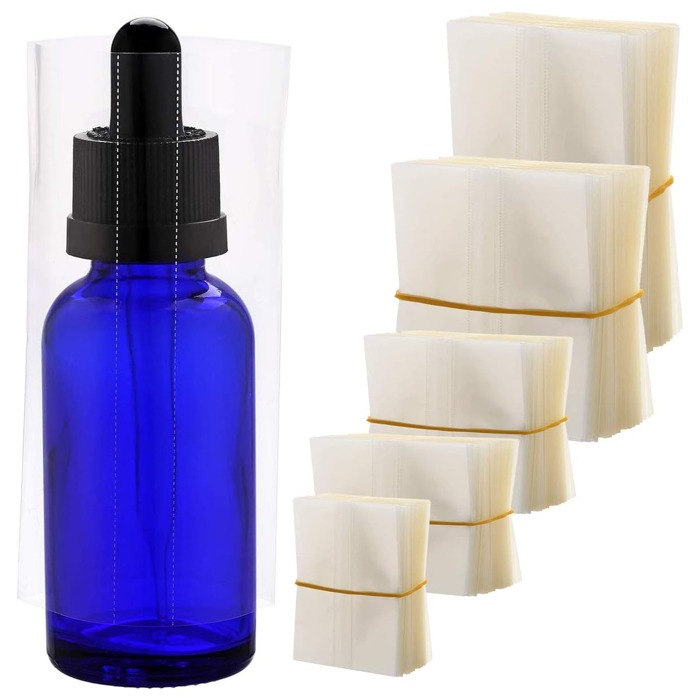
Mixed shrink band set for testing several sizes
A multipack that puts 38 x 28, 45 x 23, 48 x 28, 55 x 85 and 65 x 60 mm bands in one box.
- Role: Amazon consumer option
- Five sizes in one pack
- Mixed set
- Perforated
- MOQ: Check current listing
For measuring the full assembled dropper and choosing a perforation style, see our dropper bottle sizing guide.
FAQ
What size shrink band fits a 30 ml dropper bottle? It depends on the cap and on the body. A cap band of about 38 to 42 mm by 26 to 30 mm is the common size for regular caps, and a retailer lists a 51 x 80 mm wrap for 30 ml bottles up to 31 mm in diameter. Measure your own bottle.
Do 5 ml, 10 ml and 15 ml bottles need different bands? Not if they share a finish and cap and you use a cap band, because the neck is the same. They do if you use a wrap, because the body width changes.
Will a band fit a child-resistant dropper cap? Not the standard sizes in the supplier listing checked for this guide. Ask for the cap diameter range and test.
Does the band cover the rubber bulb? A collar band does not. Check how your cap assembles and whether a longer band is meant to close over the top.
Is a band required on essential oils? No rule was found that requires one for essential oils or cosmetics in general. Tamper-evident packaging is required for some product types, such as certain over-the-counter drugs, so check the rules for your category and market.
References
- Specialty Bottle, “Shrink Bands”, product pages Source
- The Cary Company, “Shrink Bands and Shrink Sleeves” Source
- TricorBraun, “Shrink Bands for Bottles and Jars: A Sizing Guide” Source
- US Plastic Corp., “Clear Shrink Bands with Perforations” Source
- US Plastic Corp., “70 mm W x 25 mm Hgt Clear Shrink Bands with Perforations” Source
Continue reading
Shrink Bands for Handmade Soap and Bath Bombs: How to Size the Wrap
A soap band is an open-ended sleeve, so the sizing starts from the bar’s perimeter rather than from a cap diameter. Here is the halving rule, why cured bars measure differently from fresh ones, and how loose the published soap band sizes really are.
Shrink Bands for Candle Tins: Sizes for 8 oz and 16 oz Slip-Lid Tins
On a slip-lid tin the band bridges the lid and the body, so the maths starts from the tin’s diameter rather than a bottle cap. Here are the bands two suppliers pair with their own tins, the two-line check you can do yourself, and why their suggested bands are taller than the tin.
Shrink Band Problems and Fixes: Wrinkles, Holes, Loose Bands and Crooked Tears
A symptom-by-symptom guide for people shrinking bands by hand: what each fault looks like, which cause the supplier instructions actually name, and which fixes are reasoning rather than a sourced rule.