Shrink Bands for Spice Jars: Size by Cap, Shaker-Lid Fit & Tamper Evidence
A spice jar is the smallest container most sellers band, and the number on the cap names the finish, not the band. Size from the measured cap, then test two heights on a filled jar with the shaker in place.
 Lena Schmidt
In this guide
- Why spice jars need their own sizing check
- What sizes suppliers pair with spice caps
- The band must grip both cap and neck
- Shaker, sifter and flip-top lids
- Heat and dry goods
- The number on the lid is a finish, not a width
- Clear or colored, and what the band covers
- Shipping and market days
- A band shows opening; it doesn’t keep spices fresh
- Order sizes and what to test
- FAQ
- References
Quick answer. Size a spice-jar band from the cap you actually use, not from the jar’s volume. Suppliers pair a 53 mm spice cap with a 92 x 40 mm band and a 63 mm spice cap with 110 x 58 mm, which leaves roughly 10 percent over the π × diameter ÷ 2 minimum for a cap exactly that wide. Uline’s sizing instructions add two rules worth following: if your measurement is near the top of a band’s range, go up a size, and the band must grip both the cap and the neck to count as tamper evident. For shaker and flip-top lids, choose a height that wraps the lid edge without reaching the holes or the hinge you want customers to use, and test on a few filled jars before ordering a case.
Why spice jars need their own sizing check
A spice jar looks like the simplest container to band: a small glass or plastic jar with a cap. Two details make it less simple. The closure is often a two-part assembly, a screw cap with a shaker or sifter insert, or a flip-top spout. And the finishes are standardized in a way that tempts you to order by label: suppliers describe their bands as fitting 43, 53 or 63 mm spice caps, and the catalog code 63-485 appears again and again.
The problem is that the number names the cap, not the band. A band is a flattened tube, and it has to open out to more than the cap’s diameter before it shrinks back down. So a “63 mm” spice band is wider than 63 mm in lay-flat terms, and a band listed only by lid size is a prompt to check the lay-flat before you buy. Our size guide covers the general method; here is how it plays out on spice jars.
What sizes suppliers pair with spice caps
Start with what suppliers actually pair with their own spice-cap listings, then check each against the geometry. A band lies flat at half its circumference, so the minimum lay-flat for a cap of diameter D is about π × D ÷ 2.
| Listing (supplier) | Band | Minimum lay-flat | Spare width |
|---|---|---|---|
| 53 mm spice cap (The Cary Company) | 92 x 40 mm | about 83 mm | about 11% |
| 63 mm spice cap, 63-485 (Container and Packaging) | 110 x 58 mm | about 99 mm | about 11% |
| Caps 1 to 1¼ in (Uline) | 55 x 56 mm | about 50 mm at 32 mm | about 9% |
| Caps 1¼ to 1½ in (Uline) | 66 x 28 mm | about 60 mm at 38 mm | about 11% |
| Caps 1¾ to 2 in (Uline) | 86 x 28 mm | about 80 mm at 51 mm | about 7% |
| Caps ¾ to 1 in (Uline, non-perforated) | 48 x 28 mm | about 39 mm at 25 mm | about 22% |
Uline figures come from cached copies of its pages. Minimum and spare width are our arithmetic from the top of each stated range, not supplier claims. Container and Packaging lists its 63 mm band as out of stock at the time of reading. For the 53 and 63 mm rows the minimum assumes the cap is exactly that wide; the number may be a neck-finish size, and a cap that fits over it can be wider, which would reduce the spare width.
Most pairings leave about 7 to 11 percent spare width at the top of the range, which is consistent with what other suppliers leave on tins and bottles. The 48 mm band is the exception at about 22 percent, which suggests it is meant for the middle of its range rather than the top. That’s the point of Uline’s own sizing note: if your measured diameter is near the top end of what a band fits, use the next largest size. A band on the margin may slide on and shrink unevenly, while one a size up simply takes a few more seconds of heat.
The Berlin Packaging listing for its 43 mm band offers a reminder that applies to every number in the table: each bottle and cap combination is unique, so testing is recommended. Treat these pairings as where to start your test, not as a guarantee.
The band must grip both cap and neck
Uline’s sizing instructions state that a shrink band must grip both the cap and the bottle neck to be considered tamper evident. That is a plain way of saying why a band is more than a wrapper. If it clings only to the cap, it can be slid off over the top. If it spans the gap and tightens against the neck as well, the cap can’t be removed without tearing it.
On a spice jar this depends on the jar’s shape. A jar with a molded neck ring or bead gives the film something to lock against. TricorBraun’s product pages say a bottle must have a neck bead to hold a seal band in place, and Container and Packaging notes that a container or lid without a lip may let the band slip. A straight-sided jar with a plain, smooth neck gives the band very little to hold. If your jar has no bead, the band may still look neat, but it is a weaker seal, and you should say no more about it than that.
Uline also gives a method for jars without necks, which is to wrap a measuring tool around the container and read the width off it. For jars that do have a neck, measure the cap’s widest point as described above, and check that the band’s height reaches the neck.
Shaker, sifter and flip-top lids
This is the spice-specific part. The top of a shaker or sifter lid carries the holes or the spout customers use, and a band that curls over the top edge too far can cover them or leave a ridge across them. At the other extreme, a band that stops short of the lid’s edge can leave the lid’s hinge or flip joint uncovered.
The way to settle it is to try two heights on a filled jar. Slide the band on so that it covers the cap’s side and the joint with the neck, turning slightly over the lid’s top edge but stopping before the holes. Shrink it, then check three things. Do the shaker holes remain fully open? Does the flip lid still open once the band is torn? And can you open the lid without breaking the band, by prying at the hinge? If you can, the band is too short or in the wrong place.
Height options in stock catalogs are limited. In the listings above, Uline’s bands for spice jars come in 28 and 56 mm heights, Cary’s 53 mm band is 40 mm tall, and Container and Packaging’s 63 mm band is 58 mm. If the available heights leave a gap, ask whether a supplier offers an intermediate height, or compare two suppliers’ bands in the same lay-flat.
This is our practical advice, not a supplier instruction. Your own lids differ, and a sample pack costs only a few dollars.
Heat and dry goods
Dry spices are forgiving in one respect: there is no sticky residue to wipe, and the contents don’t melt or soften the way a balm does. Heat is still worth controlling, because glass and plastic jars can get hot at the cap, and some blends contain oils.
Suppliers disagree on equipment. Cary’s product page says its bands require a heat gun for accurate sealing, while Berlin Packaging says a hair dryer or a heat gun will do, and one Trustpilot review on Cary’s spice-cap listing says the bands shrank very fast and tight on spice bottles. Those three statements can all be true, because they concern different films and different jars. Our heat tools guide compares the equipment.
The routine is the same as elsewhere: cap the filled jar firmly, slide the band on, apply heat evenly while turning the jar, and stop when the film is smooth. Test one or two jars first, and let them cool before you handle them.
The number on the lid is a finish, not a width
Catalog codes like 63-485 describe the neck finish: the thread diameter in millimeters, and the thread style. Container and Packaging’s own listing is headed “for 63 mm neck finish”. The cap that screws onto that finish is wider than the thread it grips, because it has a wall, and a shaker cap with a ribbed side or a flip-top body can be wider again. So a cap described as 63 mm is not necessarily 63 mm across.
That is why the table’s minimums are a floor, not a target. If you measure your cap at 66 mm, the minimum becomes about 104 mm, and the 110 mm band leaves only about 6 percent spare. The error is in your favor only if you measure. Put calipers on the cap, write the number down, and let it, not the catalog code, set the size.
The same logic applies when you change cap supplier. Two shaker caps with the same finish code can differ by a millimeter or two in outside diameter, and when a band has a few millimeters of margin, that matters.
Clear or colored, and what the band covers
Most stock spice bands are clear. A clear band shows the cap color and the seam, and it makes a tear obvious. Container and Packaging lists some of its bands in black and red as well as clear. A colored band hides the cap and can serve as a branding element, but it also hides any dust or damage on the lid, so keep the lid clean before you cover it.
A band at the lid does not replace the label, and the label should be positioned to stay clear of the band’s lower edge. If the jar label wraps high on the neck, test the height before ordering a case, because a band that shrinks onto a label can lift a corner. One craft seller’s customer reports using bands over kraft paper labels for protection, which is a different use and shows that heat and paper can coexist, though it is a single anecdote.
Shipping and market days
Spice jars are shaken, stacked and carried in bags. Before a first run, pack a few banded jars the way you ship them and shake the box. Check that the band hasn’t split along the perforation, that the shaker insert hasn’t loosened, and that no spice has escaped under the lid. A seal that looks fine on the bench can fail at the first courier.
If you sell at markets, think about handling by customers. Shoppers pick jars up, turn them over and shake them. A band that tears with a light nudge wastes a jar, and one that’s too tough to open frustrates the customer. Test the opening on a few jars by hand and adjust.
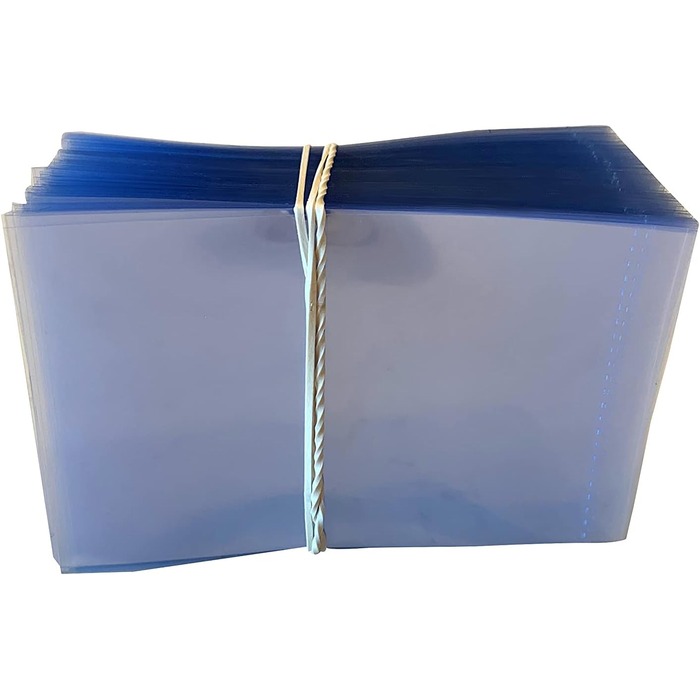
86 x 56 mm clear perforated shrink band for spice jars
A clear perforated band sized 86 x 56 mm, listed for spice and small cosmetic jars.
- Role: Amazon consumer option
- 86 x 56 mm
- Perforated
- For spice jars
- MOQ: Check current listing
A band shows opening; it doesn’t keep spices fresh
Product pages sometimes blur two jobs. Cary’s question-and-answer section says neck bands can be used to seal food to ensure freshness. A band is a tamper indicator. I did not find evidence that it works as a moisture or aroma barrier, and a perforated film tube wrapped around a cap is not an airtight seal.
If freshness matters, look at what sits inside the cap, such as a liner or an induction seal, and at the jar and lid design. Our comparison with induction seals covers how the two relate. For marketing, avoid implying that the band preserves the spice; say that it shows the jar hasn’t been opened.
Order sizes and what to test
Pack sizes vary. Cary bundles its 53 mm band in packs of 200, Container and Packaging lists its 63 mm band in cases of 5,000, and Uline prices bands per thousand. Small spice brands are better served at the first end of that range until the size is settled. See our cost guide for what each pack size works out to per band.
Before a case, run a quick test on filled jars from your real batch. It takes a few minutes and tells you whether the band fits, grips and opens as you need.
- Measure the cap. Widest outside diameter with the lid on, in millimeters.
- Compute the minimum lay-flat. π × diameter ÷ 2, then take the next listed size up if you are near the top of a range.
- Check for a neck bead or lip. Feel below the cap on a production jar.
- Buy a sample pack in two heights. Same lay-flat, different heights.
- Shrink three filled jars of each. Check grip on cap and neck, and that the shaker holes are clear.
- Try to defeat the seal. Pry at the hinge or lip; the band should tear first.
- Record the specification. Cap code, measured diameter, band size and height, supplier and heat setting.
Keep the record. When you change a cap or jar supplier, it tells you what to retest.
FAQ
What size band fits a 63 mm spice cap? Container and Packaging pairs a 110 x 58 mm band with its 63-485 spice lids. By the arithmetic, a 63 mm cap needs at least about 99 mm of lay-flat. Confirm with your own cap.
Will the band block the shaker holes? It can if it’s too tall or placed too far over the top. Test two heights on a filled jar and check the holes before you order a case.
Does the jar need a neck bead? For a reliable seal, yes. Suppliers say the band needs a bead or lip to hold it in place; without one it may slip or be lifted.
Does a band keep spices fresh? I found no evidence that it does. It shows that the jar was opened; any freshness effect comes from the liner and closure.
Perforated or non-perforated? Perforated bands open more easily. Our perforation guide covers the trade-off.
References
No academic references apply to this page. Sizing figures come from supplier catalog pairings and from arithmetic on measured diameters.
Continue reading
Shrink Bands for Handmade Soap and Bath Bombs: How to Size the Wrap
A soap band is an open-ended sleeve, so the sizing starts from the bar’s perimeter rather than from a cap diameter. Here is the halving rule, why cured bars measure differently from fresh ones, and how loose the published soap band sizes really are.
Shrink Bands for Candle Tins: Sizes for 8 oz and 16 oz Slip-Lid Tins
On a slip-lid tin the band bridges the lid and the body, so the maths starts from the tin’s diameter rather than a bottle cap. Here are the bands two suppliers pair with their own tins, the two-line check you can do yourself, and why their suggested bands are taller than the tin.
Shrink Band Problems and Fixes: Wrinkles, Holes, Loose Bands and Crooked Tears
A symptom-by-symptom guide for people shrinking bands by hand: what each fault looks like, which cause the supplier instructions actually name, and which fixes are reasoning rather than a sourced rule.